
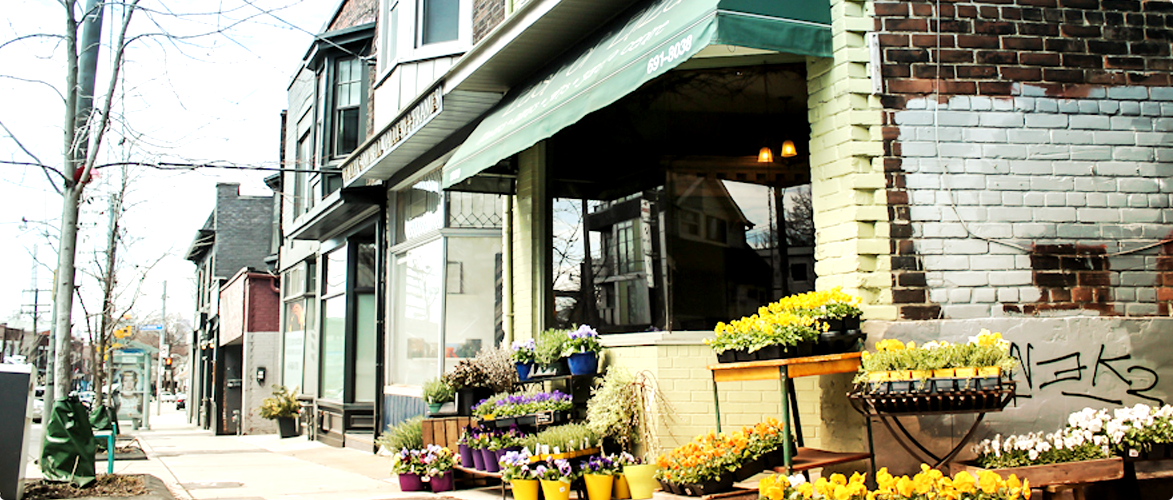
Upper Beach, also called Beach Hill, is the residential area north of Queen Street East in the east end, roughly between Kingston Road and Gerrard Street and east of Coxwell Avenue. It's distinct from The Beach proper, which sits south of Queen close to the water, but shares the same housing era and neighbourhood fabric: detached homes and semis from the 1900s to the 1930s on streets that were built for working families and have been significantly renovated over the past two decades. Semis trade between $1.2 and $1.6 million. Detached homes run from $1.5 to $2.2 million. The lake is a 10 to 15-minute walk south. The waterfront premium that drives prices in The Beach fades as you move north, and that gap is the reason buyers who want the east end's character without its highest prices keep landing here.
Upper Beach occupies the residential blocks north of Queen Street East in the east end, roughly between Kingston Road and Gerrard Street and east of Coxwell Avenue. The neighbourhood is sometimes called Beach Hill, and both names point at the same place: the elevated residential streets that sit above the commercial activity of Queen and below the Danforth corridor to the north. The lake is 10 to 15 minutes away on foot. The boardwalk is a regular destination rather than a distant one, which is why buyers here consistently describe themselves as living in the Beaches area even though they’re not technically south of Queen.
The streets are solid and residential, built in the same working-class construction tradition as the neighbourhoods further west: detached homes and semis from the 1900s through the 1930s, brick construction, relatively consistent lot sizes. The renovation activity has been significant over the past twenty years. Properties that sold as unrenovated worker houses in the early 2000s now have updated kitchens, finished basements, and rear additions that have expanded the original floor plans without fundamentally changing the street character.
Kingston Road runs through the area as the main commercial strip, with a more local and everyday character than Queen Street East below. There are cafes, independent restaurants, a hardware store, a pharmacy, the kind of retail that a neighbourhood uses rather than one it performs for visitors. It’s the commercial strip of a place that hasn’t been gentrified to the point of losing its functionality, and residents appreciate that distinction even if they wouldn’t always put it in those terms.
The dominant purchase in Upper Beach is the semi-detached house from the early 20th century: typically two storeys, three bedrooms, a single bathroom that’s been updated at some point, a kitchen that may or may not have been touched since the 1990s, and a backyard that is either a practical asset or a project depending on how the current owner has treated it. These semis trade between $1.2 and $1.6 million. The spread reflects condition, whether the kitchen and bathroom have been updated, and the specific street.
Detached homes are available but not the majority. They run from around $1.5 million for a three-bedroom on a standard 25-foot lot to $2.2 million or above for a larger property on a deeper lot with a recent renovation. The detacheds on streets close to the ravine system, where the lots can be irregular and sometimes larger than the standard grid, represent some of the better value in the area for buyers who prioritise outdoor space over a second-storey addition.
There’s no condo supply to speak of in Upper Beach itself. Buyers who want a condo with proximity to the Beaches area typically look at purpose-built or converted buildings on Queen Street East south of the neighbourhood, or further west in Leslieville. The Upper Beach market is almost entirely freehold, which is one of the reasons buyers with families consistently prefer it over denser options further west.
Upper Beach tracks the broader east-end freehold market fairly closely. In a competitive spring market, well-presented semis priced at $1.2 to $1.4 million can attract multiple offers and close above list. The neighbourhood doesn’t have the concentrated buyer pool of Trinity Bellwoods or Leslieville, where demand is deep enough to produce consistently contested situations. Here, a well-priced property moves quickly; an overpriced one sits and adjusts.
The buyers in this market are mostly families or couples in their mid-30s to mid-40s who have been looking in the east end for some time and have typically narrowed the decision to Upper Beach versus one or two other neighbourhoods. They’re price-sensitive in the sense that the difference between $1.3 and $1.5 million for a semi is a real number, not a negotiating point. Sellers who price correctly and present the property well find the market responds. Sellers who test the ceiling find themselves sitting longer than expected and often accepting less than a correct original price would have achieved.
Days on market in Upper Beach are somewhat longer than in the most competitive east-end pockets, reflecting the neighbourhood’s position slightly off the primary demand concentration. Buyers in 2026 are finding more time to conduct proper due diligence and fewer situations where an unconditional offer feels compulsory. That has shifted the balance somewhat in favour of buyers, particularly for semis that have older kitchens or bathrooms that need work.
The buyers who end up in Upper Beach are almost always choosing it over The Beach itself, Leslieville, or Danforth Village. The decision against The Beach is straightforward: the lake premium south of Queen adds $300,000 to $500,000 to a comparable property, and for buyers who do the maths on how often they’ll actually use the lake view from their window versus use the boardwalk as a regular walk, Upper Beach often wins. The lake access is still genuinely convenient. The premium just isn’t as steep.
The decision against Leslieville often comes down to character. Leslieville has become one of the city’s more visible gentrification corridors, with a Queen Street East strip that draws comparisons to Ossington and Roncesvalles at their peaks. Upper Beach is quieter and more neighbourhood-facing. Buyers who want to live in a place that feels like a community rather than a destination often describe the difference that way.
Danforth Village to the north is genuinely comparable on housing stock and price, and buyers who land in Upper Beach rather than Danforth usually cite Beaches proximity as the deciding factor. A fifteen-minute walk to the boardwalk is something you use regularly. The same walk to a commercial strip on the Danforth is useful but doesn’t shape daily life in the same way. For households with children who will spend summer afternoons at the lake, that distinction is not trivial.
The specific street matters more in Upper Beach than the general neighbourhood name implies. Streets closer to Queen Street East have easier access to the commercial strip and shorter walks to the lake, but also more ambient noise from traffic on Queen and Kingston Road. Streets further north, approaching Gerrard, are quieter and more removed but add five minutes to the lake walk and put you closer to Danforth Village in practical terms than to The Beach. Walk several streets at different times of day before settling on a block, not just the specific house you’re considering.
The renovation history of these early 20th-century semis is worth examining carefully before making an offer. Many properties have been partially updated in layers over decades: a kitchen replaced in 2005, a bathroom done in 2012, a furnace replaced in 2019, but original windows and original electrical panels that haven’t been touched. The question isn’t whether work has been done but whether the remaining work is cosmetic or mechanical. A home inspection by someone familiar with Toronto’s pre-war housing stock will tell you the difference. An older electrical panel or original knob-and-tube wiring in the walls is a real cost, not a cosmetic issue, and the insurance implications alone can affect your carrying costs.
Parking is worth confirming explicitly. Many of the semis in Upper Beach don’t have a garage or a dedicated parking pad, and street parking is uncontrolled in most of the area but can be competitive on the streets closest to Queen. If you’re bringing two cars, or if parking is a daily requirement rather than an occasional one, check the specific property and street rather than assuming the area generally handles it.
Buyers in this market have usually toured a dozen properties across the east end before arriving at Upper Beach. They’re comparing your semi against what they saw in Leslieville last month and what they’ll see in Danforth Village next weekend. The properties that stand out in that comparison are the ones where the condition is honest and the price reflects it. A semi that’s been kept up properly, shows cleanly, and is priced where the comparables support will move. A semi that requires work but is priced as though it doesn’t will frustrate everyone and eventually adjust.
The kitchen and bathroom are the two rooms Upper Beach buyers walk into and form an immediate opinion about. Not because they’re the most important structurally, but because they’re the most visible indicator of whether the rest of the house has been maintained or ignored. A dated but clean kitchen signals maintenance. A dated and worn kitchen signals deferred attention everywhere. If you’re selling and the kitchen is the weak point, a modest cosmetic update often recovers its cost several times over in buyer confidence, even if the appliances and layout remain the same.
Spring is the strongest window for listings in Upper Beach, as it is across the east end. The period from mid-February through early May brings the most active buyers. A correctly priced semi listed in March will see more traffic and more competition than the same property listed in August or November. If your timeline allows flexibility, the spring window is worth targeting.
The boardwalk along Lake Ontario is the defining amenity of the Beaches area, and Upper Beach residents use it regularly enough to treat it as a neighbourhood asset despite the walk required to reach it. On a summer morning the boardwalk fills with runners, cyclists, people with dogs, and families headed to the beach. The lake is free, the boardwalk is well-maintained, and the combination of water, sand, and accessible green space within the city is genuinely unusual. Residents who move here from other parts of Toronto consistently cite the boardwalk as the thing that changed their daily routine most significantly.
Kingston Road through Upper Beach is the neighbourhood’s commercial strip in the way that Queen Street East is for The Beach, but quieter and more functional. There are independent cafes, a range of restaurants that serve the neighbourhood rather than destination diners, and the kind of everyday retail that makes running errands on foot practical. The strip isn’t polished or self-consciously curated. It works, which is different from performing, and residents who have lived through the Leslieville and Junction gentrification cycles often describe Kingston Road’s current character as preferable precisely because it hasn’t reached that stage yet.
The ravine system on the northern and eastern edges of the neighbourhood is less celebrated but genuinely useful. Taylor-Massey Creek and the ravines connected to it provide accessible green space for trail walking and off-leash dog use. Families with children or dogs who use the ravines find them less crowded than the boardwalk on peak summer days, and the network connects outward enough to provide real variety for regular users.
The 502 Kingston Road streetcar is the primary transit connection through Upper Beach, running along Kingston Road and connecting to the Broadview subway station on the Bloor-Danforth line. The route is reasonably reliable in off-peak hours and tends to bunch during morning rush. Most residents who commute by transit use the streetcar to Broadview and then the subway, which puts them at King and Bay in about 35 to 40 minutes from the eastern end of the neighbourhood.
The 22 Coxwell bus runs north-south and connects to Coxwell subway station on the Bloor-Danforth line, which is an alternative to the Kingston Road streetcar route for residents on the western streets. The Queen streetcar is accessible by walking south to Queen Street East. Cyclists find the east end generally manageable: the Martin Goodman Trail runs along the waterfront and connects west toward downtown, and the residential streets through the neighbourhood are quiet enough for comfortable daily cycling.
Driving downtown from Upper Beach takes 25 to 35 minutes in moderate morning traffic. The Gardiner Expressway access via Cherry Street or the DVP are both within reach, though neither is immediately adjacent. Residents who drive daily to midtown find the routing via the DVP more reliable than the surface street alternatives. Parking in the neighbourhood itself is generally not a constraint outside of peak summer weekends when visitors arrive for the beach.
The Beach proper, south of Queen Street East, is the most direct comparison for Upper Beach buyers. The housing stock is the same era and construction type. The difference is proximity to the lake and the premium that proximity carries. A semi south of Queen on a comparable street will trade $300,000 to $500,000 above an equivalent property in Upper Beach. For buyers who will use the lake regularly and want the sense of living directly in the Beaches area, the premium is defensible. For buyers who calculate that they’ll walk to the boardwalk several times a week either way, Upper Beach is the more rational purchase and the price difference is genuine value.
Leslieville, west of Coxwell, is a different kind of east-end neighbourhood: more urban, more bar-and-restaurant-dense, oriented toward Queen Street East as a destination strip rather than a local one. Prices are broadly comparable to Upper Beach at the semi level. Buyers who choose Leslieville over Upper Beach usually want the Ossington-style commercial energy and are less focused on the lake proximity. Buyers who choose Upper Beach over Leslieville want the quieter residential character and the Beaches area feel, and are generally less interested in the active commercial scene.
Danforth Village, north of Upper Beach, has similar housing stock at slightly lower prices. The main difference is orientation: Danforth Village faces north toward the Danforth commercial strip and its Greek and Portuguese restaurants, weekend market activity, and east-west transit on the Bloor-Danforth line. Upper Beach faces south toward the lake. At comparable budgets, the choice between the two often comes down to whether the buyer sees themselves as a Danforth household or a Beaches household, and both are genuine identities in the east end.
Norway Junior and Senior Public School, located in the neighbourhood at Norway Avenue and Kingston Road, is the primary public elementary option for most Upper Beach streets. It serves JK through Grade 8 and has a strong local reputation, particularly for its community feel and its arts and athletic programming. Parent involvement is high, which correlates with the stability and atmosphere of the school more than any single program. Families who have chosen Upper Beach partly for the school report that it delivers on its local reputation in practice.
Malvern Collegiate Institute is the public secondary school catchment for the neighbourhood. It’s a large school with a broad academic and extracurricular range, and has traditionally had a strong athletics profile. Its academic results are solid without being exceptional by the standards of the city’s top-ranking public secondary schools. Families with specific academic priorities sometimes investigate program schools or private options at the secondary level, but Malvern is not a school families feel they need to work around, which is a meaningful distinction from some other east-end secondary catchments.
For the Catholic system, St. John the Baptist Catholic School operates in the neighbourhood. French Immersion options are available through the TDSB but require application to specific program schools rather than automatic catchment placement. Always verify the specific address against current TDSB boundaries before making school assumptions, as the catchment lines in this part of the east end have shifted in recent years and a street that was in one catchment two years ago may not be today.
What is the difference between Upper Beach and The Beach? The Beach refers to the area south of Queen Street East, close to the water, with direct access to the boardwalk and Lake Ontario. Upper Beach sits north of Queen, further from the lake, with Kingston Road as its main commercial strip instead of Queen. The housing stock is similar in era and construction quality, but the waterfront premium that drives prices south of Queen fades significantly as you move north. A semi in Upper Beach typically trades at $1.3 to $1.5 million where a comparable property south of Queen would be $1.8 to $2.2 million. Upper Beach buyers are usually choosing proximity to the area’s character and institutions without paying for lake sight lines they won’t use every day. The lake itself is still a 10 to 15-minute walk, which is close enough to be genuinely useful.
How far is Upper Beach from the boardwalk? From most streets in Upper Beach, the boardwalk along Lake Ontario is a 10 to 15-minute walk south. The walk takes you through the Queen Street East commercial strip, which often means a coffee stop or an errand on the way. By bike it’s five minutes. Residents describe the lake as a regular part of their week rather than a special occasion trip. The practical difference between Upper Beach and The Beach isn’t really about access to the water. It’s about whether you’re paying for a lake view from your window or a lake walk you do several times a week, and the price gap between those two experiences is real and persistent.
How does Upper Beach compare to Leslieville? Leslieville is west of Coxwell and has a more developed commercial strip on Queen Street East, with a wider range of restaurants, bars, and independent retail that draws comparisons to Ossington or the Junction. Upper Beach is quieter and more residential, and has a neighbourhood feel that draws comparisons to The Beach rather than to Leslieville’s more urban character. Prices at the semi level are broadly comparable, though Leslieville has seen stronger appreciation over the past decade because of its position in the east end’s development corridor. Upper Beach buyers are usually specifically drawn to the Beaches area and the lake proximity, not primarily comparing against Leslieville.
What are prices like in Upper Beach in 2026? Semis trade between approximately $1.2 and $1.6 million depending on size, condition, and the specific street. Detached homes run from around $1.5 million to $2.2 million, with properties on larger or irregular lots near the ravine system occasionally reaching the upper end of that range. These prices are noticeably less than south-of-Queen properties in The Beach, where a comparable semi would trade $300,000 to $500,000 higher. Buyers comparing Upper Beach with Danforth Village to the north will find Upper Beach modestly more expensive for equivalent properties, reflecting the premium the market assigns to Beaches proximity.
The streets of Upper Beach were developed primarily between 1900 and 1930, as the eastern edge of Toronto expanded and the lake shore became a destination for working and middle-class families who could afford the streetcar fare to reach it. The houses built here were modest by the standards of the period’s grander residential developments further west, but they were built solidly: brick construction on established lots, with the expectation that the families who moved into them would stay. Many of the structural elements that buyers prize today, including the full brick construction and the established lot dimensions, are direct products of the building standards of that era.
The neighbourhood’s history is inseparable from the history of The Beaches more broadly. The boardwalk and the lakefront that define the area’s identity today were developed through the 1920s and 1930s as the city invested in lakefront access. Kew Gardens and Woodbine Beach, south of Upper Beach, became summer destinations for a much larger part of the city than the immediate neighbourhood, and the commercial strips on Queen Street East developed in part to serve that seasonal traffic. Upper Beach sat slightly removed from the lakefront activity but close enough to share in the neighbourhood identity it produced.
The shift toward the current residential profile began in the 1990s and accelerated through the 2000s, as buyers who had been priced out of The Beach proper discovered that the streets north of Queen offered comparable housing stock at noticeably lower prices. Renovation activity increased, prices rose, and the neighbourhood acquired a resident demographic that is younger and better-paid than the one that occupied it thirty years ago. The character has changed, but the bones have not: the street scale, the brick semis, and the proximity to the lake remain what they were when the neighbourhood was first built.
Street-level knowledge is hard to find online. Our team works in Upper Beach (Beach Hill) every day. They know which pockets hold value, where the school catchment lines actually fall, and what the market is doing right now. Talk to us before you make a decision about Upper Beach (Beach Hill).
Talk to a local agent