
Thorncliffe Park sits east of the Don Valley in the former East York, hemmed in by Overlea Boulevard to the north and the valley itself to the west. It's one of the most densely populated small neighbourhoods in Canada, built almost entirely of tall rental apartment towers from the 1960s and 70s, and home to one of the most concentrated South Asian and Middle Eastern communities in the city. The commercial strip on Overlea feels like a bazaar, with Pakistani, Bangladeshi, Afghan, and Middle Eastern grocers, restaurants, and clothing shops packed side by side. Almost nobody owns their unit in Thorncliffe Park proper. The neighbourhood runs on rental housing, and that's not a deficiency, it's the entire structure. Buyers looking for property here are usually looking at the residential edges, at adjacent East York streets, or at the occasional condo unit that surfaces in the broader area. What Thorncliffe offers is density, culture, affordability in Toronto's rental market, and surprisingly good access to the rest of the city once the Eglinton Crosstown is fully running.
Stand on Overlea Boulevard on a Saturday afternoon and it’s immediately clear this isn’t a typical Toronto neighbourhood. The sidewalks are packed. Grocery carts full of halal meat and basmati rice weave past teenagers in hockey jerseys. The smell from the restaurants, Pakistani karahi, Bangladeshi fish curry, Afghan bolani, drifts out across a street lined with South Asian clothing shops, money transfer offices, and vegetable stalls that spill onto the pavement. Thorncliffe Park is one of the most culturally concentrated neighbourhoods in Canada, and it has been for decades. The towers that line Overlea and spread south toward the Don Valley were built in the 1960s and 70s as rental housing, and rental housing is what they remain. This is not a neighbourhood that converted its stock to condos. The ownership rate here is among the lowest of any urban community in Toronto, which makes Thorncliffe Park unusual in a city where homeownership is the dominant ambition. That structure shapes everything: who lives here, what the commercial strip looks like, how long families stay, and what options exist for buyers who want to own something in or near the area.
The geography helps explain the density. Thorncliffe Park is a compact area, roughly bounded by Overlea to the north, the Don Valley Parkway corridor to the west, Leaside to the north and east, and Flemingdon Park to the north across Eglinton. It covers less than two square kilometres, and into that space several high-rise towers hold tens of thousands of residents. The Don Valley trail system runs along the western edge, offering green space that balances some of the built density. That access to the ravine and the broader trail network is one of the neighbourhood’s genuine amenities, used heavily by families and cyclists who make up a surprising proportion of Thorncliffe’s daily commuters.
For buyers, the honest framing is this: if you want to own in Thorncliffe Park proper, your options are limited and specific. The neighbourhood is structured around rental. What buyers typically find is that they’re drawn to the area by price points or cultural community, and they end up looking at the residential streets just east in East York, or at the occasional apartment unit that comes to market. Understanding that distinction before you start looking saves a lot of time. Thorncliffe Park is worth knowing thoroughly, because it tells you something real about how Toronto’s east side is changing and what the Eglinton Crosstown will mean for this part of the city once it’s running at full capacity.
Thorncliffe Park proper is rental. That’s the starting point for any buyer’s research. The towers on Overlea Boulevard and the surrounding residential streets were constructed as purpose-built rental apartments, and unlike so many Toronto rental buildings from the same era, most of them haven’t converted to condos. The owners of these buildings have held them as income-producing rental assets, which means the units inside are not available for individual purchase. If you see a listing labelled “Thorncliffe Park” and it’s a condo for sale, you’re almost certainly looking at a property on the edges of the neighbourhood boundary or in an adjacent area rather than inside the original tower stock.
What does occasionally come to market are a small number of townhouses and semi-detached homes on the residential streets to the east and south of the towers, where the neighbourhood transitions toward East York. These properties, when they appear, attract strong interest because prices here are lower than in Leaside or the more established East York residential streets. As of 2026, semi-detached homes in this transition zone are trading in the $850,000 to $1.1 million range depending on condition, lot size, and how far from the commercial strip they sit. Detached homes are rare and price accordingly. There are also purpose-built rental buildings where investors occasionally acquire entire units through private transactions, but these are off-market deals and not something a typical buyer encounters.
The condo market near Thorncliffe Park sits mostly in the Leaside or Flemingdon Park adjacent areas. Entry-level units in that broader zone run from approximately $350,000 for a small one-bedroom to $550,000 for a two-bedroom in a building with decent amenities. Buyers who want to be near the community, access the commercial strip, and use the trail system without paying Leaside prices do find value here. The key is understanding which address is genuinely inside Thorncliffe and which is a marketing boundary applied to get better search visibility. Look at the actual street and building stock, not just the neighbourhood label on the listing.
Because Thorncliffe Park is predominantly rental, the ownership market here behaves differently from most Toronto neighbourhoods. There’s no reliable volume of sales data to track month-over-month the way you can with a condo-heavy or freehold-heavy area. When properties do sell, they sell individually and the comparable pool is thin. This means buyers and their agents need to look more broadly at East York comparables, Flemingdon Park comparables, and the broader east end condo market to establish value. Sellers who price against Leaside will sit. Sellers who price against the actual transaction history for comparable density and address quality will move.
The Eglinton Crosstown is the dominant variable in this market’s near-term future. Leaside station and Laird station will both be within reasonable distance of Thorncliffe Park, and the stations will give the neighbourhood a direct rail connection that it has never had. Every major transit infrastructure project in Toronto has produced price appreciation in adjacent markets, and there’s no reason to expect the Crosstown to behave differently. Properties that were priced partly on a transit discount, specifically the lack of subway access, will reprice once the line is running. That adjustment may already be partly baked into prices depending on when in 2026 you’re reading this, but there’s likely more movement to come once riders actually experience the improved commute time.
Investors who bought into the rental buildings years ago have seen strong rent growth driven by immigration patterns and the neighbourhood’s affordability relative to the rest of Toronto. New arrivals, particularly families from Pakistan, Bangladesh, Afghanistan, and Somalia, consistently choose Thorncliffe for cultural community, affordability, and the commercial infrastructure that supports their daily life. That demand shows no sign of softening, which keeps vacancy rates low and supports the rental asset valuations even as interest rates have remained elevated. For buyers considering a small multi-unit or a townhouse to rent out partially, the rental demand here is real and durable.
The majority of people who live in Thorncliffe Park are renters, and they choose it for specific, practical reasons. Affordability is the primary one. A two-bedroom apartment in Thorncliffe costs considerably less than a comparable unit in Leaside, Davisville, or even Flemingdon Park. For a newly arrived family or a young couple trying to build savings, that difference matters enormously. The second reason is community. Toronto’s South Asian and Middle Eastern populations in Thorncliffe have been building their commercial and social infrastructure here since the 1970s. There are mosques, halal butchers, South Asian grocery stores, Pakistani and Bangladeshi restaurants, and cultural associations that have been operating for decades. For families who want to live near their community, this is one of the few places in Toronto where that community is geographically concentrated enough to walk to.
Buyers who target Thorncliffe Park or its immediate edges are a smaller, more specific group. Some are investors who understand the rental demand and want income-producing property near a Crosstown station. Some are buyers priced out of Leaside who are willing to trade address prestige for more square footage or a better price per room. Some are families from the South Asian community who have moved up economically and want to own rather than rent but stay close to the cultural and commercial infrastructure they use daily. This last group is particularly active in the East York streets just east of the neighbourhood boundary, where the homes are older but solid and the prices are still a significant step below Leaside.
There’s also a segment of buyers who come to Thorncliffe for the trail access. The Don Valley trail system runs along the western edge of the neighbourhood, and buyers who cycle, run, or want ravine access without paying ravine-lot premiums sometimes find value here. The trail connects south to the lakefront and north through the valley, making it genuinely useful for daily commuting by bike. That’s an amenity that doesn’t show up in the listing description but matters considerably to people who use it.
If you’re buying a freehold property on the East York edges of Thorncliffe, the due diligence looks standard but a few things deserve extra attention. Many of the homes in this zone were built in the 1940s and 50s, before current insulation standards, electrical panel requirements, and foundation waterproofing practices. A home inspection that covers the electrical panel, the basement for moisture, and the roof condition is not optional here. Budget for the possibility that a 1950s semi-detached will need an updated 200-amp panel, basement waterproofing, or a new roof within the first few years of ownership. These are not dealbreakers but they need to be in your financial model before you set your offer price.
For condo buyers looking at units in the broader area, the usual Toronto condo checklist applies with a few specific notes. Status certificate review is essential, and you want a lawyer who will read the reserve fund study carefully. Buildings in the Thorncliffe-adjacent area include some older stock that was constructed or converted in earlier decades, and reserve funds in these buildings are sometimes undercapitalized relative to the maintenance that aging building systems require. A special assessment in year two of ownership is an unpleasant surprise that a competent status certificate review will often flag in advance. Never waive the status certificate condition in this price range.
Transit planning is worth mapping specifically before you commit to a purchase. Run the commute from the actual address at the actual time you’d be leaving for work. The bus connections to Pape and Broadview stations work, but the frequency during off-peak hours is different from what you’ll experience during the rush. If the Eglinton Crosstown is your primary reason for buying here, confirm the operational timeline before you price that premium into your offer. The line has had delays before, and buying on the assumption of an amenity that isn’t yet operational is a risk you should price honestly.
Selling freehold property on the Thorncliffe edges requires an agent who knows the actual buyer pool for this area. The buyers here are not the same as Leaside buyers. They’re more price-sensitive, often newer to Toronto’s real estate market, and frequently financing at or near their ceiling. That means your price needs to be grounded in real comparables from this specific zone, not aspirational comparisons to Leaside sales two streets over. Overpricing and then chasing the market down with reductions is particularly damaging here because the buyers you want, the ones who are ready and qualified, move quickly when something is priced correctly and disappear when it isn’t.
Presentation matters more than many sellers expect at this price point. The buyers in the $850,000 to $1.1 million range in this zone are often stretching to get there. A home that’s clean, decluttered, and in good repair will outperform one that needs obvious work, even if the priced-in value is similar on paper. Fresh paint, functioning appliances, and a clear basement go a long way. Professional photos are not optional in 2026. Listings with poor photography get fewer showings, full stop, regardless of price.
The Crosstown factor works in sellers’ favour. There is a genuine and growing buyer awareness that the Leaside and Laird LRT stations will improve access from this part of the city, and sellers of properties within walking distance of those stations should make that explicit in listing materials. Buyers who are priced out of Leaside but want the eventual transit connection are specifically searching for this, and a listing that addresses it directly will attract more of them. If your property is a ten-minute walk from a Crosstown station, say so plainly, name the station, and describe what the commute to Yonge and Eglinton will look like once the line runs.
The commercial area along Overlea Boulevard is one of the most distinctive retail environments in Toronto. It functions less like a standard urban commercial strip and more like a bazaar, a dense concentration of specialty shops, restaurants, and services almost entirely oriented toward South Asian and Middle Eastern customers. There are several Pakistani and Bangladeshi grocery stores that stock produce, spices, and prepared foods that you simply can’t find in standard Toronto supermarkets. The halal butchers are well-established and draw customers from across the east end. The restaurants, mostly karahi houses, biryani spots, and Bangladeshi fish curry places, are among the best value meals in the city and consistently busy.
Beyond the food and grocery infrastructure, Overlea has clothing boutiques selling South Asian formal wear, money transfer and remittance services, travel agencies specializing in South Asian and Middle Eastern destinations, and a number of professional offices including immigration consultants and accountants who serve the community specifically. There are several mosques within the neighbourhood, and religious services, community events, and social support networks run through them in ways that make them central to daily life for many residents. This isn’t incidental to the neighbourhood’s character, it’s the foundation of it.
The famous Thorncliffe Park street hockey culture deserves mention here because it has genuine historical roots. The outdoor rinks and street hockey games in the neighbourhood produced players who went on to higher levels of the sport, and the area’s connection to hockey, unusual for such a culturally diverse neighbourhood, became part of its identity in ways that even Wayne Gretzky has referenced publicly. The community centres in the area run programming that draws families, and the mix of cricket, soccer, and hockey that happens in the parks on any given weekend captures something accurate about the neighbourhood’s character: multiple cultures using shared space and mostly getting along with it well.
Thorncliffe Park’s transit situation is in transition, which is either a problem or an opportunity depending on your timeline. Right now, the neighbourhood is served primarily by bus. The 81 Thorncliffe Park bus connects to Pape station on the Bloor-Danforth subway, which is the most-used route for downtown commuters. The 88 South Leaside connects to Broadview station, also on the Bloor-Danforth line. These routes are reliable during peak hours but frequency drops off in evenings and on weekends, which makes car ownership feel more practical than it should for a neighbourhood this close to downtown. Travel time to Union Station by transit is typically 35 to 45 minutes door to door during rush hour, which is competitive with many parts of the 416 but not as good as it will be post-Crosstown.
The Eglinton Crosstown LRT, when it reaches full operation, will add Leaside station and Laird station as meaningful transit nodes for Thorncliffe residents. Leaside station at Bayview and Eglinton is approximately a 15-minute walk from the heart of Thorncliffe Park. Laird station at Laird Drive and Eglinton is slightly closer for residents on the north side of the neighbourhood. The Crosstown connects directly to Yonge and Eglinton at Eglinton station, which links to the Yonge subway line, giving Thorncliffe residents a one-transfer route to downtown, Midtown, and the entire north-south spine of the city. The improvement in commute quality once this connection is active is real and significant.
Cycling is genuinely viable from Thorncliffe Park because of the Don Valley trail. The trail access point at the bottom of the valley gives cyclists a car-free route south to the Bloor Viaduct area and the lakefront trail system. It’s not a fast commute in bad weather, but on a good day a cyclist can ride from Thorncliffe to downtown in 25 to 30 minutes on a mostly trail-based route. That’s a legitimate asset for a neighbourhood at this price point and distance from the core. Drivers access the Don Valley Parkway quickly via Overlea and Leaside connections, which makes the neighbourhood practical for people who combine transit and driving depending on the day.
Flemingdon Park sits directly north of Thorncliffe, on the other side of Eglinton Avenue, and the two neighbourhoods are often compared because they share a similar housing stock profile and similar demographic character. Flemingdon has the same high-rise rental tower model, built in the same era, and it houses a large South Asian and East African population. The differences are worth knowing. Flemingdon Park has slightly more condo conversion activity, meaning there are marginally more ownership opportunities within the actual tower stock. It also sits closer to the Ontario Science Centre area and has a slightly different commercial strip character. Prices for ownership in Flemingdon run comparable to Thorncliffe, and the same transit calculus applies, both will benefit from Crosstown access, with Don Mills station on the Crosstown being the key node for Flemingdon residents.
East York proper, the residential streets east of Thorncliffe, represents a different product entirely. These are freehold homes, mostly semis and detached, on quiet streets with tree cover and the physical character of a 1940s and 50s Toronto suburb. Prices on those streets range from the high $800,000s to well over $1 million depending on the specific street, the lot size, and how close you are to Leaside. Buyers who want freehold ownership and are priced out of Leaside but want to stay in the east end consistently look here. The tradeoff is that you’re on a residential street rather than the walkable commercial density of Overlea, but you’re also getting a backyard, a driveway, and a home that doesn’t share walls in the same way a condo does.
Against Leaside, the comparison is straightforward on price and stark on address character. Leaside is a premium residential neighbourhood with an established retail village, excellent schools, and a strong resale market that has outperformed the Toronto average consistently. A property that costs $950,000 in the Thorncliffe edge zone might cost $1.3 million or more in Leaside for equivalent square footage. The gap reflects the transit discount, the school district distinction, and the address premium that Leaside commands. Whether that gap is worth closing depends entirely on your priorities and what you actually need from a neighbourhood on a daily basis.
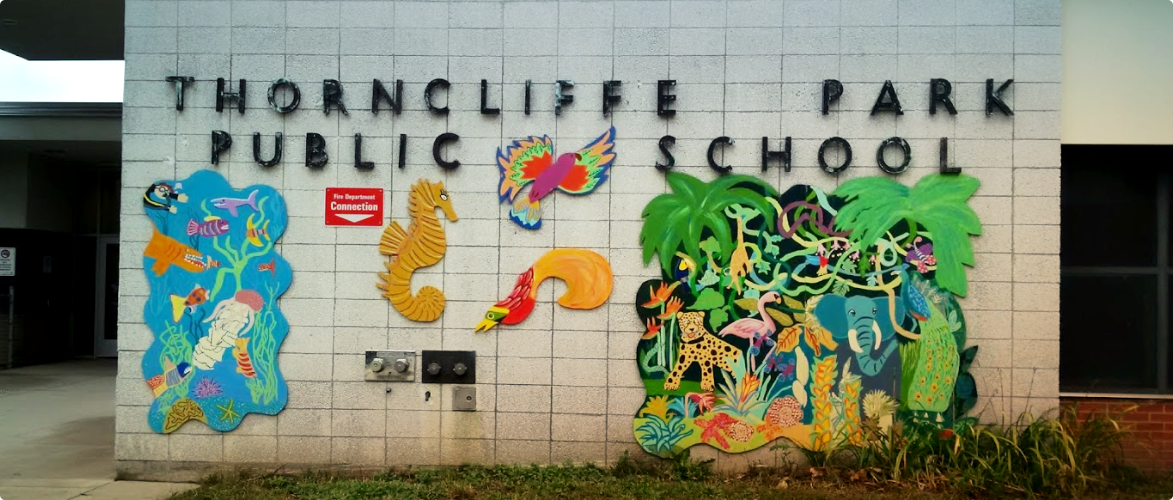
Thorncliffe Park Public School is notable by any measure. It consistently ranks among the most linguistically diverse schools in the Toronto District School Board, with over 50 languages spoken among its student families. That’s not a statistic that exists in the abstract. It means classrooms where kids are translating concepts for each other, where parents from very different backgrounds are navigating the same school system together, and where the school’s staff have developed real expertise in settlement support and English language learning. For families arriving in Canada, this can be a genuine asset: the school knows what it’s doing with new arrivals because it’s been doing it for decades. For families who value a culturally homogeneous school environment, it’s a different calculation.
R.A. Lafferty Public School also serves the neighbourhood and draws from the same demographic range. Secondary school students typically attend Leaside High School, which is in a different catchment area but accessible, or East York Collegiate, which has its own character and range of programs. Catholic families are served by the Toronto Catholic District School Board’s schools in the area. The private school options in the immediate neighbourhood are limited, and families with strong private school preferences tend to be looking at either the Leaside cluster or schools further north and west.
Daily life in Thorncliffe Park is structured around the towers, the commercial strip, and the parks. The community centres run programs including fitness, youth sports, and cultural events that serve a population that doesn’t necessarily have the disposable income for private gym memberships or recreation leagues. The parks, including the large green space between the towers, are heavily used by children and families throughout the year. The Don Valley trail system at the bottom of the hill is used by cyclists, joggers, and dog walkers. There’s a genuine neighbourhood quality to daily life here that surprises people who arrive expecting a bleak tower environment. The density produces community in ways that lower-density suburban neighbourhoods sometimes don’t.
Can I buy a condo or house in Thorncliffe Park? Thorncliffe Park is almost entirely rental housing. The towers that define the neighbourhood were built as rental stock in the 1960s and 70s, and most remain under rental ownership today. Individual units inside those buildings are generally not available for purchase. What does come up occasionally is a small number of townhouses and semi-detached homes on the residential streets at the eastern edges of the neighbourhood boundary, and sometimes condo units in the broader Thorncliffe-adjacent area. As of 2026, semi-detached homes on those edges trade in the $850,000 to $1.1 million range. Entry-level condos in the broader area run $350,000 to $550,000. If you want to own in this part of the city, your search will likely extend into East York proper or toward the Leaside border rather than staying strictly within Thorncliffe Park’s tower stock.
How do I get downtown from Thorncliffe Park? The current routes are the 81 Thorncliffe Park bus to Pape station on the Bloor-Danforth subway, and the 88 South Leaside bus to Broadview station. During rush hour, either route gets you to Union Station in roughly 35 to 45 minutes door to door. Off-peak, frequency drops and the journey feels longer. The significant change coming is the Eglinton Crosstown LRT, which will add Leaside station and Laird station as transit nodes within walking distance of the neighbourhood. Once operational, the Crosstown connects directly to Eglinton station on the Yonge line, cutting downtown travel time and opening up a broader transit network for east-end residents. If the Crosstown completion timeline affects your buying decision, confirm the current status before you price that improvement into your offer.
What schools serve Thorncliffe Park? The neighbourhood’s primary schools are Thorncliffe Park Public School, which is one of the most linguistically diverse schools in the Toronto District School Board, and R.A. Lafferty Public School. Both are TDSB schools and serve a student population that reflects the neighbourhood’s South Asian and Middle Eastern majority. Thorncliffe Park PS has significant settlement and English language learning resources as a result of decades of experience with newly arrived families. For secondary school, students attend Leaside High School or East York Collegiate depending on specific address and program. Catholic families are served through TCDSB schools in the area. Families with strong private school preferences will find limited options immediately in the neighbourhood and typically look toward the Leaside or Midtown private school cluster.
What will the Eglinton Crosstown mean for Thorncliffe Park property values? Every major transit infrastructure investment in Toronto’s history has produced measurable price appreciation in the neighbourhoods it serves. The Crosstown will bring Leaside and Laird stations within walking or short bus range of Thorncliffe Park, providing a direct rail connection that the neighbourhood has never had. Properties that were priced with a transit discount, based on the current bus-to-subway commute, will reprice once the line runs and buyers can actually experience the improved commute. Some of that premium may already be reflected in 2026 asking prices, but the full adjustment typically happens after the line is operational and commuters have firsthand data on travel times. Buyers purchasing now are getting some of the upside. Buyers waiting for proof before acting may be paying the premium.
Thorncliffe Park was developed in the late 1950s and through the 1960s on land that had previously been used as a horse racing track, the Thorncliffe Race Track, which operated from 1934 until the late 1950s. The site’s flat, cleared land made it attractive for the kind of large-scale residential development that planners and developers were pursuing at the time. The towers that went up through the 1960s represented a then-dominant theory of urban housing: tall buildings set in open landscape, with parking and green space between them, as an efficient response to postwar population growth. By the time the towers were complete, Thorncliffe Park was one of the more modern residential addresses in the former East York.
The demographic transformation of the neighbourhood began in earnest in the 1970s and accelerated through the 1980s as immigration patterns brought large numbers of South Asian and Middle Eastern families to Toronto. Many settled in Thorncliffe specifically because of the affordable rental housing and the proximity to community networks that were beginning to form. The commercial strip on Overlea evolved to serve these residents, and by the 1990s, Thorncliffe had become the kind of neighbourhood where an entire day’s errands, grocery shopping, banking, clothing, mosque attendance, could be done without leaving the area. That self-sufficiency has been both a strength and a reason why the neighbourhood’s character has remained stable over decades.
The street hockey culture in Thorncliffe developed partly as a result of the physical layout of the neighbourhood, open courtyards between towers, flat asphalt spaces, and a lot of kids with time outside. The neighbourhood produced players who reached competitive levels, and the image of Pakistani-Canadian and Bangladeshi-Canadian kids playing hockey in a setting that looked nothing like the suburban arenas where most Canadian hockey develops became a symbol of how cultures adapt and mix in Canadian cities. That image has been referenced in hockey media, in cultural journalism, and in Wayne Gretzky’s public comments about the neighbourhood. It’s a small piece of the Thorncliffe story but an accurate one: this is a neighbourhood that takes what the city offers and makes something genuine out of it.
Street-level knowledge is hard to find online. Our team works in Thorncliffe every day. They know which pockets hold value, where the school catchment lines actually fall, and what the market is doing right now. Talk to us before you make a decision about Thorncliffe.
Talk to a local agent For Rent
 For Sale
 For Sale
 For Rent