
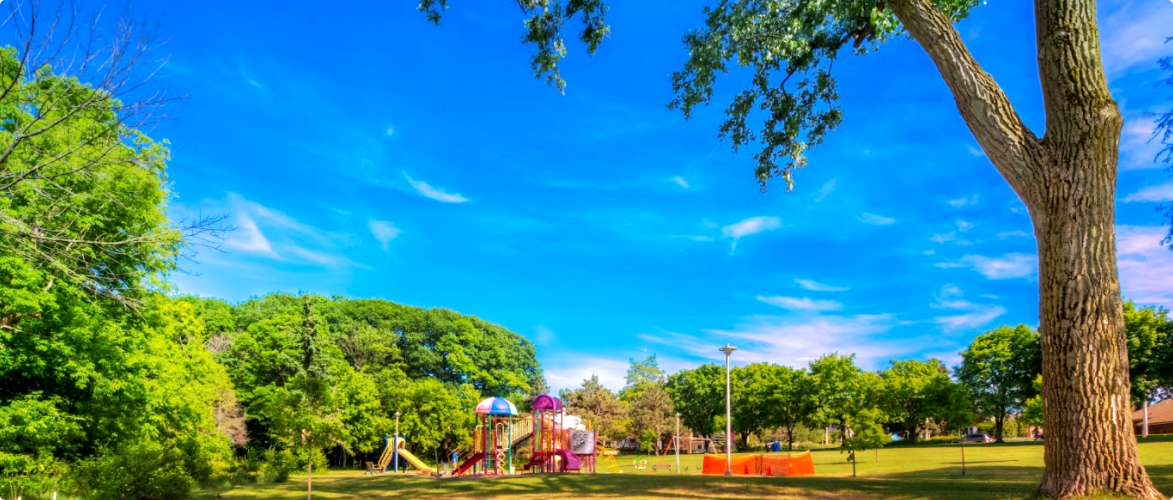
Todmorden Village sits along the Don Valley in East York, south of O'Connor Drive, where the valley topography gives streets a physical character uncommon in the broader east end. The Todmorden Mills heritage site, Don Valley trail access, and homes that range from post-war to early 20th century make this a specific and low-volume market. Detached homes sell from $900,000 to $1.4 million in 2026, with ravine-facing streets commanding meaningful premiums.
Todmorden Village occupies a quiet corner of East York along the Don Valley, south of O’Connor Drive and east of Broadview Avenue, in an area that has managed to maintain a distinct character from the rest of the city’s east end. The neighbourhood takes its name from the Todmorden Mills heritage site, where the remains of 19th century mills sit at the edge of the Don River, a reminder that this valley was industrially significant before it became one of Toronto’s most valued ravine corridors.
The Don Valley itself defines the neighbourhood’s western edge, and the topography here is less flat suburban and more genuinely hilly, with streets that rise and fall along the valley’s edge in a way that gives the neighbourhood a physicality uncommon in East York’s broader post-war grid. Houses on the valley-facing streets have views into the ravine that are among the more striking natural outlooks available in the inner city, and they sell accordingly.
The neighbourhood is quiet without being remote. Broadview and Pape avenues provide bus connections north and south, linking to the Bloor-Danforth subway at Broadview station and Pape station respectively. The Don Valley bike trail runs through the valley below, connecting north to the ravine system and south toward the waterfront. Residents who cycle use the trail system as a daily route rather than a recreational destination, and that connects Todmorden Village to a broader network of car-free movement that Inner Toronto residents pay significantly more to access from elsewhere.
The housing stock is a mix of older pre-war and post-war homes, some of them on the more unusual and character-rich end of the spectrum for this part of the city. It’s not a neighbourhood of uniform subdivisions. The topography demanded more varied architecture, and the result is a more visually interesting streetscape than most of East York’s flatter residential areas provide.
Todmorden Village’s housing is more varied than most East York neighbourhoods. The post-war bungalows and splits that dominate Scarborough and parts of East York are present here, but they share streets with older pre-war homes, cottages, and some more architecturally distinctive houses that were built to take advantage of the valley setting. The character range is wider than the average price range would suggest.
Detached homes sell from $900,000 at the low end for properties in original condition or with limited updates, up to $1.4 million for well-renovated homes with ravine or valley views, good lot sizes, and the premium locations on the valley-facing streets. The premium for ravine adjacency here is real and consistent. A property on a street that overlooks the Don Valley commands meaningfully more than a comparable property on an interior street a block away from the valley edge.
The lot sizes vary more than in a planned subdivision. Some streets have narrow frontages on steep lots; others have more conventional dimensions. The topography creates unusual lot configurations that can be assets, providing privacy and views, or complications, requiring retaining walls or limiting addition potential. A home inspection and an architect’s assessment of addition feasibility is worth doing before committing to a property where you’re planning significant changes.
Semi-detached and attached housing is less common in this neighbourhood than in some East York areas, reflecting the irregular street patterns that the topography created. When semis do appear, they’re typically at a modest discount to comparable detached properties and represent a lower-priced entry into a neighbourhood that doesn’t otherwise offer a discounted option. There’s no condo supply here; Todmorden Village is a freehold neighbourhood without the apartment buildings or condo towers that appear elsewhere along the Broadview and Pape corridors.
Todmorden Village is a low-volume market where individual property characteristics matter more than neighbourhood averages. The inventory in any given year is small enough that comparables are limited, and buyers and agents need to be careful about extrapolating from a small number of transactions. A property that sold for a specific amount in the neighbourhood might have had a feature, a valley view, a double lot, a recently renovated kitchen, that explains its price and doesn’t translate directly to a different property on a different street.
The buyer pool is also more specific than in a higher-volume neighbourhood. People who target Todmorden Village have usually identified the Don Valley access, the neighbourhood’s character, or the specific ravine views as their priority. They’re not the buyers who are comparing twelve neighbourhoods and landing here because it ticked the most boxes; they’re buyers who’ve decided this specific area is what they want and are waiting for the right property. When that property appears, they act.
In 2026, the freehold market in this part of East York is moderately active. The post-2022 correction brought prices back from the peak but values have stabilized, and the neighbourhood’s specific assets, valley access, character housing, transit proximity, have maintained a floor that more generic suburban addresses don’t have. Sellers who bought before 2021 still have significant equity. Sellers who bought near the 2022 peak are negotiating from a flat position.
Conditional offers are possible in this market because the low transaction volume means fewer competing buyers on most properties. This is one of those East York pockets where a buyer willing to ask for an inspection condition can often get one, which is a meaningful advantage on older homes with unusual lot configurations and varied renovation histories. Don’t assume you need to match downtown competitive-offer standards here; assess each property individually.
Todmorden Village attracts a specific buyer who’s chosen the Don Valley access and the neighbourhood’s historic character as their primary criteria. These buyers have often looked at Riverdale, Leslieville, and the Pape Village area before arriving here. They’ve found those areas priced above what they need to pay for the combination of ravine access and inner-city location, or they’ve specifically decided that Todmorden Village’s quieter character and more modest scale is what they want rather than a louder neighbourhood narrative.
Cyclists and trail runners who use the Don Valley trail system regularly are consistently drawn here. The trail access from the neighbourhood isn’t just recreational, it’s practical. A cyclist can commute from Todmorden Village to the downtown core by the Don Valley trail in about 30 to 40 minutes, entirely or largely off road, which is an unusually pleasant option for a property at this price. Buyers for whom that daily quality of life matters are willing to pay for an address where it’s possible.
The heritage character and the older housing stock attract buyers who find character and history in an older house an asset rather than a maintenance concern. These are buyers who want original hardwood floors, older brick, and the proportions of a house built for the landscape it sits in rather than for a developer’s standardized floorplan. They’re prepared for the maintenance that comes with older properties and they’d rather have the character than the convenience of newer construction.
Families with children who want a quieter, greener environment close to the city also appear here. The neighbourhood’s proximity to Broadview and Pape stations means that urban destinations are accessible, but the daily environment is calmer and more naturalistic than most inner-city options. The Don Valley as a play space and after-school environment is a real draw for families who want their children to grow up with access to something that isn’t entirely urban.
The streets of Todmorden Village follow the valley topography rather than a strict grid, which gives the neighbourhood a more organic layout than most of East York. Pottery Road runs along the valley bottom, passing the Todmorden Mills site before climbing up toward O’Connor Drive. The streets above the valley, including the residential streets off Broadview Avenue south of O’Connor, sit on higher ground with the valley views that command premiums at the high end of the market.
The streets immediately adjacent to the Don Valley ravine are the most sought-after and the most price-differentiated. Properties on valley-facing streets where the rear yard or the front elevation overlooks the ravine sell at the top of the neighbourhood’s range. The view and the valley access from these specific addresses are features that no amount of renovation can add to an interior street property; they’re geographic and permanent. Buyers who’ve decided they want that specific asset need to track supply carefully because it’s limited and comes up infrequently.
The interior streets, set back from the valley but within the broader neighbourhood, are quieter and more uniform in their residential character. These are the streets where the majority of transactions occur and where buyers get the neighbourhood’s proximity to the valley and its transit access without the ravine-view premium. The character of these streets is pleasant, with mature trees and the kind of established residential feel that East York’s neighbourhoods have accumulated over decades of continuous habitation.
The Pottery Road area at the valley bottom has an unusual and somewhat industrial character from its heritage use and current cycling infrastructure. It’s not a primary residential street, but the activity at the valley bottom, the bike path, the heritage site, the occasional restaurant and commercial use, gives the neighbourhood a lower register of activity that residents access on foot or by bike rather than by car.
Todmorden Village’s transit is bus-dependent for subway access, with buses on Broadview and Pape providing the connections north to Broadview station and Pape station on the Bloor-Danforth line. Neither station is walking distance from most addresses in the neighbourhood; the bus is required. From Broadview station, the subway connects west toward downtown and east toward Kennedy and Scarborough Centre. The total commute from the neighbourhood to downtown takes approximately 35 to 50 minutes depending on the specific address and the transfer timing.
The Don Valley bike trail is the neighbourhood’s most distinctive transit alternative. The trail runs through the valley below the neighbourhood and provides a cycling route south toward the Lower Don Trail and the waterfront, and north into the ravine system. A commute to downtown by bike on the trail is possible and pleasant in a way that surface road cycling in the area often isn’t. Riders who use the Don Valley trail estimate the commute to downtown’s eastern edge at around 30 to 40 minutes, depending on origin and destination. For cyclists willing to make that trade, the trail commute from Todmorden Village is one of Toronto’s better car-free commuting situations.
Car access involves O’Connor Drive and Broadview Avenue as the primary routes out of the neighbourhood. The 401 is accessible via the Don Valley Parkway, which is accessible from the valley road system nearby. The DVP can be either an asset or a liability depending on congestion conditions; morning peak on the southbound DVP is often severely congested, and residents who drive downtown by that route should account for realistic commute times rather than optimistic off-peak estimates.
Car sharing services are accessible from the neighbourhood, and several of the Broadview commercial strips to the north have the density of services and transit infrastructure that makes car-light living practical for residents willing to organize their errands around transit and cycling rather than daily car use.
The Don Valley is the neighbourhood’s defining green feature and it’s genuinely exceptional by Toronto standards. The valley is wide here, the ravine walls are steep, and the natural environment at the valley bottom feels meaningfully removed from the urban grid above. The Todmorden Mills heritage site, at the base of the slope off Pottery Road, sits within the park system and the restored buildings including the brewery remains and the Helliwell farmhouse create a heritage park environment that’s unlike anything else in the inner city.
The Don Valley trail system provides trail access north toward the forks of the Don and the E.T. Seton Park area, and south toward the Lower Don and the waterfront. These trails are among the most used in Toronto’s ravine system and for good reason: the Don Valley from this area southward through Corktown and to the lake is a long, largely natural corridor through the city. Cyclists can ride the full length from Pottery Road to the waterfront in about 40 minutes; hikers and runners use sections of it for regular workouts.
Taylor Creek Park connects to the Don Valley system at the forks area to the north, providing an east-west trail extension. Residents of Todmorden Village effectively sit at a junction of trail systems, with access to significantly more varied trail running and cycling routes than a neighbourhood map alone would suggest. The combined trail access from this neighbourhood is among the best in the inner city.
The ravine also provides a visual and acoustic buffer from urban noise on the valley-facing streets. Properties above the valley edge have a natural noise reduction benefit from the vegetation and the valley depth. This is not a technical sound barrier but it’s a perceptible difference in the ambient sound environment, particularly from the streets where the ravine is immediately behind the property. Buyers who value quiet in a city environment find this adds to the appeal of those specific addresses beyond the view alone.
Todmorden Village has limited commercial activity within the immediate neighbourhood boundary. Pottery Road at the valley bottom has a handful of businesses, including some restaurant and commercial uses that serve the cyclists and residents who pass through, but it’s not a complete commercial strip. The neighbourhood’s primary retail access is through Broadview Avenue to the north or O’Connor Drive to the north and east.
Broadview Avenue, a short bus ride or walk north, has the Riverdale and Playter Estates commercial infrastructure: cafes, restaurants, specialty food shops, and service businesses catering to the inner-east community. The Danforth is accessible from Broadview and from Pape, adding a full east-end commercial strip within transit range. For most everyday errands, residents use the Broadview Avenue corridor rather than anything within the immediate neighbourhood.
The Pape Avenue commercial node, near Pape station, provides a grocery store and additional service businesses accessible by bus or cycling. The combination of Broadview and Pape access means residents of Todmorden Village are within a short trip of two distinct commercial nodes, which covers everyday needs adequately even without local commercial development.
The trade-off is honest: Todmorden Village’s residential quiet and its valley character come at the cost of walkable retail. Residents who want to step out to a coffee shop without a bus or bike trip are living in the wrong neighbourhood. The peace is not incidental to the address; it’s a result of the low commercial density, and buying here means accepting that trade in exchange for the ravine access and the neighbourhood character. Most residents who’ve chosen Todmorden Village did so knowing this and actively preferred it.
The TDSB elementary schools serving Todmorden Village are in the East York school system. The specific catchment school for any address in the neighbourhood should be confirmed through the TDSB boundary tool, as the irregular geography of the neighbourhood means boundaries can be less predictable than in a standard grid area. The schools in the area are typical of inner East York public schools: community-oriented, diverse, and well-attended without the academic ranking focus of some North York and midtown schools.
French Immersion options are available through the TDSB for families who want bilingual education. The application process runs through the board and does not guarantee placement based on catchment, though catchment priority varies by program. Families interested in French Immersion should begin the process early and confirm the specific programming available from their address.
The TCDSB serves Catholic families in the area. Boundary verification with the Catholic board is as important as with the TDSB, particularly given the neighbourhood’s irregular geography.
Secondary school in this part of East York typically means Riverdale Collegiate Institute or Danforth Collegiate and Technical Institute, depending on the specific address. Both are large east-end secondary schools with full program offerings. Riverdale Collegiate has a reputation as one of the more academically oriented public secondary schools in the east end, which is a genuine differentiator from the standard secondary school offering in comparable price-range neighbourhoods in Scarborough. For families for whom secondary school academic programming matters in their purchase decision, Todmorden Village’s potential Riverdale catchment is worth verifying for the specific addresses they’re considering.
Todmorden Village’s protected ravine land and heritage site status mean the most distinctive natural features of the neighbourhood are not going to change. The Don Valley ravine is regulated by the TRCA, and development within the regulated area is restricted. The Todmorden Mills heritage site is protected under heritage legislation. These protections are robust and the neighbourhood’s defining assets are among the more secure in the city’s planning framework.
The residential streets of the neighbourhood are not under significant development pressure. The housing is primarily low-density detached, and the planning framework doesn’t encourage intensification on the interior residential streets. The Broadview Avenue corridor to the west and O’Connor Drive to the north and east are where the planning framework encourages higher density, not the ravine-adjacent residential streets.
The Don Valley trail system has been subject to ongoing investment and improvement over the past decade. The city and the TRCA have continued to expand and maintain the trail network, and the trajectory is toward more trail infrastructure rather than less. The Rosedale Valley Road area at the southern end of the valley has seen improvements that benefit the full trail system, and the Lower Don Trail connection toward the waterfront has been improved as part of the Port Lands and naturalization projects.
The neighbourhood’s price trajectory has been steadily upward over the past decade, with the ravine-adjacent properties appreciating at a rate consistent with or slightly above the broader east-end freehold market. The specific assets here, the Don Valley access and the heritage character, have maintained their premium relative to comparable-priced properties without these features. In 2026, those premiums are still present and the neighbourhood’s fundamentals for long-term value are solid.
What is Todmorden Mills and how does it affect the neighbourhood? Todmorden Mills is a heritage site at the bottom of the Don Valley off Pottery Road, preserving the remains of 19th century paper and flour mills along with the restored Helliwell farmhouse and the Parshall Terry house. The site is managed by the city as a cultural heritage and museum facility, with programming and events through the seasonal schedule. The mills operated in the 1800s when the Don River provided water power, and the site represents one of the earliest industrial settlements in what is now Toronto. For residents of Todmorden Village, the site is part of the neighbourhood’s identity and provides a specific historical context that makes this particular section of the Don Valley different from the ravine stretches further north or south. The heritage designation protects the site permanently. It also means the valley bottom at this location has a managed, accessible character rather than purely natural ravine, which some residents prefer as a daily amenity and others consider less naturalistic than the wilder sections of the valley.
Is Todmorden Village prone to flooding? The Don Valley is subject to flood risk during significant storm events, and the lower sections of the valley, including the Pottery Road corridor and the valley bottom near Todmorden Mills, are within flood-regulated areas. The residential streets on the valley slopes and above the valley rim are generally above the flood zone, but buyers on streets adjacent to the ravine edge or with lots that slope down toward the valley should confirm the TRCA flood risk designation for their specific property. The devastating flooding of the Don Valley during Hurricane Hazel in 1954 resulted in the regulatory framework that now protects the valley bottom from residential development; the streets in Todmorden Village are generally above the flood zone, but individual property verification with the TRCA is always advisable for any ravine-adjacent purchase.
How does Todmorden Village compare to Riverdale at the same price? Riverdale, to the west along the Don Valley north of Gerrard, is a more established and higher-demand neighbourhood with a deeper buyer pool and a clearer neighbourhood identity in the city’s real estate consciousness. At comparable prices, Riverdale properties are typically smaller or on narrower lots, and the competition is more intense. Todmorden Village offers more property for a comparable dollar, with the same Don Valley access, because it’s less well-known and has a smaller buyer pool. The trade-off is that Todmorden Village has less commercial walkability and less of the social scene that Broadview Avenue provides in Riverdale. Buyers who specifically want the valley access and the residential quiet find Todmorden Village a better value. Buyers who want to walk out their door to restaurant options and the Riverdale social environment pay the Riverdale premium.
Can I add on to an older house in Todmorden Village? The answer depends on the specific property and its relationship to the TRCA regulated area. Properties adjacent to the ravine edge may have restrictions on additions or alterations within the regulated setback from the top of bank. A TRCA pre-consultation will clarify what’s possible before you spend money on architectural drawings. Properties that are not within the regulated area can generally proceed with additions under standard municipal zoning, subject to lot coverage and setback rules. The irregular lot configurations in this neighbourhood, a product of the topography, can limit addition potential in ways that aren’t obvious from a standard lot survey. An architect who has worked in ravine-adjacent settings, familiar with both the planning rules and the practical constraints of building on sloped lots, is worth consulting before making renovation potential part of your purchase rationale.
Buying in Todmorden Village requires an agent who understands ravine-adjacent properties, including the TRCA regulated area and its implications for addition potential, the flood risk verification process, and the valuation of ravine views and trail access in a market where data is thin.
The low transaction volume in this neighbourhood means that comparable sales analysis requires more interpretation than in a high-volume market. An agent who can explain why a specific property sold at its price, and how that translates to the property you’re looking at, is providing genuine analytical value. An agent who simply runs a price-per-square-foot average on the neighbourhood and applies it uniformly is not being useful here.
If you’re buying a property with specific heritage characteristics or on an unusual lot configuration, the home inspection should involve a structural engineer if there are any questions about the foundation’s relationship to the slope. Valley-adjacent properties with older construction can have foundation and drainage issues that a standard home inspection surfaces but doesn’t fully characterize. A structural engineer adds to the pre-purchase cost but provides a level of certainty on an unusual property that a general home inspection can’t match.
TorontoProperty.ca covers East York and the Don Valley corridor. If Todmorden Village is on your list, reach out for a specific conversation about what’s available and how to assess the properties in this specific market.
Street-level knowledge is hard to find online. Our team works in Todmorden Village every day. They know which pockets hold value, where the school catchment lines actually fall, and what the market is doing right now. Talk to us before you make a decision about Todmorden Village.
Talk to a local agent