
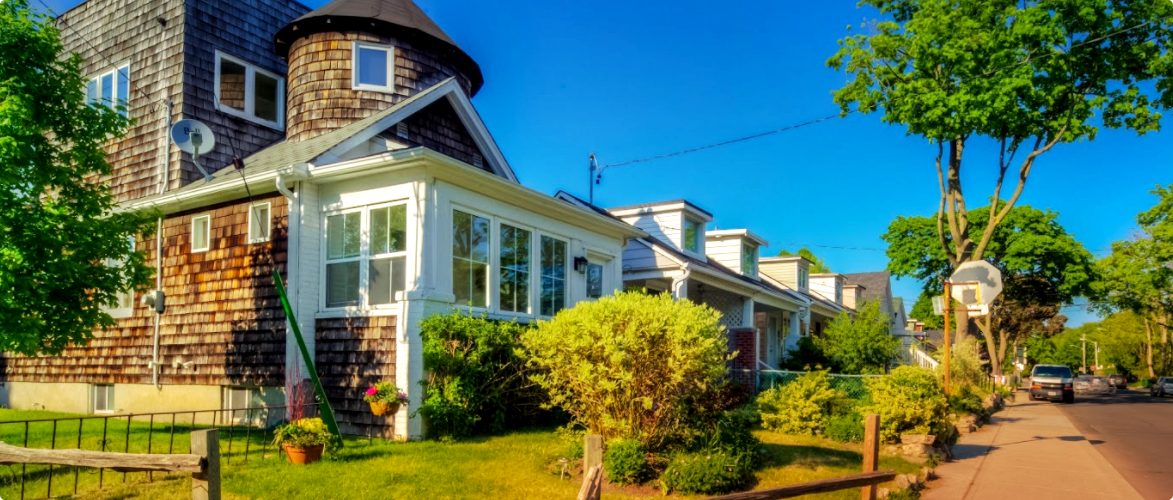
Woodbine-Lumsden is East York east of Woodbine Avenue, a quiet post-war bungalow neighbourhood between O'Connor Drive to the north and Taylor Creek Park to the south. Detached homes on full lots, Taylor Creek trail access from the southern streets, and a transit connection via Woodbine Avenue bus to the Bloor-Danforth subway. Detached bungalows sell from $850,000 to $1.3 million in 2026.
Woodbine-Lumsden is East York in its most straightforward form: quiet residential streets between Woodbine Avenue, O’Connor Drive, Victoria Park Avenue, and Taylor Creek Park, with post-war bungalows sitting on decent lots and a community that values its own particular quietness. It’s not a neighbourhood that generates real estate hype. It generates the kind of appreciation that comes from people buying here, living here, and not leaving.
The neighbourhood’s name comes from the two streets that define its character most clearly. Woodbine Avenue to the west provides the bus connection south to Woodbine subway station on the Bloor-Danforth line, which is the practical transit anchor. Lumsden Avenue, the residential street that runs east-west through the neighbourhood’s middle, is the kind of tree-lined residential street that doesn’t make Instagram but makes daily life genuinely pleasant.
Taylor Creek Park runs along the southern boundary, providing the ravine access that gives this part of East York a natural backdrop that flat suburban neighbourhoods without ravine adjacency can’t replicate. The trail access from the neighbourhood’s southern streets is direct and used regularly by residents who walk, run, and cycle through the creek valley as part of their daily routine rather than as a planned outing.
The price here is lower than what you pay for a comparable property in Leslieville or the Danforth corridor to the north and west. That reflects the longer bus trip to the subway and the neighbourhood’s position at the less fashionable eastern end of East York’s freehold market. It doesn’t reflect any meaningful difference in housing quality or neighbourhood character from those more expensive addresses. Buyers who’ve done the comparison and decided the premium for the Leslieville address isn’t justified by the practical differences in daily life end up in Woodbine-Lumsden and stay.
The dominant housing type in Woodbine-Lumsden is the post-war bungalow and raised bungalow, built primarily in the late 1940s through the 1960s on 30 to 40-foot lots. This is a somewhat narrower lot profile than the Scarborough bungalow neighbourhoods, reflecting the more urban density of inner East York compared to the wider-lot suburban grid of Scarborough. Some streets have semis; detacheds are the majority but not the overwhelming majority that you find further east.
In 2026, detached bungalows in reasonable condition are selling from $850,000 to $1.0 million. Well-maintained or renovated properties push into $1.1 to $1.3 million territory. The premium for Taylor Creek adjacency on the southern streets is real and adds $50,000 to $100,000 or more to comparable properties versus equivalent-condition homes on interior streets. Semi-detached homes run from $750,000 to $950,000 depending on condition and location.
The renovation potential is one of the neighbourhood’s consistent buyer motivations. A bungalow bought in the $850,000 range on a 30-by-120-foot lot, with a functional renovation and attention to the basement, produces a home that can command $1.1 to $1.2 million. The ceiling is lower than in East York’s more central addresses but it’s a genuine renovation return opportunity for buyers who approach it with a realistic budget and timeline.
Garden suites are increasingly relevant here. The city’s garden suite program allows second dwelling units in rear yards, and while the lots here are narrower than in Scarborough, many are deep enough to accommodate a modest garden suite. The income potential from a 450 to 600-square-foot garden suite in this part of East York runs $1,600 to $2,100 per month, which is meaningful in carrying cost terms. Buyers who are planning for multi-generational use or income offset should assess garden suite feasibility at any specific address before committing to that as part of their purchase rationale.
Woodbine-Lumsden trades at the busier end of East York’s outer freehold market. It’s not as competitive as the streets immediately around Woodbine or Greenwood to the west, but it’s more active than Dentonia Park or the quieter east Scarborough bungalow markets. Multiple-offer situations appear on well-priced properties in good condition in the spring market. Buyers who’ve been competing in Leslieville and repeatedly losing find the competition here somewhat more manageable, though it’s not a passive market.
The price range is constrained enough that buyers from across a range of budgets land here. First-time buyers with $850,000 to $900,000 budgets find the lower end of the detached market accessible. Move-up buyers from condos or smaller east-end properties find the $1.0 to $1.2 million range provides meaningful improvement in space and land. The result is a buyer pool that’s diverse by background and motivation but relatively consistent in terms of the property it’s competing for.
Days on market for well-priced properties run one to three weeks in active periods. Overpriced properties sit for longer and eventually reduce. The ceiling here is clearly defined by what the neighbourhood’s transit situation and East York outer-market positioning justifies, and sellers who price above it consistently find buyers comparing them to East York properties closer to the subway and finding those better value.
The O’Connor bus route along O’Connor Drive and the Woodbine bus along Woodbine Avenue both provide connections to the subway system, and buyers who specifically commute by transit recognize the neighbourhood’s position as transit-functional rather than transit-excellent. The distinction affects the ceiling and, in turn, the market dynamic. It’s a neighbourhood where you need to be either comfortable with the transit situation or comfortable with a car as your primary commuting mode.
The buyers who land in Woodbine-Lumsden have usually considered the Danforth, Leslieville, Greenwood-Coxwell, and other established East York addresses first, and have arrived here after one of two conclusions: they’ve been outbid in those markets and found the price difference too large to bridge, or they’ve decided that the premium those addresses command isn’t justified by the practical differences in daily life. Both conclusions lead to the same neighbourhood.
Families with young children are well-represented. The bungalow stock provides the interior space and the lot provides the outdoor space that a family needs, at a price that leaves budget for the other costs of family life. Taylor Creek Park at the end of the street is a genuine draw for parents who want their children to grow up with access to natural space. The neighbourhood is quiet enough that kids can be outside safely on the residential streets, which matters to parents in ways that are real but hard to quantify.
Young professional couples buying their first freehold, typically coming out of east-end condo or apartment living, are the other consistent buyer type. They’ve made a deliberate decision that they want a house in East York rather than a condo, and they’ve found that Woodbine-Lumsden is where their budget reaches a detached property rather than the semi or attached townhouse that the same money would buy closer to the Danforth. The trade-off between address prestige and property type is real and they’ve made it consciously.
Investors looking at renovation and hold strategies also appear. The neighbourhood’s proximity to the established East York market, and the clear path from a $850,000 purchase to a $1.1 million outcome with a functional renovation, makes the arithmetic attractive to patient investors who are willing to do the work rather than pay a premium for someone else’s renovation.
Lumsden Avenue is the neighbourhood’s primary east-west residential spine and gives the neighbourhood its name. It’s a tree-lined residential street with a quiet character that’s representative of the best blocks in the area. The streets north and south of Lumsden within the neighbourhood grid are similar in character, with the primary variation being proximity to O’Connor Drive to the north and Taylor Creek Park to the south.
The streets south of Lumsden, between the middle of the neighbourhood and Taylor Creek Park, are the most sought-after. Properties on these streets have the creek proximity that buyers who specifically want Taylor Creek access are paying for. Some streets back directly onto the park, with rear yards that open to ravine access. These addresses command premiums of $50,000 to $100,000 over comparable properties on interior streets, which is rational given the permanent nature of the park border.
The streets north of Lumsden, closer to O’Connor Drive, are functional and quiet but less distinctive. The O’Connor Drive corridor itself is busier than the residential streets, and properties immediately adjacent to O’Connor experience more traffic noise than the interior grid. Buyers who want maximum residential quiet in the neighbourhood are better positioned on the mid-neighbourhood streets than immediately adjacent to O’Connor.
The Woodbine Avenue side of the neighbourhood, to the west, has a slightly more urban character as the commercial activity on Woodbine, modest though it is, bleeds into the adjacent residential streets. The Woodbine bus route adds some activity on the avenue. The O’Connor bus on the northern boundary is similar. The deep interior of the neighbourhood, away from both arterials, is where the most consistently quiet residential character is found.
Transit in Woodbine-Lumsden requires a bus connection to the subway, and there’s no shortcut around that. The Woodbine bus runs south along Woodbine Avenue to Woodbine subway station on the Bloor-Danforth line. The O’Connor bus provides a connection north toward the broader East York bus network. From Woodbine station, Line 2 runs west toward downtown and east toward Kennedy and Scarborough Centre. The total trip from the neighbourhood to downtown takes 40 to 55 minutes depending on the specific address and transfer timing.
The Woodbine bus runs frequently enough during peak hours that the wait time is rarely the limiting factor; it’s the total travel time that requires acceptance. Buyers who commute by transit and who’ve lived with 25-minute or shorter commutes will find this stretch. Buyers who’ve commuted 45 minutes or more from other addresses and are comfortable with that journey find the Woodbine bus an acceptable part of the package.
The Taylor Creek trail provides a cycling commute option for residents of the southern streets. The trail connects west toward the Don River trail and east toward Scarborough, and a connection south via the Don Valley to downtown is achievable by cycling in about 35 to 45 minutes from the neighbourhood. For buyers who cycle for commuting and errands, the trail access changes the practical transit equation significantly. The trail is most useful in spring, summer, and fall; winter cycling on the ravine trails depends on conditions and is not a reliable year-round commuting option for most riders.
Car ownership is practical here. The 401 is accessible via Victoria Park Avenue to the east, and the Don Valley Parkway is a short drive west. For residents who drive for work and use the neighbourhood’s transit for personal trips, the combination of car access and transit availability covers most destination patterns. Parking is available in front of most houses, which is not a given in more urban Toronto neighbourhoods at similar or lower prices.
Taylor Creek Park is the defining green space feature and it’s the reason many buyers specifically seek out the southern streets of this neighbourhood. The creek runs along the southern boundary, and the park follows the valley from the Don River junction in the west toward Scarborough in the east. The trail here is paved and well-maintained, used year-round by residents of the surrounding neighbourhood for walking, running, and cycling. The park’s vegetation is mature and the creek valley provides a genuine sense of natural space, neither a manicured park nor a wild ravine, but something in between that feels more connected to the natural world than a standard city park.
The most direct access for Woodbine-Lumsden residents is from the streets at the southern edge of the neighbourhood, where paths lead down into the creek valley from the residential streets. Residents on these streets are typically a one to three-minute walk from the trail. The access means that the trail is used as a morning run or evening walk as naturally as a sidewalk, without requiring a drive to a trailhead or a significant detour from home.
Taylor Massey Creek, a tributary of the Don, runs through the park in this section and provides the creek environment that gives the park its character. The creek is home to fish and a variety of bird species, including Great Blue Herons that appear regularly in the shallower sections. For urban dwellers who’ve given up on wildlife sightings in the city, the creek environment here regularly provides them.
E.T. Seton Park to the west is accessible by cycling through the Taylor Creek trail and connecting at the Don River junction. The broader ravine trail network accessible from this neighbourhood extends in multiple directions and provides trail variety well beyond what the immediate neighbourhood map would suggest. Residents who explore the full trail connection find significantly more green space than the local park itself indicates.
Woodbine-Lumsden has modest local commercial activity. O’Connor Drive to the north has a small commercial node with a grocery store, a pharmacy, and basic service businesses that handle everyday needs. Woodbine Avenue to the west has a modest commercial strip. Neither is a destination commercial area, but together they cover the basic routine shopping without requiring a car trip or a significant transit journey.
The Danforth, a ten to fifteen-minute bus ride north or a bike trip via the side streets, provides access to the full east-end commercial and restaurant strip. The Danforth’s range of restaurants, cafes, specialty food shops, and entertainment options is effectively accessible to residents of Woodbine-Lumsden in a way that makes the neighbourhood’s own limited commercial activity less constraining than it would otherwise be. Most residents use the local strip for routine purchases and the Danforth for anything more deliberate.
The independent retail along Woodbine Avenue, between the Danforth and O’Connor, has seen some improvement over the past several years. A cafe, a wine bar, a specialty food shop or two. It’s not a transformation but it’s a trend in the right direction. For buyers who value local walkable commercial options, the trajectory is modestly positive even if the current state is modest.
For major shopping, Scarborough Town Centre is accessible by car in about fifteen minutes. The east-end big-box retail on Kingston Road and in the Pickering-area large-format shopping districts is accessible for residents who need that range of retail. Most residents make those trips infrequently and handle the majority of shopping through the local strip, the Danforth, and delivery services that cover this area reliably.
The TDSB elementary schools serving Woodbine-Lumsden are in the East York school system. The specific catchment school for any address should be verified through the TDSB boundary tool; the neighbourhood spans a section where two or three elementary school catchments may intersect. The schools in this part of East York are community-oriented and diverse, with parent involvement that tends to be high in established owner-occupier neighbourhoods. They’re not ranked academically at the top of the Toronto public school system but they’re functional and attended.
French Immersion is available through the TDSB for families who want a bilingual program. The application process runs through the board and early registration is advisable. French Immersion access in this part of East York means a school that’s not necessarily walkable, which is typical of the TDSB’s French Immersion program delivery model. The specific school available from any address in the neighbourhood should be confirmed with the board.
Catholic families are served by the TCDSB in the area. Boundary verification with the Catholic board is essential, as the East York Catholic catchment boundaries differ from the TDSB boundaries.
Secondary school in this part of East York typically falls within the catchment for Danforth Collegiate and Technical Institute, a large school with a varied program including arts, technology, and academic streams, or East York Collegiate Institute. The specific secondary school catchment for any address should be confirmed with the TDSB. For families for whom secondary school catchment is a primary consideration, Woodbine-Lumsden’s position at the eastern end of East York means the secondary school options are slightly less established in their academic reputation than Riverdale Collegiate, which serves addresses further west. It’s worth verifying the specific catchment and the school’s current program profile before making it a factor in a purchase decision.
Woodbine-Lumsden is a stable residential neighbourhood without significant active development pressure. The interior streets are zoned low-density residential and there are no major development applications proposing changes to the residential grid. Taylor Creek Park’s protected status means the ravine boundary is permanent. The neighbourhood’s character is likely to remain consistent over the near and medium term.
The O’Connor Drive corridor is identified in the city’s planning framework as an area where some intensification is possible over the long term. Mixed-use development on commercial sites along O’Connor is within the planning vision, which could eventually change the character of the avenue itself while leaving the residential streets off it relatively unchanged. Buyers on the northern streets of the neighbourhood immediately adjacent to O’Connor should be aware of this as a long-term planning signal without treating it as an immediate change.
Woodbine Avenue to the west is similarly a candidate for modest intensification as a transit corridor. The Woodbine bus route’s designation supports higher-density development on the avenue over time. The residential streets east of Woodbine Avenue are largely insulated from this, but the avenue itself will likely see incremental redevelopment of commercial properties over the coming decades.
The broader East York freehold market has appreciated steadily over the past decade, and Woodbine-Lumsden has participated in that appreciation from a lower base. The neighbourhood’s trajectory has been consistent with the east-end freehold market’s overall movement, without the dramatic peaks and corrections of the most in-demand addresses. Buyers purchasing here for a long hold find fundamentals that are solid: low inventory, stable owner-occupancy, protected green space, and transit access that, while not excellent, is functional for the price range.
How does Woodbine-Lumsden compare to Leslieville at the same price? At the same dollar amount, Leslieville typically offers a semi-detached home or a smaller detached on a narrower lot, closer to the Danforth’s restaurants and Queen East’s commercial strip, on the subway or within shorter bus range. Woodbine-Lumsden offers a full detached bungalow on a comparable lot with Taylor Creek access and more residential quiet, but with a longer bus trip to the subway. The comparison comes down to property type versus transit and commercial walkability. Buyers who’ve decided they want a detached house with a real yard consistently find Woodbine-Lumsden the better value. Buyers who prioritize being close to Leslieville’s restaurant scene and the shorter transit commute pay the Leslieville premium and get that. Neither is wrong; it depends on which daily life features matter more to the specific household.
Is Taylor Creek Park accessible in winter? The paved sections of Taylor Creek trail are maintained and accessible in winter, though conditions vary by the severity of freeze-thaw cycles and precipitation. The trail is plowed after significant snowfall but not necessarily to the same standard as city sidewalks; winter users should expect some slip risk and dress and footwear accordingly. The creek itself and the adjacent unpaved sections are not maintained in winter. The trail is used year-round by a committed cohort of runners and cyclists who don’t let weather stop them, but it’s less busy in winter than in the other seasons. For buyers who are specifically valuing the trail access as a year-round feature, it should be understood as a paved urban trail with seasonal variation rather than a year-round wilderness experience.
What is the actual bus commute to downtown like from here? From the residential streets of Woodbine-Lumsden, the practical transit commute to downtown involves the Woodbine Avenue bus south to Woodbine subway station, then Line 2 westbound to wherever your downtown destination is. From doorstep to Bloor-Yonge intersection takes approximately 45 to 55 minutes depending on where you are in the neighbourhood, how long you wait for the bus, and the subway’s current conditions. From Woodbine station to Union Station, transferring to the Yonge line, takes about 30 minutes on a normal day. This is a real commute that requires planning your mornings rather than being spontaneous about departure times. Residents who’ve normalized 45 to 55-minute commutes from other cities or from 905-area addresses find it manageable. Toronto-centric buyers accustomed to 20-minute subway rides from midtown find it long. Know which category you’re in before committing to the address.
Are the bungalows in Woodbine-Lumsden suitable for renovation to add a second storey? Second-storey additions are done on bungalows throughout East York and Woodbine-Lumsden is no different. The feasibility depends on the specific house’s foundation and structural condition, the lot characteristics, and the zoning requirements including setbacks and lot coverage maximums. A basic second-storey addition on a 30-foot-wide lot typically involves a pop-top addition that increases usable floor area significantly without expanding the footprint. Budget expectations for a second-storey addition that includes new bathrooms and a functional layout renovation run from $200,000 to $350,000 or more depending on scope and finish level. The resulting property generally reaches $1.2 to $1.4 million in Woodbine-Lumsden, which covers the renovation cost if the purchase price was in the lower part of the market range. Buyers planning to do this should engage an architect before finalizing any purchase to confirm feasibility and get a realistic budget range for the specific house they’re considering.
Woodbine-Lumsden is a neighbourhood where the purchase decision turns on a clear trade-off, and a good buyer’s agent helps you articulate and evaluate that trade-off rather than just showing you listings. The trade is property type and green space access versus transit speed and commercial walkability. An agent who understands where this neighbourhood sits in the East York spectrum can help you decide whether the trade makes sense for your specific situation.
For buyers considering renovation, the agent’s role extends to helping assess renovation potential at each property before you get emotionally committed to an address. Addition feasibility, garden suite potential, basement suite status, and the realistic ceiling for renovated properties in this specific neighbourhood are all factors your agent should be able to speak to with specificity rather than generality.
The home inspection matters on bungalows of this era. The 1950s and 1960s construction has predictable deferred maintenance items that inspection surfaces. An agent who pushes you toward waiving inspection to be competitive is not serving your interests in a market where conditional offers are possible on most properties with a realistic negotiating approach.
TorontoProperty.ca covers East York and the Taylor Creek corridor thoroughly. Reach out if Woodbine-Lumsden is on your list for a specific read on what’s available and what realistic value looks like for your budget and criteria.
Street-level knowledge is hard to find online. Our team works in Woodbine-Lumsden every day. They know which pockets hold value, where the school catchment lines actually fall, and what the market is doing right now. Talk to us before you make a decision about Woodbine-Lumsden.
Talk to a local agent For Sale
 For Rent
 For Sale
 For Sale