
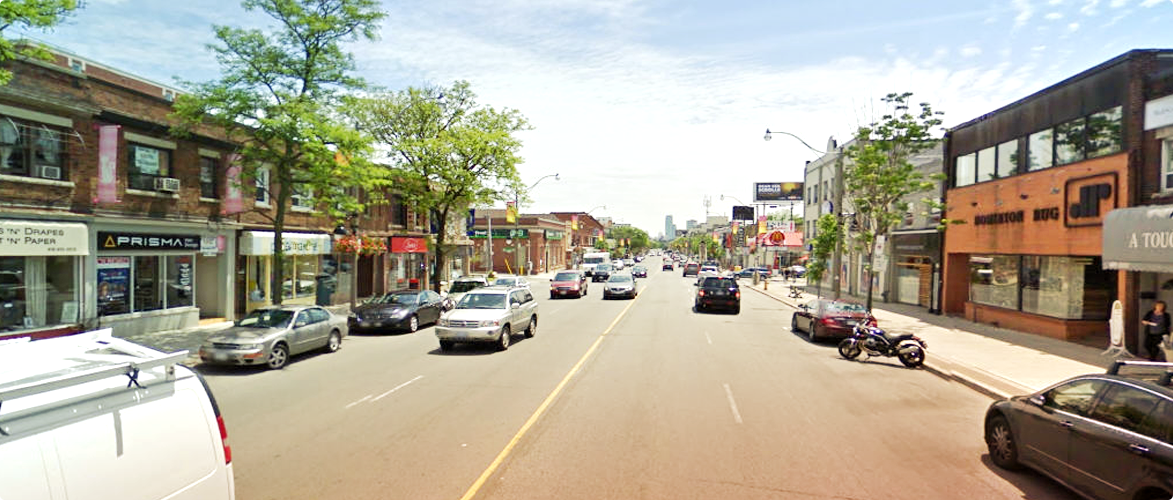
Teddington Park is one of the smallest and most expensive residential enclaves in Toronto: a cluster of deep-lot streets just north of Lawrence Park and south of York Mills, centred on the park the neighbourhood shares its name with. There are fewer than 400 properties here. Homes are large detached from the 1920s to 1940s, on lots deep enough to hold houses that were built when space was not a constraint. Entry-level detached properties start around $4 million. The best streets and largest properties trade between $8 and $15 million. Fewer than 20 transactions happen in a typical year, and a meaningful share never reach the public market.
Teddington Park sits north of Lawrence Park and south of York Mills, tucked between Avenue Road to the west and Yonge Street two kilometres to the east. The neighbourhood takes its name from a small park at its centre, and the residential streets curve around that park in a way that makes the enclave feel self-contained. It is not a neighbourhood you drive through on the way somewhere else. You come here because you mean to.
The street count is modest. Teddington Park Avenue itself, along with Old Forest Hill Road, Dawlish Avenue, Lympstone Avenue, and a handful of connecting streets, hold the majority of the housing stock. Most of the properties are large detached homes from the 1920s through the 1940s, built on lots that were generous by the standards of the time and remain so by any current measure. The combination of lot depth, house scale, and mature tree canopy gives the neighbourhood a character that newer money can buy into but can’t reproduce from scratch.
There are no apartment buildings here worth noting, no commercial strips, no through traffic. Avenue Road at the western boundary connects to Lawrence and to the larger city, but the streets inside the enclave remain quiet. Residents who have lived on Teddington Park Avenue for twenty years describe it as one of the few places inside the old City of Toronto where you genuinely know your neighbours. That is not an accident. It is what the density and the scale of the neighbourhood produce naturally.
The typical Teddington Park property is a two-storey or two-and-a-half-storey detached home from the interwar period: 1920s Tudor Revival, 1930s Georgian, and the occasional post-war build from the late 1940s. Lot depths routinely reach 150 to 200 feet. Some properties sit on assembled lots that are larger still. The houses were built when domestic service was expected, which means the floor plans include rooms and proportions that mid-century and modern floor plans abandoned: proper dining rooms, separate service entrances, basements with ceiling heights that support full-depth habitation.
Renovation quality varies considerably. Some properties have been updated continuously and well, with kitchens and mechanical systems that reflect current standards without destroying the original character. Others carry thirty-year-old renovations that were expensive when they happened and now look it. The spread between a well-maintained property and one that needs a full mechanical overhaul can run $2 to $3 million at this scale. Inspection matters here more than in markets where the purchase price absorbs the repair cost more easily.
Entry-level in the neighbourhood means approximately $4 million for an older home on a standard lot with deferred maintenance or cosmetic issues. Renovated homes on the better streets with the lot depth and house scale the neighbourhood is known for trade between $6 and $10 million. The finest properties, most of which sit on Teddington Park Avenue or its immediate surrounds, on the deepest lots with the original architectural character intact and a serious renovation behind them, have sold above $12 million. The ceiling has reached $15 million and above for the right property in the right market.
Teddington Park is one of the few residential markets in Toronto where the published transaction data understates actual activity. A meaningful share of transactions happen privately: seller and buyer connect through agents who work this specific neighbourhood, price is agreed, and the property never appears on MLS. Buyers who monitor only the public market will miss inventory. At this price point, that asymmetry matters.
The properties that do reach the public market rarely sit for long when priced correctly. The buyer pool for $5 to $10 million detached homes in a specific north Toronto enclave is small in absolute terms but concentrated in its expectations. Overpriced properties stay on the market for months; correctly priced properties attract attention quickly, sometimes from buyers who had not been actively looking but respond to the right address. Because fewer than 20 homes change hands in a typical year, each transaction carries unusual weight. There is no comparable sale for every property, which means price negotiations require more judgement than comparable analysis alone can provide.
Market conditions in 2026 have introduced some flexibility. Properties that would have sold without conditions in 2021 are now accepting inspection clauses. Sellers who list in the $7 to $9 million range are sometimes negotiating $200,000 to $400,000 below list. The dynamics that applied during the peak years no longer hold uniformly, and buyers who are well-prepared are finding more room to negotiate than the neighbourhood’s reputation might suggest.
The buyers who end up in Teddington Park are almost always choosing it over one of three alternatives: Rosedale, Forest Hill South, or Lawrence Park. The decision against Rosedale is usually about density and noise. Rosedale has more apartments, more through traffic, and a more social profile. Teddington Park is quieter and more private. Buyers who want the sense of a genuinely residential enclave, where the street is quiet on a Tuesday afternoon and the neighbours are settled rather than transient, tend to find that Teddington Park delivers it more consistently than Rosedale does.
The decision against Forest Hill South often comes down to community ties. Many buyers in Teddington Park have children at Upper Canada College on Lonsdale Road, or are members of the Granite Club on St. Clair Avenue, and the proximity to both from Teddington Park is a real practical consideration rather than a marketing point. Forest Hill South has comparable house scale but sits slightly further from that specific cluster of institutions.
The buyers here are almost uniformly from the upper end of the professional and business ownership spectrum: corporate executives, law partners, founders who have exited a business, senior financial professionals. Many have lived in Rosedale or Forest Hill first and are moving north for the quiet and the space. Others are arriving from outside Toronto entirely, choosing between Teddington Park and equivalent addresses in other Canadian cities, and settling here because the neighbourhood offers the specific combination of privacy, school proximity, and city access they need.
The lot, not the house, is often the real asset in Teddington Park. At this price level buyers sometimes focus on the quality of the renovation and overlook the fundamentals underneath it: lot depth, lot width, orientation, proximity to the park, and the specific street. A well-renovated house on a 100-foot lot is not the same purchase as a less-finished house on a 175-foot lot, even if the prices are similar. The underlying land value diverges significantly over time. Ask for a survey before finalising any offer and review it carefully.
Mechanical systems in homes from the 1920s and 1930s represent real replacement costs even on properties that appear well-maintained at a surface inspection. Knob-and-tube wiring is not uncommon in the older houses that haven’t been fully rewired. Original clay sewer laterals are present on some lots. A full inspection from a firm experienced with interwar residential construction is worth the time even if the seller resists it. At $6 or $8 million, the cost of a deferred mechanical discovery is not an inconvenience. It is a material financial event.
The off-market pipeline deserves attention before you make any offer on a public listing. An agent who is active in this specific neighbourhood will know which properties have been informally discussed among sellers and buyers for months before they formally list, if they list at all. Committing to a public listing without first determining whether there are private options you haven’t seen is a reasonable gap to close. The neighbourhood is small enough that two or three conversations with the right people can give a near-complete picture of what might be available.
The buyer pool for a $7 million home in Teddington Park is smaller than the buyer pool for a $1.5 million semi in Trinity Bellwoods, and it behaves differently. These buyers have usually toured multiple properties across several neighbourhoods before arriving at a decision. They’re not making an emotional purchase in a competitive multiple-offer weekend. They’re weighing options over weeks or months, and a property that can’t justify its price under that kind of scrutiny will sit until the price adjusts.
Presentation matters at this level, but the definition of presentation is different from what it means in the mid-market. Staging a $7 million house with rented furniture convinces no one. What buyers at this price point respond to is evidence that the property has been genuinely and carefully maintained: systems that work, a roof that hasn’t been deferred, a kitchen that was done well and done recently, outdoor space that has been treated as an asset rather than an afterthought. Sellers who invest in the actual substance of their property before listing consistently outperform those who invest only in cosmetics.
Timing your listing in Teddington Park matters somewhat less than in busier markets, because the pool of active buyers is small enough that you’re not really riding a seasonal wave. A correctly priced property listed in November will find its buyer. The spring concentration of buyers in the general market does apply here too, but a seller who waits for May and overprices by ten percent will underperform a seller who lists in October at the right number.
Teddington Park has no commercial strip of its own. The nearest everyday retail is on Avenue Road at Lawrence: a collection of cafes, a LCBO, dry cleaners, and similar neighbourhood-scale services. Yonge and Lawrence to the east has a larger commercial concentration with banks, pharmacies, restaurants, and the Lawrence subway station at its core. Residents treat these as close enough. The absence of a commercial strip inside the neighbourhood is not experienced as a gap. It is part of what makes the streets quiet.
The Granite Club on St. Clair Avenue West, a private club with tennis, curling, skating, dining, and social facilities, is a five-minute drive from Teddington Park. Upper Canada College on Lonsdale Road, one of Canada’s most established independent boys’ schools (JK to Grade 12), is similarly close. For households with children in UCC or memberships at the Granite Club, the proximity from Teddington Park is a genuine daily convenience. These institutions draw a community that partly overlaps with the neighbourhood’s residents, and that social continuity is one of the reasons families with specific institutional commitments choose this address over others at similar price levels.
Lawrence Park Collegiate Institute, the top-ranked public secondary school in the old City of Toronto by most measures, is the catchment school for Teddington Park. Bedford Park Junior Public School handles the elementary years. Both are within walking distance for most streets. The quality of the public school options here is notably better than what buyers at similar price points encounter in Forest Hill or Rosedale, where many families default to the private system entirely.
Most Teddington Park residents drive. Avenue Road is the primary southern connection: it runs directly to Eglinton, then to the midtown commercial core and the financial district beyond. The drive from Teddington Park to King and Bay in moderate weekday morning traffic runs about 30 minutes. Avenue Road is one of the more reliable north-south arterials in Toronto; it doesn’t have the bottleneck behaviour of Yonge or Bayview during peak periods.
Lawrence subway station on the Yonge-University line is a 10 to 15-minute walk from most streets in the neighbourhood. The station provides a reliable connection south to Eglinton, Bloor, and Union. For residents who want to leave the car at home on occasion, the walk to Lawrence and the subway south is a practical option, particularly for one-way commutes where parking at the destination is the real constraint. Surface bus service on Bayview Avenue runs south toward Eglinton and the Crosstown LRT.
The airport is 30 to 40 minutes by car via the Allen Expressway, which connects to Lawrence Avenue West and then to the 401. Residents who travel frequently for business find the access to Pearson better from Teddington Park than from Rosedale or the Annex, where the routing to the airport is less direct. This matters more than it sounds: for a household with one partner travelling weekly, the cumulative time and stress of that commute over years is a real consideration when choosing between equivalent addresses.
Rosedale is the comparison most buyers in this range have considered first. It carries the older brand: the name appears in national coverage of Toronto real estate the way Forest Hill does, as shorthand for established wealth. Practically, Rosedale is denser, has more apartment buildings within and adjacent to it, and sits closer to the downtown core. Buyers who want to be in the city in the most direct sense often choose Rosedale. Buyers who want residential quiet and a sense that the enclave is genuinely protected from through traffic and noise tend to find Teddington Park delivers that more reliably.
Forest Hill South offers comparable lot sizes and a similarly private residential character. The school question lands differently there: Forest Hill CI is a good public secondary school but not Lawrence Park CI, and a significant portion of Forest Hill South families use the private system or Upper Canada College by design. Teddington Park’s proximity to UCC is therefore a specific advantage for households who have already committed to that school. Forest Hill North, north of Eglinton, has larger lots at lower prices but sits further from the core and has a somewhat different buyer profile.
Lawrence Park, immediately south of Teddington Park, has similar housing stock at prices roughly 20 to 30 percent lower. The house sizes are smaller, the lots less deep, and the streets more numerous and connected to the broader grid. Buyers who have Lawrence Park budgets and Teddington Park preferences sometimes wait for a Teddington Park property to appear that they can reach, or they buy in Lawrence Park and accept the trade-off explicitly. The two neighbourhoods share a catchment for Lawrence Park CI, which removes one of the more common reasons families would choose the slightly more expensive address.
Bedford Park Junior Public School serves the elementary years for most Teddington Park streets. It’s a small school with a strong parent community and a reliable academic standing. The size means your child’s class will be genuinely known to the teachers, which is not something every Toronto public elementary school can say. Parents who investigate the school consistently report it as one of the practical advantages of the address, not an afterthought.
Lawrence Park Collegiate Institute is the secondary school catchment for Teddington Park and consistently ranks among the highest-performing public secondary schools in the old City of Toronto. It has a strong academic culture, active extracurricular programming, and a student body that reflects the neighbourhoods it serves. The proximity to Upper Canada College means that Teddington Park families have a genuine choice at the secondary level: a well-regarded public school within walking distance, or one of Canada’s most established independent schools a five-minute drive away. Not many neighbourhoods offer both seriously.
For the Catholic system, St. Gabriel Catholic School handles elementary and connects to the Catholic secondary system. Families who want French Immersion should investigate the TDSB immersion program options, which operate at specific schools and require application rather than guaranteed catchment placement. Check the TDSB boundary tool for the specific address before committing to any school plan.
How much does a home in Teddington Park cost? Entry-level detached properties start around $4 million for older homes on standard lots that haven’t been updated since the 1990s or require meaningful work. Well-renovated homes on the better streets trade between $6 and $10 million. The finest properties on the deepest lots, particularly those surrounding the park itself, have sold above $12 million and occasionally above $15 million. These aren’t frequent transactions. In a typical year, fewer than 20 properties change hands in the neighbourhood, and some of those happen privately without any public listing. The price range reflects both lot size and renovation quality; a $2 to $3 million gap between a maintained property and one with deferred work is not unusual at this scale.
How does Teddington Park compare to Rosedale and Forest Hill? All three occupy the same tier of the Toronto market but differ in character. Rosedale has the older brand recognition and sits closer to the financial district. Forest Hill South has comparable lot sizes and a similarly private residential feel. Teddington Park is the smallest and most private of the three. It has no commercial strip, very few apartment buildings, and a consistency of ownership that keeps the neighbourhood’s character remarkably stable. Buyers choosing among them are usually weighing commute needs, school commitments, and whether the address they want is primarily about proximity to the city or distance from it.
Are properties in Teddington Park ever sold off-market? A meaningful share of Teddington Park transactions happen without any public MLS listing. At this price point, sellers often prefer to control who walks through their home, avoid building a public price history, and transact through the network of agents who work at this level. Buyers who monitor MLS alone will miss inventory. Working with an agent who has active relationships in the specific neighbourhood is not a nice-to-have here, it is a practical requirement. Some properties in Teddington Park have changed hands multiple times over two decades without ever appearing publicly. The neighbourhood is small enough that a thorough agent will know most of what might be available within a short time of serious looking.
What transit options exist from Teddington Park? Most residents drive, and Avenue Road is the main connection south. Lawrence subway station on the Yonge-University line is a 10 to 15-minute walk from most streets in the neighbourhood and provides a reliable connection toward the financial district. The surface bus on Bayview runs south toward Eglinton and the Crosstown LRT. At this price point and neighbourhood profile, transit access is not typically a primary decision factor for buyers. What does matter for many households is the airport route: the Allen Expressway via Lawrence Avenue West puts Pearson about 30 to 40 minutes away, which is noticeably more direct than the routing from Rosedale or the Annex.
The streets that make up Teddington Park were developed primarily in the 1920s and 1930s, when the area north of Lawrence Park was opened to residential construction as the city expanded northward and suburban lots were marketed to professional and business families who wanted more space than the Victorian rows further south could offer. The houses that appeared on Teddington Park Avenue and Dawlish Avenue were large by the standards of the time, built for households with domestic staff, and reflected the architectural tastes of the period: Tudor Revival, Georgian Revival, and variations that mixed both.
The neighbourhood took its name from the small park at its centre, which appears in city records from the early years of the development. The park has remained a constant in the neighbourhood’s identity ever since. Unlike many Toronto parks of comparable size, Teddington Park has never been redeveloped, reclassified, or encroached upon by the surrounding streets. Its consistent presence over ninety years is part of what has preserved the residential character of the streets around it.
The social history of the neighbourhood runs alongside the history of several private institutions nearby. Upper Canada College has been on its Lonsdale Road site since 1891. The Granite Club moved to its current St. Clair location in 1972. The overlap between these institutions and the families who have owned properties in Teddington Park across generations is not incidental. It reflects a pattern of Toronto professional life in which address, school, and club have historically reinforced one another, and which continues to shape who chooses the neighbourhood today.
Street-level knowledge is hard to find online. Our team works in Teddington Park every day. They know which pockets hold value, where the school catchment lines actually fall, and what the market is doing right now. Talk to us before you make a decision about Teddington Park.
Talk to a local agent