
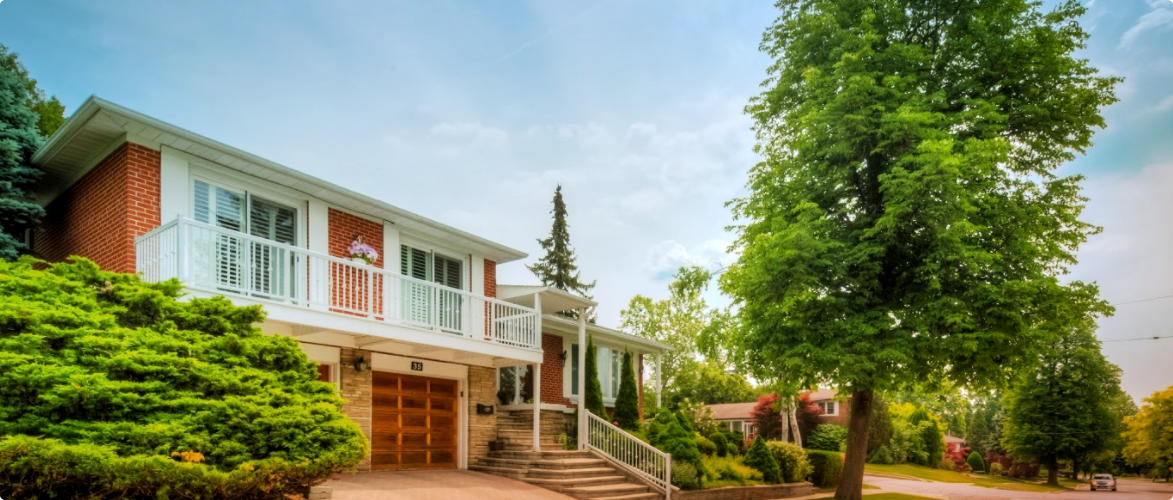
Graydon Hall is a quiet, established North York neighbourhood east of the Don Valley Parkway near York Mills Road. It is known for large lots, executive detached homes, mature tree canopy, and direct access to the Don Valley ravine trail network. The neighbourhood takes its name from Graydon Hall Manor, a 1936 Tudor Revival estate that now operates as an event venue.
Graydon Hall sits in one of North York’s quieter corners, tucked east of the Don Valley Parkway between Lawrence Avenue East and York Mills Road. It’s not a neighbourhood you pass through on your way somewhere else. You have to be going there. That quality is, for most people who buy here, exactly the point.
The neighbourhood takes its name from Graydon Hall Manor, the 1936 Tudor Revival estate on Don Mills Road that now operates as a wedding and event venue. The manor grounds give the area an unexpected grandeur, and the ravine land that runs through and around the neighbourhood reinforces the sense of distance from the city even while you’re inside it. Residents back onto quiet treed lots, and the sound of the DVP is easy to forget about once you’re a block or two in.
What defines Graydon Hall is the combination of large lots, executive-scale detached homes, and genuine privacy. These are not typical North York subdivisions. The lots run deeper and wider than most of the city, many with mature tree canopy that took decades to grow. The architectural character varies, with some older traditional-style homes alongside more recent custom builds, but the scale stays consistent. This is a neighbourhood of principal residences, not investment properties or rentals.
Buyers come here because they want space, quiet, and the kind of neighbourhood where the same families have lived for twenty years. The DVP gives fast access downtown and to the 401, which makes it workable for commuters who don’t want to rely on transit. York Mills station is reachable by bus if you need it. But the honest picture is that Graydon Hall rewards people who drive, own their home outright, and want to be left alone in a good way. It is not a neighbourhood for first-time buyers or anyone looking for walkable amenities nearby. What it offers instead is some of the best residential land in North York, in a setting that has remained genuinely stable for decades.
Almost everything for sale in Graydon Hall is a detached house on a substantial lot. There are no condo towers here, no stacked townhomes, no laneway suites of note. The neighbourhood is effectively single-family residential, and it has stayed that way through several cycles of intensification pressure that have reshaped surrounding areas.
The housing stock reflects the neighbourhood’s history. Many of the homes date from the 1960s and 1970s, built as comfortable executive housing when this part of North York was still developing. You’ll find two-storey brick homes with double-car garages, four-bedroom layouts, formal living and dining rooms, and the kind of floor plans that were designed for a different era of family life. Some have been updated substantially, others less so. The condition varies enough that buyers should look carefully at each property rather than assuming from the exterior.
Lot sizes are a key part of the value here. Many lots run 60 to 80 feet wide and 120 feet deep, occasionally deeper. That’s genuinely unusual in a city where 25-foot lots have become standard in most neighbourhoods. The lot size means more garden, more separation from neighbours, and in some cases real development potential, though most buyers here are purchasing to live in the home rather than to redevelop.
In 2026, expect to pay between $1.8 million and $3 million for most detached homes in Graydon Hall, depending on lot size, interior condition, and how recently the home has been updated. Custom builds and extensively renovated properties on larger lots push above $3 million. There are occasional entry-level opportunities in the $1.6 to $1.8 million range for homes that need significant work, but they don’t stay on the market long. The neighbourhood has a track record of price resilience through market softening, which buyers at this price point tend to factor into their thinking.
Graydon Hall is a low-turnover neighbourhood. Families buy here and stay for ten, fifteen, twenty years. That means the available inventory at any given time is limited, and when a well-maintained home comes to market in a good pocket, it tends to generate serious attention quickly. You won’t find the constant churn of listing activity that you see in more transient parts of the city.
The market here behaves differently from the broader Toronto detached market in one important way: it’s less susceptible to the emotional bidding wars that characterize entry-level detached properties. Buyers in this price range are typically more deliberate. They’ve often already sold a home, they have financing arranged, and they’re not buying their first property. Transactions tend to be more structured, with properties sitting for a reasonable period before conditional offers are negotiated. That said, a well-priced and well-presented home can still attract multiple offers, particularly in spring when inventory is thin.
Days on market for Graydon Hall properties runs higher than the Toronto average, partly because of the price point and partly because buyers at this level are selective. A home that’s overpriced will sit. Sellers who price correctly based on recent comparable sales typically transact within thirty to forty-five days. Properties that have been on the market for sixty-plus days usually have a pricing or condition issue that needs addressing.
The neighbourhood has held its value comparatively well through the 2022-2023 market correction and the subsequent period of rate-driven softness. Executive detached properties on large lots in established areas of North York don’t tend to see the same percentage drops as condos or entry-level freeholds, partly because supply is structurally constrained and partly because the buyer pool, while smaller, is also less leveraged.
The typical Graydon Hall buyer is at a specific stage: they’ve already succeeded somewhere else in the city, they’re trading up from a smaller home, and they want to stop moving. These are households in their late thirties to mid-fifties, usually with children in secondary school or approaching it, who are prepared to spend at the upper end of what North York detached commands in exchange for space, privacy, and long-term stability.
A meaningful portion of buyers here come from the broader North York and Scarborough market, people who’ve done well in Don Mills, Leaside, or Bayview Village and are looking for more land without leaving the east-of-DVP corridor they know. Others come from the downtown market, having made money on a smaller freehold and deciding they’d rather have a proper house and a proper yard than a narrow Victorian on a 16-foot lot in Leslieville.
What buyers are trading off is walkability and transit convenience. There’s no subway station within comfortable walking distance. The commercial strips nearby don’t have the density of restaurants and independent shops that inner-city buyers are used to. Graydon Hall is a neighbourhood you drive from. Buyers who’ve lived car-dependent lives in the suburbs don’t notice this as a sacrifice. Buyers coming from a walkable inner-city neighbourhood should honestly assess whether they’ll adapt to it or resent it after six months.
International buyers and newcomers to Canada with capital also purchase in this area, attracted by the combination of lot size, home quality, and proximity to good schools and the DVP. The neighbourhood’s reputation for stability and its association with established professional families makes it a recognizable target in those communities. That buyer pool adds a layer of demand that persists even when the broader Toronto market softens.
The neighbourhood boundary is fairly tight, and within it the differences between streets are real but not dramatic. Broadly, homes closer to the ravine and the Manor grounds tend to have more mature tree coverage and a greater sense of enclosure. Streets further east toward Don Mills Road feel slightly more open and suburban in character.
Graydon Hall Drive itself is the neighbourhood’s spine, and properties on it benefit from the street’s identity and established character. Lots here run generously, and the homes tend to be among the larger ones in the area. It’s the address people mean when they say “Graydon Hall” in the most specific sense.
The streets that branch off toward the ravine edges, including parts of Arjay Crescent and the quieter residential culs-de-sac, attract buyers specifically looking for ravine proximity or backing. A ravine lot here adds a premium, sometimes substantial, because the combination of that green backdrop with the lot sizes available is rare in Toronto. Those properties rarely come to market and rarely last long when they do.
The southern edge of the neighbourhood, where it meets Lawrence Avenue East, is slightly more exposed to traffic and has less of the enclosed residential feel. Buyers looking for the full Graydon Hall experience are generally better served by properties further north and away from the arterial. The western edge near the DVP has some noise exposure on lots that back toward the highway corridor, and that’s worth assessing in person before making an offer rather than assuming it’s negligible.
There’s no meaningful commercial presence within the neighbourhood. The nearest retail cluster is on York Mills Road or along Don Mills Road, which keeps the streets quiet but means any errand requires a car. That’s by design for most residents here, and it’s part of what makes the neighbourhood feel genuinely residential rather than transitional.
Graydon Hall is primarily a driving neighbourhood. That’s not a criticism of the area, it’s an accurate description of how residents get around, and buyers should factor it into their lifestyle assessment before purchasing.
The DVP is the key asset for drivers. Access via Lawrence Avenue East puts you on the expressway quickly, and from there downtown is fifteen to twenty minutes in light traffic. The 401 is similarly accessible via the DVP or Don Mills Road, making connections to Scarborough, Mississauga, and the airport straightforward by car. York Mills Road gives east-west access across North York without needing to use arterials like Lawrence or Sheppard.
Transit exists but requires a bus connection. The 34 Eglinton East bus and the 54 Lawrence East bus both operate in the general area, with connections to York Mills station on Line 1 of the TTC subway. York Mills station is the most useful link, putting downtown within a reasonable commute. The bus ride to the station adds time and makes transit less competitive with driving for most trips. There is no subway station within walking distance of the neighbourhood.
Cycling is possible on quieter residential streets but the arterial connections to transit or retail are not particularly cycle-friendly. There are no protected cycling lanes on the major roads nearby. Residents who cycle tend to do so recreationally in the ravine system rather than as a primary mode of transportation.
Walkability is low by Toronto standards. Walk Score for the neighbourhood sits well below the city average. The nearest grocery and retail options require a car or a bus ride. Buyers who currently walk to get groceries or transit should honestly reckon with that change before committing to Graydon Hall.
The ravine system is the neighbourhood’s most significant natural asset and one of the primary reasons buyers choose it over other executive housing areas in North York. The Don Valley ravine network runs along the western and southern edges of the neighbourhood, and several properties back directly onto the ravine or have trail access within a short walk.
The Lower Don Trail and the network of paths that connect through E.T. Seton Park and Sunnybrook Park are accessible from the neighbourhood, offering kilometres of walking and cycling trails through mature forest along the Don River. This is one of the most extensive ravine trail networks in the city, and residents in Graydon Hall are better positioned to access it than most of Toronto.
Graydon Hall Manor itself contributes green space in a different sense. The manor grounds, while not a public park, add a significant amount of landscaped and wooded land to the neighbourhood’s visual character. Events there bring some traffic on weekends but don’t disrupt the residential feel of surrounding streets.
For more structured park use, Windfields Park sits to the north and provides sports fields, a community centre, and open green space. The Ontario Science Centre grounds, accessible via the ravine trails, are also within the broader network. Families with children use the ravine trails extensively, and dog owners in particular tend to find this one of the best-served areas in North York for off-leash and trail use. The combination of the ravine access with the large private lots means residents here have more green space per household than almost anywhere else in the city at this price point.
Graydon Hall has no commercial strip of its own. Residents drive to shop, and the options within a few minutes are solid without being exceptional. The nearest concentration of retail and dining is along York Mills Road, particularly around the York Mills and Leslie intersection, where you’ll find a grocery store, pharmacy, and a cluster of restaurants serving the professional demographic that lives in the broader area.
Don Mills Road is the other main commercial corridor for residents. The Shops at Don Mills, about ten minutes south, is an open-format retail development with a mix of national brands, independent restaurants, and service retailers. It’s well-suited to the neighbourhood in tone, not a big-box power centre, and it has expanded its dining options over the past several years. The Aga Khan Museum and Park, also on Don Mills Road, adds cultural programming and a well-regarded restaurant at Diwan if you want something more considered for a weekend lunch.
For everyday grocery shopping, the options within a ten-minute drive include a Loblaws at York Mills, a Whole Foods a bit further along, and various smaller grocers and specialty food shops that serve the diverse North York population. There’s no shortage of South Asian, East Asian, and Middle Eastern grocery options within a reasonable drive, which matters to a portion of the neighbourhood’s buyer base.
There are no independent coffee shops or boutique retail within walking distance. The neighbourhood trades those amenities for privacy and space. Buyers who shop locally and on foot in their current neighbourhood will find the adjustment noticeable. Buyers who are already accustomed to driving for most errands will find the area well-served for what it is.
Schools are a significant draw for families buying in Graydon Hall, and the catchment options are generally well-regarded by North York standards. The area falls within the Toronto District School Board, and elementary-aged children typically attend schools in the broader Don Mills and York Mills corridor.
Rippleton Public School on Rippleton Road serves part of the neighbourhood at the elementary level and has a strong reputation among local families. York Mills Collegiate Institute is the secondary school most closely associated with the area and has a long history as one of North York’s more established public high schools. It offers strong academic programming and has an active extracurricular culture. The school draws from a wide catchment that includes some of North York’s most affluent residential areas, which affects the school culture and resourcing.
For Catholic families, St. Bonaventure Catholic School and the Toronto Catholic District School Board’s secondary options in the area provide an alternative stream. French immersion is available through the TDSB, and buyers specifically interested in immersion programs should confirm current catchment boundaries with the board directly, as these have shifted in recent years.
Private school access is another consideration at this price point. The neighbourhood is within reasonable driving distance of several of Toronto’s best-known independent schools, including Crescent School for boys and Bayview Glen. Families who already have children enrolled in private school, or who are planning to, often find Graydon Hall’s central North York location a practical fit. The concentration of families with children in similar schools creates a social ecosystem that new arrivals often find easier to enter than they’d expect.
Graydon Hall has seen relatively little of the high-rise and mid-rise intensification that has transformed nearby corridors like Sheppard and Don Mills. The neighbourhood’s positioning away from major transit corridors and its established single-family character have protected it from the development pressure that rezones more accessible areas. That’s unlikely to change in the near term.
What has been happening is gradual infill at the individual property level. Older homes on large lots have been replaced by custom builds, a pattern that has been consistent for the past decade and continues. Buyers should expect to find a mix of original mid-century homes alongside contemporary builds, and should assess each property on its own merits rather than assuming the street is uniformly either old or new.
The broader York Mills and Don Mills corridor has seen some condominium activity to the west and south, but it hasn’t encroached into the Graydon Hall residential core. The Crosstown LRT (now Eglinton Crosstown), which will significantly reshape parts of Eglinton Avenue, doesn’t directly affect this neighbourhood, but its completion will improve transit access to broader midtown from nearby stations, which may incrementally improve the neighbourhood’s transit connectivity for residents who use it.
The Graydon Hall Manor property itself has remained stable as an event venue. There have been periodic discussions about the site’s long-term use given its landholdings, and buyers adjacent to the property should stay informed about any future planning applications. For now, it operates as it has for years and is considered an asset to the neighbourhood rather than a development risk.
Is Graydon Hall a good neighbourhood for families with school-age children?
Yes, and it’s one of the main reasons families choose it at this price point. York Mills Collegiate Institute is a well-resourced public secondary school with a strong academic track record. Elementary options in the area are similarly regarded. Private school access by car is excellent, with several of Toronto’s better-known independent schools within a fifteen to twenty minute drive. The neighbourhood’s physical character, large lots, quiet streets, ravine access, also suits family life in a way that more urban neighbourhoods at similar price points don’t. If schools are the primary consideration, confirm current catchment boundaries with the TDSB before making an offer, as they can change.
How close is the DVP noise to residential streets?
It varies by property. Homes on the western edge of the neighbourhood, particularly those with rear exposures toward the highway corridor, will hear more traffic noise than homes further east. On most residential streets, the tree coverage and distance reduce the DVP to a background hum that most people adapt to quickly. The best way to assess this is to visit a specific property on a weekday morning during peak traffic hours. Don’t rely on a Saturday afternoon visit. The difference between a property 200 metres from the DVP and one 600 metres away is noticeable, and it should factor into your offer price if noise is a concern.
What are the property taxes like for homes in this price range?
Toronto property taxes are calculated on assessed value, which in most cases trails the actual market value. For a home assessed at $1.5 million (which may have a market value closer to $2.2 million in 2026), annual property taxes typically fall in the range of $10,000 to $14,000. The City of Toronto’s tax rate is higher than surrounding municipalities, which surprises some buyers. Budget accordingly, particularly if you’re comparing carrying costs with similar homes in Markham or Richmond Hill, where the tax rate is meaningfully lower.
Are there any heritage or conservation restrictions on these properties?
Most residential lots in Graydon Hall are not subject to individual heritage designations, but properties adjacent to or near the ravine may have conservation authority permissions required for significant landscaping changes, additions, or new construction near the valley edge. The Toronto and Region Conservation Authority (TRCA) regulates activity near ravine edges, and buyers planning major renovations or additions to properties with ravine proximity should review the TRCA mapping and consult with the city’s planning department before finalizing purchase plans. This is a due diligence step, not a barrier to renovation, but it can affect timelines and scope.
How does Graydon Hall compare with nearby Banbury and York Mills as a place to buy?
All three are executive detached markets in the York Mills corridor and share a similar buyer profile. Banbury tends to have slightly larger and more consistently upscale homes, particularly in the Bridle Path-adjacent section, with prices to match. York Mills as a general neighbourhood is broader and more varied in character. Graydon Hall sits in a middle ground: more consistent in character than generic York Mills but less expensive than top Banbury. The ravine access and the Manor’s presence give it a specific identity. Buyers who want the very best addresses choose Bridle Path or the north end of Banbury. Buyers who want a strong neighbourhood with good lots and good schools at a somewhat lower price point than those areas often land on Graydon Hall.
Buying in Graydon Hall requires a different approach than buying in a higher-volume neighbourhood. The inventory is thin at any given time, which means buyers who wait for the perfect listing often wait a long time. A buyer’s agent who knows this area well will monitor expired listings, do direct outreach to owners in specific streets or pockets, and sometimes identify off-market opportunities that never reach the public listing stage. At this price point and with this level of inventory scarcity, off-market is worth pursuing.
Due diligence on these properties is worth doing thoroughly. Homes from the 1960s and 1970s often have deferred maintenance, outdated electrical panels, older HVAC systems, or finished basements with work that predates current code. A thorough home inspection by an inspector who is specifically experienced with older detached homes is essential. Don’t use an inspector you haven’t vetted. The inspection on a $2 million home should cost you $600 to $800 and take three to four hours. If it costs $350 and takes an hour, it’s not the inspection you need.
TRCA mapping is a specific due diligence item for any property near the ravine. Confirm the exact extent of the regulated area and any prior permit history for work near the valley edge. This is especially relevant if you’re planning additions, decks, landscaping, or any work that involves grading near a slope.
Survey review matters here because lot boundaries on older properties are not always where people assume. Fences may not sit on the property line. Driveways may encroach. On a property this size, a boundary discrepancy of even a metre or two has real implications. Get an up-to-date survey or a title insurance policy that specifically covers survey defects, and understand what you’re getting.
Finally, the seller profile in this neighbourhood often includes long-time owners who are emotionally attached to the property and have a price in mind that may not reflect current market conditions. Patience and a clear comparable analysis are your best tools. A good buyer’s agent will help you construct an offer that’s grounded in reality without being unnecessarily adversarial.
Street-level knowledge is hard to find online. Our team works in Graydon Hall every day. They know which pockets hold value, where the school catchment lines actually fall, and what the market is doing right now. Talk to us before you make a decision about Graydon Hall.
Talk to a local agent