
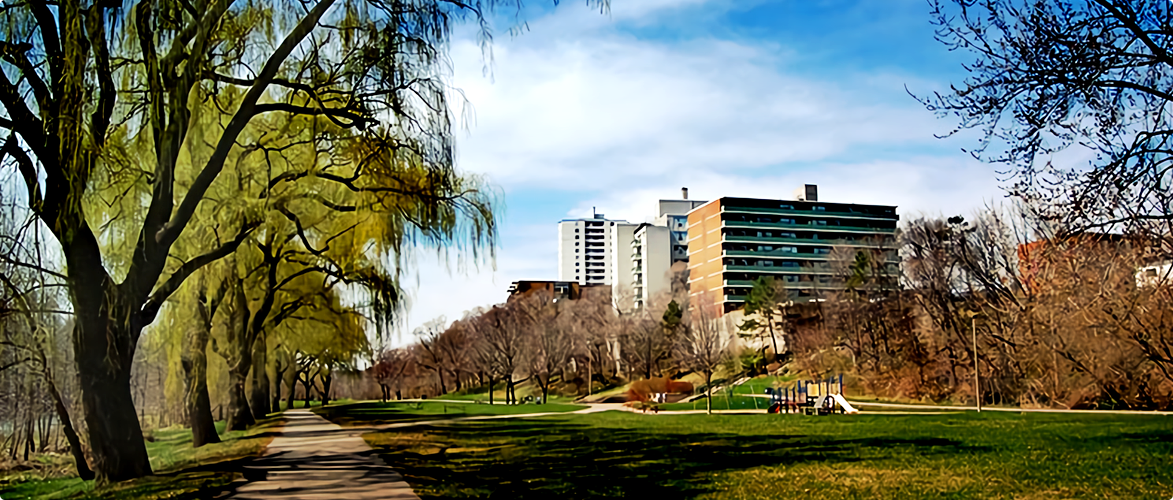
Humberlea is a small northwest Toronto neighbourhood near Weston and the Humber River. Affordable post-war bungalows on modest lots make up the housing stock. The neighbourhood is within walking distance of Weston GO station on the Kitchener line, which provides express service to Union Station in under twenty minutes, making it one of the better-connected affordable neighbourhoods in the city.
Humberlea is one of Toronto’s smaller and less-discussed residential neighbourhoods, sitting in the northwest part of the city near Weston and the Black Creek corridor. It’s bounded roughly by Lawrence Avenue West to the south, the Humber River to the west, Black Creek Drive to the east, and the rail and GO corridor near Weston to the north. The neighbourhood is compact, predominantly residential, and has the settled character of a community that was built at one time and has changed slowly since.
The housing here is almost entirely post-war detached bungalows and raised bungalows, built as affordable family housing for the northwest Toronto working-class communities of the 1950s and 1960s. Many of those families have stayed, and the neighbourhood has a stability to it that is more common in smaller urban communities than in the churn of more speculative real estate markets.
What distinguishes Humberlea from similar northwest Toronto neighbourhoods is the combination of Humber River ravine access and proximity to Weston GO station, which provides one of the better transit connections available in this part of the city. The Kitchener GO line provides express service to Union Station in under twenty minutes from Weston, which is fast enough to make Humberlea a viable base for downtown workers who are prepared to drive or take a short bus to the station. The Eglinton Crosstown’s eventual extension to this corridor, under the Mount Dennis hub plan, further improves the area’s transit picture over the medium term.
Buyers who choose Humberlea are almost always doing so on a value basis: a detached bungalow with ravine proximity and a surprisingly fast downtown transit option, at a price that reflects the neighbourhood’s modest profile rather than its genuine practical merits. That’s a gap worth understanding.
Humberlea is a bungalow neighbourhood, full stop. The housing stock is almost exclusively detached bungalows and raised bungalows on lots that run 40 to 50 feet wide. There are no condo towers, no stacked townhomes, and limited semi-detached inventory. This is one of the most homogeneous housing markets in the city in terms of typology, and that consistency shapes both the buying experience and the market dynamics.
The bungalows here are smaller than their North York counterparts on average. Original floor plans typically have two to three bedrooms, one bathroom, and a basement that was often finished at some point with varying degrees of quality. Many homes have had basic updates, kitchens and bathrooms refreshed, but the structural bones are the original postwar construction, which means buyers should expect aging mechanicals, original windows that may have been replaced once already, and basements with moisture history in a meaningful proportion of properties.
In 2026, detached bungalows in Humberlea in fair to good condition sell in the $800,000 to $1.1 million range. The lower end of that range represents homes that need significant updating. The upper end represents homes with renovated interiors, updated mechanicals, and in some cases finished basement apartments. Properties with direct ravine exposure or backing onto the Humber River trail command the top of the range and occasional premiums above it.
Lot sizes are generally modest, and the potential for significant addition or redevelopment is limited on some lots by lot coverage requirements and TRCA regulated areas near the ravine. Buyers who are planning to renovate or add significant square footage should review the lot dimensions, current coverage, and TRCA mapping before making assumptions about what’s achievable. The bungalow’s value in this market is as a livable family home on an affordable lot, not as a development opportunity in the traditional sense.
Humberlea is a thin market. In a typical month there may be only two to five active listings in the neighbourhood, which means buyers need to be patient and prepared to move quickly when a suitable property appears. The low volume also makes comparable analysis more challenging, since there may be fewer recent transactions to anchor an offer price to.
When well-priced properties come to market in good condition, they attract attention from first-time buyers and value-oriented purchasers who’ve been watching the area. The market can become competitive on specific properties even while overall activity is modest. A buyer who has done their research and is pre-approved with firm financing is better positioned than one who needs to go back to their broker to confirm numbers after seeing the listing.
Humberlea’s market has followed the northwest Toronto pattern in its response to rate cycles: moderately sensitive to rising rates, with days on market extending noticeably when financing costs are elevated. The recovery in 2025 and into 2026 has been gradual. Prices are below 2021 peaks but are recovering as affordability improves with rate reductions. For buyers, this is a workable market that rewards preparation and patience more than it rewards speed for its own sake.
The neighbourhood rarely sees bidding wars of the kind that characterized Toronto’s hottest periods, which means buyers in Humberlea have more often been able to negotiate conditions into their offers. That’s worth preserving where possible. The home inspection and financing conditions that protect buyers from expensive surprises are more achievable here than in more competitive markets.
Humberlea’s buyer profile is dominated by first-time buyers and value-conscious households who’ve been priced out of more desirable options. The neighbourhood attracts people who are making a deliberate financial decision: a detached bungalow for under $1 million in Toronto, with Weston GO station accessible for a fast downtown commute, is a combination that’s genuinely rare. Buyers who’ve found it, run the numbers, and decided the tradeoffs are acceptable form the core of the market.
The Weston and Black Creek community has a significant West Indian and African community presence that extends into Humberlea, and a portion of buyers here come from those communities, either purchasing in the neighbourhood where they or their family have rented or worked, or choosing it because the community fabric is familiar and valued. These buyers are typically purchasing to establish permanent roots rather than to flip or move again in five years.
Downtown workers who are prepared to use GO transit make up a third profile. The Kitchener GO line from Weston station to Union is fast enough that a household with one or two downtown commuters can make the math work if they’re prepared to drive or take the bus to the station. For buyers priced out of the $1.2 to $1.5 million midtown or east end properties they might prefer, Humberlea at under $1 million with a twenty-minute GO commute is a genuine alternative worth modelling seriously.
What all these buyer profiles have in common is a pragmatic relationship to the neighbourhood’s limitations. They know the commercial amenities are sparse, the neighbourhood profile is modest, and the social infrastructure is different from what you’d find in more affluent parts of the city. They’ve decided those tradeoffs are acceptable given the price and the access. That honesty about what the neighbourhood is and isn’t seems to produce a higher rate of buyer satisfaction than it might look like from the outside.
Humberlea’s street grid is compact and relatively simple. The most significant internal distinction is between streets that back onto or face toward the Humber River ravine and those that are in the interior of the neighbourhood away from the ravine edge.
Riverview Gardens and the streets running parallel to the Humber River have the most desirable positioning in the neighbourhood. Properties here either back onto the ravine or have quick walking access to the Humber River trail. The privacy that a ravine-backing lot provides is the same in Humberlea as it is in Graydon Hall or Etobicoke: a natural buffer that will never be developed, providing permanent green views and wildlife presence that is out of proportion to the modest size and price of the homes it backs. These properties don’t come up often and are worth monitoring specifically if ravine access is important to your household.
The streets closer to Black Creek Drive on the eastern edge of the neighbourhood have more traffic exposure and less of the enclosed residential character of the interior. Black Creek Drive itself is a busy arterial, and the noise and air quality effects of proximity to it are real. Buyers who are considering properties near the eastern boundary should assess this honestly before purchasing.
The western part of the neighbourhood nearest to Weston station has slightly more mixed character, with some light industrial and commercial uses in the transition zone between the residential neighbourhood and the Weston commercial and GO station corridor. This pocket is more practical for transit users but has less of the purely residential feel of the interior streets. For buyers who will rely on GO transit, the convenience of proximity to the station may outweigh the slightly less residential character of the adjacent area.
Transit is Humberlea’s most underappreciated asset, and it’s the thing that makes the neighbourhood genuinely interesting for downtown workers despite its northwest Toronto positioning.
Weston GO station is the key connection. The Kitchener GO line runs from here to Union Station in approximately seventeen to twenty minutes during rush hour, with UP Express service also stopping at Weston for airport-bound travellers. That’s a faster downtown trip than many people get from inner-city neighbourhoods with subway access, and it costs less than a subway ride from the Finch stations once you factor in the full travel time from those areas. GO trains run frequently during rush hours, making the morning and evening commute genuinely practical.
Local TTC bus service operates along Lawrence Avenue West to the south, connecting to Lawrence West station on Line 1. The 52 Lawrence West bus is the main local connector. Additional bus routes along Weston Road and Black Creek Drive connect to other parts of the TTC network. For trips that don’t align with GO train schedules, bus connections to the subway are available but add significant time.
The Eglinton Crosstown LRT connects at Mount Dennis station, which is a short distance south and east of the neighbourhood. This connection improves access to midtown and the Eglinton corridor, and Mount Dennis is designed as a multi-modal hub that will connect the Crosstown to the Kitchener GO and Barrie GO lines. As the transit network around Mount Dennis matures, Humberlea’s connectivity picture improves further, which is one of the medium-term arguments for the neighbourhood’s value.
Driving is comfortable, with access to Highway 400 via Lawrence Avenue or Black Creek, and the 427 accessible via Eglinton or Lawrence. The airport is twenty to twenty-five minutes by car or expressway, which matters to households with frequent travellers.
The Humber River is Humberlea’s defining natural feature, and the trail access from the neighbourhood is excellent by any standard. The Humber River Trail runs continuously from Steeles Avenue in the north to Lake Ontario in the south, passing through Humberlea and connecting residents directly to the provincial Greenbelt trail network above and the lake shoreline below. This is a trail system of genuine quality, and residents who use it regularly consider it one of the best things about living in the neighbourhood.
The river corridor here is wide and forested, with mature trees along both banks and a variety of wildlife that is more associated with rural Ontario than a large city. Great blue herons, red foxes, coyotes, and migratory birds are regular presences along the trail. In winter the trail is walkable in most conditions and has a different, quieter character that regular users often prefer to summer weekends.
Humber Trail Park provides formal park access to the river corridor from within the neighbourhood, with entry points that make the trail accessible without requiring a drive. Families with children use these access points for after-school and weekend walks, and the river itself, accessible for wading in designated areas during summer, is a draw for younger children in particular.
Beyond the river corridor, the neighbourhood’s green space is limited to the standard city park amenities: a few neighbourhood parks with playgrounds and open fields. Humberlea Park itself is a modest community park that serves the immediate residential area. For more extensive green space beyond the ravine, James Gardens in Etobicoke is a short drive away and provides manicured gardens along the Humber that offer a different character from the wilder ravine trail.
Retail options in and immediately around Humberlea are sparse. The neighbourhood is residential and doesn’t have its own commercial strip. Residents drive or take transit for most of their shopping.
Weston Road, a few minutes away to the north and east, is the main commercial corridor for the area. Weston has a historic main street character that has been somewhat preserved in its building stock, though the tenant mix has changed over the years and reflects the demographic of the current community rather than the neighbourhood’s earlier history. You’ll find Caribbean and South Asian restaurants, a variety of independent food shops, a range of personal services, and the kind of small-business retail that serves a diverse working-class community. It’s practical and authentic to the area it serves.
For larger grocery runs, a No Frills on Weston Road and various smaller independent grocers cover everyday needs. A Walmart Supercentre on Albion Road is a short drive for bulk and general shopping. Specialty grocery options for Caribbean, South Asian, and African cuisines are accessible in the Weston and Lawrence West corridors, reflecting the community’s demographics.
The Mount Dennis area, which is developing as a transit hub and community investment zone, has seen new commercial activity as the Crosstown completion approaches. This is likely to add service retail and food options that are currently missing from the Humberlea-adjacent area. The pace of that development has been slower than initially hoped, but the trajectory is toward improvement.
For dining out in any serious way, residents generally travel further, either into Etobicoke, toward the Bloor and Runnymede restaurant strip, or east toward the Lawrence West and Dufferin area. The neighbourhood’s own options are limited to the functional, which is not unusual for a residential neighbourhood at this scale and price point.
Schools in the Humberlea area are part of the TDSB and TCDSB systems, and the catchment options reflect the neighbourhood’s northwest Toronto positioning. As with other northwest Toronto neighbourhoods, the schools here serve a very diverse student population with high proportions of students for whom English is a second language and who come from households navigating economic pressures.
Humberlea-Pelmo Park Jr/Sr Public School is the main local public school serving the neighbourhood at the elementary level. The school serves a mixed-age student body and has the kind of community-school character that can be an asset in a residential neighbourhood where families know each other through the school network. Provincial assessment results at northwest Toronto schools generally run below city averages, which should be understood in its full context: the student population demographics, not school quality in isolation, are the primary driver of those results.
At the secondary level, Weston Collegiate Institute is the most accessible public high school for students from this neighbourhood. Weston CI has been through significant change over the years and serves a large catchment area. Parents with specific program interests, such as IB, arts, or specialist high skills majors, should research current program availability at Weston CI and at alternative options in the TDSB catchment.
For Catholic families, St. John Bosco Catholic School at the elementary level and nearby TCDSB secondary schools serve the area. French immersion options in this part of the city may require travel to designated schools outside the immediate catchment, and families committed to the French immersion pathway should confirm current options with both the TDSB and TCDSB before finalizing a purchase.
Humber College’s North Campus is accessible by transit or car, and York University is reachable via the GO and TTC connection through Finch West or Weston stations. For households with post-secondary education in the immediate future, these connections are worth factoring into the practical case for the neighbourhood.
Humberlea itself is unlikely to see major development activity in the near term. The neighbourhood’s lot sizes and bungalow stock may support gradual infill at the individual property level, but there’s no major transit station area designation within the neighbourhood that would trigger the intensification requirements that are reshaping corridors like Eglinton or Finch.
The more significant changes are happening in the adjacent areas. The Mount Dennis Hub is the most consequential nearby development project: a major transit interchange area where the Eglinton Crosstown, Kitchener GO, and Barrie GO lines will all connect. The city and province have designated Mount Dennis for significant mixed-use intensification, and development applications in the area are reflecting that ambition. The full buildout of Mount Dennis will take years or decades, but the direction is clear, and the area’s profile as a transit hub will grow.
Weston Village itself has been the subject of city-level planning attention, with efforts to revitalize the Weston Road main street and improve the public realm. The Weston Go station area improvements associated with the UP Express launch created some investment in the station precinct, and the Mount Dennis transit hub will extend that influence further. For Humberlea residents, this translates into a slowly improving transit and commercial environment in the areas they travel through rather than in the neighbourhood itself.
Flood risk management along the Humber River is an ongoing infrastructure priority. The TRCA and the City of Toronto continue to invest in flood mitigation in the Humber watershed, including stormwater management improvements and floodplain monitoring. Buyers near the ravine edge should monitor this activity and understand that the regulated area mapping may change as mitigation work is completed.
Is the GO train connection from Weston actually fast enough to commute downtown?
Yes, and it’s one of the best-kept secrets in northwest Toronto real estate. The Kitchener GO line from Weston station to Union Station takes approximately seventeen to twenty minutes on an express trip. Compare that to a forty-five minute TTC subway and bus commute from nearby neighbourhoods with no GO access, and the math is significant. Rush-hour GO trains run every fifteen to thirty minutes in peak direction, which is frequent enough to make it a reliable commute option. The main limitation is that GO train frequencies drop significantly during off-peak hours, so the commute works best for traditional nine-to-five schedules. For hybrid workers who commute two to three days a week, the GO option is even more attractive because flexibility is less of an issue. The walk or short bus ride from Humberlea to Weston station is the last piece; budget five to ten minutes for that connection.
How serious is the flooding risk near the Humber River?
The Humber River floodplain is among the most carefully mapped in the Toronto region, following Hurricane Hazel in 1954. Properties within the TRCA regulated area near the river face real restrictions on development and real flood risk during major storm events. The flooding risk has not been eliminated despite decades of mitigation work. Before purchasing any property in proximity to the Humber ravine, check the TRCA flood mapping for the specific address, ask the vendor about any history of water in the property or in the neighbourhood during heavy rainfall, and speak to your insurer about overland flood insurance before closing. Standard home insurance does not cover overland flooding. That gap in coverage is not hypothetical in a river-adjacent neighbourhood.
Can I add a legal second suite to a bungalow in Humberlea?
Potentially yes, but it requires the suite to meet the city’s second suite bylaw requirements and the Ontario Building Code. Minimum ceiling heights, egress windows, fire separation between units, smoke and CO detection, and separate utility metering are the main requirements. Many existing basement apartments in the neighbourhood were created informally and don’t currently meet all these standards. The cost of bringing a substandard basement suite to legal compliance varies depending on what work is required, but budgeting $20,000 to $50,000 for a full compliance retrofit is reasonable. The rental income from a legal suite, in the $1,200 to $1,600 per month range for a basement one-bedroom in this area, is meaningful against carrying costs. The registration process through the city is manageable but takes time. Start the process after closing rather than assuming it will be complete before your first tenant moves in.
What does the Mount Dennis transit hub mean for Humberlea property values?
The Mount Dennis hub is a genuine transit investment that will over time improve the area’s connectivity and potentially its commercial and residential character. The effect on Humberlea specifically will be indirect, as the hub is in Mount Dennis rather than in the neighbourhood itself. The practical benefit for Humberlea residents is a broader transit network accessible from nearby, not a station in the neighbourhood. Property value effects from transit infrastructure improvements are real but take years to materialize, tend to be concentrated closest to the transit investment, and are often partly priced in before the infrastructure opens. Buying in Humberlea today because of the Mount Dennis hub is reasonable as a supplementary consideration, but it shouldn’t be the primary investment thesis for a purchase you’re making for personal use.
Buying in Humberlea requires a buyer’s agent who is honest about what this neighbourhood is and has specific knowledge of how the Weston GO connection affects the area’s value proposition. This is not a market where you can rely on generic Toronto comparable analysis, because the specific asset of GO train access distinguishes it from otherwise similar northwest Toronto bungalow streets.
The TRCA regulated area is the most important site-specific due diligence item for any property with ravine proximity. Before your offer is firm, confirm the TRCA mapping for the specific address. Know what percentage of the lot, if any, falls within the regulated area, what restrictions apply to works in that area, and what the implications are for any renovation or addition you’re planning. This is not a bureaucratic formality. Regulated areas constrain what you can do with the property and require separate approval processes that add time and cost to renovation projects.
Flood insurance must be investigated for any property near the Humber. Contact your insurer before closing, confirm the availability and cost of overland flood insurance for the specific address, and factor that cost into your ongoing ownership budget. If an insurer declines to offer overland flood coverage or quotes at an unusually high premium, that’s meaningful information about the flood risk at that specific property.
The home inspection on a bungalow from this era covers the same categories as any older Toronto bungalow: electrical panel and branch circuit wiring condition, HVAC age and function, foundation and basement moisture, roof condition and remaining life, windows and exterior envelope. Humberlea properties near the river may also have had water intrusion history from periods of high river levels, which can appear in the foundation, basement slab, or window wells. Ask the vendor specifically about any history of water in the property during heavy rainfall or spring thaw. The vendor’s disclosure statement, if provided, should be read carefully and any ambiguous items clarified in writing before the condition period ends.
Street-level knowledge is hard to find online. Our team works in Humberlea every day. They know which pockets hold value, where the school catchment lines actually fall, and what the market is doing right now. Talk to us before you make a decision about Humberlea.
Talk to a local agent