
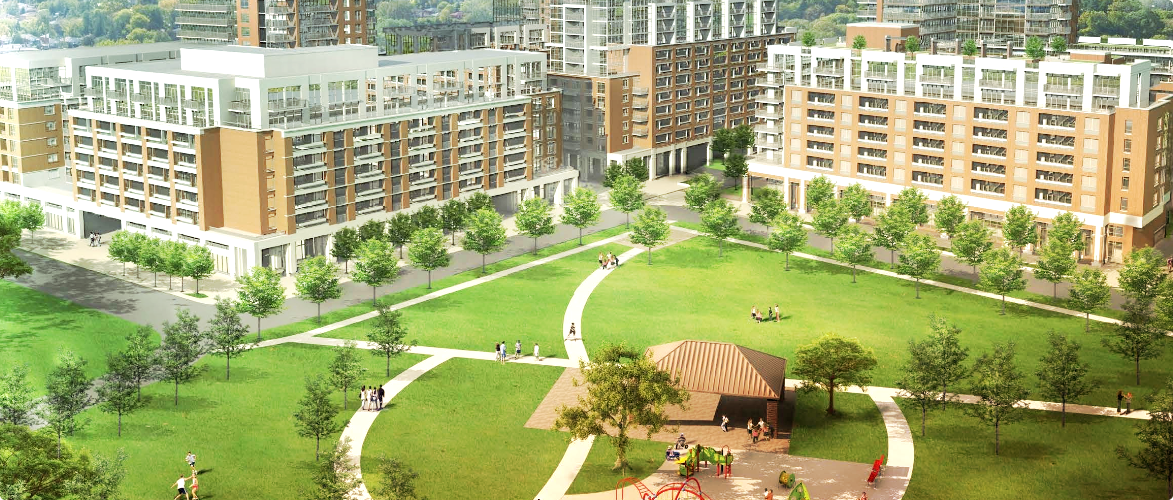
Lawrence Heights is a North York neighbourhood undergoing major transformation through the Lawrence-Allen Revitalization Plan. The multi-phase project is replacing the original post-war social housing with a mixed-income community, new streets, new parks, and thousands of new residential units, with Lawrence West subway station and Allen Road access anchoring its long-term appeal.
Lawrence Heights is a North York neighbourhood in the middle of one of the most significant urban redevelopment projects in Toronto’s recent history. Located between Allen Road to the east and Bathurst Street to the west, along the Lawrence Avenue West corridor, it has spent the past fifteen years as the subject of the Lawrence-Allen Revitalization Plan, a large-scale effort to transform a post-war public housing community into a mixed-income, mixed-tenure neighbourhood with new streets, new parks, and several thousand new residential units.
The original Lawrence Heights neighbourhood, built by Toronto Community Housing Corporation (TCHC) in the late 1950s, was designed as a superblock social housing community with limited street connections to the surrounding city. Over the decades, it became isolated in ways that reinforced poverty concentration, and by the early 2000s it was one of Toronto’s most consistently underprivileged communities. The revitalization plan, approved by the city in the early 2010s, set out to change that by replacing the existing TCHC housing stock with new mixed-income buildings and reintegrating the neighbourhood into the city’s street grid.
That process is now well underway. Parts of the neighbourhood have been demolished and are being rebuilt. New streets have been created. New market-rate and affordable residential buildings are either under construction or have been completed. The neighbourhood is in a state of active transformation, which creates both opportunity and uncertainty for buyers researching it.
Lawrence West subway station on Line 1 is the neighbourhood’s transit connection to the city. Allen Road is immediately east, connecting to the 401 in minutes. These are strong infrastructure assets, and they anchor the neighbourhood’s long-term case for continued investment and development.
Lawrence Heights is not yet a finished neighbourhood. Buying here means buying into a neighbourhood that is genuinely becoming something new, with all the upside and uncertainty that involves. For buyers who understand that, it offers options that are hard to find elsewhere in North York.
The housing market in Lawrence Heights is less straightforward to describe than in most Toronto neighbourhoods, because the neighbourhood is in a state of planned transformation. The private freehold market in Lawrence Heights is limited, partly because much of the land was historically held by Toronto Community Housing Corporation and partly because the revitalization process has been replacing the original stock with new mixed-income buildings rather than adding conventional market housing in large quantities.
Private homes do exist in and around the Lawrence Heights boundaries. The streets bordering the TCHC lands, and some pockets within the broader neighbourhood boundary, have post-war detached and semi-detached homes that have been privately owned through the neighbourhood’s history. These homes are similar in age and type to the broader North York housing stock: brick post-war construction, typically on 30- to 40-foot lots, with basement levels that may or may not be used as secondary suites. In 2026, a privately owned detached home in this area typically trades between $900,000 and $1.3 million, depending on condition, specific location within the neighbourhood, and proximity to the redevelopment areas versus the more established private streets.
The new residential development coming out of the Lawrence-Allen Revitalization is producing a mix of housing types including market-rate condominiums, affordable ownership units, and replacement social housing. The market-rate condominiums in the new mixed-income buildings are the primary way new buyers are entering the neighbourhood. These units are typically priced in the $600,000 to $900,000 range for one- and two-bedroom ownership condos, reflecting the area’s developing status rather than the price premiums commanded by more established North York condo locations.
The social housing component of the neighbourhood is being rebuilt rather than reduced. The revitalization plan commits to replacing all existing TCHC units on a one-for-one basis, so the neighbourhood will continue to have a substantial affordable housing component. Buyers considering the area should understand this as a planned and permanent feature of the neighbourhood’s housing mix, not a transitional condition.
For buyers considering Lawrence Heights as an investment or owner-occupier purchase, the key variables are the specific location within the neighbourhood, the building type, and the stage of the revitalization on the blocks immediately surrounding the property.
The Lawrence Heights market is thin in a conventional real estate sense. The limited supply of private freehold homes means comparable sales are scarce, which makes valuation harder and gives both buyers and sellers less reliable benchmarks than in higher-volume neighbourhoods. When a private home does come to market in Lawrence Heights, it often sells to a buyer who has been specifically watching the neighbourhood and has decided it represents value relative to the redevelopment trajectory, or to a buyer who has family or community ties there and has specific motivations for being in that location.
The new condo buildings in the revitalization area have their own sales processes, typically through developer sales centres for new units and through the standard MLS resale market for units that have been purchased and then resold. The developer sales process for the newer buildings in the Lawrence-Allen area has included a proportion of affordable ownership units managed through programs that have income and asset eligibility requirements, which creates a parallel market track from the standard condo resale market.
For the private freehold homes that do trade, days on market are typically longer than in busier North York neighbourhoods, reflecting the smaller buyer pool. Buyers who are specifically looking in Lawrence Heights tend to be researched and deliberate rather than reactive, which means the competition dynamics are less intense but the negotiations can be more considered.
The neighbourhood’s revitalization status creates an unusual market dynamic. Properties adjacent to areas that have been demolished and are awaiting construction are in a temporarily uncertain environment. Properties adjacent to completed new buildings are in a more settled situation. The sequencing of the revitalization plan matters for which blocks are in which state at any given time, and buyers should research the current status of specific blocks they’re considering rather than making assumptions about the neighbourhood as a whole.
Longer-term, if the revitalization proceeds as planned and the neighbourhood successfully transitions to a mixed-income community with improved streets and parks, property values in the adjacent and surrounding areas stand to benefit. This is the core investment thesis for buyers considering Lawrence Heights, and it requires confidence in the timeline and execution of the revitalization plan.
Lawrence Heights attracts a narrow but specific set of buyers. The neighbourhood’s current state and its ongoing transformation mean that most buyers are either community-connected, investment-oriented, or actively looking for value in a neighbourhood they believe has a better future ahead of it.
Community-connected buyers, those who have family in the area, who have lived in Lawrence Heights at an earlier stage of life, or who have social and cultural ties to the communities that have lived here for decades, make up a significant portion of whoever is purchasing in and around the neighbourhood. The West Indian, African, and other immigrant communities that have been part of Lawrence Heights since the 1960s and 1970s have generational roots here. Family members buying to be close to their parents, or former residents returning who want to be part of what the neighbourhood becomes, are real buyer profiles.
Investment-oriented buyers are attracted by the revitalization thesis. If you believe the Lawrence-Allen plan will succeed in transforming Lawrence Heights into a functioning mixed-income community, and if you accept that the timeline will be long, the properties in and around the area represent a potential value play. This is a higher-risk, higher-patience proposition than buying in a neighbourhood that has already gone through its transformation, and buyers taking this position should be financially comfortable holding through a multi-year development process without certainty on the outcome or the timeline.
First-time buyers priced out of adjacent neighbourhoods, like Bathurst Manor or Wilson Heights, sometimes look at Lawrence Heights as the next step down in price with the potential for appreciation if the revitalization accelerates. For this buyer, the research requirement is higher than for a more transparent neighbourhood, and the due diligence around specific streets and the revitalization plan status is essential before making a decision.
The trade-offs buyers accept here are real: the neighbourhood is not yet the finished product, the street environment in parts of it remains challenging, and the timeline for the full transformation extends well into the 2030s. Buyers who accept this picture with open eyes are better positioned than those who expect a faster resolution.
Lawrence Heights as a neighbourhood boundary is defined differently by different sources, and this matters because the character varies considerably depending on which specific blocks you’re talking about. The core TCHC lands, the original superblock public housing area, sit roughly between Allen Road and Flemington Road, and between Lawrence Avenue West and the streets north toward Ranee Avenue. This core area is where the revitalization has been most actively reshaping the physical environment.
The streets along Flemington Road and the residential blocks immediately west of Allen Road have a different character. These include a mix of private homes, some older apartment buildings, and the newer mixed-income buildings that are the product of the revitalization. Flemington Road itself has seen new construction as part of the redevelopment, and some of the neighbourhood’s newer residential product is found along this street.
The blocks along Ranee Avenue to the north and along Marlee Avenue to the west have more of the characteristics of the adjacent Bathurst Manor and Glen Park neighbourhoods. These streets have private freehold homes that have been part of the community’s private housing stock for decades, and their character is closer to a conventional post-war North York residential street than to the social housing core. Buyers looking in this area often find that properties on Ranee or Marlee carry different pricing and dynamics from properties deeper in the TCHC lands.
Lawrence Avenue West itself is the commercial spine and transit corridor. The commercial strip along Lawrence in this area is modest, serving daily needs rather than offering destination retail. The Lawrence West subway station is the transit hub, and the commercial activity clusters around it.
For buyers doing specific research, it’s worth downloading the Lawrence-Allen Revitalization Plan phasing diagram from the City of Toronto website and identifying where the specific properties you’re considering fall within the phasing. Whether a property is on a block that’s been completed, is under active construction, or is in a later phase that hasn’t started yet makes a real difference to what your daily environment will look like in the near term.
Lawrence West subway station on Line 1 is the neighbourhood’s most important infrastructure asset for transit users. From Lawrence West, trains reach Bloor-Yonge in about twelve minutes and Union Station in about twenty minutes. The station is accessible from most of the neighbourhood on foot, with the walk from the core of the Lawrence Heights area taking roughly ten to fifteen minutes. The station serves as a bus terminal with several routes connecting the neighbourhood to surrounding areas.
Bus service along Lawrence Avenue West is frequent and runs east-west, connecting to the Yonge corridor at Lawrence subway station on the east side. This connection allows residents to travel across the northern part of the city using surface transit, supplementing the north-south subway. The 52 Lawrence West bus runs through the neighbourhood and provides this east-west link.
Allen Road runs along the eastern edge of the neighbourhood and provides direct highway access to the 401 within a few minutes. This is a significant asset for car commuters. The 401 access is quick and relatively unimpeded for most of the day, though the Allen Road corridor itself, between the 401 and Eglinton, can back up significantly during peak hours. Drivers heading downtown via Allen need to allow for this variability.
The Bathurst Street corridor at the western edge of the neighbourhood provides an additional north-south transit route and a surface option for drivers heading south. Bathurst has TTC bus service connecting through to Bloor Street and beyond.
Cycling in Lawrence Heights is limited by the infrastructure, similar to other North York neighbourhood areas. The residential streets within the neighbourhood are low-speed and manageable for cycling. Allen Road and Lawrence Avenue are not practical cycling corridors. The broader trail network in the area, including the Black Creek trail, provides recreational cycling routes without requiring navigation of busy arterials.
The revitalization plan for Lawrence Heights has included new street connections as part of its design intent, creating better internal walkability and connectivity to adjacent streets and transit. As phases complete, the pedestrian experience within the neighbourhood improves incrementally.
Green space is one of the areas where the Lawrence-Allen Revitalization Plan has committed to improvement, and the park network within and around the neighbourhood has been part of the planning from the beginning. The original superblock design of Lawrence Heights was criticized for, among other things, the way it positioned open space, with large undifferentiated green areas that weren’t well-integrated with streets and buildings. The new design creates parks that are more purposefully laid out and better connected to the surrounding residential environment.
Allen Park, running along the eastern edge of the neighbourhood adjacent to Allen Road, provides a linear green buffer between the residential area and the expressway. It’s a functional parkland rather than a destination, but it contributes to the green edge of the neighbourhood and provides a walking route parallel to Allen Road that separates pedestrians from the highway traffic.
Champlain Park, in the broader area between Lawrence and Wilson, is one of the larger local parks. It has sports fields, a community centre nearby, and the kind of multi-use green space that serves neighbourhood families for everyday recreational use.
Balmoral Park and the neighbourhood parks within the private residential areas to the north and west of the TCHC lands provide playground and open space access for residents on those streets. These are standard North York neighbourhood parks, modest in scale but serving the local streets effectively.
Earl Bales Park on Bathurst, a more substantial green area, is accessible by bus or car and provides the kind of larger park experience that the immediate neighbourhood doesn’t offer. It’s a meaningful amenity for residents who can make a fifteen-to-twenty-minute trip for a more significant outdoor experience.
As the revitalization builds out, the new parks that are planned as part of each phase will add green space that is integrated with the new street network. The long-term green space picture for the neighbourhood is intended to be better than the original design, though it will take years to mature in both physical completeness and in the way that communities grow into new parks over time.
The retail and commercial situation in Lawrence Heights is one of the areas where the neighbourhood’s current state is most honestly described as limited. The Lawrence Avenue West commercial strip near the subway station has everyday services, including grocery options, pharmacies, and fast food, but it does not have the range or quality of commercial amenity that more established North York neighbourhoods offer.
The revitalization plan anticipates new ground-floor commercial space in the mixed-use buildings being constructed as part of the project. Some of this new commercial space has been completed in the earlier phases, and new retail and food businesses have begun establishing in the ground floors of the newer buildings. This process is early. A neighbourhood that has been a social housing superblock for sixty years does not develop a diverse, high-quality commercial strip quickly, regardless of how good the new buildings are. Buyers who need vibrant street-level dining and retail within walking distance should research what’s currently operating rather than what’s planned.
Yorkdale Shopping Centre is accessible from Lawrence Heights by transit (a subway ride from Lawrence West to Yorkdale) or by car via Allen Road in under ten minutes. For residents who want serious retail access, Yorkdale’s proximity via Allen is a real practical benefit.
Bathurst Street to the west and Lawrence Avenue to the east both carry more established commercial strips with more variety than the immediate neighbourhood offers. The Bathurst and Lawrence intersection area, a few minutes by transit or car from Lawrence Heights, has grocery stores, restaurants, and services that supplement what’s available immediately in the neighbourhood.
The honest expectation for a buyer moving to Lawrence Heights today is that the nearby commercial environment is functional for basics and improving, but not yet a neighbourhood where you can walk out your door to a range of good restaurants and independent shops. That may change as the revitalization builds out more units and activates more commercial frontage, but the timeline for that change is years, not months.
Schools serving Lawrence Heights are part of both the Toronto District School Board and the Toronto Catholic District School Board systems. The neighbourhood’s public schools have historically served a high proportion of students from lower-income households, including many newcomers to Canada, and this shapes the classroom environment and the school community in ways that some parents value and others approach with caution.
Amesbury Middle School has served the neighbourhood and is part of the school infrastructure in this part of North York. At the secondary level, the neighbourhood’s students have been served by schools in the broader North York area. William Lyon Mackenzie Collegiate Institute on Viewmount Avenue in the adjacent Wilson Heights neighbourhood is one option. The TDSB’s alternative and specialty school network provides additional options for students with specific program interests.
The revitalization plan for Lawrence Heights has involved some consideration of school facilities and their relationship to the new neighbourhood structure. As population grows in the redeveloped area, the school capacity question becomes more pressing, and the city and school boards have been in discussions about how to accommodate the new residential population in the neighbourhood’s schools.
On the Catholic side, TCDSB schools in the North York area serve families in the system, including those in and around Lawrence Heights. Confirming the specific school assignment for any address at time of purchase is important, as the boundaries in this part of the city can be complex given the revitalization-related population shifts.
For buyers with families considering Lawrence Heights, the school situation deserves direct research and realistic expectations. The schools serving this neighbourhood are not known for competitive academic reputations in the way that schools in Willowdale or Forest Hill are. They serve communities with significant social needs and do that work seriously, but buyers for whom school reputation is a primary decision factor typically look at other North York neighbourhoods before settling here.
The Lawrence-Allen Revitalization is the defining development story of this neighbourhood, and its current status and future trajectory are the most important things a prospective buyer can research. The plan was approved by the city over a decade ago and has been moving through phases of demolition, infrastructure work, and new construction since then. As of 2026, some phases of the revitalization are complete and occupied. Others are under construction. Still others are in later phases whose construction has not yet started.
The plan at its completion calls for replacing the existing TCHC housing with roughly 5,700 new units total, a mix of market-rate, affordable, and social housing, along with new parks, new streets, and new community facilities. The full buildout is a multi-decade project. The original completion targets have shifted as the project has encountered the typical delays and cost escalations that large urban redevelopment projects face. Buyers should check the city’s Lawrence-Allen planning page for the current phase status and timelines rather than relying on early projections that may have changed.
Daniels Corporation has been the primary private development partner for the market-rate and mixed-income components of the revitalization. Several of their buildings in the Lawrence Heights area have been built, sold, and are occupied. Their ongoing involvement in subsequent phases is part of the plan, though the specifics of future phases are subject to ongoing approvals and agreements.
The new street network being built as part of the revitalization is designed to reconnect Lawrence Heights to the surrounding city by creating through-streets where the original superblock design had none. This street creation is a visible and significant physical change to the neighbourhood structure and is one of the clearest signals of the long-term intent to change how the neighbourhood functions.
External development pressure from the broader North York housing market is also affecting Lawrence Heights. The land in this area has risen significantly in value over the past decade, and the combination of subway access and Allen Road access makes sites in and around the neighbourhood attractive to developers beyond the revitalization plan itself. Some sites at the edges of the neighbourhood have seen development applications filed that are separate from the TCHC/Daniels revitalization process.
Is Lawrence Heights actually a viable place to buy a home in 2026? For a specific kind of buyer, yes. The freehold homes in and around the neighbourhood’s private streets are real properties that people live in and buy. The new condo buildings from the revitalization are occupied by real residents. The honest assessment is that it’s a neighbourhood that requires more research, more realistic expectations about the current environment, and more patience than buying in a more established area. The upside case, if the revitalization continues progressing, is that early buyers will see appreciation as the neighbourhood transforms. The downside case is that the transformation takes longer than expected and the holding experience is more difficult than anticipated. This is not the right neighbourhood for a buyer who wants clarity and comfort from day one.
What is the Lawrence-Allen Revitalization Plan and how does it affect me as a buyer? The Lawrence-Allen Revitalization Plan is a City of Toronto and Toronto Community Housing Corporation initiative to replace the post-war social housing superblock with a mixed-income, mixed-tenure neighbourhood. It involves demolishing the original TCHC towers and replacing them with new buildings that include social housing replacement units, affordable ownership units, and market-rate condominiums. New streets, parks, and community facilities are being built as part of each phase. As a private buyer, the plan affects you in several ways: it determines the construction activity that will surround you, it shapes the future character of the neighbourhood, and it means that the specific blocks adjacent to your property may be at different stages of development than your own building. Understanding the current phase map before buying is essential.
What price premium or discount should I expect relative to adjacent neighbourhoods like Wilson Heights or Bathurst Manor? Comparable private freehold homes in Lawrence Heights typically trade at a discount of 10 to 20 percent relative to equivalent homes in Wilson Heights, reflecting the neighbourhood’s current state and the uncertainty premium associated with buying in an area undergoing major transformation. The new condo units from the revitalization trade at discounts relative to comparable condos at better-established transit nodes like Yorkdale or Lawrence Park. Whether these discounts are adequate compensation for the additional uncertainty is a judgment call that depends on your risk tolerance and your conviction about the neighbourhood’s trajectory.
Will the neighbourhood change significantly in the next 5 to 10 years? Almost certainly, yes, though the direction and pace of change are more predictable than in some other transitional neighbourhoods because the revitalization is a planned, approved, publicly committed process rather than a speculative one. Several thousand new units are in the pipeline, new streets have been built and more are planned, and new public space is part of every phase approval. The neighbourhood in 2035 will be physically different from what it is in 2026. What’s harder to predict is the rate at which commercial, retail, and social infrastructure follows the residential development. New buildings can be built quickly. Community character, retail density, and the feeling of a working neighbourhood take longer to develop.
Buying in Lawrence Heights requires a higher level of due diligence than most North York neighbourhoods, and a buyer’s agent who is genuinely familiar with the revitalization plan and its current state is a meaningful asset. This is not a neighbourhood where standard market comparables work smoothly, where the nearby sales history gives you a clean read on value, or where the future environment of a specific property is easy to assess without specific research into the revitalization phasing.
Before making an offer on any property in or adjacent to the Lawrence Heights TCHC lands, your agent should be able to tell you: what phase of the revitalization the surrounding blocks are in, which blocks have been completed and which are awaiting construction, what’s been approved adjacent to the property, and what the city’s current timeline commitments are for the phases that haven’t started. Some of this information is public through the city’s planning portal. Some requires familiarity with the project’s history and current status. A buyer’s agent who can’t provide clear answers to these questions probably doesn’t have the specific knowledge this market requires.
For buyers considering new condo units in the revitalization buildings, the due diligence overlaps with standard condo purchasing but has some specific dimensions. Understand whether the building is part of the TCHC/Daniels partnership and what the community composition of the building is, specifically the proportion of market-rate, affordable, and social housing units. The mix of tenure within a building affects its community character and management dynamics. It’s not a reason to avoid a building, but it’s context worth having.
For freehold buyers, the standard North York due diligence applies: thorough home inspection, survey review, title review, and lawyer review of any unusual title conditions. In a neighbourhood where the land ownership and tenure history is complicated, including properties that have been in TCHC ownership and have undergone changes in ownership structure, title review is more important than in a straightforwardly private market neighbourhood. Your real estate lawyer should confirm there are no encumbrances, right-of-way issues, or TCHC-related conditions attached to any property you’re considering.
Finally, visit the neighbourhood at multiple times of day and on multiple days before committing. The environment around an active construction zone is different from the environment of a completed block. Walk the specific streets you’re considering. Talk to residents if you can. The experience of living there is something that a real estate listing and a market report can only approximate.
Street-level knowledge is hard to find online. Our team works in Lawrence Heights every day. They know which pockets hold value, where the school catchment lines actually fall, and what the market is doing right now. Talk to us before you make a decision about Lawrence Heights.
Talk to a local agent