
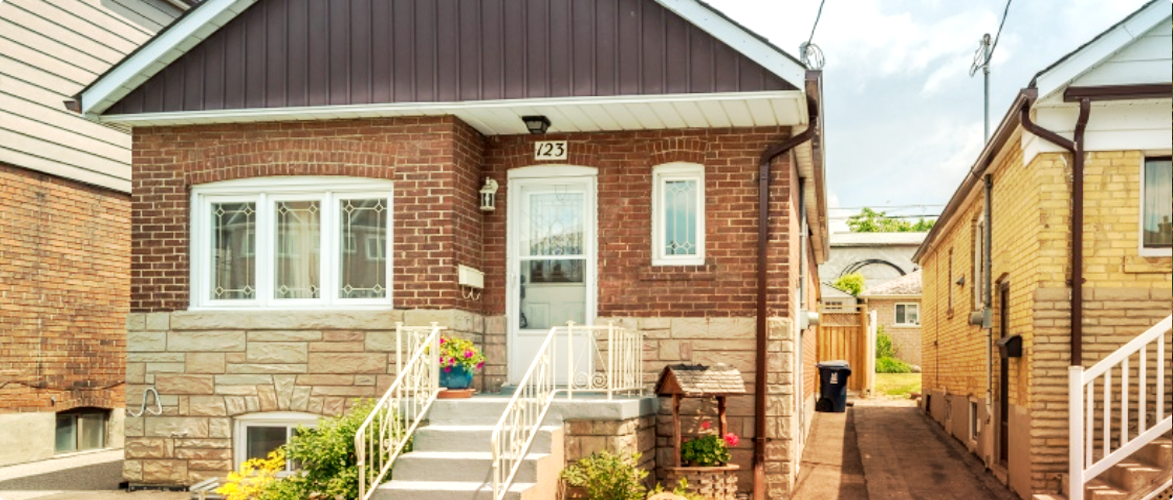
Keelesdale-Silverthorn is a working-class, diverse neighbourhood in northwest Toronto, built out in the postwar decades along Keele Street and Eglinton Avenue West. It offers some of the most affordable freehold housing within reach of rapid transit in the city, with the Keelesdale station on the Eglinton Crosstown LRT now connecting residents directly to Midtown Toronto.
Keelesdale-Silverthorn occupies the northwest corner of old Toronto where Keele Street meets Eglinton Avenue West. It’s a neighbourhood that most Torontonians have driven through without stopping, a long residential grid of postwar streets running west of Keele and south of Eglinton that has functioned quietly as affordable family housing for decades. The families who live here now are predominantly working-class, the neighbourhood is ethnically diverse in the genuine way that comes from immigration over many decades rather than from gentrification, and the housing stock is modest but solid.
What’s changing the neighbourhood’s story is the Eglinton Crosstown LRT. The Keelesdale station at Keele and Eglinton represents a step change in this area’s transit connectivity. Residents who previously relied on the 32 Eglinton West bus to connect to the subway now have direct rapid transit access to Midtown and beyond. That access was not priced into these properties five years ago and it’s being priced in now, which is part of why buyers with limited budgets are paying attention to this neighbourhood in a way they weren’t before.
Silverthorn, the southern portion of the neighbourhood around Silverthorn Avenue and the streets running off it, has its own identity within the broader area. It’s slightly quieter, slightly more residential in feel, and sits at the west end of a pocket that buyers who’ve done their homework specifically target. The streets here run on a diagonal to the city grid, which gives the area a different feel from the standard Toronto block pattern and creates a slightly more enclosed, neighbourhood-like atmosphere.
This is not a neighbourhood for buyers who want polish or a curated local restaurant scene. It’s a neighbourhood for buyers who want a detached or semi-detached home in Toronto at a price that doesn’t require extraordinary financial sacrifice, in a community that has its own real character rather than a performed one. The Crosstown changes the access equation without changing what the neighbourhood fundamentally is, which for a certain type of buyer is exactly the right combination.
The housing stock in Keelesdale-Silverthorn is almost entirely postwar residential: detached and semi-detached bungalows and two-storey houses built between 1945 and 1970, with a smaller number of wartime cottages from the early 1940s mixed in. Brick construction throughout. Lot sizes typically run 25 to 30 feet wide and 100 to 115 feet deep, which is standard for this era and this part of Toronto. Backyards are functional, garages are usually detached at the rear, and the homes themselves are modest in their original footprint, typically 800 to 1,100 square feet above grade on a bungalow.
The condition of properties varies considerably. Some have been maintained consistently and updated along the way, with proper kitchens and bathrooms, updated mechanical systems, and interiors that a buyer could move into without significant work. Others have had minimal investment for decades and require renovation from top to bottom. The range between these is wide, and the price difference between an updated and an original condition home is correspondingly significant.
Basement apartments are common here, both legal and unpermitted. The economics of this neighbourhood have historically pushed homeowners to extract rental income from the basement, and a large proportion of the housing stock has been modified to include a lower unit. This is relevant both as an income opportunity and as a due diligence issue: buyers need to understand the permit status of any basement unit in a property they’re considering.
In 2026, detached bungalows in Keelesdale-Silverthorn trade in the $850,000 to $1.2 million range. Semis come in at $750,000 to $950,000. The spread within each category is wide and driven primarily by condition, lot position, and proximity to the Keelesdale station. A renovated detached bungalow on a quiet street within walking distance of the station can push comfortably above $1.1 million. An original condition home on a busier street with maintenance issues will be at the lower end of the range.
Keelesdale-Silverthorn is a genuinely competitive market for properties that check the right boxes, meaning good condition, proximity to the Keelesdale station, and a workable lot. These properties attract multiple offers and can sell above asking in the spring market. Properties with significant issues, poor presentation, or pricing that doesn’t reflect current conditions sit longer and sometimes require price adjustments.
The Crosstown effect has brought a new class of buyer to this neighbourhood: buyers who previously weren’t considering the area but who ran the numbers on transit access versus price and found that Keelesdale-Silverthorn stacks up. These buyers tend to be well-researched and move quickly when they find the right property. Their presence in the market has increased competition on the desirable end of the inventory and compressed the gap between what buyers were paying two or three years ago and what they’re paying now.
Turnover is moderate to high compared to more established and expensive neighbourhoods. The working-class buyer base has higher mobility than an owner population anchored by community ties or long-tenure stability, and this generates a reasonable stream of inventory in most markets. It also means that the renovation history of properties is sometimes short: a house that was purchased, quickly updated to a rental-income configuration, and is now back on the market may have finishes that look updated but are not high quality. Buyers should look carefully at the workmanship on renovated properties rather than taking updated finishes at face value.
The rental investor market is active here, which adds a layer of buyer competition on the properties with the most obvious income potential. Investors who can offer firm offers on favourable terms sometimes outcompete end-user buyers who need conditions. Having a pre-approval in place, a home inspector on call, and the ability to move quickly is essential for buyers in this neighbourhood who want to compete effectively.
Keelesdale-Silverthorn attracts buyers who are explicitly prioritising the ratio of space to cost. The defining characteristic of this buyer is a clear-eyed calculation: they can get a detached house in Toronto at a price that is actually manageable, in exchange for accepting a neighbourhood that is working-class, not particularly glamorous, and still evolving. The trade is clear and for the right buyer it’s the correct one.
Many buyers here are first-time buyers at the higher end of their budget, and the Crosstown access is often what tips the calculation. Getting from Keelesdale to Yonge and Eglinton is a direct LRT ride. Getting downtown is a transfer but still faster than it was a few years ago. For buyers who were previously choosing between a condo in a better-served neighbourhood and a freehold in a poorly-connected one, the Crosstown has shifted that calculation in Keelesdale’s favour.
Investors and house hackers are a consistent presence. The combination of relatively low entry price, basement apartment potential, and transit access makes this a neighbourhood where the numbers work for income property strategies. Some buyers are purchasing as owner-occupants with the explicit plan of renting the basement; others are buying purely as rentals. The investment buyer is rarely the competing buyer you want to face in a multiple offer situation, so buyers who are end users should structure their offers to compete on terms, not just price.
The neighbourhood also attracts new Canadians and immigrants who are buying their first home after renting in Toronto for several years. The community character here, diverse and unpretentious, suits buyers who are not drawn to the social signalling of higher-profile neighbourhoods. For these buyers, Keelesdale-Silverthorn offers a genuine community with real roots, not just a collection of streets with amenable prices.
Within Keelesdale-Silverthorn, the distinction between the streets closest to the Keelesdale station and those further away is the most commercially significant variable. Properties within a ten-minute walk of Keele and Eglinton are trading at a notable premium compared to properties that require a longer walk or a bus to reach the station. Buyers should map their specific property options against the station location and not assume the neighbourhood is uniform.
Silverthorn Avenue and the streets running off it to the south, including Beatrice Street, Northcliffe Boulevard, and Lanark Avenue in the southern section of the neighbourhood, have a slightly different character from the northern streets closer to Eglinton. They’re quieter, the street pattern is slightly less rigid, and the properties here tend to attract families who want less proximity to the arterial traffic of Eglinton in exchange for a more settled residential feel. The trade-off is a longer walk to the Keelesdale station.
Keele Street itself is a busy arterial that carries significant bus and car traffic. Properties directly on Keele deal with that traffic and noise, and they tend to trade at a discount to comparable homes on interior streets. The best streets in this neighbourhood are the quiet residential ones running east-west off Keele, far enough from the arterial to be peaceful but close enough to the station to benefit from its access.
The northern end of the neighbourhood, closest to Eglinton Avenue West, will likely see the most change over time as the Crosstown corridor continues to attract mid-rise development. The current character of these blocks is single-family residential but the zoning discussions around the Eglinton corridor suggest that will evolve. Buyers purchasing on or very near Eglinton should understand that the streetscape is likely to intensify over the next decade.
The Keelesdale station on the Eglinton Crosstown is the neighbourhood’s transit anchor. From Keelesdale, the LRT runs east through Midtown Toronto, connecting at Cedarvale to the Yonge-University subway line and continuing east toward the Scarborough border. Westbound, it runs through Mount Dennis and connects at that station to the Kitchener GO line, opening up access to Union Station via GO. This is a genuinely well-connected transit position for a neighbourhood in this price range, and it’s the central reason that Keelesdale-Silverthorn is attracting buyers who weren’t looking here five years ago.
Surface bus service on Keele Street (the 41 Keele) runs north-south, connecting to Bloor-Danforth subway at Keele Station to the south and to Finch Avenue to the north. The 32 Eglinton West bus remains an option, though the LRT is now the faster route for east-west travel. For trips that don’t align neatly with the LRT corridor, the surface bus network provides coverage, though service frequencies on some routes require patience.
Driving from Keelesdale-Silverthorn is straightforward. Keele Street connects to the Black Creek Drive expressway corridor, and from there to the Allen Expressway and the 401. The QEW and 427 are a longer drive via Eglinton westbound, but airport access via the 427 is achievable in under half an hour in reasonable traffic. For buyers who drive regularly, this neighbourhood’s location at the western edge of old Toronto and the eastern edge of Etobicoke provides reasonable access in multiple directions.
Cycling from Keelesdale to the downtown core is a real option for fit riders, primarily via the West Toronto Railpath and the broader cycling network. The Railpath, a multi-use trail on a former rail corridor, provides a car-free route south that connects to the Bloor area. It’s not an easy commute for everyone but it exists for those who want it. Cycling on Eglinton or Keele themselves is less pleasant given the traffic volumes.
Keelesdale Park is the neighbourhood’s main green space, a substantial park straddling the Keelesdale and Rockcliffe-Smythe neighbourhood boundary along Keelesdale Road and Silverthorn Avenue. It includes sports fields, a community centre, tennis courts, and a wading pool, and it functions as a genuine community gathering space that serves the surrounding residential streets. The park’s size gives it a quality of openness that smaller neighbourhood parks can’t match.
Black Creek runs through the western edge of the neighbourhood’s vicinity, part of the larger Black Creek-Humber River system that provides a green corridor through this part of Toronto. The Black Creek trail connects to the Humber River trail system to the south and west, opening up multi-kilometre trail runs and cycling routes that feel genuinely removed from the urban grid. Reaching the Black Creek trail from the interior streets of Keelesdale-Silverthorn typically requires a ten to fifteen minute walk or a short bike ride, but the access is real and residents who use it value it highly.
The Humber River system further west is accessible by bike or car and provides some of the best natural trail experiences in Toronto’s western suburbs, including the Humber River Recreational Trail running from the lake all the way north to Woodbridge. For families with children who like to cycle or for adults who run or walk for exercise, this regional trail access is one of the underappreciated assets of living in the western part of Toronto generally.
Within the neighbourhood, street trees are present on most residential blocks but the canopy cover is uneven compared to more established areas like Lawrence Park or Cedarvale. The neighbourhood is urban and relatively dense; it doesn’t have the leafy residential quality of some Toronto neighbourhoods. The parks compensate reasonably well for what the streets lack in green coverage.
Keelesdale-Silverthorn’s local retail is functional rather than aspirational. The Keele Street commercial strip provides the daily necessities: convenience stores, a few restaurants and takeout options, a pharmacy, and the service businesses that dense urban neighbourhoods generate. The Eglinton Avenue West corridor adds grocery options and a wider range of commercial services within a short distance of the neighbourhood’s northern edge.
The Weston Road strip to the west, accessible by bus or a short drive, adds another commercial option, including grocery stores and a range of businesses serving the West Toronto working-class community. For residents who drive, Stockyards Village at St. Clair and Keele is a major retail hub with Canadian Tire, a grocery store, an LCBO, and a range of chain retailers that cover most household needs without a long drive.
The honest assessment is that Keelesdale-Silverthorn is not a neighbourhood where you’d choose to go out for dinner on a Friday night. The dining options on Keele and the immediate surroundings are casual, ethnic, and varied but not the kind of places that attract visitors from other neighbourhoods. Residents who prioritise restaurant culture in their local environment tend to drive or transit to the Junction, Bloor West Village, or take the LRT east to the more commercial Midtown stretches of the Eglinton corridor.
What the neighbourhood does provide is convenience for daily basics without requiring a car trip. Most residents can walk to a grocery store, a pharmacy, and basic services. That functional convenience is real and appreciated. Buyers who’ve done their research understand what this neighbourhood is and what it isn’t, and the ones who thrive here are those who have consciously traded off a restaurant neighbourhood for a home they can afford in a city they want to live in.
The Toronto District School Board schools serving Keelesdale-Silverthorn include Keelesdale Junior Public School for younger elementary students and Silverthorn Community School, which has a history of serving the neighbourhood’s diverse student population with programming that reflects its demographics. Enrollment at both schools reflects the working-class, immigrant-heavy character of the community: classrooms are diverse, multilingual, and in some cases serve students for whom English is a second language.
For middle school, the TDSB feeder pattern directs students to schools in the area depending on their specific street catchment. Parents should verify the current catchment directly with TDSB before assuming which school a specific property feeds into, as catchment boundaries in this area have been adjusted over the years and the information found on third-party real estate sites is not always current.
On the Catholic side, the Toronto Catholic District School Board operates in this area through St. Alphonsus Catholic School, which serves elementary students from the neighbourhood within the TCDSB system. Catholic school families have the option of the separate school system from junior kindergarten through to secondary, and the TCDSB schools in this area are part of that network.
For secondary school, the TDSB high school serving most of this neighbourhood is Humberside Collegiate Institute or York Memorial Collegiate Institute depending on the specific catchment. York Memorial has a varied program offering and serves a student body that reflects the neighbourhood’s diversity. Buyers who prioritise French immersion programs or specialized arts and music programs should confirm program availability at the specific secondary school their address feeds into, and consider whether an application-based transfer to a different school with the desired program is appropriate. The TDSB offers various specialized secondary programs that are accessible through application rather than catchment, which broadens options for families willing to manage a longer school commute.
The Eglinton Crosstown and its Keelesdale station represent the most consequential development change in this neighbourhood’s history. The station is built and operating, and the development pressure it creates along the Eglinton corridor is already visible in planning applications and land assembly activity near the station area. The City’s vision for the Eglinton corridor anticipates mid-rise mixed-use development along the avenue itself over the coming decade, which means the blocks immediately adjacent to Eglinton are likely to see new condo and apartment buildings where single-family residential currently exists.
For buyers purchasing interior residential streets, this corridor intensification is a background factor rather than an immediate concern. The streets that are specifically targeted by the city’s planning framework are on or immediately adjacent to Eglinton, not the residential blocks two or three streets north or south. But buyers should understand that the broader neighbourhood character will evolve as the corridor densifies and as new residents, new retail, and new commercial energy arrive with the LRT.
Lot severances and infill development continue in the residential interior. Detached homes on wider lots are occasionally severed and rebuilt as two narrower infill houses. This adds supply but it also changes the streetscape character over time. Buyers who are purchasing adjacent to or on a street where this activity is occurring should factor in that the neighbour on one side could be demolished and replaced within their ownership horizon.
There are no major institutional developments currently proposed for the neighbourhood interior, and no large-scale community facility changes expected in the near term. The story in Keelesdale-Silverthorn is transit-driven change along the corridor combined with steady incremental densification in the residential areas, which is a manageable trajectory rather than a disruptive one. Buyers who want a neighbourhood that will look materially different in ten years are probably in the right place; buyers who want total stasis may find some of the changes uncomfortable.
How does this neighbourhood compare to Mount Dennis for a buyer on the same budget? The two neighbourhoods are close in price and share some characteristics, but they have different transit positions and different community characters. Mount Dennis has the advantage of the transit interchange at its station, where the Eglinton Crosstown meets the Kitchener GO line, which gives direct GO train access to Union Station. That’s a material advantage for buyers who commute downtown. Keelesdale-Silverthorn’s Keelesdale station is on the same Crosstown line but doesn’t have the GO connection, making the transit advantage slightly less pronounced for downtown commuters. On the other hand, Keelesdale has been somewhat more stable as a residential neighbourhood and has a longer-established owner base. The right choice depends on whether GO access matters to your commute and on which community character suits you better. Both are reasonable options at similar price points.
What are the realistic concerns about safety in this neighbourhood? Keelesdale-Silverthorn has elevated property crime rates compared to Toronto’s more affluent neighbourhoods, and there are occasional incidents of more serious crime, particularly near commercial nodes. This is consistent with the socioeconomic profile of a working-class urban neighbourhood, not with exceptional levels of danger. The vast majority of residents experience no crime personally and describe feeling comfortable in their daily lives. The practical precautions in this neighbourhood are the same as in any dense urban area: lock your car, secure your bicycle, be aware of your surroundings at night near commercial streets. These are not unusual requirements. Buyers who come from suburban backgrounds may find the density and urban character unfamiliar; that adjustment is normal and usually takes a few months to settle.
Is this a good neighbourhood to buy in for five years or for the long term? The Crosstown effect makes the medium-term story for Keelesdale-Silverthorn more compelling than the long-term stability case. Over five to ten years, the combination of transit access and relatively low entry price creates conditions for appreciation as more buyers compete for the same limited freehold supply. Over twenty or thirty years, the neighbourhood’s fundamentals, decent housing stock, reasonable green space access, and genuine community, provide a solid foundation. Buyers who are buying purely for short-term appreciation are taking a real estate bet that could go either way. Buyers who plan to live here for a meaningful stretch of time and who would be comfortable in the neighbourhood under current conditions are making a sound decision regardless of what the market does.
What permit issues should buyers investigate before making an offer? The two most common permit issues in this neighbourhood are unpermitted basement apartments and unpermitted additions or decks. An unpermitted basement unit is not necessarily a reason to walk away from a property, but it affects your insurance, your ability to represent it accurately to a mortgage lender, and your legal exposure as a landlord. The cost of retroactively permitting a basement apartment that was built without a permit varies widely depending on what needs to be brought to code, but $20,000 to $50,000 is a realistic range in many cases. Before making an offer on any property with an existing basement unit, have your agent pull the permit history from the City of Toronto’s online permit database, and factor any required remediation into your offer price.
Buying in Keelesdale-Silverthorn requires an agent who can move quickly and who understands what good value looks like in a neighbourhood where property condition varies dramatically. The spread between a well-maintained detached bungalow and an identical-looking one that has significant deferred maintenance can be $100,000 or more, and distinguishing between them requires either a detailed inspection or an agent with enough neighbourhood experience to read a property accurately before the inspection happens.
The investment buyer competition in this neighbourhood is real and requires a specific strategy for end-users. Investors often offer firm with no conditions, which end-user buyers typically can’t or shouldn’t match on an older property with unknown condition. The way to compete is to get your financing in order before you start looking so your pre-approval is solid, identify a home inspector who can turn around a report in 24 to 48 hours if needed, and be prepared to make offers that are conditional on inspection but with a short inspection period. An agent who understands how to structure offers competitively without asking you to waive all protection is worth significantly more than one who simply tells you to go firm.
The Crosstown proximity premium is real but not perfectly uniform across the neighbourhood. Your agent should be able to explain the specific transit walk-time from any property you’re considering and help you understand whether the current asking price reflects that premium accurately. Properties that are marketed as “steps from Keelesdale station” when they’re actually a 20-minute walk are not uncommon in listing descriptions, and understanding the actual relationship between the property and the station access is a basic piece of due diligence.
Basement apartment assessment is essential in this neighbourhood. Before you close, understand whether any basement unit is legal, what permits exist, and what the current rental income is if it’s tenanted. If a property is sold with a tenant in place, you need to understand the tenant’s rights under the Residential Tenancies Act, including the fact that you cannot simply ask a tenant to leave because you’ve purchased the property. Your agent should walk you through the tenant situation as a standard part of evaluating any income property in this neighbourhood.
Street-level knowledge is hard to find online. Our team works in Keelesdale (Silverthorn) every day. They know which pockets hold value, where the school catchment lines actually fall, and what the market is doing right now. Talk to us before you make a decision about Keelesdale (Silverthorn).
Talk to a local agent