
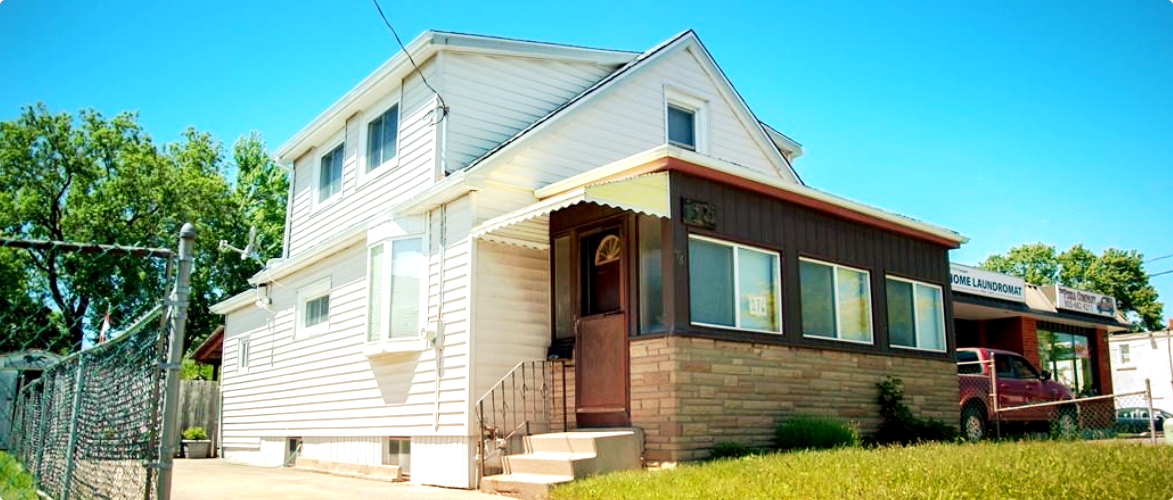
Carlton Village sits adjacent to Corso Italia in west Toronto, between St. Clair Avenue West and the CP rail corridor, with Dufferin subway station at the eastern edge. Italian-Canadian heritage, an active commercial strip on St. Clair West, and freehold homes with subway access at prices below comparable west-end addresses. Detached homes sell from $900,000 to $1.3 million in 2026; semis from $750,000.
Carlton Village sits in west Toronto between St. Clair Avenue West, Dufferin Street, Lansdowne Avenue, and the Canadian Pacific Railway corridor to the south, immediately adjacent to Corso Italia. The neighbourhood was built primarily in the post-war decades when Italian immigrants, and then their families, shaped the block-by-block character of this part of the city. That heritage is still visible in the built environment, in the family names on mailboxes, and in the commercial culture of St. Clair Avenue West, where Corso Italia’s espresso bars, pastry shops, and soccer club culture continue to operate with genuine community identity rather than nostalgic performance.
The practical daily reality of living here has improved significantly over the past decade. The Dufferin subway station is walking distance from the eastern edge of the neighbourhood, providing a transit connection that most comparable west Toronto bungalow neighbourhoods don’t have. The St. Clair Avenue West streetcar connects east toward Yonge and west toward Keele, giving residents two functional transit options for different destinations. The combination of subway access via Dufferin and streetcar access via St. Clair is better transit infrastructure than the price range alone would predict.
The neighbourhood’s commercial heart is the stretch of St. Clair Avenue West between Dufferin and Lansdowne, which is the Corso Italia commercial strip. This is not a neighbourhood trying to become something; it’s a neighbourhood that knows what it is. Caffe bars, Italian bakeries, pizzerias, butcher shops, and the Fumo Sports Centre, which has functioned as the social centre of the Italian-Canadian soccer community for decades. The strip is active during the World Cup in a way that few city blocks can match, and the year-round baseline is genuine local commercial life rather than curated destination retail.
Housing prices here are among the more accessible in west Toronto for a freehold purchase near a subway station. The neighbourhood’s working-class identity and its position slightly off the Annex-Bloor West axis of west-end desirability keeps prices more rational than you’d find for comparable transit access in Roncesvalles or the Junction. That gap is closing, but it hasn’t closed yet.
The housing stock in Carlton Village is primarily post-war detached and semi-detached homes, with some pre-war properties mixed in on the streets that were developed earlier. The lot sizes run to the standard inner Toronto dimensions: typically 25 to 30 feet wide and 100 to 120 feet deep for semis, somewhat wider for detacheds. These are not the spacious Scarborough lots; they’re the compressed inner-city lots that come with urban proximity.
Detached homes in Carlton Village are selling from $900,000 to $1.3 million in 2026. A detached in original or minimally updated condition starts at the low end. Well-maintained or partially renovated homes move into $1.0 to $1.2 million territory. Fully renovated detached homes on decent lots approach $1.3 million. Semi-detached homes represent the lower entry point and run from roughly $750,000 to $950,000 depending on condition and the specific street.
The semi-detached supply is more significant here than in purely suburban Scarborough neighbourhoods, and it’s an important part of the buyer entry point. For buyers who want to be in west Toronto near Corso Italia at an accessible price, a semi in the $750,000 to $850,000 range provides genuine value relative to comparable semis in higher-demand west-end addresses. The semi market here is active and moves when priced correctly.
Basement suites are common. The inner-city bungalow and semi format, with a full basement below grade, accommodates a basement apartment more easily than some larger-format suburban houses. Many properties in the neighbourhood have existing basement units in various states of permit and legality. The rental income potential in this part of west Toronto is meaningful; a one-bedroom basement suite on the St. Clair corridor currently rents from $1,600 to $2,200 per month, depending on condition and quality.
The Carlton Village market is more competitive than the Scarborough and outer East York bungalow markets, reflecting the better transit access and the west-end address. Multiple-offer situations appear regularly on well-priced semis and detacheds in the spring market. The buyer pool here includes people comparing this neighbourhood to the Junction, Roncesvalles, Bloor West Village, and the Davenport-Dufferin area, and finding Carlton Village more accessible on price for comparable transit access.
Days on market for well-priced properties run one to two weeks in active market periods. Properties that are priced correctly relative to condition and to the neighbourhood’s ceiling move quickly. Sellers who price based on what they paid at the 2022 peak, or based on what their renovated neighbouring property sold for, often find the market is more discriminating than they expected. Condition and specific street matter here in ways that are observable in the data.
In early 2026, the market is active but not frenzied. The post-2022 correction brought prices back from the peak and values have stabilized at a level that reflects the neighbourhood’s actual fundamentals: west-end address, subway access via Dufferin, Corso Italia commercial character, and housing stock that offers freehold at an accessible price. Buyers have more time to do due diligence than in the peak years, and conditional offers are occasionally achievable on properties where the competition isn’t intense. Don’t assume it’s possible on every property, but it’s worth asking.
The spring market from late February through May is the most competitive period. September through November is active but slightly less intense. The summer period is slower. Buyers who are not constrained to spring timing should consider whether the fall or early winter market offers better negotiating conditions for their specific budget and criteria.
Carlton Village draws buyers who are specifically looking for west Toronto freehold at a price below the Roncesvalles and Junction premium, with the Dufferin subway connection as a non-negotiable. The buyer profile tends to be younger than in the more established and expensive west-end addresses: first-time buyers or couples buying their first freehold who want to be in the west end but can’t reach the asking prices on Roncesvalles semis.
Italian-Canadian families who have deep roots in Corso Italia are a consistent buyer cohort. The neighbourhood’s heritage community is still present and actively purchasing, both buying for themselves and helping their children and grandchildren purchase nearby. The community continuity is visible on many streets where the same family names have been on the properties for 40 or 50 years, and where the next generation is choosing to stay rather than move to the suburbs.
Buyers from the Bloor-Lansdowne and Dufferin area who are moving up from condos or apartments find Carlton Village a natural step. They know the transit connections, they use Corso Italia already, and they’re looking to transition to a freehold property while staying in the community they know. This is a straightforward move-up buyer rather than a neighbourhood-discovery buyer, and their familiarity with the area means they act decisively when the right property appears.
The rental income potential attracts investors who are specifically calculating the cap rate on a west Toronto property with a basement suite. The combination of price, transit access, and rental demand makes the arithmetic more compelling here than in higher-priced comparable west-end addresses where the purchase price outpaces the rental income. Long-hold investors who are patient and focused on cash flow rather than quick appreciation find Carlton Village’s fundamentals defensible.
The neighbourhood’s residential streets run between St. Clair to the north, the CP rail corridor to the south, Dufferin to the east, and Lansdowne to the west. The streets within this rectangle are mostly quiet and residential, with the principal variation being proximity to St. Clair’s streetcar and commercial noise versus the quieter streets further south toward the rail corridor.
The streets directly off St. Clair are more urban in character and benefit from the commercial activity and transit access on the avenue. Buyers who walk to Corso Italia’s espresso bars and want to be within a block of the streetcar accept slightly more noise and activity in exchange for that convenience. These streets appeal to buyers for whom the commercial strip is a daily amenity rather than occasional use.
The streets in the southern half of the neighbourhood, closer to the CP rail corridor, are quieter from a street-level perspective but affected by rail corridor noise. Train frequency on the CP corridor is real, and properties within earshot of the tracks should be assessed with that noise environment in mind. The quietest streets in the neighbourhood are in the middle of the grid, away from both St. Clair and the rail corridor, where neither arterial noise nor rail noise is dominant.
Pelham Park Gardens, the small parkette at the heart of the neighbourhood that gives this combined area its full name, provides a neighbourhood-scale green space on the interior streets. It’s not a destination park but it anchors the residential character of the block it’s on and provides a reference point for the neighbourhood’s most genuinely residential interior. Properties on streets near Pelham Park Gardens are among the most consistently sought after for their combination of quiet character and proximity to the Corso Italia strip and Dufferin station.
Dufferin subway station on Line 2 is the neighbourhood’s primary transit asset. It’s on the Bloor-Danforth line and connects west toward Lansdowne, Runnymede, and Kipling, and east toward Spadina, Bloor-Yonge, and the full eastern line. From Dufferin station to Bloor-Yonge takes about 8 minutes. From Dufferin station to Union Station via Line 2 and a Yonge connection takes approximately 20 minutes. This is excellent inner-city transit access that few comparable price-range addresses in Toronto can match. The station is walking distance from the eastern edge of the neighbourhood; residents in the western part of the neighbourhood on the Lansdowne side take a shorter walk or a quick streetcar east.
The St. Clair Avenue West streetcar runs east-west along the northern boundary, connecting east toward Yonge and the Yonge-St. Clair commercial area, and west toward Keele and further west toward the Stockyards and the Caledonia area. The streetcar service makes St. Clair Avenue destinations accessible without requiring the subway, which is useful for trips that don’t follow the east-west subway corridor. It adds a second transit axis that most comparable-price-range west-end neighbourhoods with only one transit line don’t have.
Cycling is practical and well-used. Dufferin Street has cycling infrastructure, and St. Clair is cycled regularly despite being a streetcar street. The Lansdowne-Dupont corridor to the east provides a quieter north-south cycling route. Riders can reach Bloor Street, Dupont, and Davenport by bike in under 15 minutes, connecting to the broader west-end cycling infrastructure. For urban cyclists, the neighbourhood is well-positioned.
Car access involves Dufferin Street north to the 401, which is about 15 minutes by car in normal conditions. The Gardiner Expressway is accessible via Dufferin south toward King and the lakeshore. For residents who drive for some trips but transit for others, the road access is adequate without being exceptional by west Toronto standards.
Pelham Park Gardens is the neighbourhood’s main parkette, a modest green space on the interior streets that provides playground access and community green space. It’s not a large park but it’s well-used by residents with young children and by dog owners, and it anchors the block it’s on with a quiet and pleasant character. For a dense inner-city neighbourhood, having a neighbourhood parkette within walking distance of most addresses is a practical amenity.
Dufferin Grove Park, a few blocks north on Dufferin Street, is a more substantial community park with a wading pool, a community oven, a farmers market, a skating rink, and playing fields. It serves a significantly larger area but is accessible on foot or by a short ride from Carlton Village. The farmers market at Dufferin Grove, held on Thursdays, is one of the better mid-week farmers markets in Toronto and attracts a loyal following from the surrounding neighbourhoods. Residents of Carlton Village treat it as a neighbourhood resource because it’s close enough to function as one.
Earlscourt Park, to the northwest, is another substantial community park serving the St. Clair-Dufferin area. The park has athletic facilities, a pool, and significant green space. Between Dufferin Grove and Earlscourt, residents of Carlton Village have access to two well-equipped community parks within cycling or walking distance, which is better park access than the neighbourhood’s own modest parkette alone would provide.
The absence of ravine access is honest to note. Carlton Village is on flat terrain in west Toronto without the ravine system that East York and Scarborough neighbourhoods adjacent to the Don Valley enjoy. The green space picture here is urban park rather than natural ravine, which means the character is different from what you get in Todmorden Village or West Rouge. Residents who specifically value natural ravine access as part of their daily environment will find this neighbourhood doesn’t deliver that.
Corso Italia’s St. Clair Avenue West strip is the neighbourhood’s most distinctive commercial feature. The stretch between Dufferin and Lansdowne has been the heart of Toronto’s Italian-Canadian community for decades, and the commercial character remains consistent: espresso bars that open early and stay busy, Italian pastry shops with cannoli and sfogliatelle, pizzerias doing takeout for families that have been customers since the parents were children, and butcher shops with the cuts that Italian cooking requires. The Fumo Sports Centre is where the Italian-Canadian soccer community watches international games, a tradition that’s particularly visible during the European Championship and World Cup.
The strip also has more recent additions: a wine bar or two, a couple of newer restaurants that appeal to a broader west-end clientele, some independent shops that have found a home in spaces the strip’s commercial evolution has opened. The Corso Italia commercial character hasn’t been replaced; it’s been joined by adjacent commercial activity that benefits from the area’s improving desirability without displacing what was already there.
Grocery access is good. The St. Clair area has several options including a large Metro and a No Frills within a short distance, along with Italian grocery stores and delis that stock the imported products the community uses. The combination of large-format grocery and specialty Italian food retail means food shopping here is practical regardless of how you cook.
For anything beyond the Corso Italia strip and local groceries, Bloor Street West is accessible by subway from Dufferin station in about 5 minutes, opening up the full range of retail and commercial options along the Bloor corridor. The proximity to Bloor’s commercial depth via the subway means Carlton Village residents effectively have Bloor West’s retail and restaurant range as a secondary commercial destination that’s very close by transit.
The TDSB elementary schools serving Carlton Village are in the west Toronto school system. The neighbourhood falls within the catchment for schools on the Dufferin and St. Clair corridors. The schools in this area reflect the diverse community composition of the neighbourhood and the surrounding area: a mix of Italian-Canadian, Latin American, Caribbean, and newer immigrant families alongside the longer-established community. They’re community-oriented schools without the academic ranking focus of some midtown and North York schools.
French Immersion is available through the TDSB for families interested in bilingual education. The application process requires early engagement and placement is not guaranteed based on catchment. Families interested in this path should begin the registration process at the JK year and confirm the specific program available from their address.
The TCDSB serves Catholic families in the area. The Italian-Canadian community’s historical connection to the Catholic school system means Catholic elementary schools in this neighbourhood often have strong community engagement and a higher proportion of long-term family connections than the secular schools in the same area. Boundary verification is essential for both boards.
Secondary school in this part of west Toronto falls within the catchment for Bloor Collegiate Institute or Central Technical School on Harbord, depending on the specific address. Central Technical School is a large vocational and technical secondary school with a specific mandate in trades, technology, and arts, and a long history in the city’s east side. For families with students who would benefit from vocational or technical programming, it’s a genuine option. For families focused purely on academic preparation, the school’s vocational orientation is a relevant consideration. Specific secondary school catchment should be confirmed with the TDSB for any address before making it a factor in a purchase decision.
The St. Clair Avenue West corridor has been the subject of intensification planning for many years, and development is occurring. The streetcar right-of-way and the transit-corridor designation along St. Clair support mid-rise and mixed-use development on and immediately adjacent to the avenue. Several sites on St. Clair in the Corso Italia stretch and in the broader Dufferin-to-Lansdowne section are in various stages of planning application or have already been redeveloped with mixed-use buildings. The commercial character of the strip will change gradually as these buildings arrive, with new retail and residential space replacing older low-rise commercial buildings.
The residential streets off St. Clair are not the subject of significant development pressure. The zoning on the interior residential streets is stable, and the development activity is concentrated at the commercial corridor. Buyers on the residential streets can expect their immediate block to look similar in ten to fifteen years, even as the St. Clair avenue itself changes.
The Dufferin corridor, as a major north-south arterial and a subway corridor, is also subject to intensification pressure. Development along Dufferin in the Bloor-to-St. Clair section has already occurred, and more is proposed. This doesn’t directly affect the residential streets east of the main commercial area but it does change the character of the Dufferin corridor itself over time.
The CP rail corridor to the south has been subject to ongoing discussions about its long-term use. Any reuse of the rail corridor, whether for public transit, cycling infrastructure, or linear park development, would directly benefit the southern streets of Carlton Village. These discussions are long-running and not settled, but the corridor represents a potential future amenity whose eventual nature is uncertain. Buyers on streets adjacent to the corridor should be aware of both the current noise environment and the speculative long-term possibilities.
How close is Carlton Village to Dufferin subway station? Dufferin station is at the northeast corner of the neighbourhood, at Bloor Street West and Dufferin Street. From the eastern streets of Carlton Village, near Dufferin itself, the station is a 5 to 10-minute walk south to Bloor and then north to the station entrance, or a more direct walk via Dufferin directly to the station. From the western streets near Lansdowne, the station is about a 15 to 20-minute walk, or a short streetcar ride east on St. Clair to Dufferin and then south to the station. Most addresses in the neighbourhood are within a 10 to 20-minute walk of the station, with a shorter effective time for those who take the streetcar to Dufferin rather than walking the full distance. By Toronto subway-accessible neighbourhood standards, this is good access and it’s the primary practical asset that distinguishes Carlton Village from comparable-priced freehold options that require a long bus to get to the subway.
What is Corso Italia and is it changing? Corso Italia is the name for the stretch of St. Clair Avenue West from Dufferin to Lansdowne (and slightly beyond), which has been the historic commercial and cultural heart of Toronto’s Italian-Canadian community since the mid-20th century. The strip has the espresso bars, pastry shops, pizzerias, butcher shops, and Italian grocery stores that have been serving the community for decades, alongside the Fumo Sports Centre and various Italian-Canadian community associations. It is changing, in the modest sense that newer residents and businesses have added to the strip without yet displacing its character. More restaurants and cafes have opened that appeal to a broader west-end clientele. Property values in the surrounding neighbourhood have risen, which tends over time to change the commercial tenant mix. The core Italian-Canadian character of the strip remains intact in 2026, and the community has the density and the institutional infrastructure to maintain it for the foreseeable future. Buyers who value the strip’s specific character should also be aware that its long-term evolution follows the city’s broader gentrification patterns, which tend to dilute working-class ethnic commercial character over time as property values rise.
How does Carlton Village compare to the Junction for buyers? The Junction, to the northwest, has proceeded further along its transition from working-class to gentrified west-end neighbourhood. Property prices in the Junction are typically $100,000 to $200,000 higher on comparable properties, reflecting the neighbourhood’s established desirability and its renovation investment cycle. The Junction has more independent restaurants and lifestyle retail, and its buyer profile is more broadly drawn from the Toronto real estate market rather than from the specific Italian-Canadian community. Carlton Village offers similar transit access to the Dufferin subway, a stronger community identity rooted in the Italian-Canadian heritage, and lower prices. The comparison is most relevant for buyers who are genuinely undecided between the two addresses; buyers who specifically want the Corso Italia environment choose Carlton Village, and buyers who want the Junction’s established renovation aesthetic and broader neighbourhood scene pay the Junction premium.
Is the CP rail corridor noise a serious issue? Properties on the streets immediately adjacent to the CP rail corridor on the southern boundary of the neighbourhood experience rail noise that is a genuine background feature of daily life. The frequency and volume depends on the track’s activity level, which varies but includes both freight and occasional maintenance traffic. Properties within one to two blocks of the corridor are clearly within earshot; properties three or more blocks away hear it as a distant sound rather than an immediate presence. Buyers should visit any property near the corridor at different times of day, including early morning when rail activity is sometimes highest, before assessing whether the noise is acceptable for their specific situation. The corridor noise is one of the reasons properties on the southern streets of the neighbourhood sell at a modest discount relative to interior streets, which is rational pricing that buyers should interpret as a signal rather than as evidence of an overriding problem.
Carlton Village is a neighbourhood where the price range is competitive enough to require quick decision-making on the right property, and specific enough in its characteristics that your agent needs to know the difference between a property on a quiet interior street and one adjacent to either St. Clair’s streetcar noise or the CP corridor. Those differences show up in asking prices and in value, and an agent who treats all streets in the neighbourhood as equivalent is not helping you buy accurately.
The basement suite situation is relevant on most properties here and worth addressing early. West Toronto rental income is strong enough that a permitted basement suite materially affects the financial profile of a purchase. An agent who can advise on permit status verification and who knows which situations are straightforward to legalize versus which are more complicated is providing real value on properties where this is a consideration.
The comparison to the Junction and Roncesvalles is one your agent should be able to make honestly rather than defensively. Carlton Village is cheaper for a reason, and the reason is primarily transit distance and neighbourhood identity rather than quality. If the Dufferin-subway access is genuinely adequate for your commute pattern, and if the Corso Italia character is something you value rather than merely tolerate, then the price difference is working in your favour. A good agent helps you reach that conclusion based on your specific situation rather than pushing you toward the neighbourhood as a default.
TorontoProperty.ca covers west Toronto including the Corso Italia and Dufferin corridor. If Carlton Village is on your list, reach out for a specific read on the current market and the streets that work best for your criteria.
Street-level knowledge is hard to find online. Our team works in Carleton Village (Pelham Park) every day. They know which pockets hold value, where the school catchment lines actually fall, and what the market is doing right now. Talk to us before you make a decision about Carleton Village (Pelham Park).
Talk to a local agent