
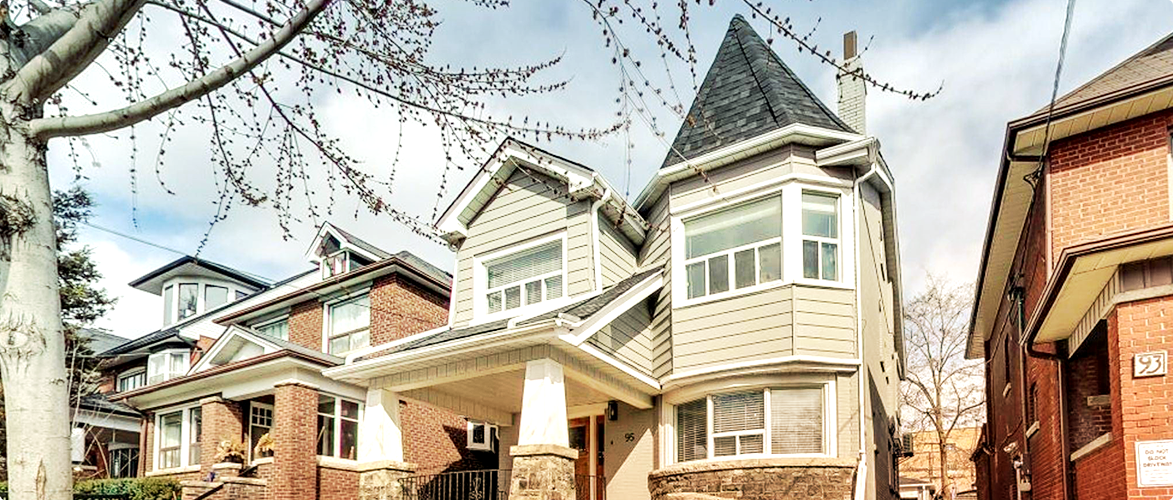
Davenport is a working neighbourhood in transition, roughly bounded by Dupont Street to the north, Dufferin Street to the west, Davenport Road to the south, and Ossington Avenue to the east. Entry-level brick semis trade between $900,000 and $1.2 million; detached homes run from roughly $1.1 to $1.6 million depending on size and condition. The neighbourhood has a real Portuguese and Italian-Canadian history that's still readable in the commercial mix on Davenport Road, and a buyer profile that has shifted significantly toward first-time owners and creative-industry households in the past decade.
Davenport sits in the west-central part of Toronto, wedged between Dupont Street to the north, Dufferin Street to the west, Davenport Road to the south, and Ossington Avenue to the east. It is a neighbourhood that has been working-class for most of its modern history, shaped in large part by the Portuguese and Italian-Canadian communities who settled here in the postwar decades and whose presence is still visible in the older commercial mix on Davenport Road: the bakeries, the tile shops, the social clubs that have been operating in the same building for forty years.
The transition that has been underway for the past decade has brought a different kind of buyer: first-time owners, creative professionals, and households priced out of Seaton Village and Bickford Park who found that the next neighbourhood west offered similar housing stock at meaningfully better value. That buyer shift has changed the commercial mix gradually, with independent cafes and restaurants appearing alongside the existing neighbourhood businesses, but the neighbourhood has not yet reached the full gentrification point that Seaton Village hit a decade ago. It is, by the standards of Toronto’s west end, still relatively affordable and still in transition.
Dovercourt Park anchors the neighbourhood’s eastern edge, a modest neighbourhood park that draws families and dog owners from the surrounding blocks and provides the kind of daily green space that makes a neighbourhood liveable rather than just habitable. The Wychwood Arts Barns, technically in the adjacent Wychwood neighbourhood but within easy walking distance, serves as a cultural reference point for the broader area and brings a farmers’ market and arts programming that residents across the surrounding blocks use regularly. Neither of these anchors is dramatic, but both contribute to the neighbourhood character that makes Davenport function as a place rather than just a collection of streets.
The dominant property type in Davenport is the brick semi-detached home, typically two or two-and-a-half storeys, built between 1910 and 1950. These are the properties that come up most often in the neighbourhood’s market activity and that represent the clearest value comparison to adjacent areas. A typical semi has a 15 to 18-foot frontage, three bedrooms, one or two bathrooms, a small rear yard, and a basement that is often unfinished or partly finished depending on what the previous owners did with it. Many have no parking, which is a practical constraint for households that need to bring a car home every day.
Entry-level semis, meaning properties that need updating and where the renovation work is still ahead of the buyer, trade between $900,000 and $1,050,000. Well-renovated semis with updated kitchens, proper bathrooms, and landscaped rear yards push toward $1.2 million. Detached homes are less common but available, running from roughly $1.1 million for a smaller or needing-work example to $1.6 million for a larger, well-renovated property with a garage or parking. There are some older apartment buildings in the neighbourhood, but the market is dominated by freehold ownership rather than condos.
The houses themselves are largely original brick construction with the characteristic qualities of early twentieth-century Toronto residential building: solid masonry, tight room dimensions by contemporary standards, stairs and layouts that reflect an era when households had different spatial priorities. Buyers who approach these properties with patience and a realistic renovation budget consistently find they can create good homes. Buyers who want move-in ready at this price point have better options in higher-density parts of the city where new construction is available. Davenport rewards buyers who are willing to work with the existing stock rather than against it.
Davenport’s market is more active and more competitive than many buyers expect for a neighbourhood at this price point. Well-priced semis in good condition draw multiple offers, particularly in the spring window from February through May. The buyer pool has deepened significantly over the past five years as buyers priced out of Seaton Village, Bickford Park, and Palmerston work their way west and find Davenport offering comparable housing stock at a consistent discount. That discount has been narrowing, and the pace of narrowing has accelerated since 2022.
In early 2026, most freehold listings are reviewed when offers arrive rather than through a formal offer-date process, but good properties at accurate prices move quickly. Days on market for well-priced semis in the $950,000 to $1.1 million range have been running at under two weeks during active periods. Properties priced above $1.3 million face a thinner buyer pool and longer days on market, reflecting both the price sensitivity of the neighbourhood’s current buyer base and the availability of competing properties in more established west-end addresses at similar price points.
The seasonal pattern follows the broader Toronto market: spring is busiest, October produces a second window, and the period from mid-November through January is substantially slower. Sellers who list in slow periods tend to see extended days on market that can stigmatise a listing even when the property is good. Buyers who are patient and can commit during slower periods often find more flexibility than the spring numbers suggest. The neighbourhood’s transition means the market is more dynamic than it looks from the outside, and buyers who visit multiple open houses over a few months rather than rushing their decision consistently find they make better purchases.
The buyers who end up in Davenport are almost always comparing it to Seaton Village, Bickford Park, or the lower end of Roncesvalles. The comparison to Seaton Village is the most common: the housing stock is similar, the transit access is comparable, and the lifestyle is broadly similar, but Seaton Village commands a premium of $200,000 to $300,000 for equivalent properties that buyers have to justify. Buyers who choose Davenport over Seaton Village are making a clear-eyed decision about value: they accept a slightly less polished neighbourhood in exchange for a lower purchase price, and many of them find that the neighbourhood character difference is smaller than they expected.
The buyer profile that consistently appears in Davenport’s market is a first-time freehold owner in their early to mid-30s, often with a background in the creative, education, or non-profit sectors, who has been renting in the surrounding areas and has been saving long enough to reach the $200,000 to $300,000 down payment required for the entry end of the market. Couples with young children are present, and the neighbourhood’s school catchment is one of the things they research. Single buyers are a notable part of the market too, particularly for the smaller semis at the lower end of the price range.
There are also buyers who come to Davenport from outside the immediate comparison set: investors looking at value over time, buyers from outside Toronto who are unfamiliar with the neighbourhood hierarchy and choose based on the housing type and location, and occasional downsizers from larger properties elsewhere who want the neighbourhood energy of the west end without the price points of Annex or Roncesvalles. This diversity of buyer type gives the market more depth than a purely first-timer neighbourhood would have, which is part of why the pricing has held reasonably well through the broader Toronto softening of the past few years.
The practical due diligence questions in Davenport are somewhat different from those in premium neighbourhoods with heritage designations. Most Davenport properties are not individually heritage-listed, and TRCA constraints are limited to the streets closest to the Nordheimer Ravine at the neighbourhood’s eastern edge. The main pre-offer issues are the standard ones for early twentieth-century Toronto residential construction: basement condition, knob-and-tube wiring in older unrenovated properties, aging plumbing, and the condition of the brick and mortar, which can require repointing after a century of weather exposure.
A home inspection is worth having on Davenport properties, particularly on semis where only half of the building was inspected. Party wall condition between semis matters: a poorly maintained party wall on the neighbour’s side is a potential water infiltration issue that a buyer of one half of a semi has limited control over. Buyers should also confirm the basement ceiling height if a future renovation includes basement finishing, because many of the older semis have basement heights that limit what’s possible. The combination of these factors is manageable, but it rewards buyers who approach the purchase with realistic expectations about carrying costs and renovation scope.
Parking is a practical constraint worth resolving before committing. Many Davenport semis have no parking at all, and many of those that do have a laneway pad that requires a car to park lengthwise in the lane rather than on a conventional driveway. TTC permit parking is available on some streets, but availability varies and wait lists exist. Buyers who will have a car at the property every night should confirm the parking situation at the specific address rather than assuming it resolves itself after purchase. This is one of the practical constraints that most significantly affects buyer satisfaction in the neighbourhood over the long term.
Presentation makes a real difference in Davenport because the buyer pool is active and comparison-shopping across multiple neighbourhoods and property types at the same time. A seller who invests in good staging, professional photography, and addressing visible maintenance issues before listing will consistently outperform one who lists as-is. The gap in outcome between a well-presented semi at $1.05 million and a poorly presented one at the same asking price is not a minor difference in days on market; it is often the difference between a competitive offer situation and a prolonged listing.
Pricing strategy matters more than in some parts of the market. The buyers at Davenport’s price point are careful with money and do their research, which means overpricing by even $50,000 puts a property in a different comparison set where it loses. The street-by-street variation in the neighbourhood is real enough that pricing should be based on the specific block rather than neighbourhood averages. A semi on a street with good transit access and proximity to Dovercourt Park prices differently than one on the western edge of the neighbourhood near Dufferin, and treating them the same is a pricing error.
The most effective selling period is the spring window from February through late May. The October period is the second-best option. Sellers who list between mid-November and late January are typically doing so out of necessity rather than choice, and the slower market in that period means they should price accordingly. The neighbourhood’s increasing buyer depth means that good properties at fair prices rarely sit for extended periods in any season, but pricing above market in a slow period compounds the problem and often produces worse outcomes than simply waiting for the spring window.
Daily life in Davenport is centred on the neighbourhood commercial strips rather than on the neighbourhood itself, which has limited retail within its own boundaries. Davenport Road provides the most immediate commercial access: a mix of small cafes, a few restaurants, convenience stores, and some of the longer-established neighbourhood businesses that reflect the area’s Portuguese and Italian heritage. The road is not a destination strip in the way that Bloor West Village or Roncesvalles Avenue are, but it functions adequately for everyday needs and it has a lived-in character that newer commercial strips lack.
Dupont Street to the north is more commercially developed and has seen significant independent food business activity in the past ten years: good coffee, a few bakeries, and restaurants that draw from across the west end. The stretch of Dupont between Ossington and Christie is worth knowing. Christie Street itself connects north to the Wychwood Arts Barns, where the Saturday farmers’ market runs from spring through late fall and has become a gathering point for households across a wide area of the west end. This is the kind of neighbourhood anchor that affects how residents actually spend their Saturday mornings, and it matters more for daily quality of life than it appears on a map.
The neighbourhood skews younger than its northern neighbours like Casa Loma or Forest Hill, and that shows in the community character. There are more rental households here than in premium freehold neighbourhoods, which brings more turnover and a more diverse community composition. The Portuguese and Italian social fabric of the original neighbourhood has been supplemented rather than fully replaced, and long-term residents who have been on the same street for decades coexist with households who arrived two years ago. That mix is part of what makes the neighbourhood feel like a real place rather than a demographic monoculture.
Transit in Davenport is workable without being exceptional. The Dufferin bus on the western boundary runs frequently and connects to Bloor-Danforth subway at Dufferin station to the south and to Wilson subway station on the Yonge-University line to the north. The Ossington bus on the eastern boundary similarly connects to Bloor-Danforth at Ossington station. Most residents of the central streets are a five to ten minute walk from one of these bus routes, making the neighbourhood transit-accessible without being on a subway line itself.
The Lansdowne streetcar is accessible from the southern part of the neighbourhood, connecting to the Queen Street West corridor. For residents who commute downtown, the combination of the Dufferin bus and the Bloor-Danforth subway is the most practical route: the subway runs frequently and provides reliable access to both the downtown financial core and to the eastern and western parts of the city. Cycling is a genuine option for the flat streets of the neighbourhood, and the area connects reasonably well to the off-road trail network via the Nordheimer Ravine path system to the east.
Driving from Davenport works well for city travel but less well for highway access. Allen Road, the northern approach to the 401, is accessible via Dufferin or Ossington in about fifteen minutes under normal traffic conditions. The downtown core is a twenty to thirty minute drive in non-peak periods. The neighbourhood is positioned in a way that makes it practical for people whose work or regular activities are distributed across the west and northwest parts of the city. People with regular downtown office commutes find TTC more reliable than driving, which is one of the reasons the neighbourhood attracts households that are comfortable relying on transit for daily movement.
The most useful comparison for Davenport is Seaton Village, which sits immediately to the east. The housing stock in both neighbourhoods is similar: two and two-and-a-half storey brick semis and detached homes built in the early twentieth century. The transit access is comparable. The lifestyle is broadly similar. Seaton Village commands a premium of roughly $200,000 to $300,000 for equivalent properties, a gap that reflects its earlier and more complete transition rather than a genuine difference in the buildings or the day-to-day experience of living there. Buyers who choose Davenport over Seaton Village are making a deliberate value decision and are often right to do so.
Bickford Park, to the southeast, is another relevant comparison. It has a more established independent retail and restaurant scene on Bloor West and Christie Street, with Christie Pits park as a major green space anchor. Properties in Bickford Park run higher than Davenport for comparable housing types, again reflecting a more complete transition and a longer track record as a desirable address. The difference in day-to-day quality of life between Bickford Park and Davenport is more visible than the difference between Davenport and Seaton Village: Bickford Park has more developed walking-distance retail. Whether that difference justifies the price gap depends on individual priorities.
The western comparison is Dufferin Grove, on the far side of Dufferin Street. Dufferin Grove is a neighbourhood that has been in transition for longer than Davenport and has a strong community identity centred on Dufferin Grove Park, one of the city’s most active neighbourhood parks with outdoor skating, a wood-fired oven, and consistent community programming. Housing prices in Dufferin Grove are broadly similar to Davenport, and buyers comparing the two often decide based on which park they prefer and which transit route is more useful for their daily pattern. They are genuinely comparable alternatives rather than a hierarchy, which is useful for buyers who are deciding between the two.
The TDSB elementary school serving most of Davenport is Rawlinson Community School on Rawlinson Avenue, a mid-sized neighbourhood school with a community focus and a consistent local reputation. It is not an alternative or specialised programme school, which means the catchment assignment is the primary route in. Parents who want to understand the school before committing to a property in the catchment should visit and speak with the principal, which the school welcomes. Winona Drive Senior Public School handles grades seven and eight for part of the neighbourhood, providing a middle-school transition before secondary school.
Secondary school catchment from Davenport points toward Bloor Collegiate Institute on the Bloor and Dufferin corner. Bloor CI has a established presence in the neighbourhood and a history as a comprehensive secondary school with a mix of academic and applied programming. It has improved its reputation in recent years and is generally regarded positively by families in the catchment. For families who prioritise alternative or specialised secondary programmes, the TDSB offers city-wide application programmes at several secondary schools accessible from Davenport by transit.
The Catholic school system runs parallel options through the Toronto Catholic District School Board. St. Mary of the Angels Catholic School serves the Catholic elementary population in the area. Families with a preference for Catholic education find the option available without significant transit challenges. For buyers for whom the school catchment is a decision factor, visiting the relevant schools and speaking with other parents in the neighbourhood during the school year is more useful than relying on aggregate rankings, which tend to reflect socioeconomic composition more than teaching quality.
Is Davenport actually gentrifying or does it just get described that way? The transition in Davenport is real and observable, not just a label applied to a neighbourhood because prices have risen. The change is visible in the commercial mix on Davenport Road, where independent cafes and small restaurants have appeared alongside the longer-established Portuguese and Italian businesses. It is visible in the buyer demographics: the households moving in are different in income and professional background from those who moved in twenty years ago, though long-term residents remain and the neighbourhood has not tipped into the full replacement of its original community. The pace of change has been gradual enough that the neighbourhood retains genuine character rather than becoming a uniform version of every other gentrified west-end street. That balance will likely shift further over the next decade as prices continue rising, but in 2026 the neighbourhood still has the mixed character that buyers who prioritise authenticity are looking for.
How does the lack of a nearby subway station affect daily life? Davenport is within a five to fifteen minute walk of bus routes that connect to the Bloor-Danforth subway at Dufferin and Ossington stations. For most residents who commute by transit, this means a bus-then-subway commute rather than a direct subway commute, which adds ten to fifteen minutes to a typical downtown trip. Most people who live here make their peace with this arrangement and find that it is a reasonable trade-off for the lower housing prices. The neighbourhood’s central west-end location means that many destinations, including the shops and restaurants on Bloor West, Christie Pits, and the Annex, are accessible on foot or by short bus ride without needing the subway at all. The bus connections are frequent enough that the total trip time is predictable, which matters as much as the raw travel time.
What are the main things that go wrong with houses in Davenport? The most common issues in the neighbourhood’s housing stock are the ones typical of early twentieth-century Toronto construction. Knob-and-tube wiring remains in some unrenovated properties and requires replacement when identified by a home inspector, both for safety and for insurance eligibility. Basement water infiltration is present in some properties, particularly on blocks with older clay tile drainage. The party walls between semis are a specific concern: a poorly maintained party wall on the adjacent property can cause moisture problems that the buyer of one half has limited control over. Repointing of exterior brick is needed on many properties where the original mortar has deteriorated. None of these are catastrophic issues in well-built masonry construction, but they are real costs that belong in a renovation budget rather than being discovered after closing.
Is Davenport Road itself a problem to live on? Davenport Road carries meaningful traffic volume and is a bus corridor, which means properties directly on the road experience more noise than those on the residential streets behind it. Whether that noise level is a problem depends entirely on the individual buyer. Properties on Davenport Road also benefit from direct bus access and slightly lower prices than comparable properties one block back, which some buyers treat as a worthwhile trade-off. The commercial section of the road gives properties on it more immediate walking-distance services than interior residential streets. Buyers who are noise-sensitive should visit a property on Davenport Road at different times of day, including morning rush hour and evening, before making a decision. The noise level on a Tuesday morning is different from a Saturday afternoon, and both are relevant data points.
The name Davenport comes from John Davenport, a British army officer who served in the War of 1812 and was granted land along the ridge north of the settlement that would become Toronto. He built a house called Davenport on the ridge in 1821, and the road that connected the property to the town below eventually took his name. The ridge itself predates his ownership by thousands of years: it marks the ancient shoreline of Lake Iroquois, the glacial predecessor to Lake Ontario, and was used as a travel route by Indigenous peoples long before European settlement. The diagonal alignment of Davenport Road, so visible on any Toronto street map, follows this natural landform rather than the surveyors’ grid that organises most of the city.
The residential neighbourhood around Davenport Road developed mainly in the late nineteenth and early twentieth centuries, as the city expanded north from its earlier boundaries and the lots along the ridge were subdivided for working-class and lower-middle-class housing. The brick semis and detached homes that make up the current housing stock were built for families who worked in the nearby manufacturing and service industries. The neighbourhood was never wealthy by Toronto standards, but it had the solidity of brick construction and tight community organisation that characterised many of Toronto’s immigrant-receiving working-class districts.
The Portuguese and Italian immigration that shaped the neighbourhood’s most recent historical chapter began in earnest in the 1950s and 1960s, as southern European families arrived in Toronto and found affordable housing in the west-central districts. Davenport and the surrounding streets became part of a broader Portuguese-Canadian community that extended from Kensington Market west through Dufferin Grove and into Davenport. Social clubs, bakeries, churches, and small businesses established in this period gave the neighbourhood its particular character. That community has aged and in some cases dispersed as the children and grandchildren of the original settlers moved to suburbs or bought in other parts of the city, but the commercial and physical traces remain visible on Davenport Road and give the neighbourhood a historical depth that purely residential streets lack.
Street-level knowledge is hard to find online. Our team works in Davenport every day. They know which pockets hold value, where the school catchment lines actually fall, and what the market is doing right now. Talk to us before you make a decision about Davenport.
Talk to a local agent