
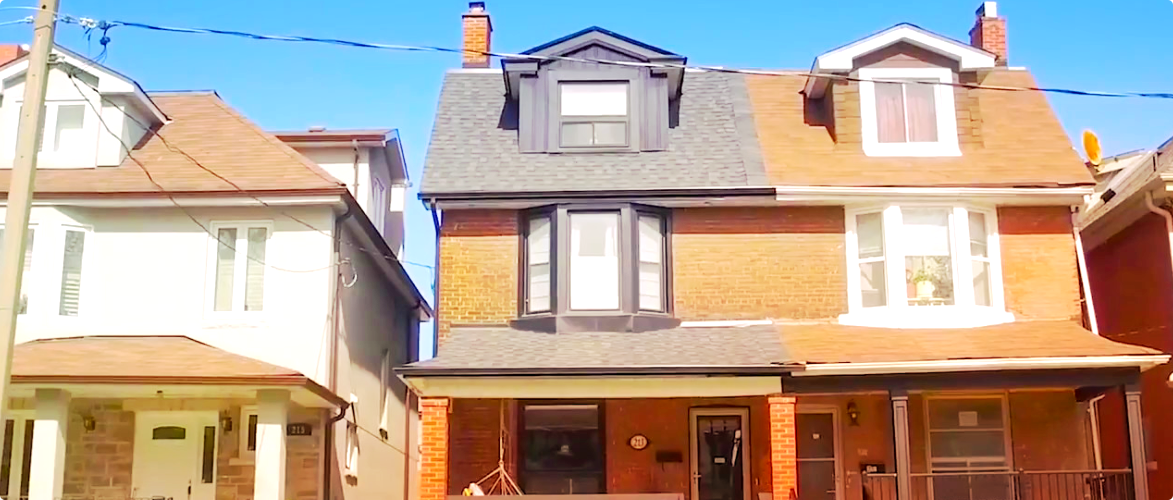
Little Italy is the College Street neighbourhood between Bathurst and Shaw where Italian cultural heritage and a dense, evolving restaurant and bar scene sit alongside Victorian brick semis on Crawford, Manning, Beatrice, and Grace. Renovated semis were trading between $1.3 and $1.8 million in early 2026, with detached homes starting around $2 million. Caffe Italia on College has been open since 1967 and is the kind of place that earns its reputation by not changing much.
Little Italy sits between Bathurst and Shaw, with College Street as its spine and a grid of residential streets running north and south. Crawford, Manning, Beatrice, and Grace are where buyers spend most of their time. The houses are Victorian and Edwardian brick, predominantly semis, built between the 1890s and the 1910s on narrow lots with laneways at the rear. It’s the same housing stock as Bickford Park to the south and Trinity Bellwoods to the east, built by the same wave of working-class settlement that filled this part of the city before the First World War.
The College Street strip is the neighbourhood’s public face and its most visible distinction. Between Bathurst and Shaw, it runs through two or three distinct eras simultaneously: the Italian-Canadian commercial identity that gave the neighbourhood its name, a later layer of cocktail bars and destination restaurants, and a current mix that has absorbed the attrition of the past few years more unevenly than the strip further east. Caffe Italia at College and Beatrice has been open since 1967. It sits alongside places that opened last year and places that have closed.
The residential character north of College is quieter than the strip suggests. Manning and Grace between College and Bloor are predominantly owner-occupied houses with the same Sunday-afternoon feel as any established west-end street. Buyers often find this contrast between the animated commercial strip and the calm residential blocks one of the neighbourhood’s more appealing qualities: proximity to a lot of life without living directly in it.
The dominant housing type is the Victorian or Edwardian brick semi: 16 to 20-foot frontage, two and a half storeys, three bedrooms upstairs, a main floor that’s typically been opened up at least once. Rear lanes run behind most of the residential blocks and give parking access where parking pads or garages exist. A semi in reasonable condition with updated kitchen and bathrooms and original hardwood refinished trades between $1.3 and $1.8 million. The spread within that range comes down to lot size, renovation quality, and whether parking is included.
Detached homes appear on the wider lots and command a meaningful premium over the semi inventory. A three-bedroom detached in good condition starts around $2 million. Larger detached properties with four bedrooms and a finished basement on a deeper lot have sold above $2.5 million. These come up infrequently and attract strong interest when they do.
The stock is less uniform than Bickford Park or the tighter grid of Trinity Bellwoods. There are corner lots with slightly more character, a few wider semis from developers who bought two adjacent lots in the early 20th century, and occasional converted duplexes where the second unit was added legally and adds rental income. The variety makes individual property assessment more important here than in some adjacent neighbourhoods where the stock is more predictable.
Little Italy’s freehold market is active but less contested than Trinity Bellwoods. The buyer pool includes buyers priced out of Trinity Bellwoods or Bickford Park who want the same west-end character at a slight discount, buyers drawn specifically to College Street, and a steady stream of buyers relocating from other cities who shortlist the neighbourhood for its walkability. Well-priced semis on Crawford and Manning attract multiple offers in spring. Properties priced aggressively can still move in a week during peak season.
In early 2026, most listings are reviewed upon receipt rather than held to a formal offer date. The best-priced properties do see informal deadlines develop organically, usually within the first week of listing. Buyers should be prepared to act quickly and to have financing arranged in advance. Conditions are more common than they were in 2021 and 2022, but sellers of desirable properties still push back on home inspection conditions on the strongest offers.
The condo segment, which includes a small number of boutique buildings and converted commercial properties along College, is moving more slowly. This mirrors the pattern across the city’s condo market. Buyers considering condos here have time that freehold buyers don’t.
Most Little Italy buyers are choosing it over one of three alternatives: Bickford Park to the south, Trinity Bellwoods to the east, or Little Portugal to the west. The decision over Bickford Park is usually about College Street. Both neighbourhoods offer similar housing on similar streets at similar prices, but Little Italy buyers want the commercial strip directly. They’re planning to walk to Caffe Italia on a Saturday morning and to Bar Raval on a Friday night, and they want the residential streets that make those walks easy.
The decision over Trinity Bellwoods is almost entirely financial. Trinity Bellwoods carries a 10 to 20 percent premium for equivalent housing and comparable access to the same west-end strip culture. Buyers who can’t absorb that premium, or who find the Trinity Bellwoods buyer pool too competitive, end up in Little Italy and typically report they don’t feel they’ve settled. The streets are the same era and character. College Street is different from Queen West but has its own depth.
The decision over Little Portugal, to the west, is usually about price and timing. Little Portugal is less expensive and still in transition in some blocks. Buyers who choose Little Italy over Little Portugal are usually paying for an established neighbourhood rather than a developing one. Both have real merits depending on budget and timeline.
The north-south position of a property within Little Italy matters more than most listings acknowledge. Streets immediately adjacent to College, on both sides, carry more foot traffic, ambient noise, and weekend energy. This is part of the appeal for some buyers and a drawback for others. The blocks between Bloor and College are where the residential character is fullest: quieter on weeknights, less affected by summer patio activity, easier to park on. If you’re buying for family use and value quiet, prioritise the northern blocks. If you want to feel the College Street energy from your porch, buy close to it.
Check the lane situation at any property you’re serious about. Lane access, parking pad dimensions, and the condition of the lane itself vary considerably. Some lanes are in poor condition; some have been improved by the city under maintenance programs. Whether a legal parking pad exists, whether a garage is present, and whether a laneway suite is feasible on the lot are all things that affect value and require specific confirmation before purchase.
The housing stock here reflects a full century of renovation decisions, and condition assessment on these houses is genuinely variable. A Victorian semi can look updated and have significant deferred maintenance behind the walls: knob-and-wiring in the attic, a foundation with water management issues, cast iron drains approaching replacement. A pre-purchase inspection by an inspector experienced with this era of Toronto housing is worth the time and the fee.
Little Italy buyers are experienced in the west-end market. They’ve seen Bickford Park, they’ve toured Trinity Bellwoods, and many have lost out on properties elsewhere before arriving here. A semi that doesn’t show well against that experience will underperform: not because the price is wrong, but because buyers will price in the work they can see needs doing and assume there’s more they can’t.
The properties that sell strongest here are the ones that respect the Victorian bones. Original hardwood refinished rather than covered. Brick exposed where it exists behind drywall. Ceilings with their original height maintained, not dropped to run ducting that should have been run differently. Buyers in this price range are paying for authenticity and character in the renovation, and they are good at telling the difference between a renovation done with genuine care and one done to photograph well.
Spring is the highest-conviction selling window. Listings that appear in March, April, and early May benefit from the deepest buyer pool of the calendar year. October is the second window. If you have any flexibility on timing, the spring listing beats an equivalent fall listing in most years. Summer listings and winter listings face reduced buyer pools that are reflected in both days on market and final sale price.
The stretch of College between Bathurst and Shaw carries more history than most commercial strips in Toronto. Italian immigration to this part of the city intensified in the postwar decades, and by the 1960s and 1970s, College was a firmly Italian-Canadian commercial district. Caffe Italia, at the corner of College and Beatrice, has been the reference point for decades. The Bar Sport culture that once defined the strip has faded with the immigration wave that created it, but enough remains, in the cafes, the Italian restaurants, the older business owners who have been there for thirty years, to give the strip a character that newer commercial areas don’t manufacture.
Bar Raval, opened on College near Manning in 2015, became one of the city’s most celebrated bars within its first year and has maintained that reputation. Its presence on College is both a draw in its own right and a marker of the neighbourhood’s standing with the city’s hospitality community. Diplomatico and Trattoria Giancarlo represent the Italian restaurant tradition. Newer restaurants and bars have layered in around these anchors without displacing them, which is a relatively healthy commercial strip outcome.
To the east, the College strip connects with Bickford Park and then transitions toward Kensington Market and the Annex. To the west, it runs into Dufferin and the beginning of Little Portugal. The 506 Carlton streetcar connects the neighbourhood to the subway and eastward to Cabbagetown. This east-west connection makes College one of the more useful transit corridors in the central west end.
The 506 Carlton streetcar runs directly along College Street and is the neighbourhood’s primary surface transit connection. It links westward to Dufferin and eastward through Kensington Market and the Annex to Castle Frank station on the Bloor-Danforth line. In peak hours it’s subject to the same bunching that affects most TTC surface routes. Off-peak it’s reliable and useful.
Christie and Bathurst subway stations, both on the Bloor-Danforth line, are reachable by a 10 to 15-minute walk from the middle of the neighbourhood. Christie is the closer station for most of the residential streets between Manning and Bathurst. Bathurst station serves the eastern edge. Either connection puts riders on one of the city’s main subway lines with direct access to downtown via the Yonge line at Bloor-Yonge.
Cycling is a practical option for residents who use it. Harbord Street, one block south of Bloor, has protected bike infrastructure that connects east toward the University of Toronto and Kensington Market and west toward Roncesvalles. College itself has bike lanes on certain sections. Riders heading downtown can reach King Street in 20 to 25 minutes from most of the neighbourhood’s residential streets, comparable to transit during rush hour and faster during midday.
Bickford Park is the neighbourhood that overlaps most directly with Little Italy in housing stock and buyer profile. The two share streets, and the boundary between them is administrative more than practical. A semi on Crawford is in Little Italy on one listing and Bickford Park on the next. The distinction buyers make between the two is largely about commercial access: Little Italy claims the College strip; Bickford Park claims the quieter Harbord corridor and the park itself. Buyers who are indifferent to the commercial strip label often find Bickford Park listings slightly better value for the same physical property.
Trinity Bellwoods, to the east, is the primary upward comparison. It offers the same era of housing on similar streets with a park that serves as a genuine neighbourhood asset and a Queen Street commercial strip that is arguably the most active in the west end. Trinity Bellwoods commands 10 to 20 percent more for comparable properties. Buyers who choose Little Italy over Trinity Bellwoods are usually making a deliberate value decision rather than settling for a lesser neighbourhood.
Little Portugal, to the west past Dufferin, offers the same era of housing at prices 10 to 15 percent below Little Italy. Its commercial strip on Dundas West has the Portuguese character that gives the neighbourhood its name and is still in the earlier stages of the commercial evolution that College Street completed a decade ago. Buyers who are patient and comfortable with a neighbourhood that is still changing sometimes find Little Portugal the better long-term bet.
The main public elementary options are Sir Charles Tupper Public School, which serves much of the core residential area, and Ossington-Old Orchard JPS to the east. Neither carries a standout academic reputation in the way that some TDSB schools further north or east do. Parents with specific academic priorities often investigate the French Immersion stream, which requires a separate application and early planning, or the Catholic system, which includes St. Francis of Assisi in the area.
For secondary school, the catchment typically flows to Central Technical School on Harbord, which has a strong arts and technical program and draws students from a wide area. Central Tech is a large school with a range of programming, and its specific streams are worth researching if you’re buying with secondary-school-age children in mind. Verify current catchment boundaries using the TDSB boundary tool, as addresses even within the same postal code can fall in different catchments.
Families buying here with children often approach the school question as one to navigate rather than one the neighbourhood resolves for them. The housing is the primary purchase rationale. The school plan is a secondary consideration that most west-end buyers in this price range address through supplementary programs, private options, or planned moves before secondary school arrives.
What are homes selling for in Little Italy in 2026? Renovated Victorian and Edwardian semis on Crawford, Manning, Beatrice, and Grace were trading between $1.3 and $1.8 million in early 2026. Condition and lot size drive most of that spread. A semi with an updated kitchen and bathrooms, refinished hardwood, and a parking pad off the rear lane sits toward the top of that range. One that hasn’t had major work since the 1990s comes in closer to the bottom. Detached homes are rarer and start around $2 million for a three-bedroom in reasonable condition. The neighbourhood sits just below Trinity Bellwoods in average freehold price, which attracts buyers with similar tastes and tighter budgets.
How does Little Italy compare to Bickford Park for buyers? The two neighbourhoods share streets and house types, and the boundary between them is administrative rather than visible on the ground. Both offer Victorian and Edwardian semis from $1.3 million. The distinction buyers make is about commercial access: Little Italy claims the College Street strip directly. Bickford Park buyers are drawn to the quieter Harbord corridor and the park. For buyers who care primarily about the housing itself, Bickford Park listings occasionally offer slightly better value for the same physical property.
Is there laneway housing potential on Little Italy properties? Many lots in the neighbourhood qualify under the city’s laneway suite bylaw. The laneways behind Crawford, Manning, and Beatrice have active examples you can inspect before buying. A one-bedroom suite runs $250,000 to $350,000 at current construction costs and adds both rental income and resale value. Not every lot qualifies: minimum lot area, lot depth, and acceptable lane access are all requirements. Some lots have garages that would need to come down first. A laneway housing consultant can assess a specific property before purchase, which is worth doing if the income potential is part of your rationale.
Which streets are best to buy on in Little Italy? Crawford, Manning, and Beatrice are where buyer interest is most consistent and resale performance strongest. Crawford benefits from its position between Trinity Bellwoods and the College strip. Beatrice has the added character of Caffe Italia at the College end. Grace Street and the northern Manning blocks are slightly quieter and a few percent below the top addresses. Buyers who want proximity to the College strip energy should focus on blocks between College and Bloor. Those who want quiet while staying in the neighbourhood find better value one or two blocks north of College, where weekend noise drops noticeably.
The Italian character of this part of College Street came from immigration patterns that concentrated in the postwar decades. Italian families arriving in Toronto in the late 1940s and 1950s settled in the affordable working-class housing on these streets, and by the 1960s the commercial strip had developed to match the population: espresso bars, social clubs, butchers, and the food importers that still operate in the area. The neighbourhood’s Italian identity was not manufactured for visitors. It was the natural result of a community building a commercial life close to home.
The shift in the commercial character of College Street began in the 1990s, when rising rents and the natural dispersal of the Italian-Canadian community as it moved into second and third generations pushed the immigration-driven businesses to the suburbs and opened the strip to the bars and restaurants that arrived in their place. This wasn’t experienced uniformly as loss: the neighbourhood gained a cultural cachet that attracted a different kind of buyer and a different kind of business. Caffe Italia, the Diplomatico, and a few other original businesses held their ground through the transition and became reference points that gave the new layer some gravity to attach to.
The residential streets north and south of College went through a comparable shift. Houses that sold for tens of thousands of dollars in the 1970s and 1980s became the subject of west-end real estate competition by the 2000s. The Victorian and Edwardian semis on Crawford and Manning that once housed factory workers and tradespeople now sell for seven figures. The character of the renovation work visible on the street is a reliable indicator of when this process reached each block.
Street-level knowledge is hard to find online. Our team works in Little Italy every day. They know which pockets hold value, where the school catchment lines actually fall, and what the market is doing right now. Talk to us before you make a decision about Little Italy.
Talk to a local agent