
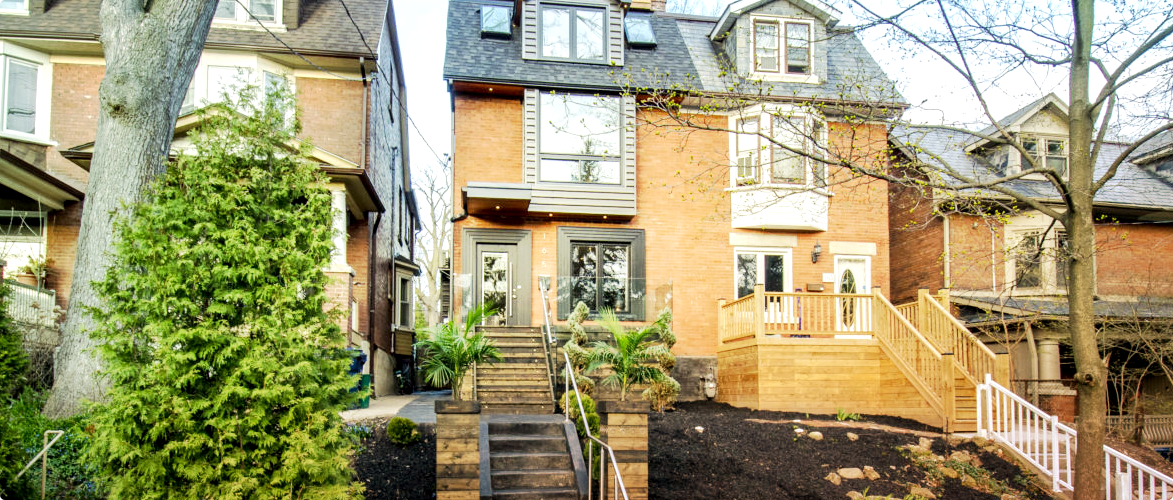
Sunnyside sits along Lake Shore Boulevard West between Parkside Drive and Roncesvalles Avenue, with the Humber River as its western boundary and High Park on its eastern edge. The neighbourhood is defined by its lakefront position: the 1922 Sunnyside Bathing Pavilion, Sunnyside Beach, and the Martin Goodman Trail run along the water, while streets of interwar and postwar detached and semi-detached homes occupy the blocks north of Lake Shore. Detached homes were trading from $1.5 million in early 2026, with semis between $1.2 and $1.7 million depending on condition and lot size.
Sunnyside occupies the stretch of Toronto’s lakefront between Parkside Drive and the Humber River. Lake Shore Boulevard West runs through it east to west, carrying six lanes of traffic between the residential streets and the water. On the south side of Lake Shore, the 1922 Sunnyside Bathing Pavilion and its restored pool, Sunnyside Beach, and the Martin Goodman Trail make up one of the most used public waterfronts in the city. On the north side, residential streets of interwar and postwar houses climb toward The Queensway and the Bloor-Danforth corridor.
The neighbourhood has clear natural boundaries that give it a distinct character. High Park sits immediately to the east, providing the 161-hectare green space that anchors this part of the city. The Humber River and the trails along it form the western edge, connecting to the larger Humber trail network heading north. Roncesvalles Village is the immediate commercial district to the north, and most Sunnyside residents do their daily shopping, restaurant going, and coffee shop visiting on Roncesvalles Avenue.
Turnover here is genuinely low. Buyers who find Sunnyside tend to stay. The combination of lakefront access, High Park proximity, Roncesvalles as a commercial strip, and a housing stock of real houses rather than condos is rare enough in the inner city that people who get in are reluctant to leave. This shows in the data: the same blocks see the same names on title for a decade or more, and properties that do come to market often attract buyers who have been watching the neighbourhood for years.
The core housing stock is interwar and postwar detached and semi-detached homes built between the 1920s and 1950s. The streets north of Lake Shore, including Galley Avenue, Dowling Avenue, Dunn Avenue, and the blocks between them, hold the bulk of the residential supply. These are brick homes on lots that are generally generous by inner-city standards: many detached properties have 30 to 40-foot frontages and rear lanes. Parkside Drive, which runs along the eastern edge of the neighbourhood adjacent to High Park, carries some larger Victorian-era homes that predate the interwar stock.
Detached homes were trading from $1.5 million in early 2026. A well-maintained four-bedroom detached with a finished basement and a rear lane on one of the quiet residential streets north of Lake Shore sits in the $1.7 to $2.1 million range depending on condition, lot depth, and renovation quality. Semis trade between $1.2 and $1.7 million, with the spread driven primarily by lot size, condition, and whether parking has been created from the rear lane. The lake premium is real and measurable. Equivalent properties two or three kilometres north carry meaningfully lower prices, and buyers buying in Sunnyside understand they are paying for the location.
There is limited condo supply in the neighbourhood. The Queensway strip to the north has some mid-rise development, and there are a small number of stacked townhomes and converted buildings. But Sunnyside is fundamentally a freehold neighbourhood, which is part of what makes it attractive to buyers who have been priced out of the freehold options in Riverdale or Leslieville and are unwilling to make the trade to condo living.
Low turnover makes the market relatively opaque. There are not many transactions per year, which means a single strong sale or a slow listing can move the apparent price range in ways that don’t reflect underlying demand. Buyers researching Sunnyside prices will find fewer comparables than they’d find in Trinity Bellwoods or Leslieville, and should treat any estimate with appropriate scepticism until they’ve seen enough specific properties to calibrate.
When properties do come to market, the interest is concentrated and buyer preparation matters. A well-presented detached on a quiet street north of Lake Shore, priced at market rather than above it, will attract multiple serious buyers who have been watching the neighbourhood and have their financing in order. The buyers in Sunnyside are generally further along in life than Liberty Village buyers: dual-income households with meaningful equity, often coming out of a previous home purchase or from another city with proceeds from a home sale. They know what they’re looking for and they move when they see it.
The spring window produces the strongest activity, consistent with the broader Toronto freehold market. Late February through May is when the most motivated buyers are active. Properties that have been sitting into fall or winter have often been mispriced initially. Buyers who are patient find that fall listings on properties that didn’t sell in spring carry more negotiation room than the same properties would have in March.
Families who have decided they want a freehold home in the inner city, lake access, and a walkable commercial strip make up the core buyer. They’ve usually looked at Roncesvalles and found the prices comparable but the lakefront absent, looked at The Beaches and found the prices higher and the commute longer, and looked at Swansea and found the supply too thin. Sunnyside sits at the intersection of those searches and satisfies most of the criteria that drive them.
Couples without children who are buying for the lifestyle, the trail, the High Park proximity, and the house rather than a condo are a significant second group. This buyer is often in their late 30s or 40s, has come out of condo living and wants outdoor space, and is willing to pay the lakefront premium for the specific combination of access to the trail, the park, and Roncesvalles. They tend to buy at the lower end of the detached range or in the semi market.
Buyers arriving from outside Toronto, particularly from cities where lakefront housing commands a larger premium than it carries here relative to income, are sometimes surprised that Sunnyside isn’t more expensive. The combination of a real sandy beach, a historic pavilion with an outdoor pool, 14 kilometres of waterfront trail, and High Park a ten-minute walk away, within the boundaries of a major North American city, is a genuine rarity. Buyers who frame the location in those terms find the prices reasonable. Buyers who frame it as a comparison to north-of-Bloor Toronto prices find it expensive.
The Lake Shore Boulevard West noise question needs an honest answer before you commit to an address. The road carries heavy traffic and the sound carries. Properties with direct Lake Shore frontage or within one block south or north of the road are genuinely noisy during the day and into the evening. The residential streets one block back, from Galley Avenue north through Dunn and Dowling, are dramatically quieter. Buyers who are drawn to the lakefront access but sensitive to road noise should be clear with themselves about whether they’ll spend more time in the house or on the trail, and buy accordingly.
Flooding history is worth checking on properties near the Humber River. The Humber has flooded during major weather events, most notably Hurricane Hazel in 1954, and the city has since implemented flood control. Properties within the Humber River flood plain are regulated by the Toronto Region Conservation Authority, and buyers should confirm the flood status of any specific property in the western section of the neighbourhood before proceeding. Most of the residential streets north of Lake Shore are above the flood risk zone, but properties along or near Humber Boulevard or the river’s edge carry different considerations.
The renovation vintage of the interwar stock matters for what you’ll find in an inspection. Many of the homes on Galley, Dowling, and Dunn were last substantively renovated in the 1980s or 1990s. Knob-and-tube wiring, galvanized plumbing, original single-pane windows, and inadequate insulation are common in homes that present well on the surface. A thorough inspection with a focus on the mechanical and structural systems rather than the cosmetic condition is the relevant thing to spend money on before waiving any conditions.
Sunnyside sellers are marketing a specific lifestyle proposition, and buyers who choose the neighbourhood have already decided they want what it offers. The job of a well-prepared listing is to show the home as the best version of itself within that proposition, not to explain why the neighbourhood is desirable. The buyers arriving already know. What they’re trying to figure out is whether the specific house is worth the specific price.
The lakefront and trail access should feature in how the home is photographed and presented. A warm morning photograph from the trail, with the pavilion visible and the lake behind it, communicates what the location offers in a way that no copy can match. Buyers from outside the neighbourhood, and buyers at the stage of shortlisting properties online before they visit, are making early decisions based on what the listing shows them about the experience of living there. Show the trail. Show High Park if it’s close. Show the back lane if there’s parking. The physical facts of this neighbourhood are its strongest selling points.
Pricing accuracy matters more here than in a market with 30 transactions per year on similar properties. There are few enough sales that an overpriced listing sits visibly without comparables moving the market around it. Sellers who price at market rather than above it and accept that the buyer pool, though motivated, is thin, consistently outperform sellers who test prices and reduce. In a low-turnover neighbourhood, the first few weeks of a listing are the most valuable window and mispricing burns them.
The Sunnyside Bathing Pavilion, built in 1922 as part of a larger lakefront development project, is a genuine piece of the city’s history. The outdoor pool, restored and operating seasonally, is one of the largest outdoor pools in Canada. The beach runs west from the pavilion toward the Humber River. On a July afternoon, the beach and trail are in continuous use from early morning until dusk. The pavilion itself has a cafe and hosts events during the warmer months. For residents, it’s not an attraction in the tourist sense. It’s the neighbourhood’s backyard.
High Park at the eastern edge adds 161 hectares of green space with trails, a small zoo, a dog off-leash area, sports fields, Grenadier Pond, and the Japanese cherry blossoms that draw crowds from across the city every spring. Sunnyside residents walk to High Park through the Parkside Drive entrance. The park’s size means there’s almost always space, even on busy spring weekends. The trails through the ravine sections of High Park give the neighbourhood a connection to a kind of green space you don’t associate with an inner-city neighbourhood this close to downtown.
Roncesvalles Avenue, running north from the Howard Park and Galley intersection, is the neighbourhood’s commercial main street by function if not by formal address. The strip has independent restaurants, cafes, a farmers’ market, butchers, bakeries, and the general commercial supply of a mature urban neighbourhood. The weekly farmers’ market on the road allowance is a summer institution. Sunnyside residents are at the southern end of the Roncesvalles strip, which means the walk is slightly longer than it is for residents further north, but still well within range for daily needs.
The 501 Queen and 504 King streetcars both run along Lake Shore Boulevard West through the neighbourhood, connecting east into downtown Toronto. The Queen car provides a more direct connection to the retail and entertainment corridors of Queen West, Queen East, and ultimately to Beaches-adjacent territory. The King car connects to the Financial District via King Street. Both are surface routes and subject to the same reliability issues that affect most TTC streetcar lines, though the Lake Shore segment tends to be less prone to delays than the more congested stretches through downtown.
The Roncesvalles streetcar on route 504 diverges north at the Howard Park intersection, connecting to Dundas West subway station on the Bloor-Danforth line. Residents on the north end of the neighbourhood are in a reasonable walk of this connection. Residents in the southern section, closer to Lake Shore, are a longer walk and tend to rely on the Lake Shore streetcar for downtown access. The Dufferin bus, running north from Dufferin Street and Lake Shore, provides another north-south connection to the subway line.
Cycling is a genuine mode of transportation from Sunnyside, not just recreation. The Martin Goodman Trail running along the water provides a continuous, largely grade-separated cycling path east toward the harbourfront and downtown. A fit cyclist can reach the Financial District in 25 to 30 minutes on the trail in conditions where the streetcar would take the same time or longer. The cycling infrastructure along Lake Shore has improved and the trail route is well-established enough that it’s a practical daily option for residents who work downtown or in the harbour area.
Roncesvalles Village is the most natural comparison because the boundary is a street rather than a meaningful gap in character. Housing types are similar, the demographic is similar, and many residents identify with both names depending on which side of Howard Park Avenue their particular block falls on. The practical difference is the lakefront. Roncesvalles buyers get a stronger commercial strip closer to home. Sunnyside buyers get the trail, the beach, and the pavilion. Prices on equivalent properties sit close enough that the decision is usually about which of those you value more rather than which you can afford.
Swansea, immediately west along the Humber River, is smaller and quieter. The housing stock in Swansea is similar in age and type but the neighbourhood has less transit access and less commercial supply. Swansea buyers get a more suburban-feeling residential environment within the city boundaries, which is what some of them want. Sunnyside is a busier place with more pedestrian activity, a major arterial road, and considerably more daily life. The Swansea buyer and the Sunnyside buyer are often looking for different experiences.
The Beaches, on the east side of the city, is the comparison that most naturally follows from any mention of lakefront Toronto living. The Beaches carries a higher price premium, a more established identity as a destination neighbourhood, and Queen Street East as a commercial strip that runs directly adjacent to the water. Sunnyside delivers comparable lakefront access at lower prices, with Roncesvalles as the commercial strip, High Park as the green space, and a commute to downtown that is arguably more direct. Buyers who choose Sunnyside over The Beaches are typically making a deliberate calculation on price per feature delivered.
The neighbourhood feeds a cluster of schools in the Roncesvalles and Parkdale catchment area. Parkdale Junior and Senior Public School and Fern Avenue Public School are the primary public elementary options accessible to Sunnyside residents. Both have respectable reputations within the TDSB. The TDSB French Immersion programme for this part of the city has separate registration processes and can involve waitlists; families with specific French programme goals should begin the process early and confirm which school would serve their specific address.
The Catholic system is a parallel option for eligible families. St. Casimir Catholic School serves the Roncesvalles and south Parkdale area and is a well-regarded option for families in the Catholic system. The combination of the TDSB and TCDSB options gives Sunnyside families meaningful choice at the elementary level, which compares favourably to parts of the inner city where one school serves a large and undifferentiated catchment.
For secondary school, the public catchment flows to Parkdale Collegiate Institute on Jameson Avenue. Parkdale Collegiate has a mixed academic profile and a strong arts programme. Families with specific secondary school priorities, including academic programmes, French immersion continuation, or arts specialisation, should research the options available through the TDSB programme school system before assuming catchment school placement is the only path. Verify current catchment assignments using the TDSB boundary tool, as boundaries in this part of the city have shifted more than once in recent years.
Why does Sunnyside get less attention than The Beaches despite having lakefront access? The Beaches has a more established and more marketed identity, built partly around Queen Street East as a commercial strip that runs directly at the water’s edge. Sunnyside’s lakefront is trail, beach, and parkland rather than restaurants and boutiques, which makes it less photogenic in the way that drives social media and real estate listing coverage. The neighbourhood is also smaller and quieter, with lower turnover. Buyers who look past the name recognition tend to find Sunnyside delivers lake access, High Park proximity, and Roncesvalles as a commercial strip at prices that are meaningfully below The Beaches for equivalent freehold properties. The neighbourhood is undermarketed relative to what it actually offers.
How does Sunnyside compare to Roncesvalles for families? The two share a boundary and a great deal of their daily life. Roncesvalles has a denser, more accessible commercial strip on the avenue itself, closer to the residential streets. Sunnyside adds the beach, the pavilion, and the Martin Goodman Trail, none of which Roncesvalles delivers. Housing in Sunnyside skews slightly larger, particularly in the interwar detached category. Both feed similar schools. Families choosing between the two are usually deciding whether the commercial strip or the lakefront is the daily use that matters more to them. School-age children tend to prefer Sunnyside; parents who do most of their daily spending on Roncesvalles Avenue sometimes wish they were a few blocks closer to it.
Is living near Lake Shore Boulevard West noisy? Directly on Lake Shore, yes. It’s a six-lane arterial road and it carries significant traffic noise throughout the day and into the evening. Properties on Lake Shore itself or within one block of it will hear the road. The residential streets one block north, from Galley Avenue through to Dunn and Dowling, are noticeably quieter. The transition from arterial noise to quiet residential street happens within 200 metres. Buyers who want the trail and beach access but not the road noise should target the residential streets north of Lake Shore and accept the slightly longer walk to the water. It’s still well under ten minutes from any address in the neighbourhood.
How often do homes come up for sale in Sunnyside? Not often. Turnover is genuinely low by inner-city standards because the combination of lakefront access, High Park, and Roncesvalles as a commercial strip is hard to replicate elsewhere in the city at a comparable price. In a typical year, a relatively small number of freehold transactions occur in the core residential streets of the neighbourhood. Buyers who are specifically targeting Sunnyside should set up listing alerts and be ready to move quickly when a suitable property appears. The buyers who succeed here are the ones who have done their financing preparation before a property appears, not after. Properties priced at market are receiving serious attention within the first two weeks of listing.
Sunnyside’s lakefront is not natural in the way it might appear. The beach, the pavilion, and the boardwalk were created through a major landfill project in the early 1920s, when the Toronto Harbour Commission extended the shoreline southward and built the Sunnyside Bathing Pavilion as the centrepiece of what was intended as a grand public waterfront. The pavilion opened in 1922. For two decades, Sunnyside was Toronto’s most popular summer destination: the outdoor pool was enormous, the beach was well-maintained, and the amusement park that accompanied the bathing complex drew visitors from across the region.
The waterfront era ended with the construction of the Gardiner Expressway in the 1950s. The elevated highway severed downtown Toronto from its lakefront almost completely, and Sunnyside lost its position as an easily accessible destination from the city’s core. The amusement park was demolished. The beach became harder to reach by foot from the north. For a generation, the waterfront sat underused. The residential neighbourhood on the north side of Lake Shore retained its housing stock and its community, but the lakefront itself declined in use and care.
Restoration came gradually from the 1980s onward. The Sunnyside Bathing Pavilion was designated a heritage structure and restored. The outdoor pool was reopened. The Martin Goodman Trail, extending along the waterfront from Humber Bay to Woodbine Beach, gave cyclists and pedestrians a continuous path and restored the waterfront as a destination for daily use. The neighbourhood that exists today reflects both the ambition of the 1920s project and the resilience of the residential streets that survived the Gardiner’s construction. The pavilion still sits at the water’s edge, a hundred years after it opened, doing exactly what it was built to do.
Street-level knowledge is hard to find online. Our team works in Sunnyside every day. They know which pockets hold value, where the school catchment lines actually fall, and what the market is doing right now. Talk to us before you make a decision about Sunnyside.
Talk to a local agent