
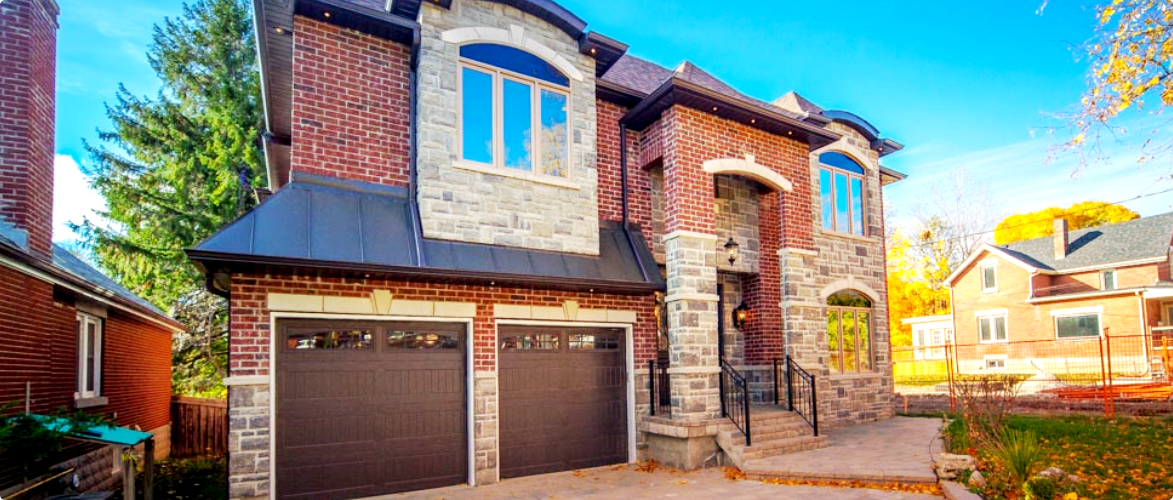
Agincourt is one of Toronto's most established Chinese-Canadian communities, centred on Sheppard Avenue East in central Scarborough. Detached homes on quiet residential streets, GO train access to downtown, and a walkable commercial strip with restaurants and grocery stores make it a practical and culturally distinct choice for buyers in the $900K to $1.4M range.
Agincourt sits in central Scarborough, roughly bounded by Sheppard Avenue East to the north, Lawrence Avenue to the south, Midland Avenue to the west, and Kennedy Road to the east. It’s one of Toronto’s most recognisable Chinese-Canadian communities, with a commercial strip on Sheppard that rivals Pacific Mall in density of restaurants, grocery stores, and specialty retailers. The residential streets behind that commercial activity are quieter than the arterials suggest: post-war bungalows, backsplit semis, and newer infill sit side by side on wide lots laid out when this was still considered the outer suburbs.
The neighbourhood takes its name from the historic Agincourt village, established in the early 19th century, though almost nothing of that era remains. What you’ll find instead is a community shaped largely by immigration since the 1980s, first from Hong Kong and later from mainland China and Taiwan. That history is visible in the businesses, the temples, the schools, and the food. Agincourt Mall on Sheppard is anchored by a T&T Supermarket and draws shoppers from well beyond the neighbourhood’s boundaries. On weekend mornings, the dim sum restaurants nearby fill early.
For buyers, Agincourt offers something genuinely useful: you’re about 25 minutes from downtown by GO train, you have walkable access to a full range of daily services in Cantonese and Mandarin, and you’re buying in a market where detached houses still start under $1 million on some streets. The trade-off is that much of the neighbourhood’s appeal is concentrated along Sheppard and the commercial areas, while the residential pockets to the south can feel less connected. Knowing which streets to target matters here more than in neighbourhoods with more uniform character.
The housing stock in Agincourt is mostly post-war residential built between the 1950s and 1970s, with a second wave of infill and rebuild from the 1990s onward. Detached bungalows dominate the side streets, typically on lots 40 to 50 feet wide with attached or detached garages. Many have been renovated, converted to in-law suites below, or replaced entirely by two-storey custom builds. The backsplit and sidesplit designs popular in this era are common, and they often offer more finished square footage than a straight bungalow at a comparable price.
Along and near Sheppard Avenue, there’s a growing condo presence. Several mid-rise buildings have gone up in the past decade, and more are in the pipeline. These tend to attract younger buyers and investors rather than the families who make up most of the detached market. Prices for condos on the Sheppard corridor have ranged from roughly $550,000 to $800,000 in 2026, depending on size, building age, and whether parking is included.
Detached houses in Agincourt sit in the $900,000 to $1.4 million range in 2026, with significant variation by street and condition. A turnkey two-storey with a finished basement commands more than a dated bungalow needing a full renovation. Semi-detached homes come in below that range and represent genuine value for buyers who want a freehold property with a yard but can’t stretch to a detached. Lot size matters here: some of the larger lots on quieter streets have future development potential, which some buyers price into their offers.
One thing worth understanding: many homes in Agincourt have been modified over the decades in ways that aren’t always permitted or professionally completed. Basement apartments, electrical upgrades, structural changes to create open-plan layouts. A thorough home inspection is not optional. Your agent should also check permit history before you firm up on any property where the modifications look significant.
Agincourt’s detached market has historically been one of the more competitive pockets in Scarborough. The neighbourhood draws a consistent buyer pool: families with connections to the Chinese-Canadian community who want to stay close to the commercial and social infrastructure on Sheppard, investors looking for income properties, and buyers priced out of North York who are willing to travel further east. That combination keeps demand relatively stable even when the broader Toronto market cools.
In the 2021 to 2022 peak, detached homes in Agincourt regularly sold with multiple offers and over asking. The correction in 2022 and 2023 brought prices down from those highs, and by 2024 and into 2025 the market settled into something more rational. By 2026, well-priced detached homes still draw competition, but the frenzied bidding of the pandemic era has not returned at the same intensity. Buyers have more time to do due diligence, though desirable properties on good streets still move quickly.
The condo market on the Sheppard corridor behaves differently from the freehold market. Supply has increased as new buildings completed, and some investors have listed units they purchased pre-construction. This has softened condo pricing relative to the freehold side. Buyers looking at condos here should check maintenance fees carefully, since some of the newer buildings carry fees that meaningfully affect the true cost of ownership. Ask specifically about reserve fund adequacy before making an offer on any condo in a building less than 10 years old.
One signal worth watching: Agincourt GO station and the Sheppard East LRT (if and when it progresses) both have potential to move values on the streets nearest to transit nodes. Properties within a 10-minute walk of Agincourt GO have historically commanded a small premium, and that logic is likely to continue.
The majority of buyers in Agincourt are families with Chinese-Canadian backgrounds, many of whom have lived in the neighbourhood for a generation and are either upgrading within it or helping adult children buy nearby. The community infrastructure here, from the grocery stores and bakeries to the Chinese-language schools and Buddhist temples, is a genuine draw for buyers who want to raise children in an environment where that culture is the mainstream rather than the minority. That’s not a small thing, and it’s a real reason people choose Agincourt over other Scarborough neighbourhoods at similar price points.
A second group is investors. The combination of detached homes that accommodate secondary suites, proximity to Agincourt GO, and a reliable rental market makes Agincourt attractive for buyers who want rental income to offset carrying costs. Some of these are local owners adding to their portfolios; others are buyers from the Chinese diaspora who see Toronto real estate as a long-term store of value. This investor presence keeps a floor under prices but also means competition for the kinds of properties that make good income properties.
There’s also a segment of buyers who arrive in Agincourt by process of elimination. They want a detached home in a safe, family-oriented neighbourhood with good schools and transit access, they’ve looked at North York and found the prices too high, and Agincourt comes up as a realistic alternative. These buyers often don’t have prior connections to the neighbourhood and are making a purely practical calculation. They typically settle in well once they’re here, attracted by the walkable commercial life on Sheppard and the established feel of the residential streets.
Young families looking for Mandarin or Cantonese-immersion school options, either through the TDSB or private programs, find Agincourt genuinely convenient. Several well-regarded Chinese language schools operate in and around the neighbourhood, and the critical mass of Mandarin and Cantonese speakers means children can maintain language skills in daily life, not just in the classroom.
Sheppard Avenue East between Midland and Kennedy is the commercial spine of Agincourt, and the streets running south off it, McCowan Road, Brimley Road, and the residential crescent streets between them, form the core of the detached market. Homes on Jonquil Crescent, Bowerbank Drive, and Sandhurst Circle are typical of what most buyers end up targeting: post-war detached homes on modest lots, many of which have been updated over the decades with varying degrees of quality.
The pocket between Sheppard and Huntingwood Drive, west of McCowan, tends to be quieter and slightly more sought after by families who want proximity to the commercial strip without being immediately adjacent to arterial traffic. Huntingwood Drive itself is busy, so homes backing onto it or with rear exposures toward the traffic will reflect that in price. Streets like Treverton Drive and the crescent streets off Brimley in this area offer better insulation from arterial noise.
South of Huntingwood toward Lawrence Avenue, the neighbourhood transitions into lower-density residential that feels more detached from the Sheppard commercial hub. These streets are quieter and attract buyers who want the neighbourhood’s price advantage but don’t need to be walkable to the restaurants and grocery stores. Prices here can be modestly lower, and lot sizes tend to be consistent with the post-war standard.
Along the Sheppard corridor itself, the newer condo buildings are concentrated between Midland and McNicoll. The stretch near Agincourt Mall has seen the most intensification. Buyers looking at condos should be aware that Sheppard is a wide, fast arterial, and the street-level experience on foot is not pleasant by Toronto standards. The trade-off is direct access to transit and walkable retail that few suburban Toronto streets can match.
Agincourt GO station, on the Stouffville line, is the main transit asset for commuters heading downtown. Trains run frequently enough during peak hours that the commute to Union Station takes roughly 25 to 30 minutes, which compares favourably to much of inner Toronto when you factor in subway congestion. Off-peak and weekend service is less frequent, and anyone who needs reliable transit for irregular hours should check GO schedules carefully before committing to the neighbourhood on the strength of the GO alone.
TTC bus service operates on Sheppard Avenue East and on Midland and Brimley, connecting to Kennedy station on Line 2. The bus on Sheppard is the 85 Sheppard East, which runs frequently during the day and connects to the Sheppard subway at Don Mills in the west. For most Agincourt residents, getting downtown on transit means either the GO train or a bus to the Bloor-Danforth line, typically adding 45 to 60 minutes door to door depending on origin and destination.
Driving is the dominant mode for most residents, and the 401 is accessible from several points around the neighbourhood. Midland Avenue, McCowan Road, and Kennedy Road all connect north to the highway. Eglinton Avenue provides an east-west alternative that avoids the 401 entirely. For buyers who work in the eastern suburbs or in Markham and Scarborough, the car-based commute from Agincourt is often easier than it would be from a more central neighbourhood, since you’re already positioned east of the downtown congestion.
There’s no subway station within the neighbourhood boundaries. The nearest is Kennedy station to the southwest. The long-planned Sheppard East LRT, which has had a complicated political history, would add transit options along Sheppard if it proceeds, but buyers shouldn’t factor it into their planning at this point.
Agincourt is not a neighbourhood that leads with its green space, but there’s more of it than the Sheppard commercial strip suggests. Thomson Memorial Park, a substantial green space south of Lawrence Avenue near Birchmount, is within reasonable driving or cycling distance and offers sports fields, a splash pad, and walking trails. It’s one of Scarborough’s larger parks and draws families from across the area in summer.
Closer to the heart of Agincourt, Agincourt Collegiate Park and the smaller parkettes scattered through the residential grid provide basic recreational space without requiring a drive. The Scarborough Heights Park further south along Brimley Road has tennis courts and a good view over the Highland Creek valley. For families with young children, the parks within the residential streets, equipped with playgrounds and open fields, tend to get heavy use on weekends from March through October.
The neighbourhood isn’t adjacent to any ravine system the way Guildwood or Highland Creek are, which is one honest trade-off versus other Scarborough neighbourhoods. If waterfront or ravine access is a priority, Agincourt doesn’t deliver that within walking distance. What it does offer is a well-maintained residential infrastructure with parks evenly distributed through the grid, so most homes are within a few blocks of some kind of green space even if it’s modest in scale.
Scarborough Town Centre is a short drive away, and the Rouge National Urban Park, one of Canada’s largest urban parks, is accessible within 15 to 20 minutes by car. Buyers who want genuine natural space for hiking and trail running won’t find it in Agincourt itself, but the broader east Toronto geography makes it accessible on weekends.
The Sheppard Avenue East corridor is the commercial centre of Agincourt and one of the most concentrated stretches of Chinese-Canadian retail in Toronto outside of Pacific Mall in Markham. Agincourt Mall anchors the strip with T&T Supermarket, which stocks a range of ingredients, prepared foods, and household goods that aren’t easily found elsewhere in the city. Several plazas along Sheppard contain restaurants serving Cantonese dim sum, Shanghainese cuisine, Taiwanese snacks, hot pot, and regional Chinese cooking from Sichuan, Hunan, and elsewhere. Weekend mornings in particular bring heavy foot traffic to the dim sum restaurants.
Beyond food, the strip supports a full range of daily services: banks, pharmacies, dental offices, optometrists, travel agents, and professional services firms, many of which operate in Mandarin and Cantonese. For residents who conduct business in Chinese, the neighbourhood is genuinely self-sufficient in a way that few Toronto communities are. This has practical value beyond cultural familiarity: elderly parents, new arrivals, and families with limited English find day-to-day life here accessible without relying on translation.
For mainstream grocery shopping, a No Frills on McCowan and a FreshCo nearby cover basics. Scarborough Town Centre is about 10 minutes by car and adds the usual selection of big box and mid-market retail. IKEA is accessible via the 401 east. For buyers who want walkable access to a wide variety of food and household needs, Agincourt’s Sheppard strip delivers consistently. It’s not a polished urban high street by downtown standards, but it functions well and it’s busy, which is a better sign than a half-empty strip mall with high turnover.
Healthcare access is reasonable: Scarborough General Hospital (now Scarborough Health Network, Birchmount campus) is a short drive, and there are medical clinics and walk-in services throughout the neighbourhood and on the commercial strips nearby.
Agincourt is served by schools in both the Toronto District School Board and the Toronto Catholic District School Board. The public elementary schools in the area include Agincourt Junior Public School, Brimwood Boulevard Junior Public School, and Chartland Boulevard Junior Public School, among others. Families frequently research school boundaries carefully before buying, since the catchment lines don’t always follow intuitive geographic boundaries in this part of Scarborough.
Agincourt Collegiate Institute is the main public secondary school serving the neighbourhood. It has a solid academic reputation and a student body that reflects the neighbourhood’s demographics, with a large proportion of students from Chinese-Canadian families. The school’s academic programs, including Advanced Placement options, are a factor for families who are planning ahead to university. Sir Wilfrid Laurier Collegiate Institute serves parts of the neighbourhood’s southern and eastern reaches.
For families interested in French immersion, the TDSB operates programs within Scarborough, though not always within the immediate Agincourt catchment. Checking with the school board directly before buying is worth doing if French immersion is a priority, since the boundaries and availability of programs change periodically. The TCDSB has separate catchments for Catholic schools, and families practising their faith through the school system should verify which Catholic school their address falls within.
Private and supplementary education is well represented in and around Agincourt. Several Chinese-language schools operate on weekends, and there are a number of private tutoring centres on the Sheppard strip that cater to the academically focused culture of many local families. The density of supplementary education options here is higher than in most Toronto suburbs, which reflects both the community’s values around education and the demand from families who want to prepare children for competitive secondary school programs and university admissions.
The Sheppard East corridor through Agincourt is designated for intensification under the City of Toronto’s planning framework. Mid-rise and high-rise residential development along Sheppard is ongoing and several additional projects are in various stages of planning and approval. This is not a neighbourhood where the skyline will stay as it is: the blocks immediately adjacent to Agincourt GO station and along the Sheppard arterial are being steadily transformed by new residential towers and mixed-use buildings.
For buyers of detached homes on the residential streets set back from Sheppard, this development pressure is largely a background issue rather than an immediate concern. The residential grid south of Sheppard is not slated for the kind of intensification happening on the arterial itself. However, properties on streets that abut Sheppard directly, or on corner lots with commercial zoning potential, may face more significant change over time as the corridor fills in.
The Scarborough Subway Extension, which will bring a new subway line north along McCowan Road to Scarborough Town Centre, is under construction. It doesn’t run through Agincourt directly, but it changes the transit landscape in east Scarborough and may redirect development pressure slightly. Buyers interested in long-term planning and infrastructure investment should track this project, as the stations at Scarborough Centre and Lawrence East will be within driving and cycling distance.
One practical note for buyers: when properties near Sheppard come to market, it’s worth checking whether any portion of the lot is subject to setback requirements or density designations in the Official Plan. Your lawyer should review title and zoning on any purchase near an arterial where development activity is clearly underway. The fundamentals of the residential market in Agincourt are solid, but the immediate arterial edges are in transition.
Is Agincourt a good place to buy if I don’t speak Mandarin or Cantonese?
Yes, though you’ll notice the cultural character immediately. The commercial strip on Sheppard is predominantly Chinese-language businesses, and the social and school community reflects that. English is widely spoken, particularly among younger residents, and day-to-day transactions are not a barrier. But buyers who want a more culturally mixed neighbourhood at a similar price point may find other Scarborough communities a better fit. Agincourt’s character is a strength for the buyers it attracts and it’s worth being honest with yourself about whether it suits your lifestyle before committing.
How is the commute to downtown Toronto from Agincourt?
By GO train from Agincourt station it’s roughly 25 to 30 minutes to Union Station during peak hours, which is genuinely competitive with parts of the inner city. The limitation is off-peak and weekend service, which is less frequent. If your schedule is irregular or you work shifts, check the GO timetable before assuming the commute will work. By TTC, the trip involves a bus connection to the Bloor-Danforth line and runs 45 to 60 minutes depending on where you’re going downtown. Driving to downtown in peak hours is not a reasonable daily option.
Are there income-property opportunities in Agincourt?
Yes. Many detached bungalows in Agincourt have legal or de facto secondary suites. Rental demand is consistent given the neighbourhood’s proximity to Agincourt GO and the Sheppard commercial hub. Before buying with rental income in mind, confirm whether any existing basement apartment is permitted and up to code. The cost of bringing a non-compliant suite into compliance can be significant, and the City has been more active in enforcement in recent years. Your agent can advise on which listings have documented legal status for their rental units.
What’s the difference between buying near Sheppard versus further south in Agincourt?
Homes near Sheppard get walkable access to the commercial strip, restaurants, grocery stores, and transit. The trade-off is arterial noise and the increasing visual intensity of a corridor in development. Streets further south toward Lawrence are quieter and more insulated from that activity but require a car or bus for most daily errands. Both have buyers who suit them well. Families with young children who want to walk to dim sum on a Saturday morning lean toward the Sheppard-adjacent streets. Buyers who want quiet residential streets and don’t mind driving for services tend to prefer the southern portions.
Agincourt’s market has a few characteristics that make working with a local buyer’s agent genuinely useful rather than optional. The variation between streets is real: a block north or south, east or west of a key arterial or school boundary can mean a meaningful difference in price, rental potential, or long-term value. An agent who works Scarborough regularly will know which streets have had permit issues, which buildings have ongoing condo board disputes, and which pockets are quietly in demand before that demand shows up in data.
The detached market in Agincourt can still move quickly when a well-priced property comes to market. Having pre-arranged financing and a clear sense of your target price range before you start touring is not just good advice in the abstract: it’s a practical necessity if you want to be able to act when the right property appears. The buyers who lose out in this market typically aren’t outbid by huge margins. They lose because they needed another week to arrange their financing or weren’t sure of their ceiling.
For buyers looking at condos on the Sheppard corridor, a buyer’s agent who understands condo financials is worth their weight. Maintenance fee increases, reserve fund shortfalls, and special assessments are not theoretical concerns in this market. The agent you work with should be pulling status certificates before you firm up, not treating them as a formality. The same diligence that protects a buyer in a downtown condo purchase applies equally here.
If you’re buying in Agincourt partly for its cultural community or because you want access to Mandarin or Cantonese-speaking services, it’s worth knowing that a number of buyer’s agents active in this market are themselves fluent in those languages. If that’s a factor in your decision, ask specifically when you’re interviewing agents.
Street-level knowledge is hard to find online. Our team works in Agincourt (Rosewood, CD Farquharson) every day. They know which pockets hold value, where the school catchment lines actually fall, and what the market is doing right now. Talk to us before you make a decision about Agincourt (Rosewood, CD Farquharson).
Talk to a local agent