
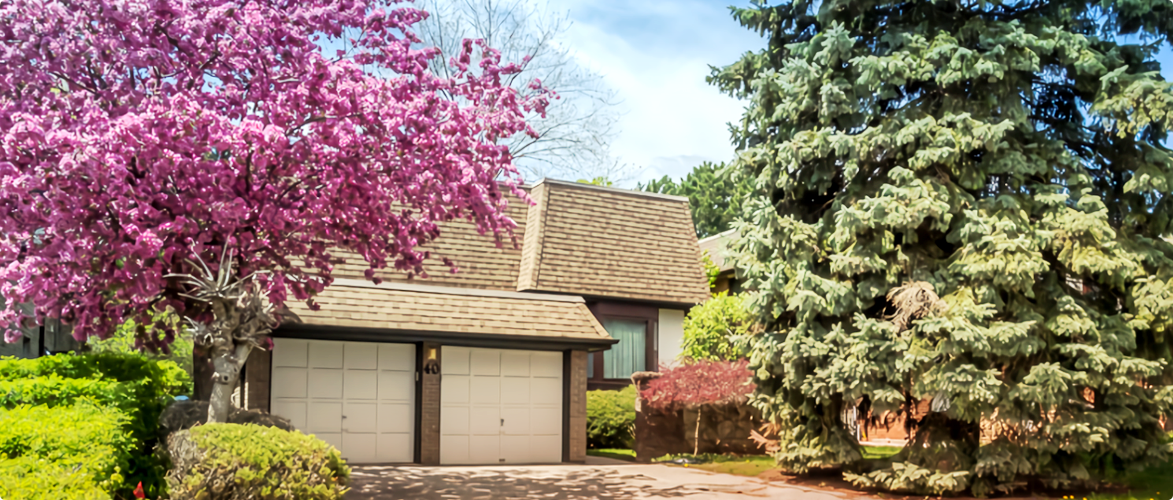
Bayview Woods-Steeles is one of North Yorks quietest and most expensive residential neighbourhoods, pressed against the Steeles Avenue border near Bayview Avenue. Large lots, mature ravine properties backing onto the Don Valley system, and the Earl Haig Secondary School catchment define it. Detached homes trade from $1.8M to well above $3.5M, and turnover is low because families who move here tend to stay.
Bayview Woods-Steeles occupies the northeastern corner of Toronto, pressed against the Steeles Avenue boundary with Markham and framed on the west by Bayview Avenue. It is one of the quietest and wealthiest residential areas in North York, built on land that backs onto the Don Valley ravine system and defined by large lots, mature tree canopy, and houses that were built to impress rather than just to shelter. The neighbourhood feels removed from the city in ways that matter to the people who choose to live there.
The development here happened primarily in the 1960s and 1970s, when builders were targeting buyers who wanted estate-like properties within Toronto’s boundaries. The results are streets lined with large custom homes, some original and well-maintained, others replaced by contemporary rebuilds on the same generous lots. The ravine edges along the Don Valley give certain streets a genuine sense of being adjacent to wilderness, and properties that back onto ravine land carry a premium that reflects how rarely that combination of privacy, nature, and urban convenience is available.
The name “Bayview Woods-Steeles” covers a larger area than the tightest definition of the neighbourhood’s most prestigious streets, and there’s meaningful variation within it. The streets closest to the Bayview Golf and Country Club and the ravine, particularly those in the western portion around Old Orchard Grove and Autumn Hill Boulevard, represent the top of the market. Streets closer to Steeles and the commercial activity along that corridor are more accessible but don’t carry the same character.
Buyers come here for a specific package: the largest lots available within Toronto’s boundaries, ravine proximity, schools in the Earl Haig Secondary catchment, and the ability to say they live in Toronto rather than Thornhill or Richmond Hill. That last point matters more to some buyers than others, but the combination is genuinely unique and supports prices that reflect it.
The housing stock in Bayview Woods-Steeles is almost entirely detached. Semis and townhouses exist but are marginal. The defining property type is the large single-family home on a lot that is wide by Toronto standards, typically 50 to 75 feet, with depths that commonly reach 150 feet or more. On the ravine-adjacent streets, some properties are irregular in shape and considerably larger, with lot areas that would support substantial builds.
The architecture runs across several decades and styles. Original 1960s and 1970s construction ranges from large brick colonials to low-slung ranch-style homes to two-storey centre-hall plans that were considered substantial when they were built and remain livable today if maintained. A significant number of these have been replaced over the past 20 years by custom rebuilds, and the new builds tend toward the contemporary or transitional styles that have dominated Toronto’s luxury residential market: stone and brick facades, open-concept main floors, principal bedrooms with walk-in closets and ensuite bathrooms of the kind the original houses didn’t include.
Pricing in 2026 starts around $1.8 million for smaller homes on standard lots in the less premium pockets of the neighbourhood and extends past $3.5 million for large custom builds on deep lots, particularly those with ravine exposure. Homes on the most sought-after streets, Old Orchard Grove and the Autumn Hill area, with lot dimensions that are genuinely exceptional, trade at $4 million and above when they come to market, which is infrequently.
Condition is predictably polarized. Well-maintained or recently renovated originals in the $2 to $2.5 million range represent genuinely good value by the standard of what they provide: space, lot, neighbourhood, schools. Unrenovated originals, which do appear on the market periodically, are priced to attract buyers willing to do the work, but the renovation scope on a 5,000-square-foot house from 1968 is significant and the budget needs to be realistic before offering.
Bayview Woods-Steeles is a genuinely low-turnover market. Families move here and stay. Many properties in the neighbourhood’s most desirable pockets come to market only once every 15 to 25 years. That scarcity is a feature of the market rather than a problem, but it means buyers need to be patient and ready to act when the right property does appear, because the next comparable listing may not come for years.
When properties do list, they attract a focused buyer pool rather than broad city-wide competition. The price points are high enough to filter out casual buyers, and the neighbourhood’s specific combination of features, large lots, ravine access, top-tier secondary school catchment, appeals to families who have researched it deliberately. Bidding wars at the top of the market do occur but are less common than in mid-tier Toronto neighbourhoods where more buyers are competing. More typically, a serious negotiation between a prepared buyer and a motivated seller resolves without the pressure auction dynamic that characterizes lower price points.
Estate sales and downsizing sales are the most common sources of inventory. The neighbourhood’s original cohort of buyers, who moved in during the 1960s and 1970s, are now at ages where the family home no longer makes sense to maintain at the same scale. Their children, who grew up here, sometimes have the financial resources to buy back in and occasionally do. More often, the buyers are newly wealthy families looking for the kind of property that simply doesn’t exist at this scale anywhere else within Toronto’s boundaries.
Days on market for properly priced properties in this neighbourhood tend to be longer than Toronto averages, reflecting both the smaller buyer pool and the deliberate pace at which buyers at this price point move. A home sitting for 30 to 60 days is not necessarily a sign that something is wrong with it. It may simply be waiting for the right buyer to complete their due diligence. Sellers who price correctly from the start typically achieve better outcomes than those who test the market high and reduce.
The buyer profile for Bayview Woods-Steeles is narrow in useful ways. Most buyers are families with school-age children, high household incomes, and a specific requirement for the kind of property size and privacy the neighbourhood provides. Many are moving from within Toronto, upgrading from a smaller house in Leaside, Willowdale, or Don Mills as their family and financial circumstances have expanded. A smaller share are arriving from the suburbs, specifically Thornhill, Richmond Hill, and Markham, and choosing Toronto for school quality, lifestyle access, or professional reasons despite the equivalent cost of a larger house north of Steeles.
The Earl Haig Secondary School catchment is a significant draw for this last group. Earl Haig’s reputation, its Gifted program, its arts and academic streams, and its overall post-secondary outcomes, is well established in the communities north of Toronto where families research these decisions carefully. Buying in Bayview Woods-Steeles to be in that catchment is a deliberate strategy and the school premium is priced into the market.
There is also a meaningful cohort of buyers within the Jewish community, given the neighbourhood’s position as an extension of the Bathurst-Jewish community corridor that runs north from Forest Hill through Bathurst Manor and up to the Steeles boundary. The proximity of synagogues in this area is a practical consideration for Shabbat-observant families, and it has historically shaped demand in the northern pockets of the neighbourhood.
What buyers are trading off to be here is city convenience. This is not a neighbourhood for someone who wants to walk to a coffee shop, subway to work without a car leg, or have the density of midtown restaurants and services nearby. The trade is deliberate: a private, spacious, quiet residential environment at the edge of a major city, with a serious secondary school, in exchange for dependence on a car for most daily needs. Buyers who make that trade consciously tend to be happy with it. Buyers who discover the inconvenience after moving in sometimes aren’t.
The western portion of Bayview Woods-Steeles, the streets between Bayview Avenue and the ravine edge, contains the neighbourhood’s most valuable real estate. Old Orchard Grove is the street that comes up most often in this conversation: deep lots, ravine exposure on many properties, mature tree coverage that creates a tunnel effect in summer, and a sense of remove from the city that’s unusual for an address still technically within Toronto. Autumn Hill Boulevard and the crescent streets that branch from it offer similar character at slightly lower prices, depending on lot orientation and ravine exposure.
Zion Heights area, in the more central part of the neighbourhood near Zion Heights Middle School, is well-suited for families whose primary concern is the school commute and who want a functional family home without paying for ravine frontage. Properties here are somewhat more affordable than the western ravine edge, and the housing mix includes more of the original 1960s stock that hasn’t yet been replaced or extensively renovated.
The streets closest to Steeles Avenue, particularly those fronting or backing onto the commercial activity along that corridor, are the least desirable addresses in the neighbourhood. The traffic noise from Steeles is real and the proximity to the retail plazas on that street changes the residential character. Buyers comparing prices within the neighbourhood should factor in what the northern boundary exposure actually means for day-to-day living.
Bayview Avenue on the western edge brings its own trade-off. Bayview is a busy arterial road, and properties that front it or are one lot deep from it experience traffic noise and proximity that reduces their appeal relative to the interior streets. The benefit of the Bayview frontage is access to the commercial strip on Bayview, which has cafes, restaurants, and services that the interior of the neighbourhood doesn’t. For buyers who walk to a coffee shop most mornings, being close to Bayview has genuine lifestyle value.
The Bayview Golf and Country Club borders the neighbourhood on the west side and provides a green buffer that keeps the character of the adjacent streets pleasant. Properties near the golf course boundary benefit from the open space without paying for private ravine access, which makes a few of those streets particularly good value relative to what they look and feel like from the street.
Bayview Woods-Steeles is car-dependent. That’s not a criticism, it’s the honest description of what life here requires. The nearest subway stations are Don Mills on the Eglinton Crosstown to the south, or Sheppard-Yonge to the southwest, both of which require a bus ride or a drive to reach. Neither is a walking option from most addresses in the neighbourhood. Residents who commute to downtown by transit typically drive to a station and park, or take a bus to the subway, which adds 20 to 30 minutes to the commute versus living closer to the subway line.
The 85 Sheppard East bus and the 11 Bayview bus both serve portions of the neighbourhood, connecting south toward Sheppard-Yonge station. Service frequency on these routes during peak hours is reasonable but not frequent enough to make transit feel like a primary transportation mode for most households.
The Eglinton Crosstown LRT, which opened in stages through 2024 and 2025, runs along Eglinton Avenue to the south and connects to the Yonge line at Eglinton station. For residents willing to bus or drive to an Eglinton station, the Crosstown provides faster east-west movement than was available before. It doesn’t fundamentally change the car-dependence of Bayview Woods-Steeles, but it does improve options for households with a destination along the Eglinton corridor.
Driving conditions are generally good. Bayview Avenue provides a clear southern run toward the 401 and midtown. The Don Valley Parkway entrance is accessible within 10 minutes by car, which matters for commuters heading to the downtown core or to offices along the DVP corridor. Steeles Avenue East connects east to Highway 404 and the 407, which are relevant for residents commuting to Markham, Scarborough, or the 400-series highway network.
Cycling is possible but limited by the lack of protected infrastructure and the distance from the city’s main cycling network. The Don Valley Trail system is accessible from the ravine edges of the neighbourhood, which is a significant asset for recreational cyclists, but for utility cycling to work or services, the neighbourhood’s topography and street configuration don’t make it practical for most residents.
The Don Valley ravine system is the neighbourhood’s defining natural asset. The ravine runs along the western and southern edges of Bayview Woods-Steeles and connects to the broader East Don Trail network, which extends south through the Don Valley for kilometres. Properties that back onto the ravine have direct access to trail systems and the experience of trees, wildlife, and stream sound from their own back yards. It’s a genuinely rare residential experience for a property inside a major city’s boundaries.
The East Don Trail itself is well-maintained for most of its length and suitable for running, cycling, and walking year-round, with adjustments for winter conditions. The trail connects south through Wilket Creek Park, Edwards Gardens, and eventually to the main Don Valley trail network. For residents who use the trail system regularly, living in Bayview Woods-Steeles means trail access without driving to a trailhead, which is a significant quality-of-life feature.
German Mills Creek runs through the ravine areas adjacent to the neighbourhood and contributes to the natural character of the ravine edge properties. The creek system and its surrounding vegetation support bird life that residents who pay attention to these things find genuinely impressive, including migrating warblers in spring and various raptors through the year.
Bayview Golf and Country Club occupies a large area on the western boundary of the neighbourhood. It’s a private club and not accessible to non-members, but its presence keeps a substantial area free of development and creates a green edge that benefits the residential streets adjacent to it. The club’s fairways and tree coverage extend the sense of open space beyond what the ravine alone provides.
For residents who want more formal park facilities, the parks within and adjacent to the neighbourhood include Bayview Woods Park with sports fields and playgrounds. For larger amenities including pools and indoor recreation, the North York YMCA and Bayview Community Centre are accessible by a short drive. The neighbourhood prioritizes natural landscape over programmed recreation, which suits the family profile that is drawn to it.
Bayview Woods-Steeles is not a neighbourhood with a walkable retail core. Daily services require a drive. The Bayview Avenue corridor to the west is the most accessible commercial strip, with a mix of cafes, restaurants, and shops between Sheppard and Steeles. It’s a comfortable suburban-style strip rather than a destination dining scene, and it works for residents who need a coffee shop, a dry cleaner, a pharmacy, and a few casual dining options without wanting to make a trip of it.
Steeles Avenue at the northern boundary of the neighbourhood has strip plazas with grocery stores, fast food, and everyday services. It’s functional but not the kind of environment residents tend to choose when they have other options. The Asian supermarkets along Steeles East, including several large Chinese and Korean grocery stores just east of Bayview in the Markham-adjacent section, are actually a notable practical resource for residents who shop for those foods regularly.
For a proper dining or shopping trip, the Sheppard-Yonge corridor to the southwest is the most accessible destination, with restaurants, the Yonge-Sheppard Centre, and the cluster of services that has built up around the Sheppard subway station. It’s 15 minutes by car without traffic, which is the honest commute for most daily errands that go beyond what Bayview Avenue or Steeles can provide.
Fairview Mall in Don Mills is about 15 minutes by car to the south and offers a full-scale shopping centre with anchor stores, which covers most larger retail needs without requiring a trip to Yorkdale or the Eaton Centre. The Don Mills area also has Shops at Don Mills, an open-air lifestyle retail centre that has a better selection of restaurants and specialty stores than anything closer to the neighbourhood.
The neighbourhood’s car-dependence shapes how residents relate to retail and services. Most households here have two cars, plan their errands, and don’t expect to be able to walk to a restaurant on a Tuesday night. Buyers moving from denser urban environments should adjust their expectations on this point before committing.
Earl Haig Secondary School is the reason many families specifically target Bayview Woods-Steeles when buying in North York. It is one of the most consistently high-performing public secondary schools in Toronto, with a Gifted program, a Claude Watson School for the Arts co-location that attracts artistically talented students from across the city, and strong post-secondary outcomes across science, technology, and humanities programs. The school’s reputation in Toronto’s Chinese, Korean, and Jewish communities is particularly strong, and it draws ambitious families who see public secondary school placement as a meaningful variable in their children’s outcomes.
Zion Heights Middle School serves Grades 6 through 8 and is the main feeder school for Earl Haig from this neighbourhood. It has a well-regarded academic reputation and the student population reflects the neighbourhood’s demographics: motivated families, high parental involvement, and strong academic expectations. The transition from Zion Heights to Earl Haig is a well-established pathway that parents in the neighbourhood understand before they arrive.
At the elementary level, Bayview Woods Public School and Fenside Public School serve the neighbourhood for JK through Grade 5. Both are Toronto District School Board schools with solid community standing. Fenside is slightly closer to the Steeles edge of the neighbourhood, while Bayview Woods serves the more central addresses.
For the Catholic system, St. Bonaventure Catholic School serves elementary students, with secondary options through the Toronto Catholic District School Board depending on address. Families intending to use the Catholic board should confirm catchments directly, as they don’t always mirror the public board boundaries.
One nuance worth knowing: Earl Haig’s Gifted program draws students from a much wider area than the immediate neighbourhood catchment, which means the overall school population is larger and more diverse than the neighbourhood itself. The Gifted stream requires separate testing and application and is not automatic even for catchment students. Buyers who are counting on the Gifted stream specifically should understand how the application and selection process works before making the school a primary driver of their purchase decision.
Bayview Woods-Steeles is among the most stable residential neighbourhoods in Toronto from a development change perspective. The lot sizes are large, zoning protections are in place for the low-density residential fabric, and there is no major transit infrastructure project adjacent to the neighbourhood that would trigger the kind of intensification pressure visible in other North York communities. Buyers choosing this neighbourhood for its established residential character face lower risk of that character changing than in many alternatives.
The most significant development activity adjacent to the neighbourhood is along the Sheppard East corridor to the south and the intensification occurring around the Sheppard-Yonge and Don Mills transit nodes. These are distant enough from Bayview Woods-Steeles that they don’t affect the neighbourhood’s interior, though they do affect traffic patterns on Sheppard Avenue and Don Mills Road that residents use for access.
Steeles Avenue on the northern boundary has seen some commercial intensification in the Markham-adjacent sections, particularly the Asian commercial plazas that have expanded in the Warden and Kennedy corridors. This is across the street from Toronto’s boundary and doesn’t directly affect the neighbourhood’s residential character, but it does shape the commercial environment residents use along Steeles.
Within the neighbourhood, the change has been property-by-property renovation and rebuild rather than area-wide transformation. This process has been raising the quality and value of the housing stock gradually over two decades. When an original 1960s house is torn down and replaced by a custom contemporary home, the surrounding properties typically benefit from the upgrade to the streetscape. There is no sign this process is slowing, and it will continue to push the neighbourhood’s average transaction price upward over the medium term.
Infrastructure maintenance is the area of ongoing concern for the neighbourhood. The ravine edge properties and the older road and utility infrastructure are on the city’s long-term maintenance schedule. Flooding events in the Don Valley ravine system, while not directly threatening most homes, can affect trail access and ravine stability on the edge properties and are worth understanding for anyone buying with ravine frontage.
Q: Is the Earl Haig catchment the main reason to buy in Bayview Woods-Steeles? It is for a meaningful portion of buyers, but it’s not the only reason. The lots, the ravine access, and the overall residential quality are all independently compelling for buyers who value large-property living within Toronto. That said, the school premium is real and priced into the market. Families who are buying here specifically for Earl Haig should verify their specific address falls within the catchment before removing conditions. Catchment maps are available on the TDSB website, but calling the school board to confirm a specific address is the only way to be certain, since boundaries have moved over time.
Q: What does a ravine lot actually mean in practice? A ravine designation means the rear portion of the lot, or in some cases the entire lot, falls within the city’s Ravine and Natural Feature Protection area. This restricts what can be built, cleared, or modified in the ravine portion. You generally cannot remove trees, add structures, or grade the land in the ravine area without city approval. For buyers, this means a ravine lot provides a beautiful, naturally buffered backyard that you don’t fully own in the traditional sense. The usable yard is often smaller than the lot dimensions suggest. Before buying a ravine property, get clarity on exactly where the protection boundary falls and what the usable area actually is.
Q: Are there flooding risks near the ravine? Properties directly adjacent to the ravine edge should be assessed carefully. The Don Valley ravine system has experienced flooding events that have damaged properties in lower-lying sections, and climate-related weather intensity is increasing. A home that backs onto the ravine at grade level, or that has a basement with windows or walkouts facing the ravine, warrants specific attention during inspection and a review of the City of Toronto’s flood mapping for that address. Insurance for ravine-adjacent properties can also carry exclusions or higher premiums. Ask about this before you’re under contract, not after.
Q: How does this neighbourhood compare to Willowdale for a family looking to spend $2-3 million? The trade is fundamentally about density versus space. Willowdale at that price range offers more walkability, subway access, and a denser community feel with more nearby services. Bayview Woods-Steeles at the same budget gets you a larger lot, more privacy, the Earl Haig catchment, and proximity to the ravine. Willowdale is better for households with one car or where someone needs to commute by transit. Bayview Woods-Steeles is better for households that are comfortable being car-dependent and place high value on space, quiet, and nature access. Neither is objectively better. They suit different life priorities.
Q: What’s the resale market like for properties at the top end? At $3 million and above, the buyer pool in Toronto narrows considerably. Properties in this range take longer to sell than mid-market homes, and pricing accuracy matters more because there are fewer comparable sales to anchor expectations. Buyers at this level should understand that they’re entering a thinner, less liquid market. That’s not a reason to avoid it, but it means the exit requires more lead time and preparation than a more liquid neighbourhood would. Properly priced properties in the $2 to $2.5 million range are more liquid and attract a broader field of buyers, which affects offer dynamics and timeline expectations.
Buying in Bayview Woods-Steeles at any price point above $2 million requires patience and preparation. Inventory is limited and the right property can take months to appear. Buyers who are serious about this neighbourhood should have their financing in order well before a property they want appears, because the properties that are priced correctly don’t sit. Setting up listing alerts for every relevant address range and attending open houses even on properties that aren’t quite right gives you the market knowledge to act confidently when the right one lists.
A buyer’s agent with specific experience in this neighbourhood adds real value. The ravine lot complications, the zoning nuances around lot coverage and building setbacks, and the practical assessment of which streets and pockets represent better long-term value within the neighbourhood all require local knowledge that a generalist agent won’t have. The difference between a property with clear ravine access and an unambiguous usable yard and one that looks similar on paper but has a protection boundary that severely limits what you can do with it is not obvious from a listing.
Building inspections on older homes here should be comprehensive and include a structural engineer assessment if there’s any indication of foundation movement, which can occur on properties adjacent to the ravine where soil conditions are more variable. Older homes in the 1960s vintage may have original electrical panels that are insurance problems, knob-and-tube wiring in finished basement areas, and plumbing that is past its expected service life. None of this is unusual for the era, but all of it needs to be understood before you price an offer.
Title insurance is standard but verify specifically for ravine-adjacent properties that the coverage extends to any encroachment issues, which can arise when deck or shed structures have historically been built into ravine protection areas without permission. Retroactive compliance is the buyer’s problem after closing if it isn’t identified before.
Finally, commission and transaction costs at this price point are meaningful in absolute terms. On a $2.5 million purchase, the land transfer tax alone (including Toronto’s municipal land transfer tax for non-first-time buyers) is substantial. Build the full cost of acquisition into your financial planning before you make an offer, including legal fees, adjustments, and any bridge financing requirements if you’re selling a current home concurrently.
Street-level knowledge is hard to find online. Our team works in Bayview Woods-Steeles every day. They know which pockets hold value, where the school catchment lines actually fall, and what the market is doing right now. Talk to us before you make a decision about Bayview Woods-Steeles.
Talk to a local agent For Sale
 For Sale
 For Sale
 For Sale