
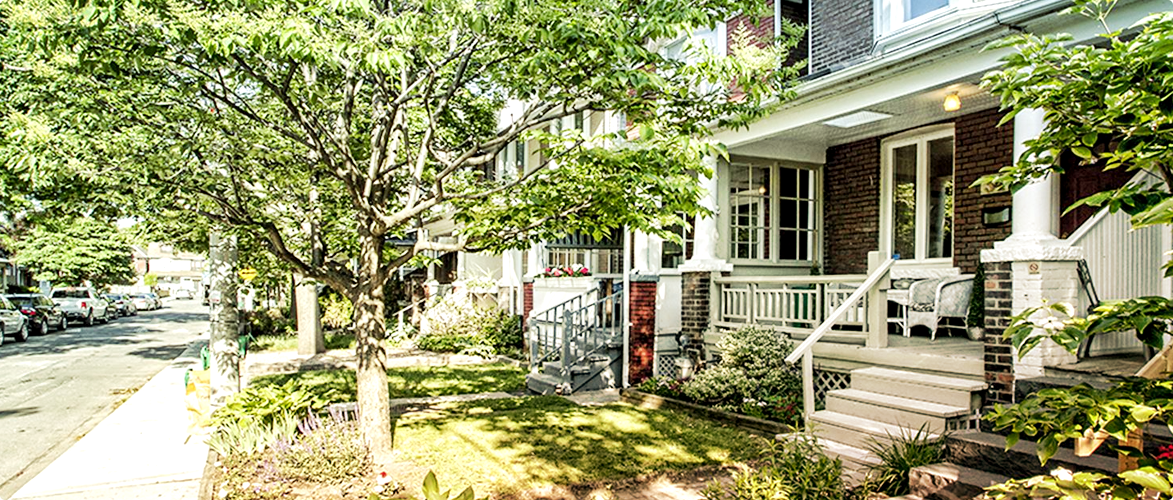
Blake-Jones, known locally as The Pocket, is a small east-end neighbourhood tucked between Coxwell and Greenwood Avenues, south of the Danforth and north of Gerrard. The CPR rail corridor to the south and the Don Valley to the west create a geographic enclosure that gives the streets a village quality unusual this close to the Bloor-Danforth subway. Small brick cottages and semis from the 1910s and 1930s were trading between $800,000 and $1.1 million in early 2026. Pape subway station is a 10-minute walk from most of the neighbourhood.
Blake-Jones sits between Coxwell and Greenwood Avenues, south of the Danforth and north of Gerrard Street. The CPR rail corridor runs along the southern boundary and the Don Valley sits to the west, creating the geographic enclosure that gave the neighbourhood its common name: The Pocket. These boundaries are real and their effect is real. Streets that would otherwise be corridors for through-traffic have no obvious reason for non-residents to use them. The result is a residential interior that feels genuinely separate from the surrounding city in a way that most neighbourhoods this close to the Danforth don’t.
There is almost no commercial activity within the neighbourhood itself. A few businesses exist on the Coxwell and Greenwood edges, but The Pocket proper is residential throughout. Residents walk to the Danforth for coffee, groceries, and restaurants, a 10 to 15 minute walk from most streets. This is a defining characteristic rather than a drawback. Buyers who choose The Pocket are choosing a purely residential neighbourhood and accepting the walk to amenities as part of that trade.
The Pocket Art Gallery, operating from a converted house on one of the residential streets, has become the neighbourhood’s most cited cultural institution. It’s the kind of thing that exists because residents put energy into it, and its presence is a reliable indicator of the community investment that characterises the area. The Friends of the Pocket community association is active and well-organised. Streets here have a high degree of neighbourliness that shows in the physical upkeep and in the way residents interact on the blocks.
The housing stock in The Pocket is small by Toronto standards. The dominant form is the working-class brick cottage and semi-detached home, built in the 1910s through the 1930s on compact lots. These are not large houses, a typical cottage runs two bedrooms, one bathroom, and a modest backyard. The semis are slightly larger, generally reaching three bedrooms, and are the more common purchase for families who need the extra room. The houses were built for working families of a different era and the lot sizes reflect that context.
A well-maintained two or three-bedroom semi in reasonable condition was trading between $800,000 and $1.1 million in early 2026. The variation comes from lot size, whether there’s parking, how extensively the house has been updated, and position within the neighbourhood. A semi on Ashdale or Galt with an updated kitchen, a finished basement that adds usable square footage, and rear parking sits at the upper end. A cottage on Harcourt or Felstead in original but functional condition with no parking sits closer to $800,000.
The small size of these houses is the reason for the relative affordability, and that affordability is the primary reason buyers choose The Pocket over other east-end options with subway access. You’re getting less square footage than you’d find in Leslieville or East York for a comparable price, but you’re getting Pape subway within walking distance and a neighbourhood character that’s unusual at this price point. The buyers who make that trade are making it deliberately.
Detached homes exist in The Pocket but they’re uncommon. When they come to market, they price above the semi range and tend to attract buyers who’ve been watching the neighbourhood and waiting for one to appear.
The Pocket isn’t a neighbourhood that generates the same volume of transactions as Leslieville or the Danforth corridors, which means the comparable sale data is thinner and individual properties matter more. A single well-presented sale in a given season can reset expectations for the street. Buyers who have been watching the neighbourhood know its stock, often by property, and can identify when something is priced to move or priced to test.
In early 2026, properties in The Pocket are typically listing without formal offer dates and reviewing offers as they arrive. The most desirable semis on Ashdale and Galt attract multiple offers within the first week when priced correctly. Properties on the edges of the neighbourhood, closer to Coxwell or Gerrard, take somewhat longer and carry more price flexibility. The spring market, from March through May, produces the most concentrated buyer activity. The October window is the secondary peak.
The relative affordability of The Pocket compared to comparable transit-accessible east-end neighbourhoods has been a consistent theme for several years, and that gap has been narrowing. Buyers who looked at The Pocket two or three years ago and chose Leslieville instead are sometimes surprised by the current pricing in both. The subway access premium, which the Danforth corridor carries but Leslieville doesn’t, is increasingly reflected in The Pocket’s numbers.
The buyers who choose Blake-Jones are usually deciding between here and Leslieville, Greenwood-Coxwell, or the Danforth proper. The decision against Leslieville is often transit. Leslieville has a developed commercial strip on Queen East and more varied housing, but no subway access. A Leslieville resident who needs downtown takes a bus or streetcar to the subway, which adds 15 minutes each way. A Pocket resident walks to Pape station. For buyers with long commutes or irregular hours, that difference is decisive.
The decision against the Danforth proper is usually price. Danforth Avenue and the streets immediately north are more expensive and more commercial. The Pocket offers the Danforth’s subway access at a discount, with a residential character the Danforth streets themselves can’t match. Buyers who want to be close to the Danforth’s restaurants and shops without living on a busy arterial often find The Pocket answers that requirement better than the Danforth streets do.
The people who end up here tend to be buyers for whom the small house size is a conscious choice: first-time buyers getting into the freehold market with a realistic budget, couples who don’t need more space than a two or three-bedroom semi provides, and people who have been renting in the east end and want to own in the neighbourhood they know. The strong community association and the neighbourliness of the streets also attract buyers who are explicitly choosing community, not just a house.
The small house sizes in The Pocket are the most common source of buyer regret, and it’s worth being honest about this before looking seriously. A two-bedroom cottage at 900 square feet works well for two people and becomes genuinely cramped for a family of four. The listings will show the dimensions, but the experience of living at that scale for three or five years is different from the experience of touring it on a Thursday evening when you’re excited about the neighbourhood. If you’re buying with growth in mind, map out specifically where the second child sleeps, where the stroller goes, and whether the basement can realistically be finished for the square footage you’ll eventually need.
The rail corridor along the southern boundary generates noise. Properties on Eaton Avenue and Felstead Avenue near the southern edge of the neighbourhood are within earshot of rail activity, including freight trains that run at night. The frequency varies but the sound is real. Walking those specific streets at night and standing in the backyard of any property you’re considering in those blocks takes five minutes and answers the question before you’re committed.
Parking is not available on every lot, and unlike some west-end neighbourhoods, the laneways in The Pocket don’t provide a universal alternative. Some streets have rear lane access and some don’t. Confirm the specific situation for any property you’re considering. If you need to bring a car home daily and park near the house, this is a decision-point rather than a minor detail.
Buyers in The Pocket are buying partly on the neighbourhood’s character, and listings that present the house in isolation from that character leave money on the table. The community association, the art gallery, the specific quality of neighbourliness on the streets, these are real assets and buyers who are choosing The Pocket specifically want to know they’re real. A listing description that mentions the Friends of the Pocket and the Pocket Art Gallery by name is more useful to a buyer who has shortlisted this neighbourhood than one that mentions “charming community feel” without specifics.
The small houses need to show well because buyers are often stretching their budget to be in the freehold market at all. A house that’s clean, well-lit, and has clear spatial logic, where each room has an obvious use and feels functional at its actual size, performs better than a house with more potential that requires the buyer to do the imaginative work. Decluttering to an aggressive degree before listing is worth doing. At 900 or 1,100 square feet, the difference between a showing that feels spacious and one that feels cramped is almost entirely in how the furniture is arranged and how much is there.
Spring listing still produces the strongest results. The Pocket’s buyer pool is concentrated enough that winter listings can sit without attracting the multiple-offer environment that a March or April listing on a well-priced property tends to generate. If you have a choice, February or March is the right time to start.
The Friends of the Pocket is one of the more active community associations in the east end. The degree of organisation is visible in the physical maintenance of the streets, in the events the association runs, and in the relationship between neighbours, people in The Pocket tend to know their neighbours to a degree that’s less common in denser parts of the city. This isn’t a marketing description; it’s the reason the neighbourhood has a name that residents use rather than one assigned by a city planner.
The Pocket Art Gallery, operating from a converted house within the neighbourhood, holds shows and events that function as neighbourhood gathering points as much as art programming. It represents a specific kind of local investment: residents decided the neighbourhood should have this and made it happen. That pattern repeats across The Pocket’s community life in ways that buyers notice on a street-level walk before they ever make an offer.
The Danforth is the neighbourhood’s commercial spine, a 10 to 15-minute walk from most Pocket streets. The stretch between Pape and Coxwell has restaurants, cafes, and independent shops dense enough that residents rarely need to leave the immediate area for daily needs. Pape Avenue itself, from the Danforth south toward Gerrard, carries some commercial activity including a few restaurants and a grocery option closer to home. The neighbourhood doesn’t have its own strip, but the Danforth is close enough that the absence of one isn’t a meaningful practical constraint for most residents.
Pape subway station on the Bloor-Danforth line is the neighbourhood’s transit anchor. From most Pocket streets, the walk to Pape station takes 10 to 15 minutes. That’s longer than it sounds when you’re excited about a house, and shorter than it feels in January at 7 a.m. when you’ve timed it wrong. It’s a realistic walking commute for residents who are prepared to make it daily, and it gives The Pocket an effective downtown connection that most of Leslieville and large parts of East York don’t have.
Coxwell subway station is accessible from the eastern edge of the neighbourhood and is sometimes a closer option depending on the specific street. The 22 Coxwell bus provides north-south surface transit along Coxwell Avenue for trips that don’t need the subway. The Danforth streetcar routes connect east-west along the Danforth corridor itself.
Cycling is practical for most of the year. The Woodbine Avenue cycling connection runs north-south nearby, and the broader east-end cycling network has improved enough that a fit cyclist can reach the Financial District in under 30 minutes from The Pocket on a direct route via the waterfront trail or Bloor Street. Many residents manage without a car entirely, which is meaningful at the price point this neighbourhood occupies, the cost of owning a vehicle in the city adds up in ways that affect how much mortgage a household can carry.
Leslieville is the comparison buyers most often arrive with when they start looking at The Pocket. The two neighbourhoods are in the same price range and attract buyers with similar priorities: east-end freehold at a budget that doesn’t stretch to Riverdale or Playter Estates. The differences are real. Leslieville has Queen Street East as a commercial strip with restaurants, coffee shops, brunch spots, and independent retail dense enough to supply daily needs on foot. The Pocket has none of that within the neighbourhood. Leslieville has no subway access, getting downtown requires a bus or streetcar to the subway, adding 15 minutes each way. The Pocket has Pape subway within walking distance. The housing in Leslieville is more varied in size and style; The Pocket’s stock is smaller and more consistent. For buyers who commute downtown and can live without a main street outside the door, Blake-Jones often wins.
The Danforth proper, the streets immediately north of the neighbourhood and along Danforth Avenue itself, is more expensive and more commercial. Properties on and near Danforth Avenue carry the noise and activity of a major arterial. The Pocket offers Danforth access at a discount and with a residential character the Danforth streets themselves don’t have. Buyers who want to be close to the Danforth’s restaurant strip without living on it find The Pocket answers that better than the alternatives.
Greenwood-Coxwell, to the east, shares the Bloor-Danforth subway access via Coxwell station and has similar housing stock. The two neighbourhoods overlap in price and buyer profile. Greenwood-Coxwell has more commercial activity on Coxwell Avenue and a slightly larger park in Greenwood Park. The Pocket has the community association character and the geographic enclosure that makes it feel different from adjacent neighbourhoods. The choice between them often comes down to where buyers find a specific property they want, rather than a preference for one neighbourhood over the other.
The primary public elementary option for Blake-Jones is Blake Street Junior Public School, which has strong community attachment from the neighbourhood’s active parent base. The school reflects the character of the community around it: involved parents, a well-maintained building, and a sense of investment that comes from a neighbourhood where people know each other. Earl Grey Senior Public School serves the older elementary grades. Neither has a reputation that drives buyers from outside the catchment to seek out the address specifically, but both are considered reasonable neighbourhood schools with a functional community around them.
The Toronto Catholic District School Board has options accessible from the neighbourhood for families in the Catholic system. French Immersion through the TDSB requires a separate application process and isn’t guaranteed at the catchment school. Families who prioritise French Immersion should confirm the specific application situation before purchasing, since waitlists and school assignments vary.
Secondary school catchment flows to East York Collegiate Institute. Families buying in The Pocket with school-age children in the 8 to 12-year range tend to investigate the secondary options carefully as part of their buying decision. The pattern common to the east end applies: the neighbourhood and elementary schools work well for younger children, and the secondary school question is worth researching before committing. Verify current catchment boundaries with the TDSB boundary tool, since specific streets can sit in unexpected catchments.
Why is Blake-Jones called The Pocket? The name comes from the neighbourhood’s physical geography. The CPR rail corridor runs along the southern edge and the Don Valley sits to the west, creating a geographic enclosure around the Blake-Jones streets. The neighbourhood is effectively pocketed on two sides by infrastructure that limits through-traffic and pedestrian access from those directions. The result is a residential area that feels self-contained and quiet in a way that’s genuinely unusual for streets this close to the Danforth and Pape subway. The name is used casually by residents and in listings, though Blake-Jones is the official City of Toronto neighbourhood designation. Both names refer to the same streets.
What are typical house prices in Blake-Jones in 2026? The small brick cottages and semi-detached homes that make up most of the neighbourhood were trading between $800,000 and $1.1 million in early 2026. The range reflects condition, size, and whether any updates have been done. A well-maintained two-bedroom cottage in original condition with a usable backyard sits toward the lower end. A three-bedroom semi with an updated kitchen, finished basement, and parking sits toward the top. These are among the more affordable freehold houses with subway access anywhere in the 416, and the transit and community quality relative to price is the main reason buyers choose The Pocket over other east-end options. Detached homes exist but are less common and price above the semi range.
How does Blake-Jones compare to Leslieville? The two neighbourhoods attract buyers looking for value in the east end, but they work differently. Leslieville has Queen Street East as a developed commercial strip with restaurants, coffee shops, and independent retail. Blake-Jones has no commercial strip of its own; residents walk to the Danforth for everything, which takes 10 to 15 minutes from most streets. Leslieville has no subway access. Blake-Jones has Pape subway station within walking distance. The housing in The Pocket is smaller and generally less expensive than comparable Leslieville semis. Buyers who prioritise transit over commercial walkability tend to prefer Blake-Jones. Buyers who want a main street to walk out onto tend to prefer Leslieville.
What is the Pocket Art Gallery? The Pocket Art Gallery operates from a converted house within the neighbourhood and has become one of its more distinctive institutions. It functions as a community gallery and creative space rather than a commercial gallery; it’s the kind of place that exists because residents decided it should exist. The gallery regularly shows local artists and hosts events that draw from across the neighbourhood. It’s one of the reasons The Pocket gets described as having a village character: small institutions like this are rare in residential neighbourhoods this close to the city’s core, and their presence reflects the degree of community investment that the Friends of the Pocket association represents.
Blake-Jones was built up in the 1910s through the 1930s as one of the working-class residential districts that expanded east of the Don Valley during Toronto’s period of rapid growth in the early 20th century. The small brick cottages and semis were built for industrial workers, many of whom worked in factories and yards accessible by streetcar along Gerrard and Danforth. The CPR rail corridor that now defines the southern boundary was a working infrastructure feature of the same era, not a heritage designation, it ran freight then and it still does.
The neighbourhood’s enclosure, the quality that gives it the Pocket name, is a consequence of that infrastructure. Streets that were laid out in the 1910s and 1920s without anticipating the degree to which the rail corridor and valley would function as barriers ended up creating a residential interior with limited through-traffic. That accident of planning has become, a century later, one of the neighbourhood’s defining assets.
The community association character that The Pocket is known for developed over several decades, accelerating through the 1990s and 2000s as younger buyers began purchasing the neighbourhood’s small, affordable houses and investing in both the properties and the community around them. The Friends of the Pocket formalised what was already a high-engagement street culture. The Pocket Art Gallery, established more recently, is part of the same pattern: residents creating institutions because they want them, rather than waiting for the neighbourhood to acquire them by commercial gravity. That quality of self-made community is genuine and it shows in the streets.
Street-level knowledge is hard to find online. Our team works in Blake-Jones (The Pocket) every day. They know which pockets hold value, where the school catchment lines actually fall, and what the market is doing right now. Talk to us before you make a decision about Blake-Jones (The Pocket).
Talk to a local agent For Sale
 For Rent
 For Sale
 For Sale