
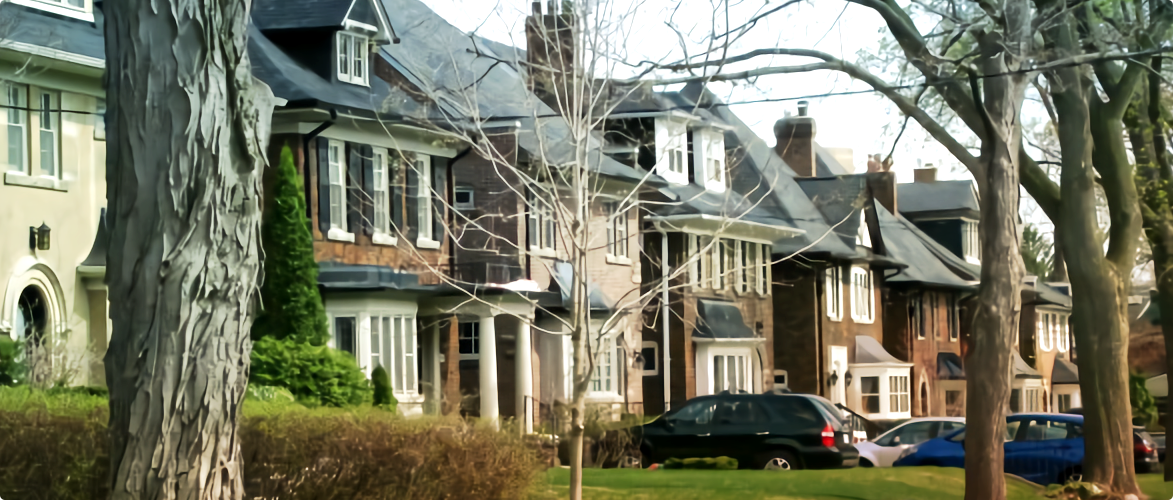
Chaplin Estates is a small, quietly affluent enclave in midtown Toronto, tucked between Eglinton Avenue and Chaplin Crescent, with Oriole Parkway to the east and Glenayr Road defining its western edge. The neighbourhood is almost entirely residential: a few streets of detached homes from the 1920s and 1940s, mostly Tudor and Georgian revival, on lots that run large by Toronto standards, shaded by a mature tree canopy that closes over the road in summer. Entry prices in 2026 sit around $2.5 million, with the top end reaching $5 million and occasionally beyond for the largest lots.
Chaplin Estates is not a neighbourhood most Torontonians can place on a map. It sits in midtown, bounded by Eglinton Avenue to the south, Chaplin Crescent to the east, Oriole Parkway to the east and northeast, and Glenayr Road to the west. The total area is small: a handful of streets, a few hundred houses, no commercial properties within the enclave itself. From Eglinton, you turn north and within half a block the city seems to lower its volume. The streets are wide and shaded by maples and oaks that have been growing since the houses were built in the 1920s and 1940s.
The housing stock is almost entirely detached, built in the Tudor revival and Georgian revival styles that were fashionable in upper-middle-class Toronto between the wars. The lots are large by Toronto standards: 50 to 60-foot frontages are common, with depths that allow for proper gardens. The building quality was high at the time of construction and most properties have been maintained and updated to a standard that reflects the neighbourhood’s market position. The streetscape is consistent in a way that takes planning and money to sustain over 80 years.
Chaplin Crescent itself runs as a curved street with Market Park at its centre, a narrow linear park that forms the green spine of the neighbourhood. The park is not remarkable by itself, but its presence gives the street an openness and a civic quality that most residential streets in the city lack. Houses face the park from both sides of the crescent, and on a summer evening the crescent has the feel of a private road even though it is entirely public.
Every property in Chaplin Estates proper is a freehold detached house. There are no semis, no townhouses, no condos, and no purpose-built rentals within the neighbourhood boundaries. The houses are predominantly from the 1920s and 1940s, with a smaller number from the 1950s and early 1960s on the peripheral streets. The dominant styles are Tudor revival, with their half-timbering, steeply pitched roofs, and casement windows, and Georgian revival, with their symmetrical brick facades and classical detailing. Both styles were built with high-quality materials and solid construction; the bones of these houses are generally sound, and the main variable is the quality of successive renovations.
Lot sizes run large. A standard Chaplin Estates property has 50 feet of frontage and 120 to 150 feet of depth, giving a usable rear garden of a scale that is rare in midtown. Some properties on the more prominent streets have larger lots still. The combination of lot size, building size, and architectural quality defines the neighbourhood’s price floor. An entry-level purchase, meaning a 1940s detached that needs a full kitchen and bathroom renovation but has its structure and character intact, sits around $2.5 million. Well-maintained properties with updated kitchens, bathrooms, and mechanical systems sell in the $3 to $4 million range. The largest and best-presented homes, particularly the Tudor revivals on Chaplin Crescent facing the park, have sold above $5 million.
Most buyers in this market renovate after purchase rather than paying a premium for someone else’s renovation choices. The architectural character of the buildings means that poorly chosen finishes are jarring in ways they would not be in a more generic house, and buyers who plan significant work should think carefully about whether the updates they want to make suit the building’s period and style. A Tudor revival with an open-concept main floor and white oak engineered flooring throughout is a mixed result. Contractors with experience in period renovation are worth finding before purchasing.
Chaplin Estates trades with a frequency and pace that reflects its size and its buyer profile. Roughly 10 to 15 transactions happen in the neighbourhood each year, making it one of the lowest-turnover residential pockets in midtown Toronto. Owners here stay for a long time. When a property does come available, it often moves quickly, partly because buyers who have been watching the neighbourhood for months or years recognise the opportunity and act on it, and partly because the supply is so limited that waiting for the next comparable property means waiting potentially a year or more.
Properties in this range are less susceptible to the seasonal market patterns that shape activity in $1.5 to $2 million neighbourhoods. Buyers at $3 million and above are not interest-rate sensitive in the same way, and their decision timelines are longer and less dependent on external conditions. That said, spring still produces the most activity, and listings from March through May see the largest pool of competing buyers. The fall window from September through November is the secondary peak. Properties listed in winter sell, but typically with fewer competing buyers and more time to negotiate.
Because the neighbourhood trades so rarely, comparable sales are genuinely difficult to find. A property sold in Chaplin Estates a year ago may be the only close comparable available, and a lot of changes in a year. Agents pricing here rely on a combination of the direct comparables, adjacent neighbourhood data from Forest Hill South and Lawrence Park South, and a qualitative understanding of where the specific property sits within the neighbourhood’s own range. Buyers should approach valuation with the same nuance, rather than expecting a clear bracket of recent sales to anchor expectations.
The buyers who end up in Chaplin Estates are typically comparing it to Forest Hill South, Lawrence Park South, and sometimes Lytton Park. The comparison to Forest Hill South is the most common. Forest Hill has higher name recognition and the highest prices in the midtown family market, particularly on its southern streets closest to Upper Canada College and the Forest Hill Village commercial strip. Chaplin Estates buyers often come from that search having found Forest Hill’s top prices out of reach, or having decided that the quieter character and slightly less prominent address of Chaplin Estates represents better value for what they actually want. The two neighbourhoods are architecturally similar; the price gap is 15 to 25 percent on comparable properties.
The comparison to Lawrence Park South is different. Lawrence Park has larger lots on average, is quieter and more removed from commercial activity, and has strong appeal to families who prioritise space and privacy above walkability. Chaplin Estates sits closer to Yonge-Eglinton, which means better access to the Eglinton subway station, a larger choice of restaurants and shops, and a shorter distance to the midtown commercial hub. Buyers who walk to the subway or want to be able to walk to dinner without getting in the car tend to choose Chaplin Estates; buyers who prefer genuine residential quiet often go to Lawrence Park.
The buyers who settle in Chaplin Estates tend to have a specific sense of what they want: a detached house of real architectural quality, on a street with consistent character, close enough to the city to feel urban but quiet enough to feel removed from it. Families with school-age children are the dominant buyer type, partly because of the Lawrence Park CI secondary school catchment and partly because the large lots and wide streets are genuinely good for children in a way that narrow urban blocks are not. Downsizers from larger suburban properties who want to be in the city without sacrificing lot size also appear in the buyer pool with some regularity.
Buying in Chaplin Estates at this price point requires a different preparation process than buying a $1.5 million property. Financing must be fully arranged before you make any offer, because sellers of $3 to $5 million properties rarely accept conditions that leave them waiting on a buyer’s bank. Pre-approval is the minimum; for the most competitive properties, buyers should have a signed commitment letter from their lender or confirm they are purchasing with cash or liquid assets. An agent who has experience in this price range and specifically in this neighbourhood is worth engaging early, because the market is small enough that relationships and local knowledge matter more than in higher-volume areas.
The due diligence on houses from this era requires professional attention. The mechanical systems in a 1930s or 1940s house, even one that appears well-maintained, will have been replaced and modified multiple times. The age of the roof, the furnace, the air conditioning system, and the plumbing connections should all be confirmed. Knob-and-tube wiring was standard in houses of this vintage and may still be present in portions of the structure even if the panel has been upgraded. Foundation inspection is worth doing carefully, particularly in the lower-lying areas closer to Oriole Parkway. These are not reasons to be deterred; they are reasons to know what you are buying.
Heritage status varies by property in this area. Some properties on Chaplin Crescent and adjacent streets have individual heritage listings or fall within conservation district studies. Before purchasing, check the heritage status of the specific property with the City of Toronto and understand what it means for future alterations. If you want to add a significant rear addition, expand into the garage footprint, or alter the roofline, heritage status will determine whether that is straightforward or complex. A heritage architect consulted before purchase can advise on what is achievable at a specific property.
Selling in a market that trades 10 to 15 times per year requires more patience and a sharper pricing strategy than selling in a high-volume neighbourhood. The buyer pool for a $3.5 million detached in Chaplin Estates is small, and the buyers in it are informed. They have looked at Forest Hill, Lawrence Park, and Lytton Park alongside Chaplin Estates, they have seen recent sales, and they will notice immediately if a property is priced beyond what the comparables support. Setting the price too high and planning to negotiate down is a less effective strategy here than in more liquid markets; a property that sits for 60 or 90 days in a neighbourhood that trades a dozen times per year accumulates a stigma that is hard to recover from.
Preparation matters at this price point. Buyers spending $3 million or more are making a deliberate choice and they notice everything: the condition of the masonry, the quality of the landscaping, the hardware on the doors, the state of the basement. Deferred maintenance that might be overlooked by a buyer at a lower price point becomes a negotiating issue or a reason to pass at this level. A thorough pre-sale inspection and a realistic conversation about what to address before listing will produce better outcomes than listing as-is and hoping for the best.
Staging in houses of this architectural character requires care. The most effective presentations work with the period character of the building: furniture that suits the scale of the rooms, window treatments that complement the casement windows, a restrained use of contemporary accessories in rooms that still have original millwork and plaster details. Heavy staging in a neutral, generic palette looks wrong in a Tudor revival and tells buyers that the owners didn’t understand what they had. Let the house be what it is.
Chaplin Estates has no commercial strip of its own. The neighbourhood is purely residential, with Market Park along Chaplin Crescent providing the only public green space within the enclave. This is by design: the neighbourhood was planned as a quiet residential area for families, and the lack of commercial intrusion is one of its defining features. Residents who want shops, restaurants, and services walk or drive to Yonge-Eglinton, which is accessible in five to ten minutes on foot from most streets in the neighbourhood.
Yonge-Eglinton is one of Toronto’s more complete midtown commercial hubs. The intersection and its surrounding streets carry a large Loblaws and a Metro within a few blocks of each other, a full range of restaurants from neighbourhood level to serious dining, coffee shops, the Yonge-Eglinton Centre for retail, and a range of professional services. The area has grown denser in recent years with the arrival of several midrise condo buildings, which has added population and expanded the commercial offering. The Eglinton Crosstown LRT, once open, will add east-west transit capacity and is expected to increase the hub’s commercial activity further.
For families, the practical amenity list is strong. Eglinton Park, sitting just south and west of the neighbourhood boundary, has an outdoor pool, a skating rink, sports fields, and tennis courts. The Chaplin Crescent Market Park gives the immediate neighbourhood its green character, even if it is narrow. Access to the Beltline Trail, a converted rail corridor that runs east-west through midtown, is available from several points near the neighbourhood and provides a car-free cycling and walking route that connects to the broader trail network. Day-to-day errands and recreational needs are all manageable without a car, though most families in Chaplin Estates own at least one.
Transit access for Chaplin Estates centres on the Yonge-Eglinton hub, which sits within easy walking distance of the neighbourhood’s southern boundary. Eglinton station on the Yonge-University line provides rapid transit south into the Financial District and north toward Lawrence and York Mills. The commute to Union Station by subway runs about 25 minutes from Eglinton, depending on the time of day. The Eglinton Crosstown LRT, when open, adds east-west rapid transit along Eglinton, connecting directly westward toward Scarlett Road and eastward to the Scarborough-Kennedy area. For residents who work in the Yonge-Eglinton area itself, the neighbourhood is effectively transit-adjacent.
Cycling is practical for some of the neighbourhood’s residents but not all. The Beltline Trail provides a traffic-free route east and west, and Chaplin Crescent’s own road character makes cycling within the neighbourhood comfortable. The connection to Eglinton and beyond involves navigating busier roads, which is manageable for confident urban cyclists but not appealing to everyone. The City of Toronto has been expanding cycling infrastructure along Eglinton Avenue, which improves conditions for the most likely commuter routes.
For residents who drive, the neighbourhood’s midtown location puts it within reasonable distance of both downtown and the 401. Allen Road is accessible in a few minutes from the western edge of the neighbourhood and provides a direct connection to the 401 and the 400 series highway network. Driving downtown takes 20 to 30 minutes outside peak hours; during rush hour, transit is reliably faster. Most households in Chaplin Estates own at least one car, and garage and driveway parking at the properties themselves means on-street competition is less of an issue here than in denser urban neighbourhoods.
The three neighbourhoods buyers most often compare to Chaplin Estates are Forest Hill South, Lawrence Park South, and Lytton Park. Forest Hill South is the most prominent of the three midtown family enclaves and commands the highest prices, particularly on its southern streets between Eglinton and St. Clair. An equivalent property in Forest Hill South typically costs 20 to 30 percent more than in Chaplin Estates, reflecting Forest Hill’s name recognition, the proximity of Upper Canada College and Bishop Strachan School, and a consistently larger buyer pool. Buyers who find Forest Hill’s top-end pricing beyond reach, or who simply prefer the smaller scale and greater privacy of Chaplin Estates, often land here.
Lawrence Park South offers a different trade-off. Its lots are large, its streets are quiet, and its distance from commercial activity is greater than Chaplin Estates. The Yonge-Eglinton hub is a 15-minute walk from Lawrence Park’s southern streets, versus five to ten minutes from Chaplin Estates. For families who want maximum residential quiet and are comfortable driving for most errands, Lawrence Park South is the better fit. For families who want to be closer to transit and the midtown commercial core, Chaplin Estates has the advantage. Prices between the two neighbourhoods are comparable on a per-square-foot basis, though Lawrence Park’s larger lots sometimes produce higher absolute sale prices for the largest properties.
Lytton Park, which sits north and east of Chaplin Estates along Yonge Street, is the least known of the group outside the real estate community. It offers similar detached housing from the same era, with a strong school catchment and a quieter character, at prices that are generally comparable to Chaplin Estates. The Yonge Street corridor is more commercially active than Chaplin Crescent, which cuts both ways: better retail access, but more traffic and noise on the main street. Buyers choosing between Lytton Park and Chaplin Estates often find the decision comes down to which specific property and which specific block appealed to them, rather than a strong functional difference between the two areas.
The school catchment is one of the reasons families specifically target Chaplin Estates. The elementary public school for most of the neighbourhood is John Fisher Junior Public School on Rolph Road, which serves the midtown area and has a solid reputation within the TDSB. The secondary catchment is Lawrence Park Collegiate Institute on Rumsey Road, which is consistently among the most sought-after public secondary schools in Toronto. Lawrence Park CI runs the IB Diploma Programme alongside the standard Ontario curriculum and has a student culture oriented toward university preparation. Catchment alone does not guarantee IB admission; the programme has its own application process. Families who are specifically buying into this area for the IB programme should confirm the application requirements and timeline before assuming the secondary school choice is automatic.
The private school landscape around Chaplin Estates is also significant. Upper Canada College sits in Forest Hill, roughly a 15-minute drive from Chaplin Estates. Bishop Strachan School and Havergal College are both within the midtown corridor. Toronto French School’s main campus is nearby. Families who prefer private schooling for their children will find the neighbourhood’s location places them within reasonable reach of most of the prominent Toronto private schools without the commute burden that some other residential areas impose. This access to both strong public and private options is part of what families are paying for when they buy in Chaplin Estates.
Catholic school families in the area are served by the Toronto Catholic District School Board. The relevant elementary school is St. Monica Catholic School on Rosemount Avenue. The Catholic secondary catchment for this area feeds to Marshall McLuhan Catholic Secondary School and St. Michael’s Choir School for eligible students. French Immersion options within the TDSB are accessible from the neighbourhood, though families interested in French Immersion should confirm current catchment boundaries with the board directly, as these change periodically and the distance to immersion-eligible schools matters for daily logistics.
Is it worth buying in Chaplin Estates over Forest Hill at a lower price point? For many buyers, yes. The two neighbourhoods have similar architectural character, comparable school catchments at the secondary level, and the same midtown location. The price gap of 20 to 30 percent on equivalent properties is real money, and what you lose in name recognition you gain in a smaller, quieter enclave with a more consistent streetscape. Forest Hill has more commercial activity at the Forest Hill Village strip, which some buyers value and others find unnecessary. Chaplin Estates has Market Park along the crescent, which is a genuine amenity that Forest Hill’s internal streets don’t replicate. The honest answer is that buyers who need the Forest Hill address for professional or social reasons should buy in Forest Hill; buyers who are choosing purely on what they are getting for the money often find Chaplin Estates the more interesting purchase.
How does the Eglinton Crosstown LRT affect the neighbourhood? The Crosstown runs along Eglinton Avenue, which forms the southern boundary of Chaplin Estates. Once open, it adds east-west rapid transit capacity alongside the existing north-south Yonge subway at Eglinton station. The practical effect for residents is better connectivity to the western midtown corridors along Eglinton, including Mount Pleasant, Leaside, and the Scarborough corridor to the east. The construction period was disruptive to Eglinton Avenue businesses and traffic, but the residential streets within Chaplin Estates were largely insulated from the construction activity. Property values in the Yonge-Eglinton area have already adjusted to anticipate the LRT opening; buyers purchasing now are not paying pre-LRT prices.
Can I build an addition or a coach house on a Chaplin Estates property? The large lots in the neighbourhood do accommodate rear additions and, in some cases, laneway or garden suites under the City of Toronto’s expanding permissions for additional residential units. Whether a specific property qualifies depends on lot dimensions, the setback of the existing structure, and the applicable zoning. A rear addition on a Tudor revival needs careful design to be proportionate and sympathetic to the original building; the neighbourhood’s consistency means an incongruous addition will be visible and may affect resale. For buyers who are specifically considering purchasing to add a significant addition, it is worth having an architect assess the specific property and the heritage implications before writing an offer.
How private is the neighbourhood really? Chaplin Estates is as private as a public Toronto neighbourhood can be. The streets are public roads and the park is open to everyone. But the lack of through traffic, the absence of commercial properties, and the scale and placement of the houses create a real sense of enclosure and quiet. The crescent road configuration on Chaplin Crescent itself means there is no reason to drive down it unless you live there or are visiting someone who does. On a weekday morning, the streets are genuinely quiet. On summer weekends, families use the park and the sidewalks in a way that feels neighbourly rather than busy. Buyers who want a private gate community or a fully secured property will not find that here, but buyers who want the quietest possible residential experience within midtown Toronto will find Chaplin Estates difficult to improve on.
Chaplin Estates was developed in the 1920s and 1930s as part of the broader expansion of midtown Toronto into what had previously been largely agricultural land north of Eglinton Avenue. The developer and land owner behind the estate’s layout designed the crescent road specifically to create a self-contained residential character, with Market Park as the centrepiece of Chaplin Crescent intended from the beginning as a shared green amenity for the houses facing it. The street names reflect the naming conventions of the period and the aspirations of the development to appeal to the upper-middle-class families who were establishing themselves in midtown Toronto between the wars.
The architectural character of the neighbourhood reflects the tastes of its original buyers. Tudor revival and Georgian revival were the dominant residential styles in upper-income Toronto from the late 1910s through the 1940s, and the builders and architects who worked in Chaplin Estates produced houses that were well-constructed and architecturally coherent without being exceptional by the standards of the period. The neighbourhood was built to last, and most of the original housing stock remains, maintained and updated but not dramatically altered in its overall character. The consistency of that stock over nearly 100 years is the neighbourhood’s defining physical quality.
Chaplin Estates has attracted a relatively constant buyer profile across its history: families with professional incomes who value residential quiet, school access, and midtown location without needing the most prominent possible address. The neighbourhood never became fashionable in the way that some Toronto enclaves have, which is partly why it has remained so consistent and private. It does not appear regularly in real estate media or lifestyle coverage, which suits its residents. The people who live here tend to know exactly what they are buying and why, and many of them stay for a generation.
Street-level knowledge is hard to find online. Our team works in Chaplin Estates every day. They know which pockets hold value, where the school catchment lines actually fall, and what the market is doing right now. Talk to us before you make a decision about Chaplin Estates.
Talk to a local agent