
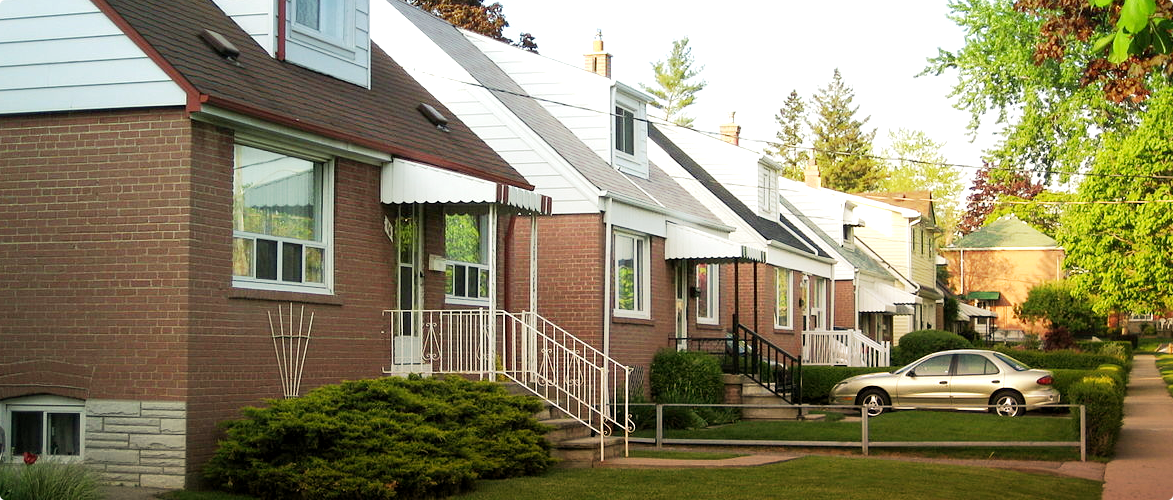
Clairlea is a post-war residential neighbourhood in central Scarborough running along the Victoria Park Avenue corridor, with detached bungalows and semis on established streets. The Eglinton Crosstown LRT now connects Victoria Park station to Midtown Toronto and the broader transit network, changing the commute picture for residents significantly.
Clairlea occupies a quiet stretch of central Scarborough along the Victoria Park Avenue corridor, sitting roughly between Eglinton Avenue East to the south and Lawrence Avenue East to the north. It’s a neighbourhood that most Toronto buyers overlook, which is increasingly a reason to pay attention. Post-war bungalows and semis on established residential streets, moderate prices by inner-city standards, and a transit picture that’s been improving since the Eglinton Crosstown LRT extended service to Victoria Park station — Clairlea has the fundamentals that attract buyers who’ve done their homework rather than followed the hype.
The neighbourhood developed in the late 1940s and through the 1950s as Scarborough’s western edge expanded to absorb the post-war housing demand. The street grid is straightforward, the lots are generous, and the trees are old enough to provide the kind of canopy that makes residential streets genuinely pleasant in summer. There’s no signature architectural character, no heritage streetscape. What Clairlea has is consistency: brick bungalows built to last, maintained by successive generations of homeowners who treated these houses as long-term investments.
Victoria Park Avenue runs along the neighbourhood’s western edge and has long served as the commercial spine for residents, with a mix of strip-mall retail, restaurants, and services reflecting the area’s diverse demographics. Eglinton Avenue East to the south is the transit corridor now, with Crosstown LRT service connecting Victoria Park station westward through the city and eastward into Scarborough. That connection changed the calculation for Clairlea, turning a bus-dependent neighbourhood into one with rapid transit access to multiple employment and entertainment centres.
The buyers showing up in Clairlea in 2026 are largely families and first-time buyers priced out of East York and the Beaches corridor who’ve worked out that the same money buys significantly more house here. Clairlea won’t generate the dinner-party conversation of more fashionable addresses. But it provides the thing that an increasing number of Toronto buyers have stopped apologising for wanting: a real house, a real lot, in a stable neighbourhood with a working transit connection to the rest of the city.
Clairlea’s housing stock is almost entirely low-rise freehold: post-war detached bungalows and one-and-a-half-storey homes on lots typically measuring 40 to 50 feet wide, with depths running 100 to 125 feet. Semi-detached homes appear throughout the neighbourhood, particularly on the shorter connector streets. The construction is largely brick, solid and well-aged, with the characteristic compact footprints of 1950s residential development. You’re buying a house that was built to house one family, on a lot that was designed for suburban living as it was understood in that era — which means driveways, garages, and rear yards that are actually usable.
In 2026, detached homes in Clairlea are trading in the $850,000 to $1.2 million range, with the spread reflecting condition, lot width, and proximity to Victoria Park station and the Eglinton Crosstown. Well-presented homes with updated systems, modern kitchens, and finished basements approach or exceed $1.1 million. Properties in original condition, needing kitchen, bath, and systems work, still move in the $850,000 to $950,000 range depending on the lot. Semi-detached homes typically sell for $750,000 to $900,000.
Basements in Clairlea bungalows are typically full-height and finished or finishable, making them attractive for either in-law suite use or rental income. The combination of a ground-floor family home and a rentable basement unit is common in the neighbourhood, and many listings will market the basement apartment as a feature. Buyers should verify permit history on any basement unit and factor legalization costs if the unit is currently unpermitted.
There is essentially no condominium product within Clairlea’s residential core. The towers on Eglinton Avenue and Victoria Park serve a different buyer profile and are technically within reach of the neighbourhood’s transit nodes but function as a separate market. Buyers looking for freehold in the $850,000-plus range are buying into a consistent, low-rise residential environment with long-term stability. The lack of new supply entering the neighbourhood means resale drives the entire market, and lot sizes are a meaningful differentiator when comparing otherwise similar properties.
Clairlea’s market has been steadily gaining momentum since the Eglinton Crosstown opened service to Victoria Park station. That transit upgrade recalibrated how buyers value the neighbourhood, and prices have reflected it. The movement isn’t dramatic month-to-month, but the trajectory over a two-to-three-year window has been upward, and the supply of new listings remains constrained. Homeowners here tend to stay for years or decades, which means new inventory comes to market at an irregular pace rather than in predictable seasonal waves.
Well-priced listings on desirable streets will generate competing offers, particularly in the spring market. The buyer pool is motivated: these are people who’ve already compared Clairlea to East York, to Scarborough’s more expensive pockets, and to the condominium alternatives, and have concluded that a Clairlea freehold offers the best value for their situation. When they find a property that fits, they act. Listing agents who price correctly for Clairlea’s market tend to see quick sales with clean offers rather than prolonged negotiations.
Properties in poor condition or with complications — unpermitted additions, overdue maintenance, problem lots — sit longer and give buyers more room to negotiate. The market is sophisticated enough that buyers aren’t overpaying for problem properties just because freehold is scarce. This creates a genuine two-tier dynamic: a competitive upper tier for move-in-ready and well-maintained homes, and a slower-moving lower tier for renovation projects where buyers are pricing in their work and risk.
The Crosstown effect on Clairlea’s market is real but shouldn’t be overstated. The transit upgrade adds value, but the neighbourhood’s prices are still fundamentally anchored to what the local buyer pool can afford and what the comparables support. Buyers who arrive expecting the same valuations as East York or the south-of-Danforth corridor will find Clairlea a relative bargain. Buyers expecting the neighbourhood to trade at its fundamentals will find a straightforward, functioning market without the distortions of extreme scarcity or speculative frenzy.
Clairlea’s buyer profile has shifted noticeably since the Crosstown opened. The neighbourhood used to attract primarily Scarborough-centric buyers who knew the area and were comfortable with full bus-transit commutes. Now it’s drawing buyers from a wider catchment: families from East York and Leslieville who’ve done the comparison and decided that the savings available in Clairlea justify the commute difference, investors looking for stable freehold product with rental income potential, and first-time buyers who’d prefer a detached home to a condo and have worked out that Clairlea is where that’s still possible at their price point.
Families with school-age children are a consistent presence in the buyer pool. The neighbourhood’s school options, the residential pace, and the lot sizes that allow kids to actually play outside are part of the draw. These buyers are often comparing Clairlea directly against other affordable Scarborough family neighbourhoods, looking at the transit, schools, and price per square foot, and making a considered decision. They’re not typically drawn by neighbourhood prestige. They’re drawn by the math and by what daily life will look like once they own.
There’s also a steady stream of buyers with family connections to the area’s diverse communities. The South Asian, Chinese Canadian, and Caribbean communities that have established roots across central Scarborough include Clairlea in the territory they consider when buying. For these buyers, proximity to family, familiar commercial strips, and community institutions matters alongside the price and transit factors.
What buyers trade off in choosing Clairlea is a longer commute to downtown than they’d face from East York, and a lower density of the kind of urban amenities — independent restaurants, boutique retail, walkable entertainment — that draw buyers to more central neighbourhoods. Clairlea is honest about what it is: a residential neighbourhood with good transit, sensible prices, and a functional if unremarkable commercial environment. Buyers who want to live in a neighbourhood that has a scene, that is becoming trendy, that their friends will recognise as a prestige address, should look elsewhere. Those who want a house and a working city aren’t giving much up here.
The streets closest to Victoria Park Avenue and the Eglinton Crosstown station form the most transit-accessible pocket of the neighbourhood. Warden Avenue to the east and Victoria Park to the west bracket the core residential grid, and the streets running east-west between them, including Clairlea Boulevard itself, Treverton Drive, and Farmcrest Avenue, are among the most consistently competitive when properties come to market. The combination of quiet residential character and short walking distance to the Crosstown station makes this the sweet spot of the neighbourhood for transit-dependent buyers.
North of Clairlea Boulevard, toward Lawrence Avenue East, the streets become slightly less transit-convenient but retain the same housing character. Havenlea Road and the streets feeding off it are well-established, with mature trees and a settled feel. Homes on these streets are typically a longer walk to the Crosstown, which tends to be reflected slightly in price, though the difference is modest for buyers who don’t commute daily by LRT.
The eastern edge of the neighbourhood, approaching Warden Avenue, includes some properties on wider lots where the original subdivision laid out more generous dimensions. Buyers focused on lot size as a future intensification play should look carefully along Warden’s side streets. The properties here are further from the Victoria Park commercial strip but gain access to Warden Avenue’s own bus service as a secondary transit option.
Victoria Park Avenue itself is primarily commercial, and the homes immediately adjacent to it face traffic and noise that reduce their residential appeal relative to the interior streets. One or two streets in from Victoria Park, the residential environment is substantially more pleasant. As with most Scarborough neighbourhoods built around commercial arterials, the premium is on depth from the main road, not proximity to it. Buyers should walk the specific block they’re considering at different times of day to assess the ambient noise level before committing.
The Eglinton Crosstown LRT is now the defining transit feature of Clairlea. Victoria Park station on the Crosstown sits at the western edge of the neighbourhood and puts Eglinton and Mount Avon in Midtown within 25 minutes, and Yonge and Eglinton within about 30 minutes, on a dedicated rapid transit corridor without the traffic delays that bus travel along Eglinton used to involve. Crosstown connections to Kennedy station also link to Line 2 subway service, providing a second route into the subway network. For buyers whose commute runs along the Eglinton corridor, Clairlea’s position on the Crosstown is a genuine advantage.
For riders heading downtown via the subway, the most efficient route remains east to Kennedy station on the Crosstown, then south on Line 2 to Union. The total commute from Clairlea to Union Station runs approximately 40 to 45 minutes door-to-door depending on exact starting point. Buses on Victoria Park Avenue and Lawrence Avenue East provide additional north-south and east-west connections. The 24 Victoria Park bus runs frequently and connects both to the subway at Victoria Park station on Line 2 (at Danforth) and to the Crosstown station at Eglinton.
Cycling in Clairlea is manageable on the neighbourhood’s internal streets, which are wide and carry light traffic. The routes onto the major arterials are less comfortable, with no dedicated cycling infrastructure on Victoria Park or Eglinton. For riders comfortable sharing the road with traffic, the connection south to the Danforth cycling network and east toward Scarborough’s trail systems is doable. The East Toronto rail trail, accessible from the broader area, provides a partially separated route for commuters heading west.
Driving from Clairlea is straightforward. The 401 is accessible north via Victoria Park or Warden in about 10 minutes. The Don Valley Parkway is approximately 15 minutes west, depending on traffic. On-street parking is generally available on residential streets. Most homes have single-car driveways, with some properties having two-car width. The lack of permit parking restrictions on most residential streets makes having a second vehicle workable for most households.
Clairlea Park is the neighbourhood’s central green space, a well-used community park on Clairlea Boulevard with a playground, sports fields, and a wading pool that sees steady summer use from families on the surrounding streets. It’s sized appropriately for the neighbourhood it serves and is maintained to a reasonable standard. This is where the neighbourhood gathers in the warmer months, and it gives the area a community anchor that pure residential grids often lack.
The Taylor-Massey Creek ravine runs through the broader area and connects to the Don River trail system, offering residents access to one of Toronto’s more extensive linear park and trail networks. Entry points from the Clairlea area lead to routes that extend south toward the lake and north toward the Don Valley, with a mix of paved and unpacked surfaces suitable for cycling, running, and walking. This ravine connection is one of the neighbourhood’s quieter selling points — the kind of green access that buyers from the inner city take for granted but that suburban neighbourhoods don’t always have.
Warden Woods is a larger natural area accessible within about 20 minutes on foot or five minutes by bike from the eastern parts of Clairlea. The woods are part of the TRCA-managed ravine system and offer forested trails in a genuine natural setting, a contrast to the manicured parks that make up most urban green space. Families with dogs in particular find this a valuable resource, and the trail network is well enough maintained to be year-round accessible in most conditions.
For residents who want access to athletic facilities beyond the neighbourhood park, the McGregor Park Community Centre is nearby on Lakeridge Drive and offers a range of recreation programs, an indoor pool, and fitness facilities. This is the community centre that Clairlea residents typically use for organised recreation, and its proximity reduces the need to drive across Scarborough for basic fitness and programming access. The centre’s pool in particular is a practical amenity for families with children in swimming lessons or competitive swimming.
Victoria Park Avenue is Clairlea’s main commercial street. The strip between Eglinton and Lawrence carries a mix of independent restaurants, South Asian grocery stores, pharmacies, banks, service businesses, and the kind of practical retail that a residential neighbourhood actually needs. It’s not a curated dining destination, but it functions well for daily life. The South Asian food along this stretch is genuinely good, with several restaurants serving Tamil, Punjabi, and Sri Lankan cuisines that attract customers from well outside the immediate neighbourhood.
For grocery shopping, a large No Frills anchors the Victoria Park and Eglinton area, providing a budget-oriented option within easy reach of most Clairlea residents. Independent South Asian grocery stores on Victoria Park stock specialty items that the chain supermarkets don’t carry, which matters significantly to a portion of the neighbourhood’s households. For buyers used to walking to Loblaws or Sobeys, there’s a slight adjustment required — the nearest full-service chain supermarket options are a short drive or bus ride away.
Eglinton Avenue East, along the neighbourhood’s southern boundary, has been evolving with the Crosstown construction complete. Several new food and service businesses have opened near Victoria Park station as foot traffic from the LRT has increased. This is a corridor that is likely to continue developing as the transit catchment effect builds, and early buyers in Clairlea are positioned to benefit from improving retail and dining options that have typically trailed the transit investment by a few years.
For a broader range of dining and retail, residents typically make short trips to Scarborough Town Centre (about 15 minutes by car), to the Kennedy and Lawrence area, or to the retail strips along Kingston Road through Scarborough. The neighbourhood itself is not a destination for dining or shopping in the way that some buyers might hope. Day-to-day practical needs are met within a short distance; anything more curated requires a trip out. This is an honest limitation of Clairlea’s current retail environment, and buyers should factor it into their lifestyle expectations.
Clairlea Junior Public School is the neighbourhood’s primary TDSB elementary school, serving the residential catchment across the core of the neighbourhood. The school operates in English with French Immersion available, which makes it a draw for families interested in bilingual education from the early grades. School community involvement is active, and the facility has seen upgrades in recent years as the board has invested in school infrastructure across the area.
At the secondary level, R.H. King Academy is one of the notable TDSB schools accessible to Clairlea students, a co-educational high school known for a strong academic program and competitive admissions into some of its specialty streams. Students from Clairlea fall within the general Scarborough East secondary catchment, and the specific school assignment depends on exact address. Wexford Collegiate School for the Arts is another secondary option within reach, offering a distinctive arts-focused curriculum that draws students from across the eastern city.
On the Catholic board side, the TCDSB operates several elementary schools in the Victoria Park and Eglinton area, serving families enrolled in the Catholic system. St. Brendan Catholic School is the typical Catholic elementary option for Clairlea-area students. Secondary students in the Catholic system feed into the broader Scarborough Catholic secondary network, with St. Malachy Catholic Secondary School and others accessible depending on exact address.
As always, school boundary assignments in Toronto are address-specific and change periodically as enrolment pressures shift. Buyers with strong preferences for specific schools should verify current boundaries directly with the TDSB or TCDSB before making an offer, rather than assuming that proximity to a school guarantees admission. Specialty programs and arts schools often have their own application processes and aren’t bound by geography in the same way as neighbourhood schools. An agent familiar with the Clairlea area will have a current read on which schools are serving the neighbourhood and what the program options look like.
The Eglinton Crosstown is the single most significant development affecting Clairlea’s trajectory. With the LRT now operational and Victoria Park station providing rapid transit access at the neighbourhood’s edge, the investment case for Clairlea has fundamentally changed from what it was five years ago. The transit improvement has attracted both end-user buyers and investors who see the neighbourhood as undervalued relative to comparable transit-accessible areas in Toronto’s east end. That repricing is still working through the market.
Along the Eglinton corridor itself, commercial and mixed-use development has been picking up in response to the LRT. The stretch near Victoria Park station has seen several new commercial ground-floor spaces filled in, and there’s active planning discussion around higher-density development at the Eglinton and Victoria Park intersection. Any mid-rise or mixed-use development approved in this zone will bring new residents and new retail without significantly affecting the residential character of the streets north of Eglinton.
The City of Toronto’s broad permissions for gentle intensification across residential zones apply in Clairlea as throughout the city. The new fourplex permissions and expanded garden suite rules are beginning to be exercised by Clairlea homeowners looking to add income-generating units to their lots. This incremental densification is likely to continue, gradually adding secondary suite options to the neighbourhood’s housing mix without changing its fundamental low-rise character.
There is no major subway extension or new transit infrastructure planned specifically for Clairlea beyond the existing Crosstown service. The neighbourhood’s development story over the next decade is likely to be one of gradual maturation: improving retail along Eglinton and Victoria Park, incremental housing intensification on residential lots, and continued price appreciation as the Crosstown transit premium continues to be priced in. It’s not a neighbourhood on the cusp of dramatic transformation, but it’s one that’s steadily becoming more valuable and more livable than it was a decade ago.
How much has the Eglinton Crosstown actually changed property values in Clairlea? The transit premium is real and measurable. Comparable detached bungalows in Clairlea are trading roughly $50,000 to $100,000 above what properties on equivalent streets in bus-only areas of Scarborough are achieving, with the gap widening as buyers increasingly factor transit quality into their location decisions. The effect is most pronounced within walking distance of Victoria Park station. Properties further north, closer to Lawrence, benefit from the Crosstown in principle but less acutely. The full pricing effect of the Crosstown is still working through the market, and buyers getting into Clairlea now are ahead of the portion of buyers who haven’t yet recalibrated to the new transit reality.
Is Clairlea a good neighbourhood for rental income properties? It’s practical for it, yes. The basement apartment model works well in Clairlea bungalows, where full-height basements on adequate lots allow for legal secondary suites with separate entrances. Rental demand in the area is consistent, driven by the transit access and the broader Scarborough affordability picture. A well-maintained basement unit in Clairlea rents in the $1,400 to $1,800 range depending on size and finish. For buyers purchasing in the $900,000 to $1 million range, this rental income partially offsets carrying costs. The math is not perfect, but it’s more favourable than in many comparable markets.
What’s the difference between Clairlea and the Clairlea-Birchmount designation you sometimes see? The official Toronto neighbourhood designation covers a broader area sometimes called Clairlea-Birchmount, stretching toward Warden Avenue to the east. For practical purposes, the character is consistent across this broader area: same post-war housing stock, same demographics, same transit access. The Birchmount end tends to be slightly quieter and further from Victoria Park Avenue’s commercial activity. Within the real estate market, agents and buyers typically treat the entire zone as Clairlea, and price differences between the western Victoria Park end and the eastern Warden end are minor and driven more by specific lot and property factors than by any meaningful neighbourhood character distinction.
What due diligence is specific to Clairlea properties? The same items that apply to all post-war Scarborough housing apply here: electrical panel age and type, roof condition, HVAC age, and foundation integrity. The specific issue worth checking in Clairlea is basement moisture. Some properties in the neighbourhood sit on soils that have experienced settling and movement, and water ingress into older basement walls is not uncommon. A thorough home inspection should include a careful look at foundation walls, basement floors, and any evidence of historic water damage. Properties with finished basements can hide older moisture issues behind drywall, which is a reason to prefer inspectors willing to go beyond the visible surfaces and test for moisture content.
Clairlea rewards buyers who move with some knowledge of the market rather than arriving cold. The neighbourhood’s pricing is reasonable and the competition is manageable, but the best properties still generate multiple offers when priced correctly, and buyers who’ve already done their comparables work will be better positioned to act quickly with a clear sense of what they’re looking at. An agent who knows Clairlea specifically will understand the difference in value between the streets closest to Victoria Park station and those further north, which sub-pockets have the best lot dimensions, and which listings have been overpriced by vendors who’ve gotten ahead of themselves on the Crosstown premium.
The transit upgrade also creates a specific conversation worth having with your agent: has the Crosstown effect been fully priced into specific streets yet, or are there pockets where the market hasn’t caught up? Early 2026 pricing in Clairlea still reflects some of the old bus-dependent valuation in its northern sections, and buyers who are primarily Crosstown commuters may find that the northern streets offer underpriced transit access relative to what the market will eventually recognise.
Permit history and basement unit compliance matter particularly in Clairlea, where rental income potential is part of the pitch on many listings. An agent experienced in this neighbourhood will know how to pull permit history efficiently and how to have the conversation with a listing agent about compliance without triggering defensiveness. Many vendors genuinely don’t know the status of their basement unit’s permits, and the due diligence process is more efficient when both sides understand what’s being verified and why.
As the Eglinton corridor continues to develop, the window for getting into Clairlea before the transit premium is fully baked into prices is narrowing. Buyers who’ve been on the fence about Scarborough versus East York will increasingly find the Clairlea value case harder to ignore. Acting with a clear brief, a realistic budget, and an agent who knows this specific market is the most practical approach to taking advantage of what’s still available here.
Street-level knowledge is hard to find online. Our team works in Clairlea every day. They know which pockets hold value, where the school catchment lines actually fall, and what the market is doing right now. Talk to us before you make a decision about Clairlea.
Talk to a local agent