
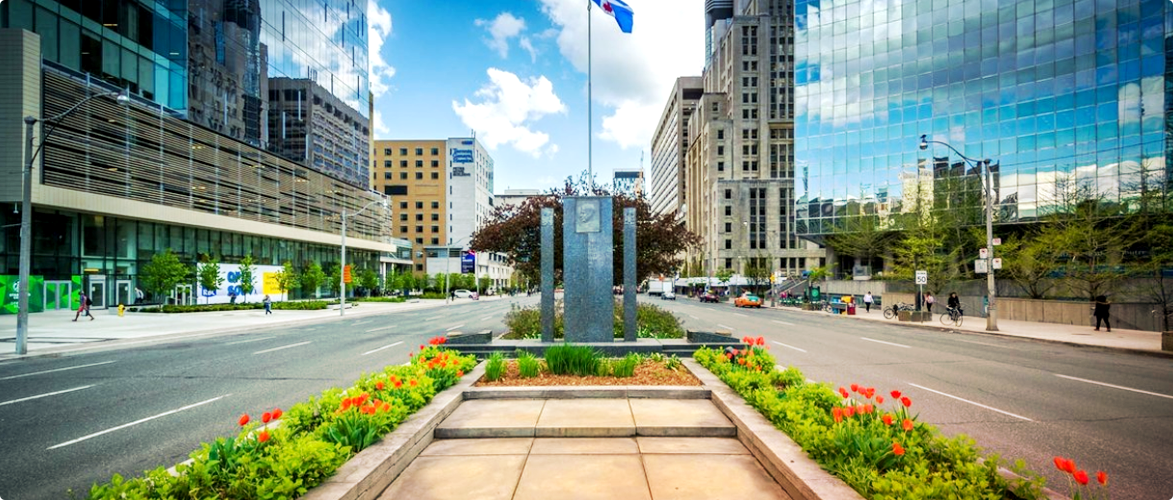
The Discovery District is the dense downtown precinct built around the University of Toronto St George campus and the largest concentration of hospitals in the country, stretching roughly from Bloor to College and from Spadina to Bay. Condos here are almost entirely purchased by investors, hospital workers, researchers, and parents buying for students at U of T or OCAD: one-bedrooms were trading between $550,000 and $750,000 in early 2026, and two-bedrooms between $750,000 and $1.1 million. Freehold property is rare; this is an overwhelmingly rental and ownership-condo neighbourhood.
The Discovery District sits in the heart of downtown Toronto, bounded roughly by Bloor Street to the north, College Street to the south, Spadina Avenue to the west, and Bay Street to the east. It’s one of the most institutionally dense blocks of land in Canada: the University of Toronto’s St George campus occupies its northern half, and a chain of major hospitals runs along University Avenue through its southern half. These aren’t incidental features. They define the neighbourhood’s character, its daily rhythm, and the practical reality of living here more completely than any other factor.
The name itself is a modern creation, promoted by the university and hospital institutions from the early 2000s onward to brand the area as a research and innovation hub. Long-time Torontonians are more likely to say they live near U of T, near the hospitals, or in Harbord Village, depending on which block they’re on. The formal name has stuck in planning documents and real estate listings but hasn’t fully replaced the older ways of locating this area. That’s worth knowing if you’re reading neighbourhood marketing materials: the Discovery District covers a lot of ground with very different sub-characters, and which block you’re actually on matters more than the branded name.
Geographically, the precinct sits on a gentle grade rising from the lakefront, with University Avenue as its main ceremonial spine and St George Street threading through the campus itself. College Street runs east-west along the southern edge, connecting to Little Italy to the west and the hospital towers to the south. The walk from the northern edge at Bloor to the southern edge at College is about 25 minutes at a steady pace, which gives a sense of how much the neighbourhood contains. For transit purposes, the discovery district is served by five TTC subway stations within or immediately adjacent to its boundaries, which is exceptional coverage by any standard and makes it effectively car-optional for most residents.
It’s a neighbourhood built for people who need to be close to something specific: the university, the hospitals, or the central business district a few blocks south. People who end up here typically have a reason that maps onto one of those three, and the neighbourhood rewards that proximity with transit access and walkability that few Toronto addresses match. What it doesn’t offer is the quiet residential character of a neighbourhood like Riverdale or the Annex. This is a working urban precinct that stays active at all hours, and the housing stock, the streets, and the daily life here reflect that.
The Discovery District is almost entirely a condo market. Freehold properties exist but appear rarely, and when they do they’re typically older multi-unit houses that have functioned as rooming houses or multi-tenant rentals for decades. The practical choice for buyers here is between buildings of different eras and different unit sizes, and that distinction matters more than it does in many Toronto neighbourhoods.
Older buildings from the 1960s through 1980s, particularly along the streets immediately north of the U of T campus, tend to have larger unit footprints than newer towers. A one-bedroom in a building from that era is more likely to be 650 to 750 square feet than the 500 to 560 square feet that became standard in purpose-built investor towers of the 2010s. The older buildings often have higher maintenance fees and may require capital for lobby and mechanical upgrades, but the living space is genuinely more usable and the buildings tend to attract a longer-term resident base rather than a transient student or Airbnb population.
New construction towers on the Spadina corridor and along College Street represent the other end of the spectrum: smaller units with higher-spec finishes, designed primarily for the investor and student rental markets. These buildings are often well-managed, but they’re dense, the common areas can feel institutional, and the unit mix is skewed heavily toward studios and one-bedrooms. For an end-user buyer who wants to live here long-term, the older mid-rise stock often offers more livable space per dollar than the newer towers despite higher fees.
Prices in early 2026 ranged from about $550,000 for a compact one-bedroom in a mid-rise building to around $750,000 for a larger one-bedroom in a better-located building closer to the subway. Two-bedrooms ran from approximately $750,000 to just over $1.1 million depending on size, floor, and building. Per-square-foot prices have softened since 2022 as the downtown condo market worked through excess investor supply, and buyers in 2026 have more room to negotiate than at any point in the preceding several years. The rental income potential here remains strong given the structural tenant demand from the university and hospitals, which keeps the investor math relevant even during softer resale periods.
The Discovery District condo market is more investor-driven than most Toronto precincts at a comparable price point, and that shapes how it behaves. A significant proportion of units in the newer towers are owned by investors rather than occupied by their owners, and that means the market responds to changes in rental yield expectations and interest rates in ways that a more owner-occupied neighbourhood wouldn’t. When rates rose through 2022 and 2023, the resale condo market here softened more than the average across Toronto, and that correction has been slow to fully reverse.
Listing-to-sale ratios in this precinct run higher than the Toronto average because the investor supply is larger. When multiple similar units in the same building appear on the market simultaneously, which happens regularly in buildings with large investor ownership percentages, buyers have room to negotiate and days on market extend. The buildings that perform best through softer periods are those with stronger owner-occupier ratios, better management, and a building reputation that attracts end-users rather than purely investors. Doing status certificate due diligence to understand the ownership breakdown in any building you’re considering is worth the time.
Seasonality in this market follows the academic calendar more than the spring-fall real estate cycle that governs most of Toronto. Demand picks up in July and August as students and academic-year renters look for fall accommodation, and again in late December for January starts. Sellers listing in the late fall shoulder season outside of academic-year demand are often working against the timing. For investors, the August listing window for September tenancy is typically the strongest rental pricing moment of the year.
The long-term demand floor here is structural and unlikely to change: U of T enrolled over 40,000 students at the St George campus in 2025, the teaching hospitals collectively employ thousands of workers who want to live nearby, and the central location draws professionals who work in the Financial District or want walkable access to downtown. None of those demand drivers disappear in a downcycle. The market softness is a price correction, not a demand problem, and historically the Discovery District has been among the more resilient precincts for rental income through soft resale periods for exactly that reason.
Graduate students and post-doctoral researchers make up a significant portion of the long-term rental population in the Discovery District, particularly in the blocks closest to the Medical Sciences complex and the Robarts Library. These are tenants who typically arrive for two to five year programs, want to walk to campus, and prefer building stability over the cheapest possible rent. They’re among the most reliable tenants in the Toronto market: professionally employed in a structured sense, stable in tenure, and genuinely motivated to stay close to where they work. For investors, a graduate student in a clinical program is a different tenant profile than an undergraduate, and it’s worth distinguishing between building locations that attract one versus the other.
Healthcare workers at the hospitals along University Avenue are a second consistent buyer and renter group. Nurses, residents, fellows, and allied health staff who work shift schedules at Toronto General, Mount Sinai, or the Hospital for Sick Children often specifically want to be within walking distance of their workplace. The shift structure of hospital work makes the short commute more than a convenience: it reduces fatigue on 12-hour day and night rotations in a way that a 40-minute transit commute cannot. This is a group that tends to stay in a unit for several years and is typically financially stable once past the residency income period.
Investors who want a straightforward hold with reliable rental income are a third buyer type. The Discovery District has been an investor target since the late 1990s for the same reason it is today: the tenant pool doesn’t dry up. Families with university-age children purchasing a unit for four years of study, then selling or renting it out, remain part of the market. These buyers are most common in the blocks closest to the St George campus and tend to prioritize building proximity to the main library and academic buildings over other factors.
End-users who genuinely want to live in this neighbourhood rather than primarily capture investment returns are a smaller but real segment. They’re typically people who work in the academic or medical complex, who value the walkability and transit access above most other things, and who have made peace with the neighbourhood’s density and urban character in exchange for a commute that takes minutes rather than hours. These buyers lean toward the older mid-rise buildings with larger units and lower turnover, and they’re the ones most likely to stay for a decade rather than cycling out in three years.
St George Street is the neighbourhood’s most distinctive residential corridor. It runs north-south through the middle of the U of T campus, flanked by some of the university’s older Victorian and Edwardian buildings, with a scale and tree canopy that feels unlike almost anywhere else in downtown Toronto. The residential buildings on and immediately off St George, particularly in the blocks between Harbord and Bloor, tend to be older mid-rises with larger suites and a more stable resident base than the newer towers further south. This is the part of the neighbourhood where end-users are most likely to be satisfied long-term, and it’s priced accordingly: units here command a modest premium over comparable square footage in newer buildings a few blocks south.
Spadina Avenue along the western edge of the precinct is a different experience entirely. It’s a wide commercial boulevard with streetcar tracks, a mix of restaurants and retail, and a density of student foot traffic that keeps it active most hours. The towers built along Spadina in the 2000s and 2010s are investor-oriented buildings with smaller units and higher tenant turnover. They’re convenient for people who want quick access to Kensington Market or Chinatown to the south, but they lack the quieter residential character of the blocks further east.
The Harbord Street corridor, which forms the northern transition between the Discovery District and Harbord Village, has a different character again. Harbord itself has a mix of restaurants and cafes that serve the university crowd, and the residential side streets off Harbord, places like Major and Lippincott, have older low-rise apartment buildings and the occasional converted house that attract long-term residents rather than transient students. This pocket functions more like a traditional residential neighbourhood than most of the Discovery District.
The blocks immediately north of College Street along University Avenue are the most institutional in character: the hospital towers, the medical research buildings, and the professional office towers dominate the streetscape. Condos in this southern section of the precinct are well-located for hospital workers but trade something in livability for that convenience. The proximity to the hospital service entrances and the traffic on University Avenue means these are not quiet residential streets, and buyers evaluating units in this section should visit at different times of day to understand what the noise and activity levels actually mean at street level.
The Discovery District has among the highest transit scores of any residential address in Toronto, and that isn’t marketing language: it reflects a genuine concentration of TTC infrastructure. The St George subway station sits at the corner of Bloor and St George and is one of the busiest interchange stations in the system, connecting the Bloor-Danforth Line 2 running east-west with the University-Spadina Line 1 running north-south. Museum station, one stop south on Line 1, sits at the southern campus edge near Bloor and Avenue Road. Bay station on the Bloor line is immediately east at Bay and Bloor. Queens Park station on Line 1 is at College and University, at the southern edge of the precinct. Spadina station is at Spadina and Bloor on the northwestern corner.
What this means in practice is that from almost any address in the Discovery District, a subway station is no more than a 10-minute walk. The Line 1 runs from Union Station in the south to Vaughan Metropolitan Centre in the north, and it runs frequently: service is every 2 to 3 minutes during peak hours, and the ride to Union is about 10 minutes from Queens Park station. For anyone commuting to the Financial District or connecting to GO Transit, that’s a commute most of the city can’t match.
Surface transit adds additional coverage. The College streetcar, TTC route 506, runs east-west along College Street and connects to the Danforth via Parliament Street. The Spadina streetcar, route 510, runs north-south along Spadina from Union Station to Spadina station. Both routes run frequently and give access to neighbourhoods west and east without requiring a subway transfer. Bus routes on Harbord, Bloor, and Bay fill in the gaps between the subway corridors.
Cycling infrastructure has improved along College Street and Spadina Avenue, with protected lanes on both routes as of 2025. The campus streets themselves are largely low-traffic and rideable during daylight hours. For people who work within the university or hospital complex, walking is the most practical choice for most trips, and the neighbourhood is genuinely designed to be walkable at a scale that most of Toronto is not. Car ownership is low by Toronto standards in this precinct, and parking is both expensive and inconvenient, which is something buyers who own vehicles should factor in before purchasing here.
Green space within the Discovery District precinct itself is mostly institutional rather than public park. The U of T campus grounds, particularly the area around Hart House, Convocation Hall, and the Front Campus lawn between King’s College Circle and College Street, are open and accessible to anyone, and in warm months they function as the neighbourhood’s de facto park. The Front Campus is a wide grassed oval with mature trees that creates a breathing space in an otherwise very dense urban precinct. It’s not a park in the formal City of Toronto sense, but it works like one for daily life, and dog walkers, readers, and people eating lunch on the grass are a regular feature from spring through fall.
Queen’s Park itself, the large provincial park surrounding the Ontario Legislative Building, is directly adjacent to the eastern edge of the precinct. It’s a significant green space with tree-lined paths, benches, and enough room to feel genuinely removed from the urban grid for a stretch. The park is open and accessible, hosts occasional public events, and is used heavily by university students and neighbourhood residents alike. The combination of Queen’s Park and the campus grounds means that residents in the eastern half of the precinct have relatively good access to open space without leaving the immediate area.
For more conventional park use, Philosopher’s Walk is a linear pathway that runs from Bloor Street south through the campus along a former creek bed, lined with trees and passing through some of the quieter parts of the campus grounds. It’s not a large space, but it’s a pleasant walking route that connects the Bloor corridor to the Museum station area and provides a rare break from the street grid. Trinity Bellwoods Park is about a 20-minute walk to the west along Queen Street, and Christie Pits is a 15-minute walk northwest along Bloor. Both parks are accessible for regular use from the Discovery District, though neither is within the precinct itself.
The ravine system that defines so much of Toronto’s natural geography doesn’t extend into the Discovery District, which sits on the relatively flat upper city plateau well north of the lake. Residents who want ravine access for trail running or cycling are looking at a transit trip or a longer bike ride to reach the Don Valley or the Humber River trail systems. For the daily running route or dog walk, the campus grounds and Queen’s Park fill the role, and they do so reasonably well given the urban density of the surrounding area.
The retail and food landscape in the Discovery District is built around the people who work and study there rather than around neighbourhood residents with conventional domestic routines. That shapes what’s available. There are dozens of coffee shops, quick-service restaurants, and lunch spots within the precinct, and the quality at the better end of that spectrum is high. Cafes on Harbord Street and in the streets immediately north of the campus, particularly around the Spadina-Harbord intersection, serve a university crowd that is discerning about coffee and lunch. Robarts Library has a food court. Victoria University and Trinity College have their own dining halls.
Full grocery options within the precinct are limited. There’s no large grocery store within the Discovery District itself. The closest Loblaws is on Carlton Street east of the precinct, about a 15-minute walk from the eastern edge. FreshCo on Spadina and a Whole Foods on Avenue Road are the practical options for residents on the western and eastern sides respectively. The St Lawrence Market is a longer trip by transit. Residents who do regular grocery runs by car or who rely on delivery services will find the grocery situation manageable. Those who want to walk to a large supermarket will find it a consistent inconvenience.
Kensington Market, immediately to the southwest along Spadina and Dundas, compensates for the grocery gap with a density of independent food shops, bakeries, cheese shops, and produce vendors that is hard to match anywhere else in the city. It’s not a substitute for a supermarket run, but for fresh produce, specialty items, and the kind of food shopping that rewards browsing rather than list-checking, Kensington is within a 10-minute walk from most Discovery District addresses. Chinatown, directly adjacent to Kensington along Spadina from Dundas south, adds another dimension of food retail for residents who cook at home regularly.
The Church-Wellesley Village is immediately east, roughly accessible on foot from the eastern edge of the precinct, and it adds a strip of bars, restaurants, and services with a distinct character. Bloor Street along the northern edge of the precinct has a denser commercial strip: banks, pharmacies, independent restaurants, and some retail. The LCBO on Bloor near Bay and the Shoppers Drug Mart at Bloor and St George are among the most practical everyday anchors for residents in the northern half of the precinct. For a neighbourhood defined primarily by institutions, the daily life amenities are reasonable, though anyone accustomed to the denser retail of Roncesvalles or Danforth will notice what’s absent.
The Annex to the north is the most direct comparison for buyers considering the Discovery District. Both are dense urban neighbourhoods with a strong university influence, both have good transit, and both attract a professional and academic resident base. The Annex skews more toward owner-occupation in its housing stock: it has a larger proportion of converted Victorian houses and low-rise apartments that attract long-term residents who aren’t primarily investors. The Discovery District is denser, more institutional in feel, and has a higher proportion of rental and investor-owned units. Buyers who want the university-adjacent character with a somewhat more residential street experience tend to lean toward the Annex. Buyers who specifically want proximity to the hospitals or to the central U of T campus typically choose the Discovery District.
Kensington Market to the southwest is a contrast in almost every dimension. It’s less dense vertically, more intensely mixed in use, and has a market and cultural character that is unlike anywhere else in Toronto. Housing stock in Kensington is older and more varied, and freehold properties do appear, though at significant prices given the location. The neighbourhood draws buyers who want the specific character of that street culture, which is vivid and not for everyone. Discovery District buyers who want access to Kensington can have it on foot, which is the best of both worlds for some residents.
The Financial District and Bay Street corridor immediately to the south and east represent a different use case entirely: very dense, primarily commercial, with condo towers that have a different buyer profile from those in the Discovery District. Condos near Bay and King attract a younger professional crowd commuting within the core; Discovery District condos attract investors, students, and healthcare workers. Transit access is comparable; the feel is very different. Buyers evaluating these two areas are typically choosing between neighbourhood character and commute destination rather than price, since comparable units trade at similar levels.
Elementary school options within the Discovery District precinct itself are limited by the neighbourhood’s overwhelmingly institutional and residential-rental character. The University of Toronto Schools, known as UTS, is a selective secondary school on Bloor Street operated by the university, with admission by competitive examination. It’s not a neighbourhood school in any conventional sense, but it draws students from across the city and is one of the most academically competitive secondary schools in Ontario. Its presence within the precinct is relevant for families with academically oriented children who are willing to compete for admission.
For families with younger children, the more practical school catchment question involves the Toronto District School Board elementary schools on the edges of the precinct. Huron Street Junior Public School, just east of Spadina on Huron, serves part of the area. Essex Junior and Senior Public School, slightly further afield, serves parts of the catchment toward the Annex. Families purchasing in the Discovery District with children of elementary school age should confirm the specific catchment boundary for the address they’re considering, since the precinct’s irregular shape and the concentration of institutional land means catchment boundaries here require direct verification from the TDSB rather than inference from the neighbourhood name.
For post-secondary proximity, the Discovery District is obviously unmatched in Toronto. U of T, OCAD, and George Brown College’s downtown health sciences campus are all within the precinct or directly adjacent. For households with family members attending any of these institutions, that proximity is practical rather than merely convenient: it removes transit time from a daily schedule that is otherwise dense, and for medical students in clinical placements at Hospital Row, the walk from apartment to hospital at 5 a.m. is a genuine quality-of-life consideration.
What do condos in the Discovery District cost? In early 2026, one-bedroom condos in the precinct were trading between $550,000 and $750,000 depending on building age, condition, and specific location. Newer purpose-built towers with smaller unit sizes tended toward the lower end of that range on an absolute basis, though their per-square-foot prices were not necessarily lower than older buildings with larger suites. Two-bedrooms ranged from $750,000 to just over $1.1 million. Buildings closer to the St George and Museum subway stations, and those on quieter streets away from the hospital and University Avenue traffic, typically commanded a modest premium over equivalent square footage further south. The condo market here has been soft since 2022, and buyers have more negotiating room than at any point in the preceding several years.
Is this neighbourhood safe? The Discovery District is a dense urban environment with high foot traffic at all hours, which produces a street-level activity that most residents experience as adding rather than reducing safety. The hospital presence means the neighbourhood never truly empties out: shift workers, on-call residents, and overnight staff create pedestrian activity through the night. The areas around Kensington Market and along some of the Spadina side streets are livelier and require the same awareness that any active urban neighbourhood does. U of T campus security patrols within the university grounds around the clock. The neighbourhood is not exceptional in either direction relative to other dense downtown Toronto precincts: safer than some, comparable to most.
What rent can I expect from a condo here? One-bedroom condos in the Discovery District were achieving rents of $2,100 to $2,600 per month in early 2026, depending on building, condition, and location within the precinct. Buildings closer to the subway stations and in better condition achieved the upper end of that range. Two-bedrooms were renting between $2,700 and $3,400. The student rental market, for furnished short-term academic-year leases, operates at slightly different rates and with different tenant expectations: some landlords achieve above-average rents for well-furnished units targeted at international graduate students, particularly in buildings close to the Medical Sciences complex. Investors should model returns using the middle of the achievable rent range rather than the top, since vacancy between tenants and the time to place a tenant affect actual annual yield.
Are there any freehold properties available in the Discovery District? Freehold properties do appear occasionally, but they’re rare and priced accordingly. The neighbourhood’s density and institutional land use have long since consumed most of the original residential housing stock. When a freehold property does come to market, it’s typically a multi-unit converted house that has functioned as a rooming house or multi-tenant rental for decades. The prices reflect both the scarcity and the income-producing potential of the existing use rather than a straightforward residential value. Buyers seeking freehold in a university-adjacent downtown neighbourhood will generally find better options in the Annex or Harbord Village, where the housing stock is more intact and listings appear more regularly.
What is the vacancy rate for rentals near U of T? Vacancy near the U of T St George campus is structurally low because annual student intake is large and consistent. The university enrolls over forty thousand undergraduate and graduate students at the St George campus, and a significant proportion seek off-campus housing in the surrounding blocks. Hospital Row adds another layer of tenant demand from healthcare workers. In practice, a well-priced, clean one-bedroom condo in a decent building close to the campus typically finds a tenant within two to four weeks of listing in the September and January peak periods. The risk to vacancy is primarily from poor pricing, poor condition, or unusual building restrictions rather than from a shortage of demand in the tenant pool.
The area that became the Discovery District was part of the original York town site and was developed as a residential neighbourhood from the mid-nineteenth century. The University of Toronto received its royal charter in 1827 and was established on its current St George campus site beginning in the 1850s, with University College completed in 1859 as the precinct’s founding building. The university’s expansion through the late nineteenth and early twentieth centuries progressively converted residential blocks into institutional land, a process that has continued in various forms ever since.
Hospital Row on University Avenue developed through the first half of the twentieth century as Toronto’s major hospitals consolidated their locations along the avenue and in the surrounding blocks. Toronto General Hospital traces its origins to 1819 but moved to its current University Avenue location in 1913. The Hospital for Sick Children has been on University Avenue since 1891. Mount Sinai Hospital opened at its current address in 1953. The concentration of these institutions along a single corridor was partly deliberate planning, partly the result of available land adjacent to the university’s medical faculty, and partly the legacy of a public health infrastructure built during a period when Toronto was growing fast and establishing permanent institutions quickly.
The name “Discovery District” is a relatively recent marketing invention, promoted by the university and hospital institutions from the early 2000s onward to emphasise the research and medical innovation occurring within the precinct. The name has had mixed uptake among residents, many of whom continue to refer to the area by its constituent parts: the campus, Hospital Row, Harbord Village for the residential blocks to the north, or simply “around U of T.” The institutional name has been more successful in attracting research investment and commercial tenants than in reshaping how Torontonians describe where they live, which is typical of neighbourhoods defined by specific built form rather than by a commercial branding exercise.
Street-level knowledge is hard to find online. Our team works in Discovery District (University of Toronto) every day. They know which pockets hold value, where the school catchment lines actually fall, and what the market is doing right now. Talk to us before you make a decision about Discovery District (University of Toronto).
Talk to a local agent