
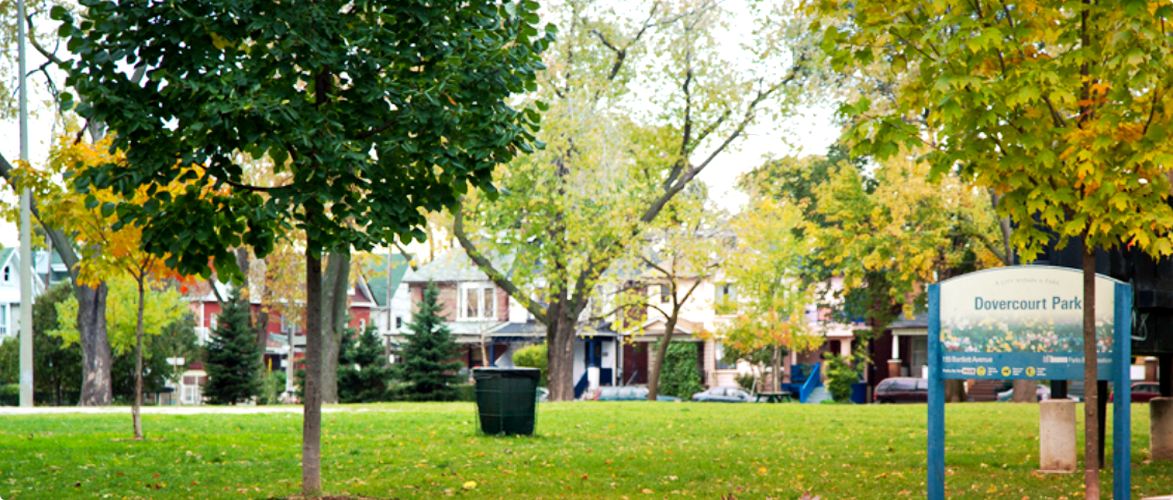
Dovercourt Park is a compact west-end neighbourhood of 1905-to-1920 brick semis sitting between Dufferin and Ossington, with Bloor Street along the south and Davenport Road along the north. It gentrified steadily through the 2010s without losing the density or the mix that made it worth gentrifying. Renovated semis on Dovercourt Road and Margueretta Street were trading between $1.1 and $1.35 million in early 2026, with the best fully-renovated properties pushing toward $1.5 million on larger lots.
Dovercourt Park sits in the part of the west end that buyers discover after they’ve priced themselves out of Trinity Bellwoods and reconsidered Roncesvalles. It’s bounded by Dufferin Street to the west, Ossington Avenue to the east, Bloor Street to the south, and Davenport Road along the north. The streets in between are dense with 1905-to-1920 brick semis on narrow lots, and the neighbourhood has the feel of a place that gentrified at a pace it could absorb rather than one that got flipped overnight.
The commercial activity concentrates along Bloor Street, where Dovercourt Park connects to the Bloordale Village strip stretching west toward Lansdowne. Restaurants, bars, and independent shops give the southern edge of the neighbourhood more energy than the residential streets suggest. The residential blocks above Bloor are genuinely quiet: family-scaled semis, backyard gardens that get real sun in summer, and lanes that have seen steady laneway suite conversion since the city bylaw came in. Concord Avenue, Margueretta Street, and Beatrice Street are the blocks that most buyers end up shortlisting.
The price advantage over comparable properties to the east is real and persistent. A renovated semi in Trinity Bellwoods trades 25 to 35 percent above a comparable property in Dovercourt Park. Some of that gap reflects the park and the Queen West address. Some of it is simply inertia in how buyers form their shortlists. Dovercourt Park has been closing the gap for fifteen years without closing it entirely, which means buyers who get there early have consistently done well.
The typical purchase in Dovercourt Park is a two-and-a-half storey brick semi from the first two decades of the twentieth century. Frontages run 14 to 18 feet. The original floor plan is three bedrooms, one bathroom, and a basement that varies from a functional lower level to a dug-out mess depending on what owners have done over the years. Renovated semis on Dovercourt Road, Margueretta, and Concord with updated kitchens, modern bathrooms, and refinished hardwood traded between $1.1 million and $1.35 million in early 2026.
A meaningful number of properties have had third-floor additions, converting the original two-and-a-half storey configuration into a full three-storey with a proper third bedroom or primary suite. These additions add substantially to usable floor area and trade at a premium reflecting the cost of the work. Expect $1.3 to $1.5 million for a well-executed addition on a renovated semi with a finished basement. Unrenovated properties in original condition or with dated cosmetic work but good bones tend to come in between $850,000 and $975,000.
Detached homes exist in the neighbourhood but are uncommon. When they appear, they carry a significant premium over semis on comparable lots. A three-bedroom detached in reasonable condition starts around $1.4 million. The lane behind many residential streets has become a secondary housing resource as laneway suites have been added. These suites generate income but also shift how the property is used; buyers should understand whether the suite is vacant, tenanted, or self-contained before factoring it into a purchase decision.
Parking is the persistent constraint. Most of the semis predate cars, and a lot of them have no dedicated off-street parking. Some lanes have garages or pads; many do not. Confirm the parking situation before falling in love with a specific property.
Dovercourt Park runs with the west end freehold market rather than against it. Spring, specifically February through May, produces the densest buyer pool and the most competitive conditions on well-priced semis. October is the second active window. The winter months are slower, and properties listed in December and January typically carry more room on price than equivalent spring listings.
In early 2026, the neighbourhood is seeing fewer formal offer nights than it did in 2021 and 2022, but desirable properties on the best streets still attract multiple offers when they’re priced correctly. The market for unrenovated semis is longer: buyers capable of managing a renovation are fewer than they were when construction costs were lower, so fixers sit for two or three weeks before finding their buyer at a number that reflects the current cost of work.
The condo market in Dovercourt Park is thin. There are a small number of purpose-built and converted buildings, mostly on or near Bloor, but the neighbourhood is predominantly freehold and buyer interest concentrates there. Days on market for condos is running longer across the city, and the Dovercourt Park supply is small enough that individual listings can be uncharacteristically slow or fast without indicating a broader trend.
The buyers who end up in Dovercourt Park have usually looked at Trinity Bellwoods and Roncesvalles first. They know the west end. They’ve done the commute math on the Bloor-Danforth line. At some point they’ve priced a semi on Crawford or Euclid and worked backwards to what they could realistically afford, and Dovercourt Park is where that math leads. It’s not a second choice by the time they arrive; it’s a deliberate conclusion.
The neighbourhood draws a younger buyer than Trinity Bellwoods: households in their early-to-mid thirties making a first freehold purchase, often coming out of a condo they bought five or six years earlier and selling into a market that gives them enough equity to carry a semi mortgage if they pick the right neighbourhood. Dovercourt Park’s price point is the right neighbourhood for that cohort in 2026. The renovation burden on many properties also selects for buyers who can manage a project, either physically or financially, which creates a different owner profile than a neighbourhood where everything is move-in ready at a price that reflects it.
Young families are present and growing in number. The semis have enough space for two adults and two children without strain. The parks are within walking distance, including Dovercourt Park itself on Delaware Avenue, which has a splash pad, a tennis court, and a playground that actually gets used. The school situation is functional but not exceptional; parents with specific program priorities typically investigate TDSB options before assuming the catchment school will serve their needs.
The north-south gradient within Dovercourt Park matters. The blocks closest to Bloor Street are noisier and have more foot traffic, which is a feature or a drawback depending on how you use the neighbourhood. The blocks north of College Avenue, toward Davenport, are quieter and more purely residential. Prices do not vary dramatically north to south within the neighbourhood, so buyers who want calm streets can find it without paying a meaningful premium.
The brick on the early-twentieth-century semis here is generally in reasonable shape, but the lime mortar pointing on older sections deteriorates over decades and repointing is a recurring cost that many sellers underinvest in. Look at the mortar joints on the front facade and on exposed sidewalls before making an offer, and factor repointing into your cost model if it needs work. A full repoint on a semi runs $8,000 to $15,000 depending on the extent and who does it. It’s not a crisis, but it’s a cost that should be priced in rather than discovered after closing.
Basements vary widely. Some have been properly underpinned and converted to usable living space with appropriate ceiling height. Others are original shallow basements with rubble stone foundations and five-and-a-half feet of headroom. A home inspection that covers the foundation type and basement condition will tell you what you’re buying. Underpinning costs $60,000 to $90,000 for a typical semi and takes two to three months, so a basement that needs it should reflect that in the purchase price.
The Bloor-Danforth subway stations at Dufferin and Ossington are the neighbourhood’s primary transit assets. Know which side of the neighbourhood a given property sits on, since a ten-minute walk to Dufferin station from the west end of the neighbourhood is a different commute than a seven-minute walk to Ossington from the east end. Both are good. The specific difference is worth knowing before you move.
Dovercourt Park buyers are experienced west-end shoppers by the time they reach an offer table here. They’ve seen the comparables in Roncesvalles and Trinity Bellwoods. They know what a $1.2 million semi looks like in this part of the city, and they can tell immediately whether a property has been prepared for sale or just put on the market. Properties that arrive in good condition, photographed well, and priced correctly find buyers quickly. Properties that arrive with deferred maintenance visible on first showing sit longer and sell for less than they would have with basic preparation.
The renovation work that matters most to Dovercourt Park buyers is the kitchen and the bathrooms. These are the rooms that close the gap between a property selling at $1.05 million and one selling at $1.25 million. Character features that survive, including original hardwood refinished properly, brick exposed where it exists, and the front facade maintained, support the higher end of the range. Work that feels installed to sell rather than to live in, including laminate over hardwood and composite stone on a kitchen that doesn’t match the house, tends to depress offers rather than lift them.
Spring is the clearest timing advantage. A well-presented semi listed in March or April will see more buyer activity than an equivalent property listed in September or November, and will likely perform better on price as a result. Sellers with flexibility should target the February-to-May window and have the property ready before listing.
Bloor Street along the neighbourhood’s southern edge runs through two distinct commercial stretches. East of Dufferin toward Ossington, the strip is denser and more varied: independent restaurants, a few bars, and the kind of retail that serves a neighbourhood doing its weekly shopping alongside people choosing it as a destination. West of Dufferin, into Bloordale Village proper, the concentration of restaurants and bars has made it a recognised night-out destination for people from across the west end. Get Well, with its games floor and bar, and the Bellwoods Brewery taproom are the highest-profile anchors, but the strip runs four or five blocks with consistent quality.
Dovercourt Park itself, the park that gives the neighbourhood its name, sits on Delaware Avenue between Westmoreland and Bartlett. It’s a functioning neighbourhood park rather than a destination: a splash pad, a tennis court, a wading pool in season, and a playground with good equipment. On a weekday morning in summer it draws the stroller crowd from the surrounding blocks. It’s not Trinity Bellwoods Park in scale or social function, but it’s a real asset for families with young children within the catchment.
The Bloor-Ossington intersection at the neighbourhood’s eastern edge is a commercial node in its own right, with options in both directions. Ossington Avenue running south from Bloor offers cafe and restaurant options that Dovercourt Park residents walk to as naturally as anything on the Bloor strip itself. The effective commercial footprint available to someone living mid-neighbourhood on Concord or Margueretta is larger than the Dovercourt Park address alone suggests.
The Bloor-Danforth subway line runs along the neighbourhood’s southern boundary, with Dufferin station at the west end and Ossington station at the east end. Most properties in Dovercourt Park are within a ten-to-fifteen minute walk of one or both stations. The Ossington station connection puts Bay Street within twenty minutes door-to-platform. Dufferin station connects west toward Kipling in one direction and east toward downtown in the other. Both stations are a practical commute asset rather than a theoretical one.
The 63 Ossington bus runs north from Ossington station up Ossington Avenue and then Dufferin Street, connecting the neighbourhood to the Annex and to communities north of Bloor. The 47 Lansdowne bus runs south from Bloor to King Street and the waterfront. Neither replaces the subway for daily commuting, but they extend the transit reach of the neighbourhood meaningfully for residents who live on the western side closer to Dufferin.
Cycling is realistic and increasingly used. The Bloor Street bike lanes run east from Christie station, putting the neighbourhood a short ride from the core network. The Don Valley trail system is a longer haul, but the Bloor Viaduct connection means a committed cyclist can reach it from Dovercourt Park in about twenty-five minutes. For a neighbourhood this close to the Bloor-Danforth line, most residents commute by subway and use a bike for local trips: groceries, the Bloor strip, Ossington.
Bloordale Village and Dovercourt Park share a boundary and the same era of housing stock. The practical difference is the commercial energy on Bloor: Bloordale’s strip between Dufferin and Lansdowne has become a destination with a higher profile than anything in Dovercourt Park proper. Properties on the Bloordale side of the boundary command a small premium for that proximity. Buyers who want the strip nearby but aren’t motivated by being immediately adjacent will find Dovercourt Park gives them essentially the same access at a slightly lower price. The two neighbourhoods bleed into each other at ground level; the distinction matters more on a listing sheet than in daily life.
Roncesvalles is the comparison that comes up most often among buyers who are seriously considering the west end. The housing stock is the same type and era as Dovercourt Park, and Roncesvalles has a well-developed commercial strip on Roncesvalles Avenue with strong independent food and retail options. High Park gives Roncesvalles a green space asset that Dovercourt Park’s smaller park cannot match. Roncesvalles is also 10 to 20 percent more expensive for comparable properties, reflecting both the park and the neighbourhood’s longer-established desirability. Buyers who narrow to these two usually decide based on which direction they commute: Roncesvalles is more useful for the Gardiner westbound; Dovercourt Park is more useful for the Bloor-Danforth east.
The west-end comparison that rarely gets made is against the blocks west of Dufferin in Dovercourt Park proper versus the comparable blocks in Corso Italia or Brockton Village. Both offer earlier-stage gentrification at a lower price point, with similar housing stock. Buyers drawn to Dovercourt Park for value reasons should look at those alternatives before deciding; the price differences are meaningful.
Dovercourt Park has gentrified without becoming uniform. The residential streets still have a mix: long-term owners who bought before the neighbourhood changed, newer owners who renovated, rental properties in various states of repair, and a handful of houses that haven’t been meaningfully updated in thirty years. That mix is visible on almost every block. Buyers who want a neighbourhood where every house looks like a magazine photo will find Dovercourt Park has not fully arrived at that point. Buyers who find the mix of a neighbourhood still becoming itself more interesting than one that has already become it tend to land here and stay.
The lane culture is real and active. The laneways behind the residential streets have seen consistent laneway suite construction since the City of Toronto bylaw came into effect, and walking the lane behind a property before making an offer tells you things the listing doesn’t. How the lane is maintained, what kind of neighbour activity happens there, whether the garage is in good shape or a liability: these details matter at the price point Dovercourt Park operates at. A well-maintained lane adds to the experience of owning a property in a way that doesn’t show up in the square footage.
The neighbourhood is also physically flat, which is relevant in a city with significant topographic variation. Cycling, running, and walking with a stroller are all easier here than in parts of the west end that climb toward Davenport or the escarpment. That flatness is one of those details buyers who have lived in the neighbourhood cite without prompting. It sounds minor. After five years of daily life, it adds up.
What are homes selling for in Dovercourt Park in 2026? Renovated semis on streets like Dovercourt Road, Margueretta, and Concord were trading between $1.1 million and $1.35 million in early 2026. Properties with a third-floor addition, a finished legal basement suite, or a double-car garage reach toward $1.5 million. Unrenovated semis with good bones but needing a full kitchen and bathrooms typically come in between $850,000 and $975,000, and represent the entry point for buyers who can manage a project. Detached homes are uncommon in the neighbourhood but appear occasionally, starting around $1.4 million and ranging higher depending on lot size and condition.
Is Dovercourt Park a good neighbourhood for families? It works well for families with young children. The semis have enough space for two adults and two children, the Dovercourt Park splash pad and playground on Delaware Avenue are within walking distance of most of the residential streets, and the Bloor-Danforth line makes the neighbourhood practical for parents commuting in different directions. The school situation is functional rather than exceptional: the catchment includes Dovercourt Public School and Bloor Collegiate Institute at the secondary level. Families with specific program needs or academic priorities often investigate TDSB French Immersion streams or alternative schools before assuming the catchment will serve them. The neighbourhood supports family life without having the school infrastructure that some buyers have been led to expect.
How does Dovercourt Park compare to Bloordale Village for buyers? The two neighbourhoods share a boundary and similar housing stock in type and era. The main difference is commercial: Bloordale’s strip on Bloor between Dufferin and Lansdowne has a more developed destination bar and restaurant scene, with Get Well and the Bellwoods Brewery taproom drawing people from across the west end on weekends. Dovercourt Park’s residential streets are quieter and see less weekend foot traffic. Prices are comparable, with Bloordale commanding a modest premium on the blocks immediately adjacent to the strip. Buyers who want the action within easy walking distance but not directly underfoot tend to find Dovercourt Park the better fit. The difference is not dramatic enough to change the commute or the daily-use math; it comes down to how much neighbourhood-as-destination matters to you.
Dovercourt Park’s price gap relative to Trinity Bellwoods and Roncesvalles has been closing for fifteen years. It has not closed entirely. That persistence tells you something about how buyer shortlists form: neighbourhoods acquire reputations that lag the reality by five to ten years, and buyers who arrived in Dovercourt Park in 2012 when the gap was wider paid prices that reflected how the neighbourhood was perceived rather than what it was actually becoming. The buyers arriving now are not getting that same arbitrage opportunity, but the neighbourhood still represents better value per square metre of brick semi than comparable options to the east.
The transit infrastructure is already in place. Two subway stations on the Bloor-Danforth line, each within walking distance of the neighbourhood’s edges, is a transit asset that most Toronto buyers understand and price accordingly. The Bloor bike lanes have extended east from Christie, putting Dovercourt Park within connected cycling range of the city’s growing cycling network. Neither of these things will change; both underpin the neighbourhood’s long-term demand as a residential address.
The laneway suite capacity across the neighbourhood’s residential blocks adds a dimension to ownership that didn’t exist fifteen years ago. A semi that can generate $1,800 to $2,200 per month from a well-built laneway suite is a meaningfully different financial asset than the same semi without one. As more of that capacity gets built out, it reshapes the neighbourhood’s ownership economics in ways that support long-term demand from buyers who think about carrying costs as well as purchase price.
Street-level knowledge is hard to find online. Our team works in Dovercourt Park (Bloorcourt Village) every day. They know which pockets hold value, where the school catchment lines actually fall, and what the market is doing right now. Talk to us before you make a decision about Dovercourt Park (Bloorcourt Village).
Talk to a local agent