
East Bayfront is a new waterfront neighbourhood stretching from Yonge Street east to Parliament, below the Gardiner Expressway, built largely from scratch over the past fifteen years as part of Waterfront Toronto's revitalization of the central waterfront. Condo prices in early 2026 range from $550,000 to $750,000 for a one-bedroom and $750,000 to $1.2 million for a two-bedroom, with south-facing lake view units commanding a clear premium. The area is still being built out, and what it looks like in five years will differ meaningfully from today.
East Bayfront runs from Yonge Street east to Parliament, bordered by Queens Quay East to the south and the Gardiner Expressway to the north. The whole area sits on what was, until recently, a working industrial waterfront: tank farms, rail yards, and port infrastructure that gradually went quiet over the second half of the twentieth century. Waterfront Toronto took over the revitalization mandate in the early 2000s, and what has been built since is a specific kind of new neighbourhood: planned public spaces, new condo towers, and a developing street grid that doesn’t yet have the depth of established Toronto neighbourhoods.
Sugar Beach and Sherbourne Common are the standout public spaces. Sugar Beach, at the foot of Jarvis, opened in 2010 with pink umbrellas, a sandy shoreline, and a promenade that has become genuinely well-used by the buildings nearby. Sherbourne Common, a few blocks east, combines a splash pad, lawn space, and a water treatment feature into an award-winning piece of urban infrastructure. The Corus Entertainment building at Queens Quay and Sugar Beach, and the George Brown College waterfront campus east of Parliament, generate a significant daytime population that the neighbourhood retail depends on.
The blocks are not equally built out. The western end near Yonge is the most developed. The stretch east of Jarvis toward Parliament has more gaps, more surface parking lots, and more development activity. Buyers who are thinking about this as a place to live for the next decade should look not just at the finished buildings but at what’s coming between them, and how the neighbourhood will feel when those gaps are filled.
East Bayfront is essentially a condo market. There are no freehold houses, no semis, no townhouses of the kind you’d find in Trinity Bellwoods or Leslieville. What you’re buying is a unit in one of several mid-to-high-rise towers built between roughly 2008 and the present, with more towers under construction or recently completed. The buildings are newer and better insulated than older Toronto condo stock, which matters both for noise attenuation from the Gardiner and for energy costs.
One-bedroom units run from $550,000 to $750,000 in early 2026, depending on floor, exposure, and finishing quality. The spread within that range is real: a seventh-floor north-facing one-bedroom in an older building trades quite differently from a fifteenth-floor south-facing unit with a lake view and updated kitchen. Two-bedrooms range from $750,000 to $1.2 million. South-facing lake view units carry an explicit premium over comparable north-facing units in the same building, and that premium has historically held up well at resale because the view is genuinely scarce in Toronto.
Parking spaces sell separately and run between $50,000 and $80,000. Locker storage is typically available for $15,000 to $25,000. Monthly maintenance fees on newer buildings run from around $0.55 to $0.70 per square foot, which for a 650 square foot one-bedroom puts monthly carrying costs before mortgage in the $360 to $450 range. Buyers calculating affordability should run those numbers alongside the mortgage payment to get an accurate picture of monthly costs.
East Bayfront condos have behaved like the broader Toronto condo market since 2022: a period of softness and elevated inventory that shifted negotiating power toward buyers. Days on market stretched through 2023 and 2024, and sellers who needed to move property accepted discounts that would have been unthinkable in 2021. The correction was sharper here than in freehold markets because the investor concentration is higher. A meaningful portion of these units were purchased pre-construction as investment properties, and when carrying costs rose with interest rates, some of those investors listed rather than absorb the cash-flow shortfall.
In early 2026 the condo market shows some stabilisation, but it remains a buyer’s market in most of the waterfront condo corridor. Well-presented units with south-facing lake views and rare floor plans sell faster and with less price negotiation than interior-facing units or north-facing units with Gardiner views. Buyers with financing in place and flexibility on timing have genuine room to negotiate, particularly on units that have been sitting for more than three weeks.
The investor component also means some buildings carry rental units that were listed and re-listed as the market softened. Buyers who plan to live in these buildings should review the owner-occupancy ratio in the building’s status certificate, as buildings with very high rental rates can have different management dynamics than owner-occupied buildings.
Three distinct buyer types account for most East Bayfront purchases. The first is the downtown worker who wants to live within walking distance of the financial district and Union Station, values lake proximity over neighbourhood character, and isn’t particularly interested in a busy commercial street or a park community. These buyers are comparing East Bayfront to CityPlace, the South Core, or the eastern Distillery area, and they’re choosing partly on price and partly on the outdoor space at Sugar Beach and the waterfront promenade.
The second is the investor buyer, purchasing either to rent out or to hold on the thesis that waterfront land in a major North American city will appreciate over a ten-to-fifteen year horizon. This buyer drove a lot of the pre-construction activity in East Bayfront and is less active at resale in 2026 than they were in 2019 through 2021, given carrying cost pressures. But they remain part of the buyer pool, particularly for units with strong rental fundamentals: smaller footprint, south-facing, higher floor, named building with strong management.
The third is the downsizer or buyer simplifying from a larger property elsewhere in the city or the GTA, who wants a lock-and-leave condo with quality finishes, a view, and easy access to Union Station for occasional trips. These buyers are less price-sensitive than younger buyers and tend to focus on specific buildings and specific floors rather than the neighbourhood broadly. They often visit multiple times at different times of day before making a decision, which is the right approach for this particular market.
The single most important piece of due diligence specific to East Bayfront is a planning check on the blocks south of the building you’re buying into. The neighbourhood is still being built out, and approvals for new towers on waterfront blocks are active. A south-facing unit on the eighth floor of a building completed in 2015 may have an unobstructed lake view today that’s partially or fully blocked in seven years when a new tower rises in front of it. The Waterfront Toronto and City of Toronto planning portal shows current applications and approvals. A real estate lawyer familiar with the waterfront precinct plan can give you a clear picture of what’s approved and what’s possible. This is not a hypothetical risk: it has happened to owners in the neighbourhood already.
The Gardiner noise question needs a site visit, not just a floor plan. Ask the listing agent which direction the unit faces, what floor it’s on, and whether there are mechanical systems between the unit and the highway. Then visit at 8 a.m. on a weekday with the windows open. What you hear in that visit is what you’ll hear every morning. Units in newer buildings with triple-pane glazing and solid concrete construction will perform better than units in older glass-heavy buildings, but there’s no substitute for checking the specific unit.
The status certificate review for any East Bayfront condo should include a close look at the reserve fund study, the building’s litigation history, and the owner-occupancy ratio. Buildings with a high proportion of investor-owned units can have more variable condo board engagement and slower response to maintenance issues. The reserve fund tells you whether the building has been saving adequately for major repairs. A building that has been underfunding its reserve is borrowing from future owners to subsidise current low fees, and the catch-up will come.
Sellers in East Bayfront are competing in a market where buyers have choices and are not in a hurry. The waterfront condo corridor in Toronto has had elevated inventory since 2022, and listing a unit at an aspirational price hoping to negotiate down is less likely to work than pricing sharply from the start. Units priced correctly and presented well do sell, but the days of multiple offer situations on condo listings in this area are largely in the past for the current cycle.
Presentation matters more in a buyer’s market than it did in 2021. Decluttering and professional photography are baseline. South-facing units should be photographed at midday when the lake view is clear and the light is direct. Virtual staging on vacant units costs $500 to $1,000 and demonstrably improves online engagement. The gap between a well-presented listing and a poorly presented one in this market is larger than in a hot seller’s market, because buyers have time to compare and will move on from a listing that doesn’t read well in photos.
Sellers with lake view units have a genuine asset that distinguishes them from the broader waterfront condo inventory, and should price accordingly rather than anchoring to what identical interior units sold for. The view premium is real and buyers who want it will pay for it. Sellers without a lake view should be honest about what they’re selling and price against comparable interior units without inflating for a view premium they don’t have. The market knows the difference.
Sugar Beach and Sherbourne Common are the two public spaces that East Bayfront residents actually use. Sugar Beach, just east of Yonge at the foot of Jarvis Street, has a sandy promenade, pink umbrellas that go up in spring, and a direct view across the inner harbour toward the Toronto Island ferry docks. On weekday lunchtimes, it draws the Corus Entertainment and George Brown campus populations. On summer weekends it’s busy with residents from the surrounding towers. Sherbourne Common, a few blocks east, has a splash pad popular with young children and lawn space used year-round by dog owners from the neighbourhood.
The Corus Entertainment building and the George Brown College waterfront campus at the base of Parliament have meaningful effects on the street-level amenities. The ground-floor restaurants and cafes along Queens Quay East exist largely because of that daytime population, and they’re open on weekdays in ways that purely residential waterfront neighbourhoods often aren’t. This is a practical benefit for residents who work from home and want a coffee shop or lunch option on a Tuesday morning. The flip side is that some of these businesses have reduced weekend and evening hours that residents who work standard office hours find inconvenient.
The LCBO Summerhill is not nearby, but the PATH system connects to a wide range of grocery and retail options once you’re in Union Station. For daily grocery needs, there’s a Farm Boy in the South Core within a ten-minute walk, and a Loblaws at the bottom of Church Street a few blocks north. The neighbourhood lacks the corner store density of established residential areas, which some residents find a genuine inconvenience and others don’t notice at all depending on how they shop.
Walking and cycling are the primary ways East Bayfront residents navigate downtown Toronto. The Martin Goodman Trail runs along the waterfront from the west end of the city through East Bayfront and east to the Beach, and it’s one of Toronto’s best cycling routes: flat, mostly separated from traffic, and direct. Bike Share Toronto stations are well distributed along Queens Quay East, and most residents who work in the financial district or on King Street cycle or walk rather than use transit for that specific trip.
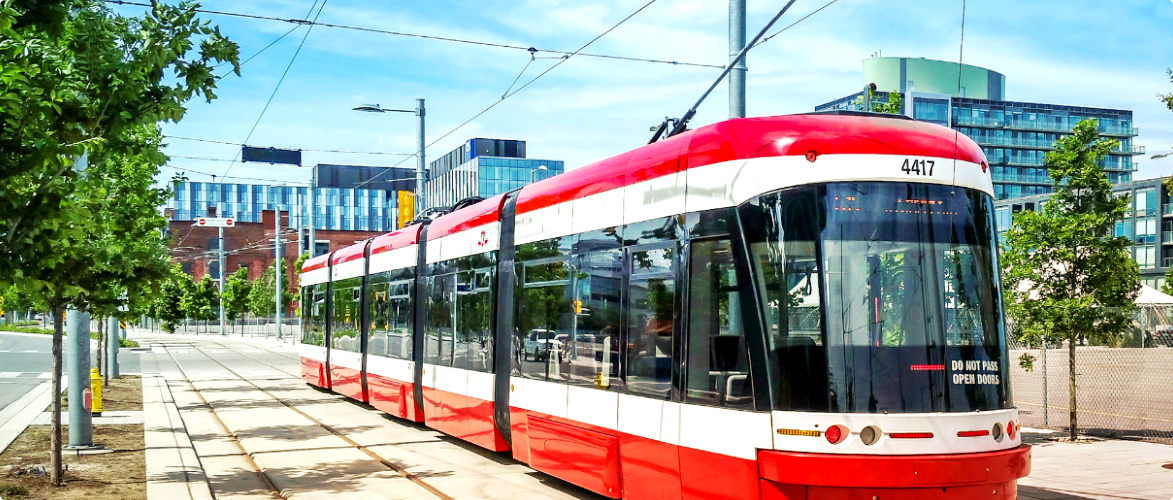
The 504 King streetcar runs along Queens Quay East and connects to King Street before continuing west. It’s the main transit link for residents and reaches Union Station at Bay Street in roughly fifteen minutes without traffic, though in peak hours surface streetcar service can be slower. The walk to Union Station is about twenty-five minutes on foot for most East Bayfront buildings, which many residents find fast enough that they walk routinely. Metrolinx GO Transit at Union provides regional connections that matter for residents with family in the suburbs or who commute to offices outside downtown.
Car ownership in East Bayfront is lower than the Toronto average, which the building parking ratios reflect: many newer condo buildings were built with one parking space per four or five units. Residents who own a car pay a premium for parking either as a separate purchase ($50,000 to $80,000 at time of sale) or through monthly rental from the building. Surface street parking is extremely limited. Residents who drive regularly find this a meaningful constraint, and buyers coming from car-dependent suburban contexts sometimes underestimate how different day-to-day logistics are in a neighbourhood where parking is genuinely scarce.
The most direct comparison is with CityPlace, the large condo development on the west side of the downtown waterfront. CityPlace has more completed infrastructure, a longer track record as a residential neighbourhood, and a comparable price range. The main differences: CityPlace is denser, with more towers and higher population concentration in a small footprint, while East Bayfront has more public realm investment and better outdoor spaces at Sugar Beach and Sherbourne Common. Buyers who visit both neighbourhoods often note that East Bayfront feels less like a condo development and more like a neighbourhood in the making, which appeals to some buyers and reads as incomplete to others.
The South Core, immediately north of East Bayfront around Bay and Bremner, has newer buildings, higher price points on average, and less outdoor space. It’s a more purely urban environment without the waterfront access that defines East Bayfront’s appeal. Buyers who don’t particularly value the lake proximity but want new construction and Union Station access often find the South Core more practical. Buyers who prioritise the outdoor experience and the waterfront promenade find East Bayfront worth the trade-off of less developed retail and longer commutes to some destinations.
The Distillery District, a few blocks northeast, is the east-end waterfront neighbourhood with the established brand, the heritage character, and the premium pricing to match. Distillery condos run 15 to 25 percent above East Bayfront prices on a per-square-foot basis. Buyers choosing between the two are usually making a decision between the Distillery’s finished neighbourhood feel and East Bayfront’s lower prices and waterfront access. Both have good transit and similar distances to the financial district. The Distillery has more retail, restaurant, and arts activity at street level today. East Bayfront has the lake.
East Bayfront is a young neighbourhood in both senses: most of the built environment is less than twenty years old, and the resident population skews younger than the city median. The 2021 census data for the waterfront precinct shows a high proportion of residents in the 25 to 44 age range, with relatively few children and a lower proportion of families with school-age children than older residential neighbourhoods. The condo form factor drives this: two-bedroom units in towers are less practical for families with two or more children than houses or townhouses are.
For families who are here with children, the Toronto District School Board catchment for most of East Bayfront feeds into Harbourfront Community Centre-area elementary options. Families should confirm catchment addresses directly with the TDSB before purchase, as the catchment boundaries in a new neighbourhood can be less intuitive than in established areas. The TTC makes school access to middle and secondary schools across the downtown core reasonably practical for older students.
The daytime population of the neighbourhood is meaningfully shaped by the Corus Entertainment building and the George Brown College waterfront campus. George Brown’s School of Design and School of Arts and Sciences buildings on the waterfront bring several thousand students and staff to the immediate area on weekdays. This shapes what’s available at street level and gives the neighbourhood a weekday energy that purely residential waterfront areas don’t have. On weekends, Sugar Beach and the promenade draw visitors from across the city, which residents experience as either a welcome activation of the public space or an inconvenience depending on their proximity and preference.
Is East Bayfront a good place to buy right now? For buyers who have been watching the waterfront condo market and waiting for a favourable entry point, early 2026 offers better conditions than anything available between 2017 and 2022. The condo correction brought prices down from their 2021 peaks, inventory is elevated, and sellers of units that have been sitting accept offers with conditions that the 2021 market wouldn’t tolerate. The caveat is that “good to buy” depends entirely on what you’re buying, at what price, in what building, and on what floor. A south-facing lake view unit in a well-managed building purchased with proper due diligence at a sharp 2026 price is a very different investment from a north-facing investor unit in a building with a thin reserve fund bought at a price that doesn’t account for the Gardiner exposure. Do the building-specific work, not just the neighbourhood-level research.
Will the Gardiner Expressway ever come down? The City of Toronto has studied the Gardiner repeatedly and the current approved plan maintains the elevated highway as far east as the Don Valley. The proposal to remove the eastern section east of Jarvis was debated extensively in 2015 to 2016 and ultimately rejected in favour of maintaining the full elevated structure. This is not a decision that looks likely to reverse in the short or medium term. Buyers who are counting on the Gardiner coming down to improve their property value or reduce highway noise are basing their assumptions on a scenario that has no current planning support. Take the highway as a permanent feature of the northern skyline and price accordingly.
What are the best buildings to buy in East Bayfront? The buildings that consistently perform best on resale and attract the most competitive offers share a few characteristics: they’re south-facing or have unobstructed lake views, they’re in the six-to-fifteen floor range where the lake is visible but future development risk from adjacent low-rise blocks is lower, they have well-funded reserve accounts, and they have active and engaged condo boards. Specific building names change with the market and with management changes over time. A more useful filter than specific building names is the status certificate review, the reserve fund ratio, the owner-occupancy rate, and a site visit at different times of day. These tell you more about whether a specific unit will serve you well than any building reputation.
East Bayfront’s transformation from industrial port to residential neighbourhood is one of the more dramatic land-use shifts in Toronto’s recent history. Through most of the twentieth century, the land between Queens Quay East and the lake was working waterfront: tank farms storing petroleum and chemicals, the Hearn Generating Station to the east, the warehouses and silos of the Port of Toronto. The area was not accessible to the public in any meaningful way. The elevated Gardiner Expressway, built in the 1950s and 1960s, ran along the northern edge of this industrial zone and physically cut off the rest of downtown from the lake.
The port decline began in the 1970s as containerisation shifted freight activity to larger facilities and the industrial economy of the Toronto lakeshore contracted. By the 1990s large sections of the waterfront were vacant or underused. The federal government established the Toronto Waterfront Revitalization Corporation, later renamed Waterfront Toronto, in 2001 as a tri-government agency with a mandate to redevelop the central waterfront for public and residential use. Waterfront Toronto invested in the public realm infrastructure, including Queens Quay East’s redesign as a pedestrian-priority boulevard, Sugar Beach, Sherbourne Common, and the stormwater management systems that support them, before private developers built the residential towers.
The Hearn Generating Station to the east, closed in 1983, remains a significant presence in the east waterfront landscape. It has hosted large-scale arts events including the Luminato Festival, and various redevelopment proposals have been floated over the years. Its future is still being determined as of 2026, and its eventual redevelopment will significantly affect the character of the waterfront east of Parliament. Buyers in East Bayfront who are interested in the long-term trajectory of the area should follow Waterfront Toronto’s planning documents for the Port Lands, which is the next major revitalization area east of the current neighbourhood.
Street-level knowledge is hard to find online. Our team works in East Bayfront every day. They know which pockets hold value, where the school catchment lines actually fall, and what the market is doing right now. Talk to us before you make a decision about East Bayfront.
Talk to a local agent