
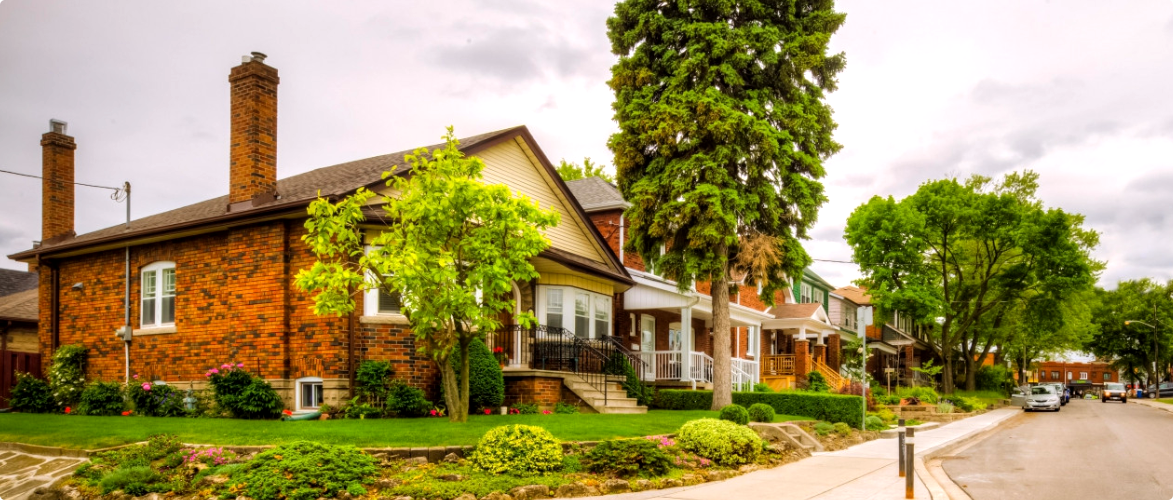
Fairbank-Belgravia sits at the West Toronto and Etobicoke border, built out in the postwar decades by Italian immigrant families who came for the solid bungalows and stayed for the community. The Eglinton Crosstown LRT now runs through the neighbourhood, with the Fairbank station at Dufferin and Eglinton opening up Midtown access that buyers in this price range could not get before.
Fairbank-Belgravia sits at the western edge of the old City of Toronto, straddling the boundary where Toronto proper meets Etobicoke. It’s bounded roughly by Dufferin Street to the east, Lawrence Avenue West to the north, Caledonia Road to the west, and Eglinton Avenue West to the south. For decades this was a quiet, working-class neighbourhood where Italian immigrant families put down roots in the postwar years, bought bungalows, planted vegetable gardens in the backyard, and stayed. That character hasn’t entirely disappeared. You still find long-time homeowners who’ve been on the same block for thirty or forty years, churches that run in Italian, and a commercial strip on Dufferin that reflects the neighbourhood’s layered immigration history.
What’s changing Fairbank is the Eglinton Crosstown LRT, which cuts directly through the neighbourhood with stations at Fairbank (Dufferin and Eglinton) and nearby along the corridor. The Crosstown has been a long time coming and its arrival is already reshaping how buyers think about this area. Properties within walking distance of the Fairbank station are attracting buyers who previously wouldn’t have considered the neighbourhood, partly because they’re getting more space for their money than they’d find in Weston-Mount Dennis or the Junction, and partly because rapid transit access to Midtown and the financial district is now real rather than theoretical.
The neighbourhood itself is flat, grid-planned, and residential in a way that feels genuinely lived-in rather than polished. You won’t find boutique coffee shops on every corner or weekend farmer’s markets. What you will find is solid housing stock, deep lots by Toronto standards, a community that’s been stable for long enough to have real social fabric, and prices that still reflect its working-class roots even as demand picks up. For buyers who want a detached home in Toronto at a price point that doesn’t require two professional incomes at their absolute ceiling, Fairbank-Belgravia is one of the shrinking number of areas where that’s still possible.
The dominant housing form in Fairbank-Belgravia is the postwar bungalow, built between roughly 1945 and 1965 on lots that typically run 25 to 35 feet wide and 100 to 120 feet deep. These are not large homes by modern standards. The original footprint is usually 900 to 1,100 square feet on the main floor, with a full basement that many owners have finished over the years. Brick construction throughout. Detached garages in the back accessed by a rear lane are common in parts of the neighbourhood, which matters to buyers who want parking without sacrificing the backyard.
Semi-detached houses make up a significant share of the stock as well, and they follow a similar pattern: brick, postwar, modest square footage, with basements that range from unfinished storage to fully legal basement apartments generating rental income. The presence of legal basement suites is worth paying attention to in this neighbourhood, because a well-configured lower unit can meaningfully offset carrying costs on a property in the $950,000 to $1.1 million range.
In 2026, detached bungalows in Fairbank-Belgravia trade in the $950,000 to $1.3 million range depending on lot size, condition, and proximity to the Eglinton corridor. Homes that have been renovated to a reasonable standard, or that sit on wider lots with development potential, push toward the higher end. Semis come in lower, typically $800,000 to $1 million for a well-maintained example. Townhouses exist but are less common in this particular neighbourhood. New infill builds on severed lots occasionally appear at higher price points, but the overwhelming majority of available inventory is original postwar stock in varying states of update. Buyers who are comfortable with a renovation project and can see past dated kitchens and bathrooms often find the best value here.
Lot severances have been occurring with more frequency as land values have risen. A 50-foot lot can be severed into two 25-foot parcels, and buyers considering a property with an oversized lot should factor in both the development potential and the likelihood that a neighbour’s lot beside them could be severed at some point in the future.
Fairbank-Belgravia has historically been a slower-moving market than the high-profile Toronto neighbourhoods that attract media attention. Homes sat on the market longer, price reductions were more common, and the buyer pool was narrower, made up primarily of people with direct family or community connections to the area. That dynamic has been shifting for several years and the Crosstown’s arrival is accelerating the change.
In the current market, well-priced detached properties in good condition tend to generate real competition. Multiple offers are not universal but they’re no longer unusual on the right property. Homes that are properly staged and correctly priced at or just under market often sell within two to three weeks. Properties that are overpriced or that have obvious structural issues linger, which actually creates opportunity for buyers who are willing to be patient and move on something the market has passed over.
Turnover in the neighbourhood is moderate. Long-time owners are selling in higher numbers than in previous years as the original Italian families who bought here in the 1950s and 60s age out of their homes, which means estate sales are a recurring part of the local inventory. These can represent good value for buyers who can move quickly and are comfortable with homes that haven’t been updated in decades. At the same time, a second wave of buyers who purchased here ten to fifteen years ago when prices were lower are now upgrading, creating a stream of renovated properties with proper kitchens and bathrooms that attract buyers who don’t want a project.
The Crosstown effect is real but not yet fully priced in. Buyers who get into Fairbank before the line reaches full ridership levels are likely making a reasonable long-term bet. The areas immediately around the Fairbank station are where competition is sharpest right now. Streets further from the station but still within a ten-minute walk have not fully caught up, and that gap is worth paying attention to.
The buyers coming to Fairbank-Belgravia today fall into a few clear groups. The first are first-time buyers or buyers moving up from a condo who want a detached house in Toronto proper and have a budget that tops out in the $1 million to $1.2 million range. They’re trading the walkability and energy of a neighbourhood like Bloor West Village or Little Portugal for more space, a real backyard, and a mortgage they can actually manage. Most of them accept that tradeoff willingly.
The second group are buyers who grew up in the neighbourhood or have family connections to the Italian-Canadian community that shaped this area. These buyers often move back to the neighbourhood when they’re ready to buy, sometimes purchasing properties from estate sales of their parents’ generation. They know the streets, they know the neighbours, and they’re not deterred by the neighbourhood’s working-class reputation.
A third and growing group are investors and house hackers: buyers who are specifically looking for properties with existing or potential basement apartments. The math works here in a way it doesn’t in pricier neighbourhoods. A detached home at $1.1 million with a legal two-bedroom basement renting at $1,800 to $2,000 per month meaningfully reduces the carrying cost. This buyer type tends to be analytical, move quickly when they find the right setup, and compete hard on the properties that have the income component already in place.
What Fairbank buyers are generally not looking for is prestige or the kind of social signalling that drives purchases in Rosedale or Forest Hill. They’re practical buyers making practical decisions, and the neighbourhood suits that approach. The comparison areas they consider most seriously tend to be the Junction, Weston-Mount Dennis, and parts of Etobicoke closer to Kipling, all of which are in a similar price band but each with a different character trade-off.
Within Fairbank-Belgravia, location within the neighbourhood matters more than it might appear from the outside. The streets closest to Dufferin Street on the eastern edge of the neighbourhood tend to be busier and less desirable for families with children. Dufferin itself carries significant traffic and the properties immediately adjacent deal with that noise and density. A block or two west the situation improves considerably.
Belgravia Avenue is one of the streets buyers ask about most often, running east-west through the heart of the neighbourhood with a mix of well-maintained bungalows and semis. The street has decent tree cover and a residential feel that holds up well. Cordella Avenue and Arleta Avenue are similar: quiet, tree-lined in parts, and representative of the best of what the neighbourhood offers in terms of postwar residential character.
The Caledonia Road corridor on the western boundary of the neighbourhood is worth understanding. Properties near Caledonia have industrial uses nearby and some buyers find the transition from residential to light industrial feels abrupt. It’s not a dealbreaker but it’s something to consider. On the other hand, access to the Allen Expressway from this part of the neighbourhood is genuinely convenient for buyers who drive north regularly.
North of Lawrence Avenue, the neighbourhood transitions into a different character entirely. The area between Lawrence and Glencairn, east of Dufferin, is sometimes called Fairbank but is distinct in feel: slightly more established, with some larger lots and a higher proportion of updated homes. Properties on streets like Roblocke Avenue and in the pockets running up toward Glencairn tend to command small premiums over comparable homes further south. Buyers who can stretch the budget slightly to get into this northern pocket often find it worth the difference in terms of street quality and long-term stability.
The Eglinton Crosstown LRT is the defining transit development for Fairbank-Belgravia. The Fairbank station at Dufferin and Eglinton connects residents to the full Crosstown corridor, running east to Kennedy and west to Mount Dennis and eventually beyond. From Fairbank station, riders can transfer at Cedarvale to the Yonge-University line, putting Bay Street offices within a reasonable commute. This is a genuine improvement over the pre-Crosstown situation, when getting to Midtown from Fairbank meant a bus to a subway or driving.
Bus service on Dufferin Street (the 29 Dufferin) runs frequently and provides direct access to Bloor-Danforth subway stations to the south at Dufferin and to Downsview-area destinations to the north. The 32 Eglinton West bus still runs but the LRT has taken over as the primary rapid transit option on this corridor. The combination of Crosstown access and Dufferin bus means that residents without a car have real transit options, though the neighbourhood is not walkable in the same way that Bloor West or the Danforth are.
Walk scores in the core of the neighbourhood run in the 70 to 80 range, reflecting the presence of a Dufferin commercial strip with basics like groceries, pharmacies, and food, but the pedestrian experience is not comparable to more established commercial neighbourhoods. Cycling is possible on quieter residential streets, though Dufferin and Eglinton are high-traffic arterials that less experienced cyclists tend to avoid. There are no dedicated bike lanes through the main corridors at this point.
Drivers have reasonable highway access. The Allen Expressway is a short drive from the western end of the neighbourhood, connecting quickly to the 401. The QEW and 427 are longer drives via surface streets unless you go through Etobicoke. For buyers who commute within Toronto rather than to the suburbs, the transit picture is the more relevant one, and on that front the Crosstown has made Fairbank meaningfully more attractive.
Fairbank-Belgravia is not a ravine neighbourhood in the way that Lawrence Park or Rosedale are, but it has more green space than its urban density might suggest. Fairbank Memorial Park is the anchor: a mid-sized park at Dufferin and Caledonia with a community centre, sports fields, a wading pool, and enough open space for the everyday uses that matter to families. It serves as the neighbourhood’s main gathering place in the warmer months and is well-used by the local community.
Dufferin Grove Park is a short distance south and, while technically outside the neighbourhood boundaries, is accessible enough to be part of the practical green space picture for Fairbank residents. Dufferin Grove has an unusually active programming culture for a Toronto park, with a community oven, a skating rink in winter, and regular market activity in warmer months.
Eglinton Flats, along the Humber River west of Keele Street, is within reasonable cycling or driving distance and provides a very different experience: open fields, river trails, and natural floodplain habitat that feels genuinely removed from the urban grid. It’s not walking distance for most Fairbank residents but it’s close enough to use regularly. The West Toronto Railpath, a multi-use trail running along a former rail corridor, connects to the broader trail network and provides a car-free route south toward the Bloor Viaduct area.
For a neighbourhood of its density, Fairbank does reasonably well on green space. It’s not a place you’d choose primarily for park access, but families find enough to work with, and the Humber River system to the west opens up trail options that aren’t immediately obvious when you’re looking at the street grid.
The Dufferin Street commercial strip is the main retail and dining corridor for Fairbank-Belgravia, running north-south along the eastern edge of the neighbourhood. It’s a working-class commercial street: independent convenience stores, a few Italian delis and bakeries that have been there for decades, fast food, and the mix of service businesses (hair salons, tax preparation offices, phone repair shops) that a dense immigrant-heavy neighbourhood generates. It is not a dining destination but it covers the daily necessities.
Eglinton Avenue West provides a second retail corridor running east-west. The Eglinton strip between Dufferin and Caledonia has a similar character to Dufferin, with grocery options, a pharmacy, and a smattering of restaurants serving the neighbourhood’s diverse population. As the Crosstown matures and the Fairbank station area redevelops, this corridor is likely to evolve, though that process takes years rather than months.
For more varied shopping and dining, residents drive or transit to nearby commercial areas. Dufferin Mall, about a kilometre south on Dufferin, covers major retail needs including a full-size grocery store, a Marshalls, and a range of chain retailers. Stockyards Village to the southwest on St. Clair West provides big-box retail including a Canadian Tire, an LCBO, and a grocery store. Neither is walking distance but both are convenient by car or quick bus.
The honest picture is that Fairbank residents who want a restaurant neighbourhood walk or take transit elsewhere. The Junction is close enough, and Bloor West Village is a reasonable transit trip. This is something first-time buyers coming from high-amenity neighbourhoods need to factor in honestly: the trade-off for lower prices is a local retail environment that prioritises function over atmosphere. For many buyers, that’s a perfectly reasonable trade. For others, it’s a friction point that matters more than they initially expect.
The public elementary school serving the core of the neighbourhood is Fairbank Public School on Dufferin Street, a Toronto District School Board school with a mixed enrollment reflecting the neighbourhood’s demographic diversity. Amesbury Middle School handles grades 6 through 8 for students in the TDSB feeder pattern from parts of the area. Separate school options include St. Clare Catholic School, part of the Toronto Catholic District School Board, which serves families who prefer a Catholic school environment for elementary aged children.
For secondary school, students in the TDSB system typically attend Vaughan Road Academy, which offers a range of programs including the International Baccalaureate. Westview Centennial Secondary School is another option in the area. The TCDSB secondary option is Father Henry Carr Catholic Secondary School, which draws from a broader Etobicoke area. Both boards run school bus and transit programs for students travelling further for specialty programming.
Private school options within practical distance include a number of the established independent schools in the Forest Hill and North Toronto areas, accessible by car or transit for families who choose that route. The neighbourhood itself does not have the cluster of private schools that some buyers expect, and families for whom private schooling is a priority usually build driving time into their calculation.
One thing worth knowing about schools in this neighbourhood: enrollment patterns and program offerings change, and what’s accurate in 2026 may not hold in three years. Buyers with school-aged children should verify current catchment boundaries directly with TDSB and TCDSB, as boundary adjustments do happen and a property’s school assignment can shift. The boards both maintain up-to-date boundary maps on their websites and catchment confirmation is part of the due diligence process your agent should walk you through.
The biggest development story in Fairbank-Belgravia is the Eglinton Crosstown itself, which has already changed the physical character of the Eglinton corridor through the neighbourhood. The stations are built, the line is operating, and the real estate market is beginning to price in what rapid transit access actually means for this area. The development that follows transit investment typically takes five to ten years to fully materialize, and Fairbank is in that early phase right now.
Mid-rise and mixed-use development applications have been filed for several sites along the Eglinton corridor in this area. The City of Toronto’s Eglinton Connects planning framework envisioned this corridor evolving into a more intensive mixed-use environment, and the Fairbank station area is included in that vision. What this means practically for buyers is that the commercial strips along Eglinton are likely to see more condo and mixed-use buildings over the next decade, bringing more residents, more retail, and a different streetscape than exists today.
Within the residential interior of the neighbourhood, the main development activity is lot severance and infill. Fifty-foot lots being severed and replaced with two detached infill houses is the predominant pattern. This creates some friction among existing residents who prefer the neighbourhood’s character as it is, but it also brings updated housing stock to an area where much of the original bungalow supply is aging. Buyers purchasing original homes should understand that the streetscape is likely to continue changing as more severances occur.
There are no major institutional or commercial developments planned for the interior of the neighbourhood at this time. The change in Fairbank will come primarily from transit-oriented development along the Eglinton spine and from gradual residential intensification on larger lots. Neither happens overnight, but the trajectory is set.
Is Fairbank-Belgravia actually safe? It’s a fair question and worth answering directly. Fairbank is a working-class neighbourhood with the crime statistics that tend to accompany urban density and lower household incomes. It’s not a high-crime area by Toronto standards, and it’s meaningfully safer than some adjacent neighbourhoods. Property crime (car break-ins, bike theft) is the most common concern, not violent crime. Long-time residents generally describe feeling safe on their own streets. Buyers coming from suburban backgrounds may find the density and urban texture unfamiliar, but the neighbourhood is not a place that requires special vigilance. Walking the streets at different times of day before you buy is sensible due diligence in any neighbourhood, and particularly useful here for calibrating your own comfort level.
What’s the realistic timeline for the neighbourhood to change? Fairbank has been described as “up and coming” for longer than most buyers would find reassuring. The honest answer is that the Crosstown genuinely changes the fundamentals in a way that previous transit promises did not, because the stations are built and operating. Areas immediately around the Fairbank station will change faster than the residential streets further from the corridor. Meaningful neighbourhood-scale change, meaning new cafes and restaurants and a different street energy, is probably a five to ten year horizon. Buyers who need that change to have already happened will be disappointed. Buyers who are comfortable with the neighbourhood as it is today and see the long-term trend as a bonus are better positioned.
Are there issues with the housing stock buyers should know about? Postwar bungalows in this price range frequently have deferred maintenance, aging mechanical systems, and original knob-and-tube wiring in some cases. Basement waterproofing is an issue on some properties given the flat terrain and clay-heavy soil. A thorough home inspection is not optional here. Buyers should specifically ask about the electrical panel, the age of the furnace and water heater, and whether there has been any basement water ingress. A property that appears well-maintained on the surface can still have significant capital requirements underneath. Budget for a proper inspection and take its findings seriously.
How does the rental income from a basement apartment actually work? Legal basement apartments in Fairbank typically rent for $1,700 to $2,100 per month depending on size, finish, and whether utilities are included. A legal suite requires a separate entrance, proper ceiling heights (generally 6 feet 5 inches minimum), smoke and CO detectors, egress windows in sleeping areas, and a building permit. Many existing basement apartments in this neighbourhood were finished without permits. Buyers considering a property with an existing basement unit should verify its permit status, both because illegal units carry liability and because your mortgage lender and insurer need to know about the configuration. Converting an unpermitted basement to a legal suite is possible but costs $30,000 to $60,000 depending on the scope of work.
Buying in Fairbank-Belgravia rewards buyers who’ve done their research and move with confidence when the right property comes up. The market is competitive on well-priced properties but not so hot that you can’t conduct proper due diligence. An experienced buyer’s agent who knows this specific neighbourhood, not just West Toronto generically, is worth a great deal here.
The specific due diligence priorities for Fairbank are worth being explicit about. First, electrical: a meaningful number of homes in this neighbourhood still have 60-amp service or original knob-and-tube wiring, either of which will cause problems with home insurance and create real safety risks if the home is being loaded with modern appliances. Have the inspector pay particular attention to the panel and visible wiring. Second, basement status: if the property has a basement apartment or a partially finished basement, understand exactly what permits were pulled. Third, lot configuration: if the lot is 40 feet or wider, understand whether it’s been flagged for severance potential, because that affects both value and future neighbourhood character.
An agent who can advise on the Crosstown’s effect on specific streets within the neighbourhood is genuinely useful. The premium that the market is placing on proximity to the Fairbank station is real but not uniform across the neighbourhood. There are streets within a ten-minute walk of the station that haven’t priced in the access fully, and there are streets that are technically closer but less desirable due to traffic or commercial adjacency. That level of granularity is the difference between a good buyer’s agent and a generic one.
Understanding the estate sale market is also relevant in Fairbank. A meaningful share of properties that come to market here are estate sales or sales by long-time owners who haven’t updated the home in decades. These properties can require significant capital investment but often have motivated sellers and less competition from buyers who are put off by the cosmetic condition. Your agent should be able to help you separate genuine structural issues from cosmetic ones, and to model out what a renovation would realistically cost before you decide how aggressively to bid.
Street-level knowledge is hard to find online. Our team works in Fairbank (Belgravia, Caledonia-Fairbank, Oakwood Village) every day. They know which pockets hold value, where the school catchment lines actually fall, and what the market is doing right now. Talk to us before you make a decision about Fairbank (Belgravia, Caledonia-Fairbank, Oakwood Village).
Talk to a local agent