
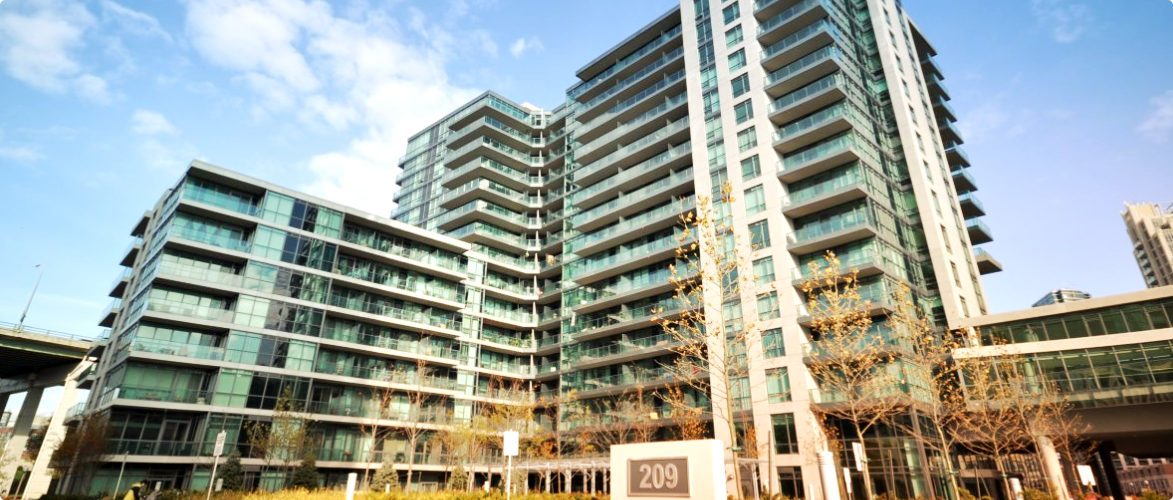
Fort York and Garrison are the condo towers and converted industrial buildings that grew up around the oldest military site in Toronto, bounded by Bathurst Street, Lake Shore Boulevard West, Strachan Avenue, and the rail corridor. Studio and one-bedroom condos on Fort York Boulevard were selling in the $550,000 to $680,000 range in early 2026, with two-bedrooms from $750,000 to $950,000. The neighbourhood is the densest new-build residential district in Toronto and, depending on what you value, that is either its appeal or its challenge.
Fort York and Garrison occupy a strip of lakefront land that the city essentially built from scratch beginning in the mid-2000s. The neighbourhood runs from Bathurst Street west to Strachan Avenue, bounded by the Gardiner Expressway and the rail corridor to the north and Lake Shore Boulevard to the south. Before the towers arrived, this was a mix of rail yards, a bus depot, and low-density industrial land that separated the older city from the waterfront. The construction boom that turned it into one of the densest residential districts in Canada happened fast, and the neighbourhood still carries the look of a place that has not quite caught up with itself.
The Fort York National Historic Site sits at the centre of this, as it always has. The fortifications were built in 1793 and successfully defended the town of York during the War of 1812. They are now a functioning museum, surrounded on three sides by condo towers that are entirely indifferent to the fact. Fort York Boulevard, the main residential spine running east-west through the neighbourhood, is named for the site but was built without much visible relationship to it. The juxtaposition is strange and, to residents who appreciate history, either charming or absurd depending on the day.
Garrison was the name used before the current development era and still appears on some maps and in some addresses, particularly around Garrison Creek, the buried waterway that ran through the area before the nineteenth century. Today the two names are used interchangeably, and most real estate listings use Fort York. The neighbourhood is young enough that its identity is still forming, which is both its challenge and, for the right buyer, its opportunity.
Fort York is almost entirely a condo neighbourhood. The residential supply is made up of purpose-built condo towers, with a small number of townhomes on and near Strachan Avenue. There are no detached or semi-detached houses in the core of the neighbourhood. If that type of property is what you’re looking for, you’re in the wrong place. What the neighbourhood does offer is modern construction, consistent finishes, and a density of amenities built into the buildings themselves: concierge, gym, party room, rooftop terrace.
In early 2026, a studio or junior one-bedroom of 400 to 500 square feet on Fort York Boulevard trades between $490,000 and $580,000. A true one-bedroom in the 550 to 650 square foot range runs $580,000 to $680,000. Two-bedrooms from 800 to 950 square feet are priced between $750,000 and $950,000, with larger units and higher floors at the top of that range. Corner units with unobstructed lake views command premiums of 10 to 15 percent over equivalent interior units on the same floor.
The quality of individual buildings matters more here than in almost any other condo market in the city. The neighbourhood went up in waves, and the buildings from the first wave (roughly 2006 to 2012) vary significantly in construction quality from those built after 2015. Maintenance fees are a meaningful differentiator: some of the older buildings are running at $0.80 to $1.00 per square foot per month, which on a 600-square-foot unit translates to $480 to $600 monthly before your mortgage. Buildings with high fees are worth investigating carefully: the fees may reflect a well-funded reserve or an aging building catching up with deferred maintenance. The status certificate tells you which it is.
Parking and storage are sold separately in most Fort York buildings and their pricing has shifted. A parking spot that was included in a 2014 purchase might add $50,000 to $70,000 to an asking price today if listed separately. Storage lockers run $15,000 to $25,000. Buyers who do not own a car should factor this into negotiations rather than paying for parking they won’t use.
Fort York condos have been under pressure since the investor-driven condo market across Toronto softened in 2022 and continued to correct through 2024 and 2025. Many units in the neighbourhood were purchased by investors during the pre-construction phase, and a significant number of those investors are now managing assets that don’t cash-flow at 2026 rates. Some have held. Others have listed, contributing to an inventory level that is meaningfully higher than it was during the peak years. This is buyers’ market territory for condos, not dramatically so, but enough that buyers with financing ready can negotiate and include conditions.
Days on market for condos in Fort York averaged 35 to 55 days in late 2025 and early 2026, compared to 15 to 20 days during the 2021 peak. List-to-sale ratios have been running at 96 to 97 percent of asking, which means modest negotiation is available on most listings but not dramatic discounts. Well-priced units in buildings with low maintenance fees and good reserve fund status still move in two to three weeks. Units in buildings with known issues sit longer.
The townhomes near Strachan Avenue are a separate story. There are only a small number of them and they attract a different buyer: people who want the neighbourhood’s location but want a private entrance and more space. These sell quickly when they come up and carry a meaningful premium over equivalent square footage in a tower. The freehold townhomes south of King Street West, on streets like Douro and Wellington, are technically on the edge of the neighbourhood and priced accordingly, from $900,000 to $1.2 million for a three-bedroom.
The buyers who end up in Fort York are generally choosing it over Liberty Village, King West condos, or the downtown core. They want lakefront access without the Distillery District price premium, and they want new construction without the wait of a pre-construction purchase. First-time buyers with household incomes around $120,000 to $150,000 make up a meaningful share: the price points are accessible compared to King West or the Entertainment District, and the buildings are young enough that major repairs aren’t an immediate concern.
A second group is buyers downsizing from a house elsewhere in the city. The appeal is the waterfront proximity, the transit connection north, and the building amenities that a condo provides in a way a house doesn’t. This buyer tends to prioritise a higher floor, a lake view, and a building with good management over price per square foot. They’re often paying in cash or with small mortgages and are less sensitive to rate pressure than the first-time buyer cohort.
End-user buyers have replaced investor buyers as the dominant group since 2022. During the 2012 to 2019 pre-construction boom, Fort York buildings were heavily purchased by investors who expected to rent or flip on assignment. Many of those investors are now selling to end users. This shift has generally been positive for the neighbourhood’s stability: people who live in their units tend to care more about building maintenance and management quality than those who never visited the property.
The status certificate is not optional in Fort York. Pull it on every building before you make an offer, and have a lawyer review it within the few days the offer allows. What you’re looking for is the state of the reserve fund relative to the reserve fund study’s projections, any outstanding special assessments, and any active litigation against the corporation. Buildings in Fort York’s first development wave are now 15 to 20 years old. Some have been well-managed. Others have deferred significant maintenance. The fee structure tells part of the story; the status certificate tells the rest.
Floor matters more in Fort York than in most condo neighbourhoods. The lower floors of many buildings face a wall of concrete: another tower, a parking structure, or the Gardiner Expressway. Units below the sixth or seventh floor in many buildings have limited natural light and no meaningful view. Lake views, city views, and park views open up on higher floors but come with premium pricing. The specific unit’s orientation within the building is worth understanding before the showing: north-facing units in many Fort York towers look directly at the Gardiner and the rail corridor. South-facing units look at the lake. East and west have their own trade-offs depending on the tower.
The noise from the Gardiner Expressway and the rail corridor affects the northern-facing and lower units in the neighbourhood. This is not uniformly severe: glazing quality in the newer buildings is good and well-selected units can be genuinely quiet despite the proximity. Walk through during rush hour or on a weekend evening, not on a Tuesday afternoon, to get an honest read on sound levels in the specific unit.
Parking is worth a separate conversation before you close. Many buyers arrive from neighbourhoods where parking was assumed and discover Fort York has no street parking on most blocks and that building parking spots cost $50,000 to $70,000 to purchase. If a parking spot is included in the listing, confirm it is deeded rather than licensed, because licensed spots can be reassigned by the corporation. If it is not included, decide before making the offer whether you need one and negotiate for it separately rather than after the fact.
The Fort York condo market rewards presentation and punishes neglect more obviously than a ground-level housing market. Buyers touring condos compare ten units in a morning and make decisions based on visual quality and feel. A unit with original builder finishes and some wear trades at a measurable discount to an identical floorplan that has been refreshed. The upgrades that move the needle are flooring (replace worn laminate with vinyl plank or hardwood), kitchen hardware and lighting, and bathroom vanities. Full kitchen renovations rarely return dollar-for-dollar at these price points; selective updates do.
Building reputation affects your sale more than you control. If your building has a history of special assessments, high fees relative to its age, or publicly known management problems, buyers’s agents will flag it and buyers will discount accordingly. There is not much an individual seller can do about this in the short term. The most you can do is price with that context in mind and not resist it.
Timing in Fort York follows the broader Toronto pattern: spring (February to May) and fall (September to October) produce the most active buyer pools. Summer listings, particularly July and August, face a thinner market and tend to sit longer. The fall window in Fort York can be particularly useful for units with lake views, because September light is strong and buyers who are motivated to be in before winter close quickly.
Fort York National Historic Site is a working museum on a 17-hectare site, open to visitors seasonally. The fortifications date from 1793, and the collection of original War of 1812-era buildings is the largest in Canada. The site runs programming, guided tours, and a popular series of events through the warmer months including living history demonstrations. Most residents of the surrounding towers walk past it regularly and a smaller number actually visit. It is genuinely unusual to have a site of that significance as your backyard, and the neighbourhood does not particularly advertise how unusual that is.
The Fort York Beltline Trail connects the neighbourhood to the broader trail system running north and is accessible from both the Bathurst and Strachan ends of the neighbourhood. The Martin Goodman Trail along the waterfront is the more heavily used route: it runs east toward the Harbourfront and west through Marilyn Bell Park to Humber Bay, and is used by cyclists, runners, and pedestrians every day the weather permits. A resident of Fort York Boulevard can be on the trail in three minutes on foot and at the Harbourfront in 20 minutes by bicycle.
Exhibition Place, immediately to the west, brings Budweiser Stage (capacity approximately 16,000) to the neighbourhood’s doorstep through the summer concert season. The Canadian National Exhibition runs for 18 days in August and September. These are assets for residents who attend them and noise sources for those who don’t. The acoustic footprint of a Budweiser Stage concert is felt throughout the neighbourhood, and buyers who are sensitive to that should account for it. The CNE is mostly visible rather than audible from inside a well-glazed condo.
The 511 Bathurst streetcar is the neighbourhood’s primary transit route. It runs from Exhibition Loop at Lake Shore through the neighbourhood north to Bathurst station on the Bloor-Danforth subway line. The trip to Bathurst station takes 10 to 15 minutes in off-peak conditions and longer during rush hour. From Bathurst station you’re connected to the Bloor-Danforth line east and west, which gets you to Union Station (and the GO network) with one transfer. The streetcar route is functional but its reliability depends on the rest of the 511 corridor, which has its own operating challenges.
Cyclists have a clear path to the downtown core. The waterfront trail east is flat, pleasant, and direct. The Fort York pedestrian and cycling bridge connects the neighbourhood to Bathurst Quay and the west waterfront. The Bloor bike lanes, accessed via Bathurst, connect east through the Annex. A cyclist from Fort York Boulevard to Front and Bay is a 20-minute trip on a reasonable day.
Drivers have immediate access to the Gardiner Expressway via Strachan Avenue or the Lake Shore Boulevard interchanges, making Fort York surprisingly convenient for highway-dependent commutes east or west. Parking within the neighbourhood itself is building-specific, with virtually no on-street parking available. Residents who own cars need a building spot or a nearby paid lot, of which there are several near Exhibition Place.
King West is the most frequent comparison. The King Street West condo corridor from Bathurst east to Spadina is older in parts, more varied in building type, and has a commercial strip that Fort York cannot match. The restaurants, bars, and independent businesses on King West between Portland and Bathurst are within walking distance of Fort York but they’re not in the neighbourhood itself. Fort York’s street-level commercial is improving but still thin relative to the residential density above it. Buyers who need walkable retail and dining in their immediate block will find King West a better fit. Buyers willing to walk ten minutes to get there, and who prioritise the waterfront, will prefer Fort York’s prices.
Liberty Village is immediately east, separated from Fort York by Strachan Avenue. The two share pricing and buyer profiles but differ in character. Liberty Village is built into repurposed industrial loft buildings with brick facades, character interiors, and a more varied streetscape. The Village itself on East Liberty Street has established cafes, a farmer’s market, and services that Fort York’s Fort York Boulevard is still catching up to. Liberty Village has no waterfront access. Fort York has no East Liberty Street equivalent. Which you prefer depends on whether you value industrial character or lakefront proximity, and both are legitimate answers.
The comparison to Harbourfront and the Entertainment District is less frequent because those neighbourhoods carry higher prices for equivalent space. A one-bedroom condo at Queens Quay East or in the Entertainment District around King and John costs $650,000 to $780,000 in early 2026. The same unit in Fort York is $580,000 to $680,000. The discount reflects the transit gap: Fort York is further from the subway network than those downtown neighbourhoods. For buyers who cycle, the distance is largely irrelevant. For buyers who depend on transit, the gap is real.
Fort York Boulevard is a wide, windy street in winter. The towers on either side channel the wind in a way that a day on nearby Strachan Avenue, or on any of the older streets to the north, does not replicate. Residents who walk to the streetcar stop at Bathurst on a January morning develop a habit of timing their departure to minimise exposure. This is a minor complaint but it is a consistent one from residents who moved from older, lower-density neighbourhoods and weren’t expecting it.
The neighbourhood has matured in the past five years at the ground level. Farm Boy opened in the area around 2019. A Loblaws is accessible near Exhibition Place. Fort York Boulevard itself has added restaurants, a barbershop, a gym, and a pharmacy. What was a nearly retail-free zone in 2012 now has enough daily amenities that residents can handle most errands on foot. The gaps are in the more character-driven retail: independent coffee shops, bookstores, neighbourhood bars that feel like they belong. Those still require a short trip to King West or Liberty Village.
The demographic of the neighbourhood has shifted as investor-owned units have transferred to end users. Buildings that were predominantly rented in 2018 now have higher owner-occupancy rates. The result is a more stable community: longer-term residents, more active condo board participation, more investment in common area maintenance. This is worth noting for buyers who are wondering whether the neighbourhood will feel transient. It has felt that way in the past. It feels less so now.
What is the transit situation in Fort York? The primary connection is the 511 Bathurst streetcar, which runs from Exhibition Loop north through the neighbourhood to Bathurst station on the Bloor-Danforth line. The trip to Bathurst station takes 10 to 15 minutes in off-peak conditions. From there you’re two stops east to Bloor-Yonge or a direct ride west to Kipling. The Gardiner Expressway is accessible from Strachan Avenue and Lake Shore Boulevard, making the neighbourhood genuinely practical for drivers heading east toward the core or west along the lakeshore. There is no subway station in the neighbourhood itself. Buyers who rely on rapid transit for commuting should factor in that streetcar-to-subway transfer and decide whether it fits their routine before purchasing.
Are Fort York condos a good investment? The honest answer depends on your entry price and your time horizon. Units purchased during the pre-construction boom of 2012 to 2019 at peak prices have underperformed expectations. In early 2026, a one-bedroom in Fort York rents for roughly $2,000 to $2,300 per month. At current mortgage rates and with typical maintenance fees, that rent does not cover carrying costs for a recently purchased unit. Buyers looking at Fort York as a place to live get reasonable value for the price point relative to comparable downtown neighbourhoods. Buyers looking at it purely as an investment vehicle should model the numbers carefully with current figures, not the figures that made sense when rates were at 2 percent.
What is it like to live in Fort York day to day? More functional than the neighbourhood’s youth would suggest. A Loblaws and a Farm Boy cover groceries within 10 minutes on foot. The lakefront trail is at the bottom of the neighbourhood and runs east to the Harbourfront and west to Humber Bay. Exhibition Place and Budweiser Stage are five minutes on foot. Fort York Boulevard itself has added restaurants, a gym, and daily services over the past several years. The genuine drawbacks are the wind tunnel between towers in winter, the lack of street parking, and a street-level environment that still lacks the texture of older, more organically developed parts of the city. Residents who move here from Trinity Bellwoods or the Annex reliably notice that difference, at least in the first year.
How does Fort York compare to Liberty Village for buyers? The two neighbourhoods are adjacent and frequently compared by buyers working at the same price point. Liberty Village has a more established street life on East Liberty Street, built into repurposed industrial loft buildings with more visual character than Fort York’s towers. Fort York has the waterfront trail, the historic site, and lake views that Liberty Village doesn’t have access to. Both lack a nearby subway station and rely on streetcar connections. Prices are comparable: one-bedrooms in both neighbourhoods run $550,000 to $680,000 in early 2026. The choice usually comes down to whether a buyer values waterfront proximity or a more established neighbourhood feel, and that is a genuine trade-off with no universal right answer.
Fort York as a residential neighbourhood is roughly 20 years old if you date it from the first major tower completions in the mid-2000s, and closer to 10 years old as a functioning community with ground-floor services and a critical residential mass. That youth shows in predictable ways: the streetscape is still maturing, the parks are young trees that haven’t yet grown into the scale of a Roncesvalles or Cabbagetown street, and the community anchors that give an older neighbourhood its sense of place are still being established. What the neighbourhood has on its side is the trajectory. Every assessment of Fort York from 2015 to 2026 has noted improvement. The gaps have closed over time.
The West Don Lands and the Port Lands development to the east are relevant to Fort York’s future because they will extend the waterfront residential district and add amenities, transit connections, and population density that feeds into the existing neighbourhood. The Ontario Line, with a future stop at Bathurst Street and potentially at Exhibition Place, will materially improve the neighbourhood’s transit grade when it opens. That opening date is officially 2031, though infrastructure projects of that scale in Toronto have a history of running past their projected dates. When it does open, the transit gap that currently depresses Fort York prices relative to its location will close substantially.
Buyers who are comfortable with a neighbourhood that is still finding itself, who value the waterfront and the historic site and don’t need a Queen West streetscape outside their door, tend to be satisfied here. Buyers who expected it to feel like an established city neighbourhood in the way that Trinity Bellwoods or Leslieville does tend to notice the gap. The honest assessment is that Fort York is a good bet for what it will be as much as for what it already is, and buyers should price that accordingly on both sides of the decision.
Street-level knowledge is hard to find online. Our team works in Fort York (Garrison) every day. They know which pockets hold value, where the school catchment lines actually fall, and what the market is doing right now. Talk to us before you make a decision about Fort York (Garrison).
Talk to a local agent