
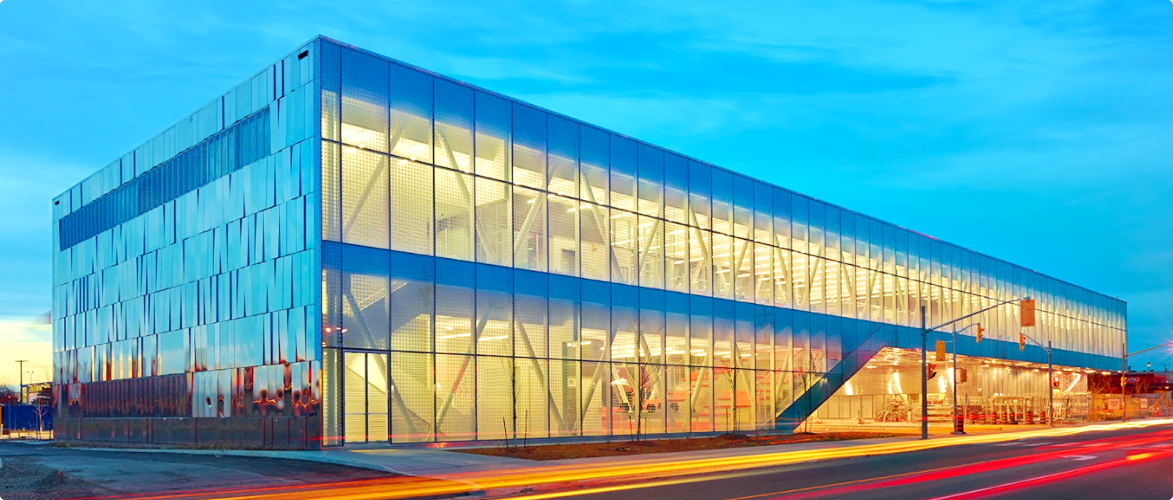
The Golden Mile is a Scarborough corridor on Eglinton Avenue East in the middle of a major transformation. The Eglinton Crosstown LRT now runs through the area, and the City-approved Golden Mile Secondary Plan will bring tens of thousands of new residential units over the next two decades. It is a development-stage area, not a functioning residential neighbourhood today, and it attracts investors and pre-construction buyers rather than families looking for an established community.
The Golden Mile is a stretch of Eglinton Avenue East in Scarborough, running roughly from Victoria Park Avenue in the west to Pharmacy Avenue in the east, with surrounding land extending north and south. The name comes from the strip’s history as one of Canada’s first major suburban commercial corridors, established in the 1950s when this part of Scarborough was at the edge of the city’s expansion. Decades later, the strip fell into the kind of big-box decline common to mid-20th-century commercial strips: surface parking dominating the streetscape, auto-oriented retail, a Costco and a Canadian Tire anchoring what was once a more varied commercial offer.
What makes the Golden Mile relevant to real estate buyers in 2026 is what’s coming, not what’s there now. The City of Toronto has approved a major secondary plan for the Golden Mile that will transform this corridor into a mixed-use urban district over the next 20 to 30 years. The Eglinton Crosstown LRT runs through this stretch, with the Pharmacy station and Science Centre station providing rapid transit connectivity that this part of Scarborough has never had. The combination of transit infrastructure and large-scale underutilised commercial land is exactly the condition that triggers major urban redevelopment in Toronto.
Buying in the Golden Mile area today is a bet on that transformation. The current built environment is not what most buyers would choose to live in. The residential options on the fringes of the commercial strip are limited and mixed in character. The investment thesis is that the transit investment, the approved secondary plan, and the economics of large-format retail land will produce a fundamentally different neighbourhood over the decade ahead. That’s a legitimate bet but it requires understanding the timeline, the risks, and the honest current state of the area before committing.
The Golden Mile area currently has limited residential supply. There are established residential streets to the north of Eglinton, in the Ionview and O’Connor neighbourhoods, and scattered residential pockets to the south toward St. Clair. But the core Golden Mile strip itself is almost entirely commercial, industrial, and big-box retail. Buyers are not looking at a traditional residential neighbourhood here: they’re looking at a development-stage area where residential supply is just beginning to emerge.
The first wave of condo and mixed-use residential projects approved under or adjacent to the Golden Mile Secondary Plan is in various stages of planning, approval, and early construction as of 2026. These projects will eventually bring several thousand new residential units to the corridor, primarily in mid-rise and high-rise configurations along Eglinton and on the larger redevelopment parcels. Pre-construction buyers in some of these projects have been purchasing since 2022 and 2023, with completion timelines typically ranging from 2026 to 2030 depending on the project.
For buyers interested in pre-construction condos along the Eglinton Crosstown corridor in this area, the typical profile is a one-bedroom or two-bedroom unit starting around $600,000 to $850,000, with larger units and those with parking commanding more. The pitch from developers centres on the LRT access, proximity to Costco and big-box retail, and the long-term transformation of the corridor. The honest caveat is that pre-construction timelines in Toronto regularly slip, and the neighbourhood transformation the marketing materials show is years away from the current physical reality.
Buyers who want established residential, a built neighbourhood with schools and parks and functioning services, should look at Ionview, O’Connor, or other Scarborough neighbourhoods rather than the Golden Mile itself. The Golden Mile is for buyers with a clear-eyed development thesis and the financial and personal capacity to hold through a longer timeline than the brochures typically acknowledge.
The Golden Mile doesn’t have a functioning resale residential market in the conventional sense, since there aren’t enough established residential units to generate meaningful comparable sales data. What exists instead is a development land market, a pre-construction condo market, and a small number of older residential properties on the fringes of the commercial area. Each of these operates differently and requires different analysis.
Development land in the Golden Mile has been trading at premiums that reflect the approved secondary plan and the Eglinton Crosstown infrastructure. Institutional developers and REITs have been acquiring and assembling parcels for years. Individual buyers are not typically competing in that segment of the market. The action for individual buyers is in pre-construction residential projects from the major developers who’ve secured sites along the corridor.
Pre-construction condo pricing in this area has been subject to the same pressures as the broader Toronto market. The 2022 and 2023 market correction put some projects on pause and led to revised launch pricing on others. By 2024 and 2025, some projects relaunched at adjusted prices. The result is that buyers entering in 2026 may find pricing that is more reasonable relative to fundamentals than what was on offer at the peak. That said, pre-construction involves carrying costs, deposit structures, and occupancy fee periods that affect the true cost of ownership and need to be modelled carefully.
For buyers in the immediate residential neighbourhoods adjacent to the Golden Mile, particularly in Ionview to the north, the transit investment is a positive signal. Properties within walking distance of Eglinton Crosstown stations have already priced in some of the transit premium, and further appreciation depends on how quickly and how completely the corridor transformation materialises.
The buyers attracted to the Golden Mile area are almost exclusively investors and speculators in the broad sense: people buying with a thesis about future value rather than for the experience of living there today. This is not a criticism. Buying ahead of major infrastructure and urban transformation is a legitimate strategy that has paid off in comparable situations across Toronto. The Distillery District area, Liberty Village, the Canary District, and parts of the Eglinton corridor west of Yonge all went through analogous development phases where early buyers took on the risk of an unbuilt vision and were rewarded when it materialised.
Some of these buyers are local investors who understand Toronto real estate and are deliberately taking a longer-term position. Others are international investors who treat Toronto real estate as a store of value and are less focused on the specific neighbourhood narrative. Pre-construction units in the Golden Mile area have been marketed to both groups.
A smaller group of buyers consists of people who want to be on the Eglinton Crosstown line for commuting purposes and are willing to tolerate the current environment in exchange for getting into the corridor at a lower price point than the more established parts of the Eglinton corridor west of the Don Valley. For this group, the Pharmacy station and Science Centre station access makes a genuine practical case: rapid transit to downtown and to Pearson via the Crosstown connection is a real commuting advantage once the full LRT is operational.
End-users who want to live in the neighbourhood as it is today rather than as it will be are not well-served by the Golden Mile. The absence of a functioning urban street, walkable services, parks, and the general infrastructure of neighbourhood life makes this a difficult sell for anyone who isn’t prepared to wait out the transformation timeline.
The Golden Mile corridor runs along Eglinton Avenue East, and the key geographic reference points for buyers are the Pharmacy station and the Science Centre station on the Eglinton Crosstown. The stretch between these two stations is the core of the redevelopment area. Sites north and south of Eglinton within a few blocks of these stations are the primary development targets under the secondary plan.
North of Eglinton, the residential streets of Ionview (roughly from Kennedy Road to Victoria Park) sit in proximity to the Golden Mile commercial area. These are established post-war streets with a functioning residential character, and they’re covered in more detail under the Ionview neighbourhood guide. Buyers interested in an established residential property with Eglinton Crosstown access are better served by looking at Ionview than at the Golden Mile core.
South of Eglinton, between the avenue and St. Clair, the land use transitions from commercial and industrial to a mix of residential and commercial. Some older apartment buildings and residential streets exist in this zone, but the area has a fragmented character that reflects years of uncertain planning status. As the secondary plan is implemented, this south-of-Eglinton pocket will likely see more attention, but it’s currently the less coherent part of the broader Golden Mile geography.
The Victoria Park station at the western end of the strip and the Kennedy station to the northwest are both important transit nodes. Kennedy station connects Line 2 and the Eglinton Crosstown with bus routes extending throughout east Scarborough. For buyers looking at properties near either of these stations, the transit connectivity is the dominant locational advantage, and it’s the factor that development financing and planning approvals are built around.
The Eglinton Crosstown LRT is the defining transit story for the Golden Mile. When fully operational, it will provide rapid transit along Eglinton Avenue from Mount Dennis in the west to Kennedy station in the east, with connections to the subway at Yonge-Eglinton, the Don Mills station, and at Kennedy. The Pharmacy and Science Centre stations serve the core Golden Mile area. Travel time to downtown by the Crosstown and connecting subway will be roughly 25 to 35 minutes from this stretch of Eglinton, which is a significant improvement over the bus service that existed before.
The Crosstown has had a famously complicated delivery history. The originally promised opening dates were not met, the project ran significantly over budget, and there were contractor disputes and infrastructure failures during the construction period. By 2026, the line is operational, though service reliability and the full build-out of the network are ongoing concerns that buyers should monitor rather than assume resolved. The transit investment is real and it changes the calculus for this corridor fundamentally, but the exact timeline for the full network to function as designed has consistently slipped, and buyers should factor that uncertainty into their planning.
Bus service on Eglinton Avenue East complements the LRT and provides connections to areas not directly on the rail line. Kennedy station to the northwest provides Line 2 subway access. For buyers in the Golden Mile who need transit for a daily downtown commute, the combination of LRT and subway provides a workable route, though the walk from any specific address to an Eglinton station can involve crossing large surface parking lots and commercial areas that are not pedestrian-friendly by urban standards.
Driving from the Golden Mile is straightforward: the 401 is accessible north of Eglinton, and Victoria Park Avenue and Pharmacy Avenue both run north to the highway. The Don Valley Parkway is accessible west via Eglinton. For car-dependent buyers, the location is reasonable, though the commercial strip itself creates traffic congestion particularly around the Costco and big-box retail areas during peak shopping hours.
Green space is one of the Golden Mile’s current weaknesses and one of the things the secondary plan is supposed to address. Right now, the corridor is dominated by asphalt, big-box footprints, and surface parking. There are no significant parks within the Golden Mile commercial core, and the walkable environment for anyone not in a car is genuinely poor by Toronto residential standards.
The secondary plan calls for new public parks and open spaces as part of the redevelopment framework. Developers building on Golden Mile sites are required to provide parkland as part of their approvals, and the plan envisions a connected public realm with streets, parks, and squares replacing portions of the current parking lot environment. This is legitimately part of the long-term picture, but it is years away from existing on the ground.
For buyers living in the adjacent residential neighbourhoods during the transformation period, the nearest established parks are in Ionview to the north and in the East York and St. Clair areas to the west and south. Taylor Creek Park is accessible by cycling or car from this part of Scarborough and provides trail access along the creek valley. Dentonia Park Golf Course to the north of the Golden Mile provides green space though its accessible use is specific to golfers.
Buyers who place high value on walkable park access should be honest with themselves that the Golden Mile in its current state doesn’t deliver this, and the timeline for it to do so is measured in years to decades rather than months. The parks and public realm elements of the secondary plan are dependent on development occurring, phased over time, and not guaranteed to materialise exactly as planned. Anyone buying in or near the Golden Mile for the parks should wait until they exist before buying.
Retail is the one thing the Golden Mile has in abundance today, though it’s the kind of retail that suits a car rather than a pedestrian. Costco, Canadian Tire, Home Depot, and a range of other large-format retailers are clustered along Eglinton and the adjacent streets. If you need to buy a refrigerator, 50-pound bags of cat litter, or a patio set, the Golden Mile is one of the most convenient locations in Scarborough. If you want to pick up groceries on foot or stop for a coffee on the way to the subway, the experience is poor.
The secondary plan envisions this changing, with ground-floor retail in new residential buildings eventually creating the kind of street-level commercial activity that makes walking pleasant. Some of the approved mixed-use projects include retail in their ground-floor plans. The trajectory is toward a more urban commercial environment, but the current reality is large-format and auto-oriented.
For residents of the adjacent neighbourhood areas, the big-box concentration is actually a practical advantage for household provisioning, even if it doesn’t contribute to walkable neighbourhood character. Having Costco, Canadian Tire, and the associated big-box cluster within a 5-minute drive covers a lot of domestic purchase needs efficiently. Combined with the LRT access for downtown trips, the location has a functional logic that doesn’t show up well in neighbourhood quality scores but works in daily life for a certain type of buyer.
Restaurants along the current Golden Mile strip are limited and oriented toward fast food and casual dining. As new residential density arrives, restaurant and café options will expand, but that expansion will follow residential population, not precede it. Buyers who want good restaurant options walkable from home should look at Agincourt, Scarborough Town Centre, or inner-city Scarborough neighbourhoods rather than the Golden Mile in its current state.
The Golden Mile commercial core has no schools within it currently. Schools serving the adjacent residential areas, particularly Ionview and the O’Connor area, are the reference point for buyers with families who are considering properties near the Golden Mile. The residential streets north and south of Eglinton in this area are served by TDSB elementary schools including Ionview Junior Public School and Norman Cook Junior Public School.
As the Golden Mile redevelops and population density increases, school capacity planning will become a significant issue. The City and the school boards have been in discussion about school sites within the secondary plan area, and some development approvals include provisions for school land dedication. However, the actual construction of new schools in the Golden Mile secondary plan area is likely to be a decade away given current timelines, and buyers with children in school age ranges now need to plan around existing school capacity in the adjacent neighbourhoods rather than planned future schools in the redevelopment area.
Secondary school for the area is served by W.A. Porter Collegiate, which serves the O’Connor-Ionview area broadly. The school has arts and technology programs and draws from the diverse population of east Scarborough. TDSB alternative schools and program schools elsewhere in the city are accessible by transit for families who want specialist programs for their children.
For buyers purchasing pre-construction condos in the Golden Mile development projects, it’s worth asking specifically which school catchment the completed building will fall into, since school boundary decisions for new addresses in redevelopment areas are sometimes uncertain until the building is registered. This sounds like a detail but it matters for families with children of school age.
The Golden Mile Secondary Plan, adopted by Toronto City Council, is the framework for the corridor’s transformation. It envisions a mixed-use, transit-oriented community with tens of thousands of new residential units, new parks and public spaces, retail and employment uses, and a redesigned street grid. The plan was years in the making and represents one of the larger planning decisions in Scarborough’s recent history. Its adoption was a meaningful threshold: the direction for the corridor is set, the transit infrastructure is built, and development applications are being processed.
The practical reality of implementation is that large-scale urban redevelopment of this type takes a long time. The secondary plan will be built out over 20 to 30 years, not 5. The earliest phases, the projects that had already received approval and started construction before the plan was fully adopted, will deliver units in the mid-2020s. The later phases, the ones requiring more complex assemblies or with more complicated approvals, will arrive in the 2030s and beyond. Anyone modelling a 3-to-5-year investment thesis for the Golden Mile should stress-test that timeline against a realistic construction and lease-up schedule.
The Eglinton Crosstown LRT is the most concrete change already delivered. The infrastructure is in the ground, the stations are built, and the service is operating. This is the transformation that is real today rather than promised for the future. Properties within walking distance of the Pharmacy and Science Centre stations have transit access that didn’t exist before, and that has real and immediate value.
One planning risk worth knowing: large-format retail like Costco and Canadian Tire typically have long lease terms and may not vacate their Golden Mile sites as quickly as the secondary plan timelines envision. Development of sites with active large-format tenants is complicated, and the pace of physical transformation on specific blocks may lag the approvals and plan targets. Buyers should look at which specific parcels are actively under development and which are still in long-term retail leases before drawing conclusions about neighbourhood transformation timelines.
Is the Golden Mile a good place to buy a condo in 2026?
It depends on your timeline and what you’re buying for. If you’re buying to live in a functioning urban neighbourhood now, it’s not ready for that and it won’t be for several years. If you’re buying as a medium-to-long-term investment with a thesis based on Eglinton Crosstown access and the secondary plan transformation, there’s a legitimate argument, but the risks are real: construction delays, occupancy fee periods on pre-construction units, and the long timeline to full neighbourhood maturity all need to be factored in. Talk to a lawyer before signing a pre-construction agreement. The contracts are not simple and the risks are different from resale.
When will the Eglinton Crosstown actually be reliable?
The LRT is operating as of 2025 and 2026, but the project had significant delivery problems and service reliability issues during its early operation period. By 2026, Metrolinx and the operator are working through the ongoing reliability issues. Buyers should monitor current service performance rather than assume the issues are fully resolved. The long-term case for the Crosstown as transformative transit infrastructure is sound. The short-term service reliability is something to verify with current riders rather than assuming from the design specifications.
What are the risks of buying pre-construction in the Golden Mile?
They’re the same risks that apply to pre-construction everywhere in Toronto, amplified by the neighbourhood’s development-stage character. Closing dates can slip by months or years, sometimes triggering occupancy fee periods where you’re paying to occupy a unit before the building is registered. Condo documents like budgets and rules are often not finalised until near occupancy. Developer insolvency, while not common, is a real risk in a market where construction financing conditions have tightened. The 10-day cooling-off period on pre-construction agreements exists for a reason: use it to have a real estate lawyer review the agreement before it becomes binding.
Are the residential streets near the Golden Mile affected by the commercial strip?
The established residential streets north of Eglinton in Ionview are genuinely separate from the commercial strip in terms of daily living experience. You’re aware the commercial corridor exists when you drive to Costco on the weekend, but the residential streets themselves are quiet and established. The noise, traffic, and visual environment of the big-box strip does not extend meaningfully into the residential grid. South of Eglinton, the relationship between commercial and residential is more complicated, and buyers in that area should inspect carefully and visit at different times of day before committing.
The Golden Mile is one of those situations where the type of advice you need depends heavily on what you’re trying to do. If you’re buying an established resale property on a residential street adjacent to the Golden Mile, the standard buyer’s agent process applies: comparables, condition, schools, transit, closing timeline. An agent who works east Scarborough regularly will know those streets and the relevant factors.
If you’re looking at pre-construction, the process is different and the skill set required is different. Pre-construction agreements are heavily weighted in the developer’s favour, and a buyer’s agent who regularly works pre-construction deals in Toronto will know where the negotiating room is, what closing provisions matter, what to watch for in the draft disclosure statement, and how to read a development timeline realistically. More importantly, you need a real estate lawyer who does pre-construction specifically. This is not the moment to use the family lawyer who handles wills and closings occasionally.
The development land and investment side of the Golden Mile is beyond what most residential buyer’s agents handle. If you’re considering purchasing a property with a development angle, advice from someone with specific expertise in Toronto development land and zoning is necessary. A residential agent can help you understand the neighbourhood but isn’t the right resource for assessing a development thesis.
For buyers whose interest in the Golden Mile area is really about being near the Eglinton Crosstown without paying the premium prices of the more established Crosstown corridors to the west, an honest agent will map out the alternatives: Ionview, Victoria Village, and the O’Connor area all offer Crosstown proximity with established residential character. The Golden Mile itself is the high-risk, long-timeline version of the same location thesis. Understanding which version suits your situation is the first step.
Street-level knowledge is hard to find online. Our team works in Golden Mile every day. They know which pockets hold value, where the school catchment lines actually fall, and what the market is doing right now. Talk to us before you make a decision about Golden Mile.
Talk to a local agent