
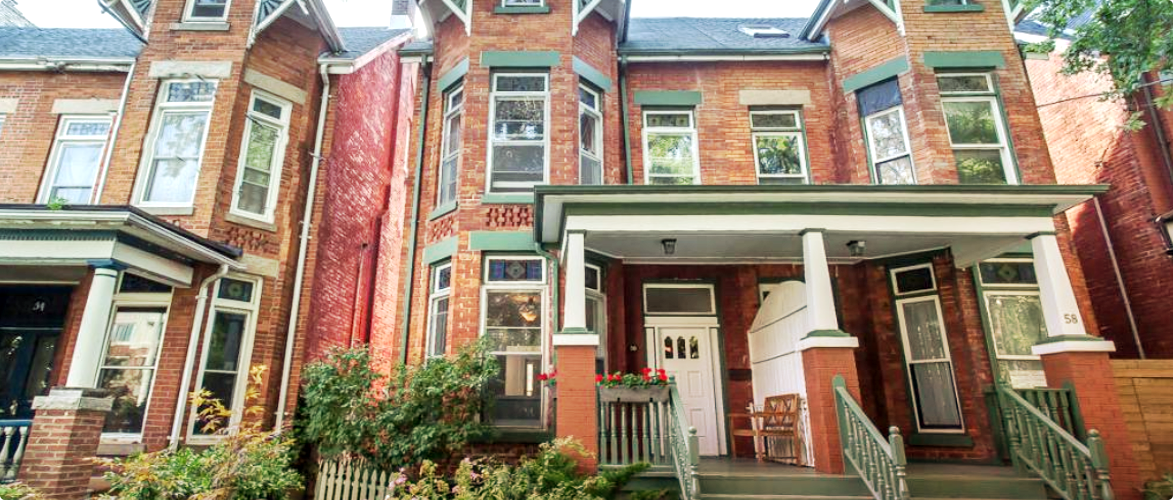
Harbord Village sits between Bloor and College, Spadina and Bathurst, a tight-knit residential neighbourhood of Victorian and Edwardian brick semis with low turnover and consistently high demand. It's one of the priciest small-scale west-end neighbourhoods in the city: semis trade at $1.4 million to $1.9 million, detached homes start at $2 million and run past $3 million on the better streets. Very few properties come to market in any given year, and those that do rarely sit long.
Harbord Village sits between Bloor Street West to the north, College Street to the south, Spadina Avenue to the east, and Bathurst Street to the west. Within those boundaries is a neighbourhood that manages to be genuinely quiet despite being flanked on all sides by major city streets. The residential blocks between Harbord Street and Lowther Avenue, and the east-west streets running through the middle, feel removed from the surrounding traffic in a way that surprises first-time visitors. The mature tree canopy helps. The low-rise housing helps more.
Harbord Street itself runs east-west through the middle of the neighbourhood and carries the Harbord Street Cycleway, one of the city’s main protected cycling corridors. East of Spadina the route connects to the University of Toronto campus and eventually to downtown. West of Bathurst it continues toward Dovercourt and Dufferin. Residents who cycle as their primary mode of transport have a protected route in both directions from their front door, which is an infrastructure advantage that most Toronto residential streets can’t match.
The neighbourhood’s central position means Spadina and Bathurst subway stations are both accessible on foot. Bloor Street West along the northern edge supplies the full commercial strip: grocery, transit, restaurants, a branch of the Toronto Public Library, Jewish bakeries and delis that have operated on this stretch for decades. All of it is there without driving, and none of it intrudes into the residential blocks.
Harbord Village is a freehold neighbourhood. The housing stock is almost entirely Victorian and Edwardian brick semis and a smaller number of detached homes, built between roughly 1890 and 1920. The renovation quality across the neighbourhood is notably high. Buyers and owners have invested in these properties over multiple cycles, and the street-level result is a block-by-block consistency of maintained brick facades, well-kept front gardens, and houses that have been updated inside without losing the original character that makes them worth buying in the first place.
Semis are the dominant purchase. A three-bedroom semi with a renovated kitchen, updated bathrooms, and working systems trades between $1.4 million and $1.9 million. The spread reflects lot depth, renovation quality, and the specific block. Properties on the quieter streets between Harbord and Brunswick, and on the blocks closest to Huron Street Junior Public School, tend to price toward the top of that range. Detached homes start around $2 million for properties requiring work and can reach $3 million or more for four-bedroom renovated houses on a full lot.
Unlike in Grange Park to the south, there is essentially no condo market here. The neighbourhood is protected from large-scale redevelopment by its low-rise character and the City’s heritage considerations for the area. Buyers looking for a condo entry point into central Toronto will not find it here. What they will find, if they can stretch to freehold prices, is the kind of house that doesn’t appear in many places this close to the city’s centre.
Harbord Village is one of the lowest-turnover residential neighbourhoods in the central city. The number of sales in any given year is small: owners who buy here tend to stay for a long time, and the pool of active listings at any given moment is thin. This creates a dynamic where buyers who have identified the neighbourhood often wait months for the right property to appear. The practical advice is to set up active alerts and be prepared to move quickly when something good comes up, because it won’t stay available while you take two weeks to decide.
Properties that are well-presented and correctly priced attract serious buyers fast. Multiple offers on desirable semis are not uncommon in the spring window, and the competition from U of T faculty and other established buyers who’ve been pre-approved and actively searching keeps the floor price firm even when the broader market cools. The neighbourhood held its value through the 2022-2023 correction better than many comparable west-end areas, which is partly a function of how little comes to market and how deep the buyer queue stays.
Buyers negotiating here need to come prepared. Conditions are present in most offers but sellers of move-in-ready properties are less likely to accommodate them, particularly in the spring. Home inspection conditions are more common now than at the peak of 2021-2022 and are generally accepted on properties where the seller doesn’t have competitive offers in hand. The best strategy is pre-approval confirmed, inspector ready to schedule within 24 hours, and a clear number on what you’re willing to pay before the offer deadline.
The buyer profile here is more consistent than in most comparable neighbourhoods. University of Toronto faculty and senior staff are a significant cohort: the proximity to the St George campus is a practical draw, and the character of the neighbourhood aligns with what many academics are looking for in a permanent home. Graduate students live in the rental portion of the housing stock, which includes basement apartments and some multi-unit properties at the Bloor Street edge of the neighbourhood.
Families who want the central west-end location but find Annex prices slightly out of reach look seriously at Harbord Village. The price comparison to the Annex is closer than it used to be, but there are still properties in Harbord Village that represent better value for equivalent square footage. The draw for families is Huron Street Junior Public School, the quiet streets, and the ability to cycle or walk to most of what a family with children needs without owning a car.
Buyers who want the physical character of the Annex without the Annex street energy also land here. The Annex’s Bloor Street West stretch has more active commercial density. Harbord Village’s Bloor Street frontage is commercial, but the side streets drop into a quieter residential mode faster. Buyers who have looked at both and found the Annex slightly too busy for their preference tend to choose Harbord Village and are rarely disappointed by that call.
Spadina station and Bathurst station both sit at the northern edge of the neighbourhood on Bloor Street West, each accessible on foot from most addresses in Harbord Village. Spadina station connects to the Bloor-Danforth line heading east toward the financial district and east-end destinations, and south on the University line toward Union Station. Bathurst station serves the same Bloor-Danforth line heading west toward Dufferin, High Park, and Kipling. From either station, the financial core is three to five stops and 15 minutes by subway.
The Harbord Street Cycleway is the neighbourhood’s defining cycling asset. It’s a protected corridor, not a painted lane, which means it’s usable year-round for most riders and doesn’t require mixing with vehicle traffic. The route connects east to the U of T campus and the downtown cycling network and west toward Dovercourt and Dufferin. Residents who work at the university or anywhere along the Harbord-Hoskin spine can commute by bike without meaningful road exposure. For buyers who cycle regularly, this is a genuine quality-of-life advantage over comparable neighbourhoods without the infrastructure.
The Bathurst Street bus runs north-south connecting to Bloor and continuing south to College, King, and the waterfront. The College streetcar runs along the southern edge of the neighbourhood east to Yonge and west toward Roncesvalles. Car ownership is optional for most residents, and many manage without one. Those who do keep a car find street parking on residential blocks available with a permit, which is less contested than in the denser areas immediately to the south.
Bloor Street West runs along the northern boundary and supplies what residents need without requiring a trip. A large Loblaws sits at the Spadina corner. Independent food shops, a pharmacy, a branch of the Toronto Public Library, and a range of cafes and restaurants fill the stretch between Bathurst and Spadina. The street is commercial but not loud in the way that Queen West or College Street in Little Italy can be on a weekend evening. The trade is done in the daytime and the strip quiets down by 10 p.m.
Several Jewish bakeries and delis that have operated on this stretch for decades remain open and active. Harbord Bakery, one of the last traditional Jewish bakeries in Toronto, has been on Harbord Street itself since 1945. These businesses are part of the neighbourhood’s identity in a way that newer arrivals on the street are not. They also supply things you actually want: good bread, proper deli, baked goods that don’t require a 40-minute wait.
Little Italy begins west of Bathurst along College Street and adds Italian restaurants, cafes, and a different commercial character within a short walk. Kensington Market is accessible to the southeast, adding the farmers’ market, bulk food shops, and the outdoor food scene that has anchored that block for generations. The neighbourhood’s position means several distinct commercial areas orbit around it, which gives residents more practical daily variety than the Bloor West frontage alone would suggest.
Huron Street Junior Public School is the primary school most associated with Harbord Village. It’s a well-regarded TDSB school with strong parent involvement and consistent enrolment from the surrounding residential streets. The school’s reputation is one of the reasons families specifically target this neighbourhood over adjacent areas: Huron Street comes up in conversations about the central west-end school options consistently and positively. Confirming catchment at a specific address is still worth doing before purchasing, as the TDSB boundaries can be drawn in ways that aren’t immediately obvious from a map.
University of Toronto Schools (UTS) is a selective independent secondary school on Bloor Street West, physically within the neighbourhood’s orbit. It draws students through a competitive entrance process, and proximity doesn’t guarantee admission. For families with high-achieving secondary-age children who are interested in pursuing the UTS application, living nearby is a minor logistical convenience rather than a significant advantage. The school’s presence nonetheless contributes to the neighbourhood’s association with education and academic life.
For secondary school within the public system, Harbord Collegiate Institute sits on Harbord Street and serves the catchment. It’s a general secondary with an established community and a physical building that has been part of the street since 1892. Private and independent secondary options are within transit reach, including some of the city’s most established schools in the Annex and Rosedale. Families in this neighbourhood who go the independent school route have transit access to most options without needing to drive.
The St George campus of the University of Toronto begins just east of Spadina Avenue, which puts Harbord Village immediately adjacent to one of the largest research universities in North America. The practical effect on the neighbourhood is significant and worth being specific about. Faculty housing demand from U of T has been a consistent source of buyers in Harbord Village for decades: people who want to walk or cycle to campus and come home to a quiet residential street rather than a student-dense apartment block find the neighbourhood a near-perfect fit.
Graduate students occupy a portion of the rental market, primarily in basement apartments and multi-unit properties on Bloor Street and near the Spadina edge. This keeps some rental supply available for shorter-term residents, but the neighbourhood as a whole skews toward owner-occupiers. The graduate student presence is lower-key than in areas directly on campus streets: Harbord Village is a short walk from campus but feels like a neighbourhood rather than a campus extension.
The research and academic culture that comes with a large university shapes what’s available and supported locally. Bookshops, lecture series, public talks, and the general intellectual density of a campus community spills into the surrounding streets. Buyers who value that ambient culture often find it a draw even if they have no direct connection to the university. It affects the cafes, the library branch programming, and the general sensibility of the commercial strip in ways that are real but hard to put a price on.
Harbord Village doesn’t have a large park within its own boundaries, which is the honest thing to say and the thing that separates it from Trinity Bellwoods to its west or the Annex’s proximity to the ravine system. Bickford Park sits at the Bloor and Harbord corner and provides a small green space with a baseball diamond and open lawn. It’s a neighbourhood park in the true sense: local, unpretentious, used daily by people who live within a few blocks of it.
What the neighbourhood has instead of a large park is excellent access to parks nearby. High Park is two subway stops west. The U of T campus grounds function as an extension of the public green space for the surrounding neighbourhood, with open lawns and a relatively pedestrian-friendly internal network. The ravine trails accessible from the Annex are a 10-minute walk north. Residents who cycle have even more reach: the Harbord Cycleway connects quickly to off-road and ravine routes that extend well into the city’s green infrastructure.
Daily life runs smoothly. The Bloor Street commercial strip covers groceries, banking, pharmacy, and most routine errands. The library branch provides what it provides. The food options within walking distance are genuinely good: a mix of the Bloor West strip, the Harbord Street corridor, and the spillover from Kensington and Little Italy. Dog owners walk the residential blocks and Bickford Park. It’s a neighbourhood that functions well as a neighbourhood rather than as a lifestyle concept, which is something that sounds obvious but isn’t universal in expensive central Toronto.
The comparison to the Annex is the one buyers in this part of the city make most often, and it’s worth being specific about because the differences are real rather than just a matter of which name sounds more familiar. The Annex is larger, more established in public perception, and has a Bloor Street West strip with somewhat higher commercial density between Spadina and Bathurst. Harbord Village is smaller, lower-profile, and quieter on most of its residential streets. The price difference between comparable properties has narrowed over the past decade.
Buyers who find Annex prices at the ceiling of their range often look seriously at Harbord Village and find that the practical daily life is nearly identical. The commute times to the subway are the same. The access to Kensington and the waterfront is the same. The schools are comparable. What changes is the street feel: Harbord Village’s residential blocks are slightly quieter, the commercial strip slightly less busy, and the number of neighbours who have lived on the same block for 20 years slightly higher. For some buyers that’s a marginal difference. For others it’s exactly what they’re looking for.
The decision against the Annex and for Harbord Village is often made by buyers who have walked both on a weekday evening and decided they prefer the way Harbord’s residential streets feel after 7 p.m. Neither neighbourhood is a compromise. They’re different enough that the choice is genuine, and buyers who know what they value in a street tend to find one pulls ahead of the other fairly quickly.
How hard is it to actually buy a house in Harbord Village?
It’s genuinely competitive. The neighbourhood has one of the lowest turnover rates in the central city: in an average year, the number of freehold properties that trade within the neighbourhood’s boundaries is small. Buyers who have identified Harbord Village specifically often wait six months to a year before the right property comes up. The practical consequence is that you need to do your homework before a listing appears rather than after. Get pre-approved, identify your non-negotiables, understand what the price range looks like for the product you want, and be in a position to move within days when something comes to market. Properties that are well-presented and priced within the range of comparable sales don’t sit for weeks here. The buyer queue is real and stays populated even when broader market conditions soften.
Does Harbord Village have good parking, or is it a problem like in many downtown areas?
Most of the Victorian semis in the neighbourhood were built before cars were a design consideration, so dedicated parking is not guaranteed and many properties don’t have it. Some homes have a rear lane garage or parking pad accessed from the laneway. A meaningful number have no parking at all. Residential parking permits cover the street, but the permits apply to the homeowner’s car and don’t resolve the question of where a second vehicle goes. Buyers who need to bring a car home every day should confirm the parking situation at any specific property before getting attached to it. For households without a car, or with one car and a high tolerance for occasional street parking constraints, it’s a manageable situation. For households with two vehicles and regular need for both, it’s a real limitation.
What is Harbord Bakery, and is it still worth visiting?
Harbord Bakery at 115 Harbord Street opened in 1945 and has been producing traditional Jewish baked goods at the same address ever since. It makes challah, rye bread, babka, rugelach, and a range of pastries from recipes that haven’t changed substantially in 80 years. It’s one of the few remaining traditional Jewish bakeries in Toronto and one of the oldest continuously operating food businesses in the central city. For residents it’s a neighbourhood institution in a way that’s not performative: it’s a bakery where local people buy bread on Saturday morning, not a tourist destination or a food media darling. Worth visiting for the challah alone. Worth living near if this is the kind of neighbourhood texture that matters to you.
Harbord Village delivers quiet residential streets within 10 minutes of a subway station, a cycling route that connects to the rest of the city, a food street that’s been there for 80 years, and Victorian housing stock that’s been well-maintained across multiple generations of owners. For buyers who want to be within walking distance of the University of Toronto, the Annex, and Kensington Market without living on a busy street, there are very few places in the city that get closer to that combination than this neighbourhood does.
The honest constraints are the price, the scarcity, and the absence of a large park within the neighbourhood’s own borders. If the budget doesn’t reach $1.4 million for a semi, the options become thin quickly. If waiting six months for the right property to appear is not compatible with the timeline, the low-turnover nature of the market becomes a problem rather than a feature. If a large park within a 5-minute walk is a requirement for daily life, Trinity Bellwoods or Roncesvalles will serve that need better.
Buyers who sit with both of those paragraphs and find the first one describes what they want are probably looking at the right neighbourhood. Harbord Village is not an accidental purchase. The people who buy here have usually been watching it for a while, understand what they’re paying for, and are making a deliberate call about neighbourhood character over square footage or price per foot. That clarity tends to produce buyers who stay, which is most of the reason the turnover is low in the first place.
Street-level knowledge is hard to find online. Our team works in Harbord Village every day. They know which pockets hold value, where the school catchment lines actually fall, and what the market is doing right now. Talk to us before you make a decision about Harbord Village.
Talk to a local agent