
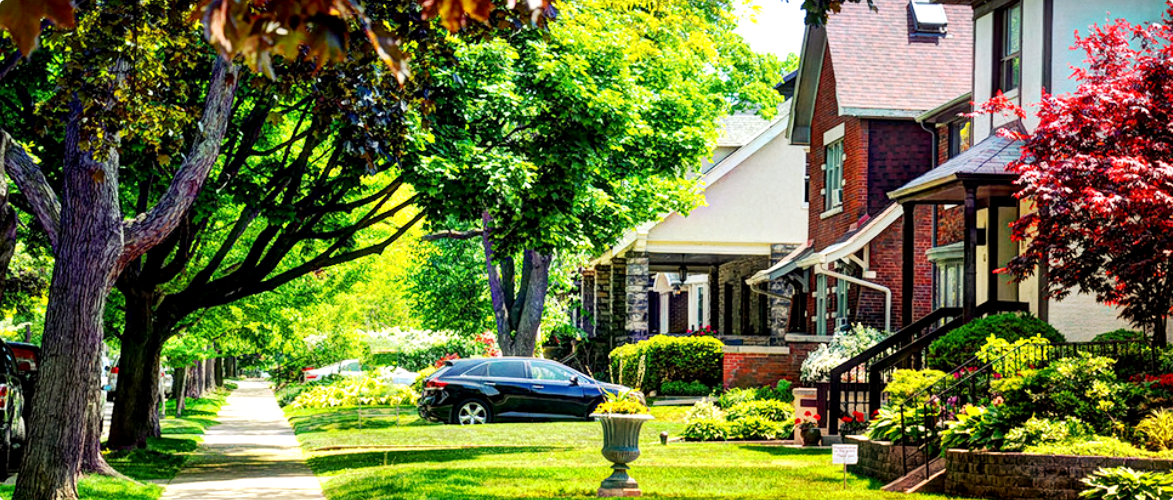
High Park is the residential neighbourhood built around one of the largest urban parks in Ontario: 399 acres of forest trails, sports fields, Grenadier Pond, and a cherry blossom grove that draws the whole city every April. The streets south of Bloor between Roncesvalles and Parkside hold some of Toronto's most sought-after freehold addresses, with Edwardian and Victorian brick detached homes trading from $1.8 million to well above $3 million. Families buy here and stay for decades, and the turnover rate reflects it.
High Park the neighbourhood takes its name from the park it surrounds: 399 acres of publicly owned land that holds forested ravines, sports facilities, a small zoo, Grenadier Pond, and a cherry blossom grove that becomes a city-wide event every April. The residential streets run south of Bloor Street West, north of Lake Shore, roughly between Roncesvalles to the east and Parkside Drive and Windermere Avenue to the west. The park is not an amenity at the edge of the neighbourhood. It is the neighbourhood’s defining fact, the reason buyers have been competing for these streets for forty years.
The housing stock reflects the era of the neighbourhood’s development. North of Bloor the character leans Edwardian: solid brick detached homes and semis built between 1905 and 1930, with the broad front porches and generous ceiling heights that era produced. South of Bloor and along the park’s eastern edge, older Victorian stock appears, built in the 1880s and 1890s when the park itself was first being established. These are serious houses on serious lots, and most have been renovated with enough care to show it.
Bloor West Village runs along Bloor Street between Jane and Runnymede, and it is one of Toronto’s better commercial strips. The businesses there are almost entirely independent: butchers, bakeries, wine shops, cafes, and restaurants that have operated on the same blocks for decades. The residents treat it as a genuine village commercial centre rather than a destination, which is exactly what makes it valuable. You can do a week’s worth of errands on foot and not encounter a chain until you leave the strip.
The standard purchase in High Park is a detached or semi-detached brick home on a 25 to 35-foot lot. Most of the detached homes are three or four bedrooms with one or two bathrooms, a basement that’s either finished as a family room or converted to a rental unit, and a rear yard that ranges from modest to genuinely deep. A well-maintained three-bedroom detached in the streets north of Bloor starts around $1.8 million. Renovated four and five-bedroom homes on wider lots trade from $2.4 million to $3.5 million, and occasionally above that for park-facing positions or exceptional properties.
Semis are the more common freehold transaction. A semi with updated mechanicals, a functional kitchen, and preserved original character trades between $1.5 million and $2.5 million. The spread within that range is almost entirely explained by lot size, the quality of renovations, and whether the property has parking. Many of the older semis were built without garages, and a property with a rear pad or garage will consistently outperform an equivalent property without one.
The rental suite question comes up often. Many High Park homeowners have a basement apartment, and in some cases the income from it meaningfully affects what a buyer can carry. A legal basement suite with a separate entrance and proper egress can contribute $1,800 to $2,400 monthly in this part of the west end. Buyers who need the income to qualify should confirm the suite’s legal status before proceeding, as the gap between a legal and an informal suite has implications for financing and insurance.
High Park is one of the lower-turnover residential markets in the 416. Families buy here and stay. Properties often sit within one family for fifteen to twenty years before coming to market, and when they do, they tend to generate quick interest from buyers who’ve been waiting. The buyer pool for detached homes here is deep and patient: established dual-income households who’ve spent time in the neighbourhood, know the streets, and are making a considered long-term decision rather than a first move into the market.
In early 2026, well-priced detached homes in the core streets are attracting multiple offers in spring and early fall. The formal offer-date process is less common than it was in 2021 and 2022, with most sellers accepting offers as they arrive. That said, strong listings in the Humberside Avenue and Clendenan Avenue corridor are still selling above asking when priced to reflect the market rather than ahead of it. Semis follow a similar pattern but with a wider range of outcomes depending on condition and presentation.
The spring window runs from late February through May and produces the year’s strongest prices. October is the second active period. December and January are quiet, and listings appearing in those months typically carry more room on price than the same property would in April. Buyers with timeline flexibility who are willing to search in winter often find better conditions than the spring competition allows.
The buyers who end up in High Park have usually been watching the neighbourhood for years. These are not impulsive purchases. The typical buyer is in their late thirties or forties, has children, and has narrowed their search to a specific west-end corridor: High Park, Roncesvalles, or Bloor West Village in the streets to the north. The decision toward High Park over the others is almost always about the park itself and the quality of the housing stock on the streets that face or border it.
The neighbourhood attracts established professionals: lawyers, architects, doctors, academics from the University of Toronto, people in media and publishing. The Bloor West Village commercial strip has a demographic pull of its own. Buyers who shop at independent butchers and wine merchants and want to walk to a weekend farmers market find this stretch of Bloor and its surrounding streets matches how they want to live in a way that few other Toronto addresses do.
There is also a significant contingent of buyers who grew up in the neighbourhood or in adjacent west-end streets and are returning after years elsewhere. Roncesvalles kids who now have families of their own, people who rented in the area in their twenties and are coming back with enough equity to buy properly. The neighbourhood rewards that kind of patient loyalty: the people who understood it early enough to return on purpose.
The gap between the streets facing the park and those a block or two removed is larger than the distance suggests. Parkside Drive and Colborne Lodge Drive command a premium that can be 20 to 35 percent above equivalent properties on the residential blocks behind them. If you’re buying for the park view and the direct access, budget for it specifically. If you’re buying for the neighbourhood and the transit access, you’ll find better value two or three blocks off the park edge where the premium fades but the daily reality is nearly identical.
Many of the detached homes in this neighbourhood were built in eras with different plumbing and electrical standards. A 1915 home that has been continuously maintained but never fully renovated can have a mix of original knob-and-tube wiring, updated panels, and copper plumbing in varying conditions depending on what each owner addressed. A thorough home inspection by an inspector who knows older Toronto housing stock is not optional here. The issues that surface in an inspection of a well-presented century home can be expensive and are not always visible during a showing.
The cherry blossom season is worth experiencing before committing to the park-adjacent streets. In late April the park’s eastern entrance and the grove toward Deer Pen Road draws thousands of visitors daily. Parking on the residential streets near the park becomes genuinely difficult, and the streets adjacent to the main entrances see foot traffic that residents describe as tourist volume. It lasts two to three weeks. Most residents regard it as the price of the park’s other eleven months. Worth knowing before you decide how close to the entrance you want to be.
High Park buyers are thorough. They’ve toured multiple properties in the neighbourhood and understand the difference between a house that has been well-maintained over decades and one that has been prepared for sale with a coat of paint and new light fixtures. The homes that produce the strongest sale prices are ones where the care is embedded rather than performed: refinished original hardwood, functioning mechanical systems with documentation, a kitchen that has been updated without stripping the house of its period character.
Presentation matters significantly in a market where buyers are paying $2 million and above. Professional staging, proper photography, and a listing that accurately describes the property’s condition and history will consistently outperform a self-managed sale with phone photos and a vague description. The buyers at this price point are buying in a category where presentation signals how the property has been treated. A listing that looks considered suggests a house that was considered. The opposite is also true.
Timing is worth planning if you have the flexibility. Spring listings in High Park, particularly between March and May, attract the most concentrated buyer pool and produce the year’s strongest prices. If your property has outdoor space or a park-facing element, spring is the obvious time: it can be seen and felt by buyers rather than described. A garden at its best in May is an asset in a way it isn’t in November.
Bloor West Village runs between Jane Street and Runnymede Road, and it’s the commercial heart of the neighbourhood’s daily life. The strip developed its independent character in the 1970s after the Bloor-Danforth subway opened and has maintained it. The businesses that define it have been there long enough to become institutions: Beaches Bakery, independent cheese shops, long-running restaurants with the same owners for decades. There are no big-box stores. The density of viable independent retail on this stretch is unusual even by Toronto standards, and it’s a genuine part of what makes the neighbourhood function as a community rather than just an address.
The High Park subway station sits at the eastern end of the Bloor West Village strip and the Keele station is a few blocks east. Both are on the Bloor-Danforth line. Residents who work downtown can be at King and Bay in under thirty minutes by subway. The Roncesvalles streetcar connects south toward the waterfront and east toward downtown on a separate route. These aren’t just transit options; they’re reasons buyers in High Park can realistically function without a car for daily commutes, which affects both how families live and what they spend on transport.
The strip south of Bloor on Roncesvalles Avenue is technically Roncesvalles village but functions as a second commercial anchor for High Park residents. The farmers market that runs on Saturdays on the Roncesvalles strip in season draws residents from both neighbourhoods. Howard Park Avenue and Fern Avenue, just east of the park’s northern edge, sit within easy walking distance of both commercial strips, making those blocks particularly well-positioned for residents who value walkability.
High Park and Keele subway stations are both on the Bloor-Danforth line, putting the neighbourhood in one of the better transit positions in the west end. Residents on streets between the two stations can reach either platform in ten minutes on foot. The subway connects directly to Bloor-Yonge, St. George, and Spadina without a transfer, which means a resident in High Park can be at any of those intersections in twenty to twenty-five minutes. For a neighbourhood at the geographic edge of the old city, that’s a strong commute.
The 506 Carlton and 504 King streetcars are accessible from the eastern edge of the neighbourhood via Roncesvalles. The Dundas West subway station, while technically in the Roncesvalles catchment, is an easy bus connection from Bloor and serves residents who work along the Yonge corridor. The 79 Dunlop and 40 Junction bus routes connect north from Bloor through the neighbourhood toward the Junction and Annette Street areas.
Cycling is viable for daily commutes and recreational use, with the park itself providing off-road trails that connect south toward the Martin Goodman Trail along the waterfront. A cyclist from High Park can follow the park trail south to the waterfront path and ride east toward downtown without touching a major road. The neighbourhood is bikeable in a way that most of the west end isn’t, because the park infrastructure provides a quiet interior route that off-sets the otherwise busy arterials.
Roncesvalles is the most natural comparison for High Park buyers. The housing stock is the same type and era. The transit access is comparable. The commercial strip on Roncesvalles Avenue holds up well against Bloor West Village. The price difference is real and consistent: equivalent properties in Roncesvalles run 15 to 25 percent less than the same property in High Park. The reason buyers accept the High Park premium is the park itself, specifically the park-adjacent streets and the sense of permanence that proximity to 399 acres of public land provides. Roncesvalles borders the park but doesn’t embed within it the way the High Park streets do.
Swansea, to the southwest, occupies the lakefront and the Humber River corridor. The neighbourhood has a different character: quieter, less connected to the main commercial strips, with a mix of postwar homes and the older Victorian and Edwardian stock found in High Park. Swansea prices run below High Park and roughly comparable to Roncesvalles. Buyers drawn to the Humber River trails and the lake proximity sometimes find Swansea a better fit than the main High Park streets, particularly if they prefer a quieter daily environment over the Bloor West Village proximity.
Bloor West Village, the streets immediately north of Bloor between Jane and Runnymede, is a distinct neighbourhood from High Park proper but functions as its northern extension in the minds of most buyers. Properties there sit above the Bloor subway line rather than south of it, with slightly less direct park access but comparable transit and commercial amenities. Prices are generally 10 to 15 percent below the High Park streets south of Bloor, making the area an option for buyers who want the neighbourhood feel at a lower entry point.
Runnymede Junior and Senior Public School, which covers JK through Grade 8, is the main public elementary option for the neighbourhood and has a strong reputation by Toronto public school standards. Humberside Collegiate Institute is the TDSB secondary school serving most of the catchment and is well-regarded within the public system. Ursula Franklin Academy, a specialized secondary school north of Bloor on Manning Avenue, draws students from this area and has a strong arts and humanities focus that appeals to families with academically oriented teenagers.
The Catholic system offers Our Lady of Sorrows Elementary School on Humberside Avenue as an alternative for Catholic families. The French Immersion programs available through the TDSB require separate applications and draw students across the system rather than by catchment. Families interested in French Immersion should apply early and confirm current wait list status, as demand in the west end has grown significantly over the past decade.
The overall picture is stronger than most comparable west-end neighbourhoods. Runnymede and Humberside both perform above system averages on EQAO assessments, and the area has a high proportion of involved, engaged school communities. Families moving to High Park specifically for the schools are not making an unreasonable calculation, though as always, catchment boundaries should be verified before any address decision is final.
What do homes cost in High Park in 2026? Detached homes start around $1.8 million for a three-bedroom on a standard 25-foot lot and run to $3.5 million and above for larger properties on wider lots or with park-facing positions. Semis trade between $1.5 million and $2.5 million depending on size, condition, and parking. The blocks directly facing the park on Parkside Drive and Colborne Lodge Drive command the highest prices in the neighbourhood and come to market rarely. When they do, they sell quickly, often before the broader buyer pool has fully mobilised.
When do the cherry blossoms bloom in High Park? The High Park cherry blossoms typically peak in late April, though the exact timing shifts by a week or two depending on the spring. The grove near the south end of the park holds several dozen Somei-Yoshino cherry trees planted in the 1950s, a gift from the Japanese community. During peak bloom the park draws tens of thousands of visitors over two weeks and the streets near the main entrances get noticeably busy. Most residents regard this as an acceptable trade-off for the park’s other eleven months. The city posts bloom status updates each spring on the High Park website.
How does High Park compare to Roncesvalles for buyers? High Park is consistently 15 to 30 percent more expensive than Roncesvalles for equivalent properties, reflecting direct park access and the prestige of the address. Roncesvalles borders the park to the east and offers the same transit connections and similar housing stock at a lower entry price. Families who want the park but can’t absorb the full High Park premium often choose Roncesvalles and walk the ten minutes into the park regularly. High Park buyers are paying for proximity and, in some cases, for properties that directly face the park.
What are the best streets in High Park? Parkside Drive and Colborne Lodge Drive are the most sought-after because they face the park directly. Properties there come to market infrequently and sell at a premium over anything else in the neighbourhood. Away from the park edge, Humberside Avenue, Clendenan Avenue, and the streets between Bloor and Morningside Avenue hold strong and consistent value. The streets nearest the Keele and High Park subway stations carry a commuter premium. South of Bloor toward the Queensway the character shifts toward smaller semis and the entry price softens. Walk the specific block at different times before committing.
High Park was donated to the City of Toronto in 1876 by John George Howard, the city’s first city engineer and architect, who had built his estate Colborne Lodge on the land overlooking Grenadier Pond. Howard stipulated that the park remain free and open to the public in perpetuity. Colborne Lodge still stands in the park and operates as a museum. The donation set the terms for everything that followed: this was always land held in common, never developed, and the residential neighbourhood that grew around it did so in the knowledge that the park was permanent.
The residential streets developed primarily between 1890 and 1930, with the westward expansion of the city following the street railways along Bloor and Dundas. The houses reflect the ambitions of families who chose to be at the edge of the growing city with access to the park rather than closer to the commercial centre downtown. Bloor West Village developed its independent retail identity in the decade after the Bloor-Danforth subway arrived in 1966, which transformed what had been a declining commercial strip into one of the city’s most resilient independent shopping streets.
The neighbourhood’s reputation as among the best residential addresses in the west end solidified through the 1990s and 2000s, as the park’s amenities expanded and the Bloor West Village strip strengthened. The cherry blossom grove, planted in the 1950s with trees gifted by the Japanese Canadian community, has become the park’s most public-facing seasonal event and a piece of the neighbourhood’s identity that is now known nationally. Buyers who arrive expecting to stay for decades are continuing a pattern the neighbourhood has held for well over a century.
Street-level knowledge is hard to find online. Our team works in High Park every day. They know which pockets hold value, where the school catchment lines actually fall, and what the market is doing right now. Talk to us before you make a decision about High Park.
Talk to a local agent