
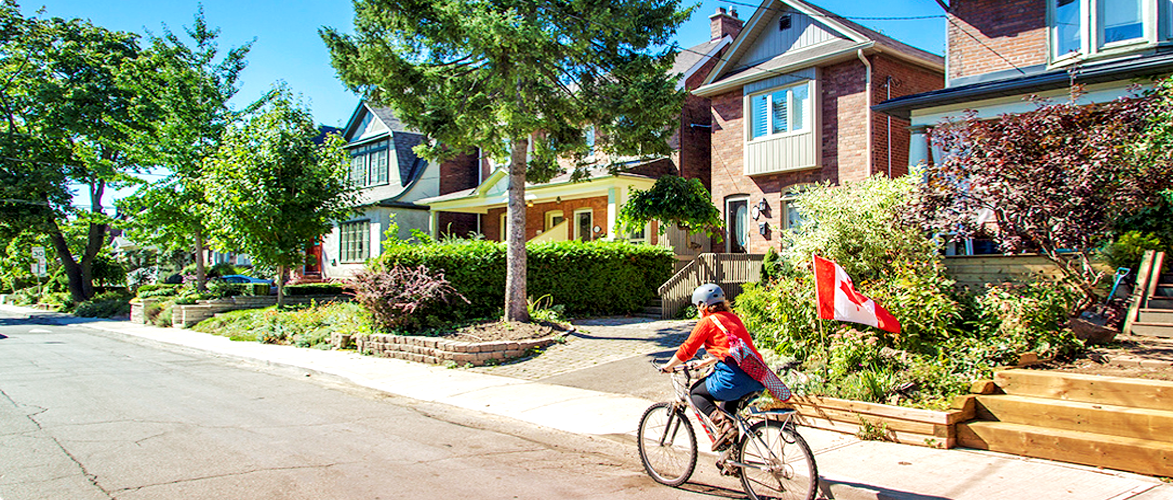
Hillcrest Village and Wychwood sit on a hill between Bathurst Street and Christie, north of Bloor, where Victorian and Craftsman-era homes line streets like Wychwood Avenue, Benson Avenue, and Yarmouth Road. Renovated semis were trading between $1.1 and $1.6 million in early 2026, with detached homes starting around $1.5 million and reaching $2.3 million on the better streets. The centrepiece is Wychwood Barns: a converted TTC streetcar facility that now holds artist studios, a year-round Saturday farmers market, and a park, with nothing quite like it elsewhere in Toronto.
Hillcrest Village and Wychwood occupy a ridge north of Bloor and Dupont between Bathurst Street and Christie, rising to St. Clair West. The geography is literal: the streets go uphill from the Dupont corridor, and the climb gives the neighbourhood both its distinct character and one of the better views of the downtown skyline you’ll find outside a condo tower. Hillcrest Park at the top of the ridge makes use of that elevation in a way that most Toronto parks can’t.
The built form is older than much of the mid-city. Victorian and Edwardian semis on Benson Avenue, Yarmouth Road, and Alberta Avenue sit alongside Craftsman-style homes with front porches and deeper lots on the upper streets near Hillcrest Park and Wychwood Avenue. The density is lower than you’d find in Trinity Bellwoods or the Annex, and the streets are quieter. This is a neighbourhood where people walk to the Saturday market and know their neighbours in a way that doesn’t feel performed.
The centrepiece is Wychwood Barns on Wychwood Avenue: a former TTC streetcar maintenance facility that Artscape converted into a community hub in 2008. The Barns hold artist live-work studios, a greenhouse, a park, and the Evergreen Farmers Market, which runs every Saturday through the year. There is nothing quite like it elsewhere in Toronto. The artist community that moved in when the Barns opened has largely stayed, and the neighbourhood’s creative character is partly a product of that decision.
The dominant purchase is the Victorian or Edwardian semi: typically three bedrooms, one and a half to two bathrooms, built between 1895 and 1920, with original hardwood floors under later renovations and a rear yard that’s usable without being generous. Benson Avenue, Yarmouth Road, Alberta Avenue, and Alcina Avenue are the most-searched streets. A renovated semi in solid condition traded between $1.1 and $1.6 million in early 2026, with the upper end of that range reflecting well-executed kitchens and bathrooms, good lot depth, and street-specific demand.
The detached market here is more meaningful than in many central Toronto neighbourhoods at comparable price points. Wychwood Avenue and the streets immediately around the Barns have detached homes with larger lots that are genuinely family-practical. A three-bedroom detached in reasonable condition starts around $1.5 million. Renovated four-bedroom properties on deeper lots have traded above $2 million, with the best examples reaching $2.3 million. If you’re comparing to Trinity Bellwoods or the Annex, the detached stock here represents better value per square foot for buyers who can identify it.
There’s no significant condo market in this neighbourhood. A handful of purpose-built rental buildings from the 1960s and 1970s exist along the St. Clair corridor, but buyers looking for condominium ownership in this part of the city typically look toward St. Clair West station or the Annex. That’s not a weakness of Hillcrest-Wychwood so much as a character of it: this is a freehold neighbourhood, and that shapes who lives here.
Parking varies by property. The Edwardian semis were built before cars and many have no dedicated parking. Buyers who need parking should investigate the specific property rather than assuming. The streets directly around the Barns and Hillcrest Park occasionally have detached garages accessed from rear laneways, but they’re not universal.
Hillcrest-Wychwood is a neighbourhood where the best properties sell quickly and the median ones take longer than agents expect. The buyer pool is smaller than in Trinity Bellwoods or Roncesvalles: buyers here are specifically looking for this neighbourhood rather than comparing it against three others. That focus creates genuine competition for well-presented semis on Benson, Yarmouth, and Alberta, while less-central streets on the western edge of the neighbourhood can sit for weeks without generating the same attention.
In early 2026, most sellers have moved away from formal offer dates. Properties are listed and reviewed when offers arrive. For the stronger addresses, informal offer timelines still appear within the first week of listing. Buyers should be ready to act quickly on well-priced semis on the core streets, and should expect some pushback on conditions even when they’re included. The freehold market in this neighbourhood is not forgiving of slow decision-making on desirable properties.
The neighbourhood’s market position reflects its place in the Toronto mid-city hierarchy. It’s meaningfully less expensive than the Annex to the southeast and Davisville to the east, while offering comparable or better housing character. The discount to those addresses has narrowed over the past decade but hasn’t closed, which is part of the ongoing buyer argument for Hillcrest-Wychwood. Buyers who bought on Benson or Yarmouth in 2015 when the discount was wider have seen strong appreciation. Whether the remaining discount persists is the market question the neighbourhood has been posing for twenty years.
The buyers who end up here are usually running a comparison against the Annex, Roncesvalles, or Davisville, and choosing Hillcrest-Wychwood for two reasons: the price, and the specific character of the neighbourhood. Neither reason is incidental.
The price argument is real. For what a renovated semi costs on Benson Avenue, you’d be buying something significantly smaller on Madison Avenue in the Annex or you wouldn’t be buying at all in Davisville. Buyers who did the Annex comparison and couldn’t make the numbers work often arrive at Hillcrest-Wychwood and find the daily life is more similar to what they imagined than the price difference suggested it would be.
The character argument is harder to quantify but consistently described by people who live here. The Wychwood Barns is a genuine community institution, not a marketing concept. The Saturday market draws actual regulars from the neighbourhood, not tourists. The artist community that settled in the 2000s gave the streets around the Barns a particular quality that hasn’t been diluted by the price increases that followed. Buyers who care about that kind of community feel, and who have looked at enough Toronto neighbourhoods to know it isn’t automatic, often choose this one specifically because they can see it rather than just assume it.
The typical buyer is in creative, education, or technology industries, often in their late thirties with a growing family. The narrow semis that constrain larger families in Trinity Bellwoods are more spacious here, and the detached stock offers a realistic upgrade path within the neighbourhood rather than requiring a move to a different part of the city entirely.
The streets divide differently here than the simple price gradient suggests. The blocks closest to Wychwood Barns, particularly Wychwood Avenue itself and the streets just north toward Hillcrest Park, command a premium that doesn’t always show in comparable sales data because there aren’t enough transactions to establish a clean line. Benson Avenue has strong, consistent demand. Yarmouth Road and Alberta Avenue are slightly more mixed: some blocks are excellent, others back onto commercial or institutional uses that lower the ceiling. Walk the specific block in the evening and on a weekend morning before you decide the address is representative of what you’re buying.
The hill itself matters for buyers with young children or elderly family members. Some streets on the ridge are steep by Toronto standards. Properties at the top near Hillcrest Park offer the views and the park access but require awareness that the walk up from Bathurst or Christie is not flat. Buyers who cycle to work and need to get back home should test the specific route before committing.
The area around Wychwood Park, the private ravine enclave just east of Bathurst below Davenport, occasionally generates buyer confusion. Wychwood Park is a legally private enclave with historically significant Arts and Crafts homes that rarely come to market. It’s not part of the Hillcrest-Wychwood neighbourhood in any practical sense: a different price tier, a different buyer profile, and a different physical setting. A property described as “near Wychwood Park” is in Hillcrest-Wychwood. A property on a Wychwood Park address is something else entirely and priced accordingly.
The commercial activity on St. Clair West generates some noise on the streets immediately adjacent. Properties on Westmount Avenue and Alcina Avenue, which run parallel just south of St. Clair, are quieter than anything directly on the commercial strip. The TTC barn on Davenport at the south end of the neighbourhood is an industrial use that buyers on the closest residential streets should walk past before committing.
Buyers in this neighbourhood are looking for the combination of character and function: Victorian bones that have been updated enough to live in without constant maintenance, but haven’t been renovated to the point where the original quality is gone. The semis that sell strongest here are the ones where the original hardwood has been refinished rather than replaced, the brick isn’t painted over, and the kitchen is contemporary without being the entire story of the renovation.
The Wychwood address has its own aesthetic expectations. Buyers here have often been to the Saturday market, they’ve walked the neighbourhood, and they have a sense of what the houses should look like. A semi that has been renovated with generic finishes that could be in any Toronto neighbourhood tends to underperform against one that feels specific to the place it’s in. The distinction sounds subjective but shows up consistently in offer prices when comparable properties on the same street are presented differently.
Timing the listing matters. Spring from late February through May is when the buyer pool is largest and most motivated. October produces a second window that’s often underestimated: families who want to be settled before the school year typically push any remaining decisions before the end of October. A November listing is workable but will face a smaller pool. December and January are slow, and sellers who have the flexibility to wait until March almost always benefit from doing so.
The neighbourhood’s modest price discount to the Annex and Davisville is part of the selling story rather than something to hide. Buyers who are looking here have already done the comparison. A good listing acknowledges what the neighbourhood actually offers rather than straining to position it as something it isn’t.
Wychwood Barns sits at 601 Christie Street, which is slightly confusing given the name: it’s on Christie, just south of St. Clair West. The building is a converted TTC streetcar maintenance barn from 1913, and the scale of it is larger than it looks from the street. Inside, Artscape operates live-work studios for artists who went through a competitive application process, a community gallery, a greenhouse that supplies the market in summer, and a large open hall used for events. The park outside the Barns is well-used and well-maintained, with a playground and open lawn.
The Evergreen Farmers Market runs every Saturday from 8 a.m. to noon, year-round. This is not a seasonal market that shuts down when it gets cold, and the attendance is genuine rather than tourist-driven. Vendors include local meat and dairy producers, bakers, prepared food, and seasonal produce. Regular attendees tend to be neighbourhood residents who treat Saturday morning at the Barns as part of the weekly rhythm rather than an occasion. For buyers trying to understand what the neighbourhood feels like in practice, a Saturday morning visit to the market is more informative than any listing description.
St. Clair West between Bathurst and Christie is the primary commercial strip. It’s less dense than Ossington or Queen West but has developed a strong concentration of independent retail that rewards the smaller scale. Crema Coffee on St. Clair West has been a neighbourhood anchor. There are independent restaurants, a bookshop, and the day-to-day retail that makes walking the strip practical rather than merely pleasant. The strip hasn’t been overrun by chains, partly because the rents reflect a neighbourhood market rather than a destination one.
Hillcrest Park, which runs along the ridge at the north end of the neighbourhood, has a playground, a wading pool in summer, and the view of the downtown skyline that makes it worth the walk up. It’s an underused park relative to its quality: residents who know it treat the hilltop as a regular destination, while buyers from other parts of the city are often surprised by how good it is.
St. Clair West station on the Yonge-University line is the main transit hub, at the top of the neighbourhood at St. Clair and Bathurst. From there, the 512 St. Clair streetcar runs west along St. Clair Avenue, and the subway provides a direct downtown connection. From St. Clair West to Union Station is roughly 20 to 25 minutes by subway, which is workable for daily commuters. The station is a genuine anchor: buyers on the Hillcrest Park streets are within a 10-minute walk, buyers on Benson and Yarmouth are 15 to 20 minutes on foot.
The 512 St. Clair streetcar runs the top edge of the neighbourhood toward Runnymede and east toward Mount Pleasant. It’s useful for lateral movement but not the primary downtown connection. Dupont station on the Bloor-Danforth line is accessible from the southern part of the neighbourhood and provides a Bloor-Danforth connection for eastbound trips and crosstown travel, though it’s a longer walk from the north end of the neighbourhood.
Cycling is the faster option for many commuters going downtown. The Dupont Street cycling infrastructure has improved and connects east toward Yonge and west toward the Junction. A cyclist in reasonable condition can reach King and Bay in 30 to 35 minutes from the Wychwood Barns, and the return trip up the hill at the end of the day is the main consideration. Buyers who cycle should test the specific route from their prospective address, since the gradient varies meaningfully by street.
Driving to downtown during rush hour is the transit option with the worst performance. The Bathurst corridor is slow in peak periods, and parking downtown is expensive. Most residents who work downtown rely on the subway or cycling. Buyers who need a car for weekend and evening use rather than daily commuting find the neighbourhood practical: street parking is available on most residential streets without permits required in the core residential area.
The Annex is the comparison most buyers have already run before they arrive at Hillcrest-Wychwood. It’s 20 to 30 percent more expensive for comparable housing types, and the reasons are defensible: the Bloor Street commercial strip is more varied and more concentrated, the transit connections are more direct, and the address carries a recognition that decades of association with the University of Toronto and Toronto’s intellectual life have built. Hillcrest-Wychwood buyers who chose here over the Annex typically report that the practical daily life is more similar than the price difference implied. You’re further from downtown but not isolated. You get more house for less money. The community institutions, particularly the Barns, are arguably stronger than anything comparable in the Annex.
Davisville is a different kind of comparison. It’s similarly priced to slightly more expensive, with a family-oriented character and strong school catchments that Hillcrest-Wychwood doesn’t fully replicate. The housing stock in Davisville runs slightly more uniform: well-maintained brick semis on quiet streets, but less of the Victorian character variation that makes Hillcrest-Wychwood streets interesting. Buyers with school-age children who are treating the school catchment as the primary decision variable often end up in Davisville. Buyers who care more about neighbourhood culture and community infrastructure tend to choose Hillcrest-Wychwood.
Corso Italia, along St. Clair West west of Dufferin, is the genuine value comparison. It’s 20 to 30 percent less expensive than Hillcrest-Wychwood for comparable square footage, and the housing stock runs primarily post-war brick rather than Victorian and Edwardian. The community character is different: Corso Italia has its established Italian-Canadian commercial culture and a strong local identity, but it doesn’t have the equivalent of Wychwood Barns, and the housing quality per dollar, while excellent, doesn’t carry the same architectural character. Buyers who prioritise value over address and aren’t specifically drawn to the Victorian stock often find Corso Italia delivers more space for the budget. Buyers who are drawn to the Hillcrest-Wychwood housing character and community institutions typically find the price difference is justified by what they’re getting.
Hillcrest Community School on Ossington Avenue is the primary TDSB elementary option for most of the neighbourhood and has a strong local reputation, particularly for the arts programming that reflects the neighbourhood’s creative community. The school runs a before and after school program and has an active parent council. It’s a smaller school by Toronto standards, which some families consider an advantage for the community feel it creates.
Winona Drive Senior Public School handles Grades 6 through 8 for part of the catchment before the secondary transition. The TDSB has adjusted catchment boundaries in this part of the city in recent years, and the current boundaries don’t always align with what older listings or neighbourhood lore suggest. The practical instruction is to use the TDSB boundary tool and enter the specific address before treating any catchment claim as settled, whether from an agent or a neighbour.
For secondary school, the catchment typically flows to Vaughan Road Academy at Oakwood and Vaughan, which has a mixed academic reputation but strong individual programs. Buyers with children approaching secondary school age often investigate the TDSB’s Regional Arts program and the IB program options available across the city, both of which require separate applications rather than catchment enrollment. The Catholic system has Our Lady of the Annunciation at Dupont and Ossington as an elementary option for families in that stream.
The honest assessment for families with school-age children is that the elementary options here are solid and the neighbourhood character is genuinely good for children, while the secondary school picture requires active planning. That’s not materially different from most central Toronto neighbourhoods outside the established Leaside-Davisville-Lawrence Park tier, but it’s worth accounting for honestly before committing to the address.
What is Wychwood Barns and why does it matter for buyers? Wychwood Barns is a converted TTC streetcar maintenance facility on Christie Street that Artscape redeveloped in 2008 into a mixed-use community hub with artist live-work studios, a community gallery, a greenhouse, a park, and the Evergreen Farmers Market. The market runs every Saturday year-round from 8 a.m. to noon, with consistent attendance from neighbourhood residents rather than tourists. The artist community that moved into the studios when the Barns opened has largely stayed, which shaped the surrounding streets in a way that’s still measurable in the neighbourhood’s character. For buyers, the Barns matters because it’s a genuine community institution that creates the kind of neighbourhood feel that most Toronto neighbourhoods describe in their listings without actually having. Properties within a short walk of the Barns consistently cite the proximity as a selling point, and buyers who’ve visited before shortlisting properties tend to weight it heavily in their final decision.
How does Hillcrest-Wychwood compare to the Annex? The Annex runs 20 to 30 percent more expensive for comparable housing types, which means a renovated semi that trades around $1.3 million on Yarmouth Road would be closer to $1.7 million on Madison Avenue. The Annex is closer to the downtown core, has a more varied and concentrated commercial strip on Bloor, and carries a stronger address recognition. Hillcrest-Wychwood offers more house per dollar, the Wychwood Barns as a community institution the Annex doesn’t have an equivalent of, and a quieter, more neighbourhood-feeling environment. Buyers who make the comparison frequently report that the practical daily life is more similar than the price gap implies. The commute from St. Clair West station to downtown is roughly 20 to 25 minutes, comparable to many Annex streets that rely on the Spadina or Bathurst bus to reach the subway.
What are the best streets in Hillcrest-Wychwood for buyers? Wychwood Avenue itself and the blocks immediately surrounding the Barns produce the strongest and most consistent demand. Benson Avenue is the most reliably searched street in the neighbourhood, with good lot sizes and strong housing character throughout most of its length. Yarmouth Road and Alberta Avenue are slightly more variable: the better blocks are excellent value, but specific sections back onto commercial or institutional uses that affect the ceiling. Alcina Avenue and Westmount Avenue, running parallel just south of St. Clair, are quieter than the streets adjacent to the commercial strip and have a strong residential feel. Buyers should walk the specific block, not just the street, before assuming the address is uniform. Two blocks apart on Benson can mean meaningfully different conditions.
What does a typical home cost in Hillcrest-Wychwood in 2026? Renovated Victorian and Edwardian semis traded between $1.1 and $1.6 million in early 2026. The lower end of that range reflects properties that need updating or are on less central streets. The upper end reflects well-executed renovations on Benson, Wychwood Avenue, or the best blocks of Yarmouth and Alberta. Detached homes start around $1.5 million for properties needing work and reach $2.3 million for renovated four-bedroom houses on better lots. The neighbourhood sits at a meaningful discount to the Annex and a modest discount to Davisville for equivalent housing types. Buyers who bought here in 2014 and 2015 saw strong appreciation as the discount to those reference points narrowed, and the question of whether further narrowing continues is part of the ongoing buyer conversation about the neighbourhood.
The residential streets of Wychwood were laid out in the 1890s and 1900s as the city expanded north from Bloor along the Bathurst corridor. The developer of the original subdivision, Marmaduke Matthews, named the area after Wychwood Forest in Oxfordshire, which explains both the name and the slightly unusual street pattern on Wychwood Avenue itself, which curves rather than following the city grid. The houses built in this period were primarily for working and middle-class families: tradespeople, clerks, and small business owners who could afford a new semi at the edge of the city’s development. The housing quality was good. The Victorian and Edwardian semis that survive in the best condition today were well-built when they were new.
Wychwood Park, the private enclave just east of Bathurst on the ravine, was a separate development: a planned artists’ colony established in the 1870s and 1880s by Marmaduke Matthews and Alexander Jardine, intended to attract Toronto’s artistic and professional class to country-like conditions at the city’s edge. The enclave has remained legally private since its incorporation, with a small number of historically significant Arts and Crafts and Edwardian homes on a ravine setting. It’s a genuinely unusual piece of Toronto real estate history, but it has no practical relationship to the Hillcrest-Wychwood housing market: different buyer profile, different price tier, different physical setting.
The neighbourhood went through a period of decline and disinvestment through the mid-20th century, as the housing stock aged and the population changed. The modern recovery began gradually in the 1990s and accelerated in the 2000s when Artscape’s conversion of the TTC barns drew an artist community into the neighbourhood at a time when the housing was still affordable enough to support live-work arrangements. The artists who came for the studios and the rents stayed for the community, and the character that arrived with them is the character that buyers are paying for now. The TTC barns, which closed as an operational facility in the 1970s, spent decades as a storage use before the Artscape redevelopment was approved in the early 2000s. The building opened as the Barns in 2008. The effect on the surrounding streets was measurable within a few years.
Street-level knowledge is hard to find online. Our team works in Hillcrest-Bracondale Hill (Wychwood) every day. They know which pockets hold value, where the school catchment lines actually fall, and what the market is doing right now. Talk to us before you make a decision about Hillcrest-Bracondale Hill (Wychwood).
Talk to a local agent For Rent
 For Rent
 For Rent
 For Sale