
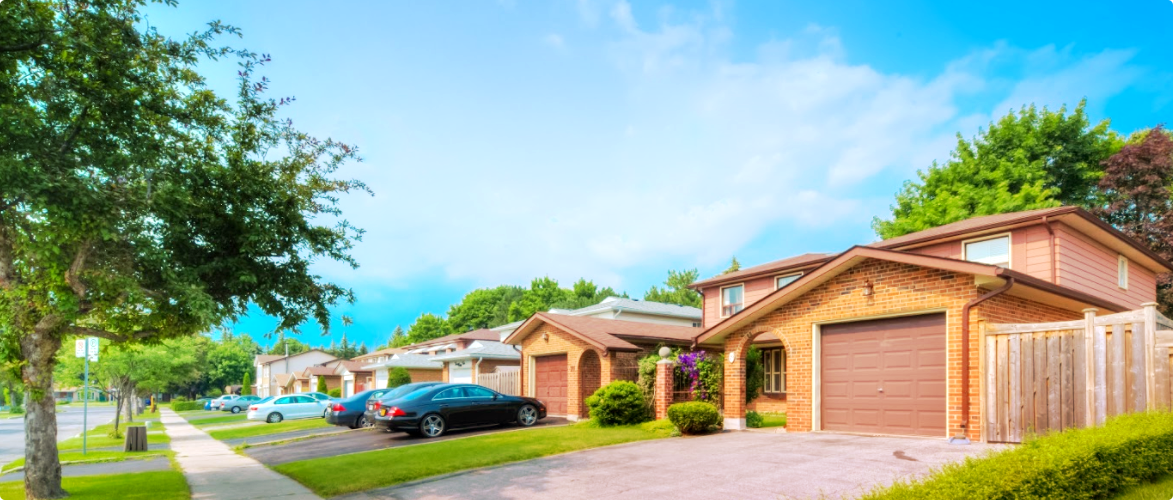
Hillcrest Village is a quiet North York neighbourhood east of Yonge Street, built primarily in the 1950s and 1960s. Post-war bungalows on generous lots dominate the housing stock. The neighbourhood is within the AY Jackson Secondary School catchment and borders the East Don ravine trail system, making it a consistent choice for families seeking detached homes at accessible North York prices.
Hillcrest Village occupies a quiet corner of North York that most of the city doesn’t think about much, and residents there tend to like it that way. The neighbourhood sits east of Yonge Street, north of Sheppard Avenue East, and below Steeles Avenue, roughly centred on Leslie Street and the suburban residential grid that fills that quadrant. It’s not adjacent to a subway station. It’s not close to a major shopping destination. What it has instead is calm streets, affordable detached housing by Toronto standards, and a ravine system at its edges that gives it an unexpectedly natural quality for an area this far into the North York fabric.
The housing here is overwhelmingly post-war residential, built out through the 1950s and 1960s as North York expanded northward. Bungalows dominate, with some raised bungalows and side-split designs that were standard for that era. The lots are generous compared to what was being built in the same years closer to downtown, typically 45 to 55 feet wide with reasonable depth. Many homes have been in the same family for decades, which contributes to the neighbourhood’s stable, settled feel.
Hillcrest Village’s identity is one of unpretentious suburban residence. It doesn’t have a commercial strip worth walking, it doesn’t have a distinctive architectural character that sets it apart visually, and its transit options require bus connections to reach the subway. But it consistently attracts buyers who are looking for a solid detached home in a quiet area at a price that’s achievable without stretching dangerously, and who are willing to trade some urban convenience for space, stability, and neighbourhood calm. That’s a specific calculation, and the buyers who make it tend to be satisfied with the result.
The housing stock in Hillcrest Village is almost entirely detached bungalows, raised bungalows, and bungalow side-splits on established residential lots. This is not a neighbourhood with significant condo or townhome inventory. Buyers come here for freehold ownership of a house on a proper lot, and that’s what’s available.
Original bungalows in good condition, updated kitchens and bathrooms but with the original structure intact, typically sell in the $1.1 million to $1.4 million range in 2026. Homes on larger lots, those facing parks or with ravine proximity, or those that have been significantly renovated or extended (second storey additions are common in the area) push into the $1.5 million to $2 million range. A small number of newer or substantially rebuilt infill homes exceed $2 million, though these are the exception rather than the rule.
Lot sizes matter here because they drive both the livability of the current home and the potential for renovation or redevelopment. Standard lots run 45 to 55 feet wide, but there are wider lots on some streets and occasional deep lots that back onto the ravine. The ravine-backing lots carry a premium that buyers value both for the visual amenity and the privacy, since those rear lots will never be developed.
The bungalow floor plans in this area range from modest, the original two-bedroom, one-bath layouts that were built for smaller postwar households, to expanded versions that have grown through basement finishing, rear additions, and second storey builds. Buyers who want to move in and live in the home as-is should prioritize updated mechanicals and a finished basement, since that’s where much of the livable space in a bungalow exists. Buyers who plan to renovate should focus on the lot, the bones, and the permitted work history rather than the current finishes.
The Hillcrest Village market moves at a pace that reflects low turnover and steady demand. Listings are not constant here: in any given month there may be only a handful of properties available, and the absence of a major transit line or commercial anchor means the neighbourhood doesn’t generate the level of speculative activity that inflates volume in more prominent areas.
When homes do come to market, the response depends heavily on price and condition. A well-maintained bungalow priced correctly against recent comparables will attract multiple interested buyers, and offer nights in a rising market can generate competitive bidding. In the softer conditions of 2024 and 2025, properties sat longer than they used to, and sellers had to price with more precision to achieve a sale within a reasonable timeframe. The market in 2026 is showing early signs of recovery, but buyers still have more room to negotiate than they did in 2021 and early 2022.
The typical transaction in Hillcrest Village involves a condition period for home inspection and financing. Buyers should not waive the home inspection on a bungalow from this era. These homes have aging infrastructure: original knob-and-wiring that may have been partially updated but not fully replaced, older HVAC systems, foundations that may have developed moisture issues over decades, and drainage patterns that reflect the original grade of the lot rather than current drainage standards. None of these are necessarily dealbreakers, but they need to be understood before the offer is finalized.
Price per square foot in Hillcrest Village is typically lower than comparable neighbourhoods closer to Yonge Street, which is part of its appeal for value-conscious buyers. The trade-off is the transit limitation and the longer distance to the commercial strips that animate more urban neighbourhoods. For buyers who’ve done the lifestyle math and decided a quiet bungalow on a good lot is worth more than a shorter commute, Hillcrest Village competes well on value.
Hillcrest Village attracts a specific buyer profile: families in their mid-thirties to late forties who need a detached home, are priced out of the Bayview and Yonge corridor neighbourhoods to the west, and are willing to trade transit walkability for an achievable freehold purchase. These buyers have usually looked at more expensive options, run the numbers, and concluded that the extra $200,000 to $400,000 required to live in Bayview Village or Willowdale isn’t justified by the lifestyle improvement for their household.
Longtime North York residents also form part of the buyer base, people who grew up in the area or have family here, who understand the neighbourhood’s limitations and have already made peace with them. These buyers often have clear preferences about which streets and pockets they want and move quickly when the right property becomes available.
A growing portion of buyers are newer Canadians, particularly South Asian and East Asian households, who are purchasing a first detached home after a period of renting or condo ownership. These buyers often prioritize lot size and school catchment over walkability and nightlife. The school catchment for AY Jackson Secondary School is a specific pull for some of these households, given the school’s academic reputation in certain program areas.
Buyers from outside North York sometimes discover Hillcrest Village after being priced out of more central options and then find that the neighbourhood surprises them in a positive way. The ravine proximity, the quiet streets, and the sense that this is genuinely a family neighbourhood rather than an investment vehicle all register as positives once buyers spend time here. The conversion rate from “I had no idea this existed” to “this is where we want to be” is higher than you might expect for an area that lacks a strong public profile.
The neighbourhood’s internal geography is relatively uniform, which means the meaningful differences between streets are subtle rather than dramatic. That said, buyers who understand those differences buy better properties.
The streets that back onto the ravine system along the eastern and northern edges of the neighbourhood are consistently more desirable. Ravine-backing lots provide natural privacy, no possibility of a neighbour building behind you, and direct or near-direct access to the trail system. These properties carry a premium of 10 to 20 percent over comparable non-ravine properties, and they generate more competition when they come to market. If a ravine-adjacent property is available, it’s worth serious consideration even if the home itself needs more work than alternatives.
The streets closest to Leslie Street have slightly more traffic exposure, particularly on the side streets that run parallel to Leslie and catch cut-through traffic. Buyers who are sensitive to traffic noise should walk or drive through their target street at rush hour before committing.
The area around Hillcrest Village Public School has a neighbourhood-hub quality that nearby streets share. Families cluster around good elementary schools, and the streets around that school tend to have a social character, families who know each other, kids walking to school, the kind of low-grade neighbourhood life that makes a residential area feel functional. That quality is worth identifying and weighting when comparing specific streets.
The southern part of the neighbourhood, closer to Sheppard Avenue East, transitions into slightly more varied housing types and is closer to the commercial activity along Sheppard. Buyers who want to be able to walk to Sheppard for transit and errands will find the southern streets more practical, at some cost to the quiet residential feel of the deeper interior streets.
Transit in Hillcrest Village requires a bus connection, and buyers who don’t drive need to factor that into their daily life. There is no subway station within walking distance of the neighbourhood.
The most useful bus connection is the 54 Lawrence East bus or routes that connect south to Sheppard Avenue, where the Sheppard subway at Bessarion, Bayview, or Sheppard-Yonge stations provides access to Line 1. Depending on where in the neighbourhood you live and which route you use, the bus ride to subway takes ten to twenty minutes. Downtown commutes from Hillcrest Village by transit run forty-five minutes to an hour in moderate traffic conditions. That’s workable for many commuters but is meaningfully longer than what’s achievable from closer-in neighbourhoods.
The 51 Leslie bus runs along Leslie Street and provides north-south connections along one of the neighbourhood’s main arterials. This connects to the Eglinton Crosstown at Leslie station, which improves access to the midtown Yonge corridor and east toward Scarborough. The Crosstown’s opening has been the most significant transit improvement for this part of North York in years, and residents who use transit regularly are beginning to incorporate it into their commute patterns.
Driving is comfortable and the neighbourhood’s position between the DVP to the west and Highway 404 to the east gives reasonable expressway access for trips in multiple directions. Leslie Street connects north to Highway 401 via a clear arterial route. Sheppard Avenue provides east-west access across North York. The absence of a subway station is less significant for residents who drive regularly.
Cycling is feasible for local trips on quieter residential streets, and some residents cycle to Sheppard or to the ravine trail network. The arterials are not comfortable cycling routes. Protected cycling infrastructure in this area is limited, and cyclists who want to commute downtown by bike should plan their route carefully and test it in advance.
Hillcrest Village’s access to the ravine system is one of its better-kept secrets. The neighbourhood backs onto a section of the ravine network that connects through to Pomona Mills Park and the broader East Don River trail system. For residents who walk or run regularly, this means direct access to kilometres of trail through forested ravine land, accessible from multiple points along the neighbourhood’s edges without needing to drive to a trailhead.
The East Don River trail corridor runs through this part of North York and eventually connects south through Flemingdon Park and into the Lower Don Trail. The full trail network from the neighbourhood to the lake is well over twenty kilometres, and sections of it feel genuinely removed from the urban environment despite being within a city of several million people. This is the kind of access that draws a particular type of buyer, one who prioritizes outdoor time and wants it to be genuinely convenient rather than a weekend drive away.
Closer to home, Hillcrest Village Park and the various smaller parkettes on the residential streets provide more immediate green space for families. These parks are well-used during warmer months and serve the neighbourhood’s family-heavy demographic practically. They’re not destination parks with extensive amenities, but they fulfil the daily need for open space and play areas.
Earl Bales Park is within a reasonable drive to the northwest and offers more extensive programming including ski slopes (small, but functional for beginners and children), a community centre, and extensive trails through the Black Creek ravine. It’s a useful complement to the neighbourhood’s own ravine access for residents who want variety in their outdoor options. The combination of immediate ravine access and the broader North York park system makes Hillcrest Village significantly better supplied with green space than its modest urban profile would suggest.
Hillcrest Village doesn’t have its own retail strip. Daily needs require a car or bus ride, and buyers who are accustomed to walking for groceries or coffee will find this a material change from more urbanized neighbourhoods.
The closest grocery options are along Sheppard Avenue East to the south and along Leslie Street. A Loblaws and several smaller grocery stores serve the area within a five to ten minute drive. The Sheppard corridor has a range of services, pharmacy, banks, convenience retail, and dining, that cover most practical needs without requiring a significant detour. There are a number of South Asian grocery and specialty food options in the Sheppard corridor that serve the neighbourhood’s diverse population.
For a more significant shopping trip, Fairview Mall at Don Mills and Sheppard is about ten minutes by car and provides the range of national retailers and dining options of a full regional mall. Bayview Village Shopping Centre is accessible to the west and has a more upscale retail character, with better grocery options and independent restaurants. Either destination covers what daily and weekly shopping requires.
Dining options within walking distance of Hillcrest Village are limited. There are a few restaurants along Sheppard and Leslie serving standard fare, and the neighbourhood has the kind of informal Chinese, Korean, and South Asian restaurants that you find throughout North York’s diverse residential areas. None of them are destination dining, but they’re functional for regular use. Residents who prioritize dining out regularly tend to drive to the better options in the broader area, including along the Yonge corridor north of Sheppard, in Thornhill, or east toward Scarborough, depending on their preferences.
Schools are a meaningful draw for many families who choose Hillcrest Village, particularly the catchment for AY Jackson Secondary School, which has a strong reputation in North York for its academic and extracurricular programming. The school’s arts and music programs are well-regarded, and it draws families who are specifically seeking that combination of strong academics and a robust co-curricular environment.
Hillcrest Village Public School serves the neighbourhood at the elementary level and has historically performed well on provincial assessments. The school serves a diverse student body that reflects the neighbourhood’s changing demographics, and it has been well-maintained by the TDSB. For families whose children are in the elementary years, it’s a solid local option that avoids the need for busing or special programs to access reasonable school quality.
For Catholic families, St. Timothy Catholic School provides a Catholic elementary option in the area, with connections to the Toronto Catholic District School Board’s secondary network. St. Kateri Catholic Secondary School is accessible for Catholic secondary students in the area, though catchment boundaries can shift and should be confirmed with the TCDSB.
French immersion demand is consistent in this area, as it is across North York. Spots at French immersion programs can be competitive, and families who are committed to the French immersion pathway should register early and confirm the closest designated school for their address. TDSB boundaries change periodically, and relying on year-old information about catchments is a common source of buyer disappointment. The verification takes twenty minutes and is worth doing before finalizing any purchase where school programming is a material consideration.
Hillcrest Village has seen modest infill development over the past decade, primarily in the form of individual lot replacements where an original bungalow has been torn down and replaced with a custom two-storey or a semi-detached pair. This pattern is common across North York’s bungalow neighbourhoods and has been gradually shifting the neighbourhood’s character, adding newer, larger homes to streets where the original housing stock remains otherwise intact.
There’s no major condominium or apartment development underway in the neighbourhood itself, which is protected from intensification by its positioning away from Major Transit Station Areas and Provincial Growth Plan nodes. The closest intensification corridors are along Sheppard Avenue East and Don Mills Road, where taller mixed-use and residential development is occurring. That activity is far enough from Hillcrest Village’s core residential streets that it doesn’t significantly affect the neighbourhood’s character.
The Eglinton Crosstown, which runs along Eglinton Avenue well to the south, has had a second-order effect on this part of North York by improving transit connectivity for the broader area. As the Crosstown generates development pressure along its corridor, some of that development activity has been redirected away from other North York corridors, which paradoxically reduces intensification pressure on areas like Hillcrest Village.
Infrastructure aging is worth noting as a development consideration of a different kind. The neighbourhood’s water and sewer infrastructure dates from the same era as the housing, and the City of Toronto has been gradually working through capital replacement programs across older North York neighbourhoods. Buyers should be aware that road disruption from infrastructure work is possible over the coming decade, though the inconvenience is typically temporary. The larger issue, privately owned lead water service pipes in some older homes, is worth investigating at the property level and discussing with the city’s lead pipe replacement program if relevant.
Is Hillcrest Village good value compared to Bayview Village or Willowdale?
Yes, on a price-per-square-foot basis for freehold detached, Hillcrest Village consistently comes in lower than Bayview Village and the central Willowdale corridors. A bungalow that would cost $1.8 million on a comparable lot near Bayview and Sheppard might be achievable for $1.2 to $1.4 million in Hillcrest Village. What you’re giving up is primarily the Yonge Street and Bayview Avenue corridor access, the prestige associated with those addresses, and the slightly superior transit walkability that comes with proximity to the Sheppard subway stations. The schools in this area, particularly AY Jackson, are genuinely competitive with what you’d get in Bayview Village. If your life is organized around schools, ravine access, and a quiet detached property, and transit walkability is less important, Hillcrest Village often makes more financial sense than its more prominent neighbours.
What should I check in a home inspection for a bungalow from this era?
Electrical is the first priority. Many homes in this neighbourhood still have original or partially updated wiring, which can include aluminum branch circuit wiring from the 1960s and 1970s or remnant knob-and-tube that was never fully removed. Neither is automatically dangerous if it’s been maintained, but both require specific handling and affect your insurance options and costs. A thorough inspector will check the panel, trace visible wiring in the attic and basement, and identify whether major updates have been made. HVAC is the second priority: a furnace from 2008 has 5 to 10 years of life left, and a furnace from 1998 needs replacement. Foundation and basement moisture are the third: North York’s clay soil and the age of these foundations means moisture has had decades to find its way in. Efflorescence, staining, or soft drywall in the basement should prompt further investigation before you remove the condition.
How do I confirm the AY Jackson Secondary School catchment for a specific address?
Use the TDSB school locator tool on the TDSB website, entering the specific address you’re considering. The school locator is updated when catchment boundaries change, which happens periodically. Don’t rely on a listing agent’s assurance about catchments, as they can be out of date or simply wrong. The TDSB locator takes sixty seconds and gives you the definitive answer. If AY Jackson is a material reason for your purchase, confirm the catchment at the address level before finalizing your offer, not after.
Is there flooding risk in this neighbourhood?
The neighbourhood’s proximity to the ravine system means some properties, particularly those near ravine edges or low-lying areas, have historically experienced basement flooding during heavy rain events. The City of Toronto’s Basement Flooding Protection Subsidy Program has helped some households mitigate this risk through backwater valve installation and sump pump additions. Before purchasing any property near the ravine edge or in a low-lying position, check the city’s flood risk mapping and ask the vendor about any history of water infiltration. A home inspection with a moisture probe can identify evidence of past flooding that cosmetic finishing work might conceal.
Buying in Hillcrest Village is fundamentally about buying an older bungalow on a good lot, and the due diligence reflects that. A buyer’s agent who specializes in North York bungalow properties will approach the purchase differently from one who primarily works in condo or new construction markets. The key skills are reading comparables accurately on a per-lot and per-square-foot basis, identifying properties where the asking price reflects deferred maintenance the seller hasn’t disclosed, and understanding which renovations and additions have been permitted and which haven’t.
Permit history is worth pulling from the city’s database before your offer. The City of Toronto’s permit history for any address shows what work has been applied for and approved. A finished basement that appears on the listing photos but has no permit on record is a liability you’re taking on at purchase. Unpermitted work can affect your ability to refinance, insure, or sell the property in the future, and it may not meet current building code. This is a standard check that any experienced buyer’s agent should do as a matter of course.
Lot size verification through the survey matters here because many lots have informal arrangements, fences not on the property line, encroachments from driveways, or additions that may sit close to the property boundary. Get a copy of the survey from the vendor if available, or budget for an updated survey after purchase if you’re planning any work near the lot boundaries. The city’s zoning bylaw specifies setback requirements from lot lines, and understanding those in advance of a renovation project saves significant time and money.
For buyers targeting ravine-adjacent properties, the TRCA regulated area mapping is essential. A property that backs onto the ravine may have a portion of its lot within the TRCA regulated area, where works require conservation authority approval. This doesn’t prevent development but it does add steps, timelines, and costs to any project near the valley edge. It should be known before purchase, not discovered during the building permit application.
Finally, this neighbourhood rewards patience. Inventory is thin at any given time, and the right property may take three to six months to appear. A buyer’s agent who is willing to monitor the market actively, reach out proactively, and bring you off-market opportunities is more valuable here than in a high-volume neighbourhood where listings are constant.
Street-level knowledge is hard to find online. Our team works in Hillcrest Village every day. They know which pockets hold value, where the school catchment lines actually fall, and what the market is doing right now. Talk to us before you make a decision about Hillcrest Village.
Talk to a local agent For Sale
 For Sale
 For Sale
 For Rent