
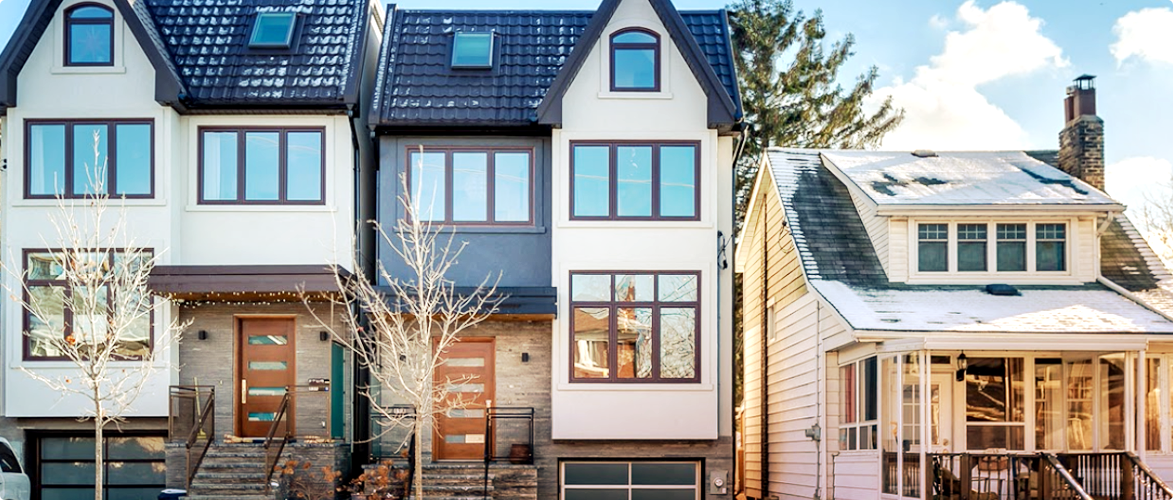
Lambton is a quiet Etobicoke neighbourhood along the Dundas Street West corridor, with postwar bungalows and sidesplits on generous lots and direct access to the Humber River trail system. It consistently trades below Old Mill prices for comparable housing, making it one of the better-value freehold options in the Humber Valley area.
Lambton sits between Runnymede Road and the Humber River in Etobicoke, along the Dundas Street West corridor. It’s an area that most Toronto buyers haven’t consciously considered, partly because it doesn’t have a strong brand identity and partly because it sits in the shadow of Old Mill, which is immediately to its south and east and gets far more attention. That’s precisely the situation that creates value: a neighbourhood with genuine quality that the market has been slow to discover.
The character here is quiet in the way that only postwar residential neighbourhoods with long-tenure owners can be quiet. Streets are lined with bungalows and sidesplits, most of them in decent condition, many of them on lots that are larger than what you’d typically find in older, pre-war Toronto neighbourhoods. The Humber River is a constant presence to the west, with ravine access that gives the area a natural buffer and trail system that residents use year-round.
Dundas Street West is the commercial and transit spine. It’s not a glamorous street, but it connects the neighbourhood to the city in a way that matters for transit riders, and the mix of businesses along it reflects a genuinely residential, family-oriented community. Lambton is not trying to be anything other than what it is, which is a stable, underappreciated pocket of Etobicoke where families can buy a proper house without paying Old Mill prices.
The comparison to Old Mill is unavoidable and instructive. Old Mill, just to the south and east, has a higher profile, better transit access, and prices to match. Lambton offers comparable housing in a comparable setting at a meaningful discount. The trade-off is a longer bus connection to the subway, which for buyers who don’t commute by transit is irrelevant, and for transit commuters is a manageable inconvenience given the price difference.
Lambton’s housing stock is predominantly postwar bungalows and sidesplits from the 1950s and 1960s, with a smaller number of two-storey homes and some 1940s wartime construction at the older end of the neighbourhood. Brick construction throughout. Lot sizes are generally 35 to 45 feet wide and 100 to 130 feet deep, which is generous by Toronto standards and a meaningful difference from the narrower 25-foot lots common in the denser parts of the old City of Toronto.
The sidesplit and backsplit formats are particularly well-represented in Lambton. These homes, built to take advantage of sloped lots, typically offer more usable space than their exterior footprint suggests: a sidesplit on a 40-foot lot can deliver 1,400 to 1,700 square feet of above-grade space across three levels, with a lower level that opens to the backyard. For families who need more space than a standard bungalow provides, the split-level format is genuinely useful.
Condition varies, but the overall standard of maintenance in Lambton is above what you’d find in Keelesdale or Fairbank. Long-tenure owners who have invested in their properties over the decades are the dominant seller type here, and a meaningful portion of the inventory comes to market in reasonably good shape. This doesn’t mean buyers can skip inspections, but it does mean the rate of deeply distressed, heavily deferred-maintenance properties is lower than in some comparable price neighbourhoods.
In 2026, detached houses in Lambton trade in the $950,000 to $1.4 million range. The lower end is occupied by original condition bungalows that need updating; the middle range is well-maintained properties with updated kitchens and bathrooms; the upper end is fully renovated homes on wider lots or properties with additions that expand the footprint significantly. The gap between Lambton prices and comparable Old Mill properties to the south is real and typically runs $150,000 to $300,000 on similar specs. Buyers who are indifferent between the two areas on lifestyle grounds and who drive to work rather than transiting will consistently find better value in Lambton.
The Lambton market is slower-moving than the city’s hottest neighbourhoods and that’s not a bad thing for buyers. Properties sit on the market long enough to allow for proper due diligence, multiple offer situations are less common except on genuinely well-priced and presented properties, and the pace of transactions allows buyers to make considered decisions rather than reactive ones. This is a market where preparation and patience produce better outcomes than urgency.
Turnover is relatively low given the long-tenure owner base. When properties come to market, they tend to stay until the right buyer appears rather than selling in the first week. This means buyers who are active in Lambton for several months develop a good sense of what fair market value is and can recognise when a property is correctly priced versus when a seller has unrealistic expectations.
The estate sale component of the market is significant. Many of the original Etobicoke families who bought here in the 1950s and 1960s are selling through estate processes, which creates a steady stream of original-condition properties at estate-driven pricing. These can be excellent opportunities for buyers who can handle a renovation and who are comfortable with the sometimes slower process of buying through an estate. Estate sales in this neighbourhood occasionally close below what a conventional sale of the same property would achieve, partly because the estate process limits the seller’s flexibility and partly because the properties require more imagination to evaluate than a turnkey home.
The price gap relative to Old Mill creates a specific market dynamic: buyers who are shopping the broader Humber Valley area compare prices between the two neighbourhoods and consistently find Lambton cheaper. This comparison shopping keeps Lambton from being deeply undervalued, as buyers who discover the gap tend to compete more than they might in a neighbourhood without such an obvious reference point nearby.
Lambton’s buyers tend to be families or couples who have done a specific value comparison and decided that the Old Mill premium isn’t justified for their lifestyle. They want the ravine access, the residential quiet, the generous lots, and the solid housing stock of the Humber Valley area, and they want it at a price that leaves room in the budget for other things. The neighbourhood self-selects for buyers who are analytical about value rather than driven by neighbourhood prestige.
Many Lambton buyers are moving within Etobicoke or west Toronto. They know the area, they understand its character, and they’re choosing Lambton over nearby alternatives like Swansea, Bloor West Village, or Runnymede because those neighbourhoods have become expensive enough that the trade-offs no longer make sense. Lambton offers comparable residential quality at a lower price point, and for buyers who aren’t attached to the social prestige of a well-known postal code, that’s a rational choice.
Buyers who drive to work are particularly well-suited to this neighbourhood. Proximity to the Gardiner Expressway via Dundas Street, and to the QEW via the Humber and Lakeshore corridor, makes Lambton a convenient base for drivers. The transit connection to Old Mill subway is manageable for commuters, but it’s a bus trip rather than a walk, which matters to some buyers more than others. The buyers who thrive in Lambton are generally those who commute by car, who use the subway occasionally rather than daily, or who work locally in Etobicoke or the western suburbs.
A smaller but growing group of Lambton buyers are people who specifically value the ravine and trail access. The Humber River trail system is one of Toronto’s best natural corridors, and properties that allow you to walk out of your backyard into the ravine or to access the trail system within a five-minute walk are attractive to outdoor-oriented buyers. This is a niche but real driver of demand for the streets closest to the Humber.
Within Lambton, the streets closest to the Humber River ravine carry the clearest premium. Islington Avenue forms the eastern boundary, and the blocks between Islington and the Humber River include some of the most desirable streets in the neighbourhood. Here, properties back onto or are within a short walk of the ravine, which changes the quality of daily life in ways that are hard to quantify on a listing sheet but immediately apparent when you visit.
Edenbridge Drive and the surrounding streets in the southern portion of the neighbourhood, toward the Old Mill area, represent the most valuable real estate in Lambton. These are properties that could plausibly be marketed as Old Mill area, and the prices reflect that positioning. Buyers who stretch their budget to get into this southern pocket are getting a different product from the standard Lambton bungalow at mid-neighbourhood.
Dundas Street West itself is a commercial arterial and properties directly on it are less desirable for residential purposes. The traffic is significant and the commercial uses along the strip create a busy character that doesn’t suit the buyers who choose Lambton for its residential quiet. The streets running north and south off Dundas, a block or two removed from the arterial, are where the residential quality is highest.
The northern portion of Lambton, toward Runnymede Road and past the immediate Dundas corridor, transitions toward a slightly different character. Properties here are comparable in housing type but are further from the Humber ravine access that defines the neighbourhood’s main appeal. Prices in this northern section are modestly lower than in the ravine-adjacent south, and buyers who are primarily attracted by the ravine access should focus their search accordingly. That said, the northern streets offer good value in their own right, and for buyers who aren’t particularly driven by ravine access, they provide the same housing quality at a slight discount.
Old Mill subway station on Line 2 (Bloor-Danforth) is the nearest rapid transit connection for Lambton residents. It’s not walking distance for most of the neighbourhood: residents typically take the 80 Queensway or the 37 Islington bus south to the station, or drive and park. The bus connection works, and the combined transit trip from Lambton to downtown is in the 45 to 55 minute range depending on where you are in the neighbourhood and the time of day. It’s not a quick commute, but it’s a functioning one.
Dundas Street West buses provide east-west service, connecting Lambton to Runnymede subway station on Line 2 to the east, which is another option for residents who find Runnymede more convenient than Old Mill for their particular destination. The 40 Junction bus runs along Dundas through the neighbourhood and provides the daily surface transit that local residents rely on for shorter trips.
Drivers have good access to major routes. Humberside Avenue connects to Bloor Street and then to the Gardiner Expressway. The Queensway leads directly to the Gardiner and Lakeshore Boulevard. Highway 427 is accessible via Kipling or Islington. The QEW and the 401 are both reasonable drives. For buyers who commute by car, whether into downtown Toronto, to the airport, or to points in Etobicoke or Mississauga, Lambton’s location works well. The drive to Union Station or the financial district, against rush-hour traffic, is typically 35 to 50 minutes depending on conditions, which is comparable to or better than what transit-dependent buyers in the same neighbourhood experience.
Cycling to downtown is achievable via the Humber River trail, which follows the river south to Lakeshore Boulevard and then east. It’s a pleasant route and not particularly difficult terrain, though the distance from the northern parts of Lambton to downtown is over 15 kilometres. For residents who live in the southern portion of the neighbourhood, trail cycling to the lakefront or to Bloor Street is a realistic option.
The Humber River ravine is Lambton’s defining natural asset, and it’s genuinely exceptional by Toronto standards. The Humber River Recreational Trail runs along the river for kilometres in both directions from the neighbourhood, connecting north to Woodbridge and Kleinburg through the Humber Valley and south to Humber Bay and the Lake Ontario waterfront. This is not a small neighbourhood park: it’s a major natural corridor that provides trail running, cycling, and walking in a setting that feels properly natural rather than managed parkland.
The valley itself, with its wooded slopes and river views, provides a visual and sensory break from the urban grid that is rare at this price point in Toronto. Properties with ravine views or ravine-adjacent backyards have access to a quality of natural environment that buyers in more expensive neighbourhoods often pay a substantial premium for. In Lambton, the ravine access comes at what is still, relative to the rest of the city, a modest price.
Lambton Park, within the neighbourhood itself, provides local park space with sports fields and a community setting. It’s well-used by families in the immediate area and provides the day-to-day park experience that complements the more adventurous Humber trail system nearby. James Gardens, a formal garden and parkland along the Humber River north of Dundas, is a beautiful and somewhat undervisited park that Lambton residents have essentially to themselves for much of the year.
For buyers who run, cycle, or simply value being able to get into natural terrain without a car trip, Lambton’s access to the Humber Valley trail system is genuinely one of the neighbourhood’s strongest assets. It’s the kind of thing that makes buyers who move here rarely want to leave, even as they acknowledge the less-than-perfect transit connection or the modest local commercial strip. The trade of transit convenience for ravine access is one that many Lambton residents make consciously and contentedly.
Lambton’s commercial amenities are concentrated along Dundas Street West, which runs through the middle of the neighbourhood. The strip is typical of Etobicoke’s working arterials: independent convenience stores, a few restaurants and cafes of varying quality, a pharmacy, a bank, and the mix of service businesses that a residential neighbourhood requires. It’s functional and slightly unglamorous, which is in keeping with the neighbourhood’s character.
Bloor West Village, one of Toronto’s more appealing commercial strips, is accessible by bus or by a short drive east along Bloor Street. It provides a significantly wider range of dining, specialty grocery, and retail options than the immediate Lambton neighbourhood offers, and many Lambton residents use it as their primary destination for shopping and eating out. The proximity to Bloor West Village is an underappreciated amenity for Lambton buyers: you get the residential quiet of the neighbourhood without being far from one of the best local commercial streets in the west end.
Runnymede Plaza and the commercial area around Runnymede and Bloor is another nearby option, providing a Loblaws, a pharmacy, and the retail services of a neighbourhood commercial node. For bulk grocery shopping, many Lambton residents use the Sobeys or Metro in the surrounding area, accessible by car in under ten minutes.
The Junction neighbourhood to the north is accessible by car or bus via Dundas Street and has developed into a notable dining and retail destination over the past decade. For residents who want a more independent, restaurant-heavy evening out, the Junction provides it without a long transit trip. This proximity to multiple established commercial areas is one of the factors that makes Lambton’s relatively modest local strip less of a concern than it might be in a more geographically isolated neighbourhood.
Schools in Lambton are part of the Toronto District School Board and the Toronto Catholic District School Board, as with the rest of Toronto. The local public elementary school is Lambton-Kingsway Junior Middle School, which serves the neighbourhood from junior kindergarten through grade 8 and has a solid community reputation. The school’s enrollment reflects the neighbourhood’s stable, family-oriented character: it’s not a school in a state of flux or challenge, and it functions as a straightforward, decent neighbourhood school.
Humberside Collegiate Institute is the TDSB secondary school that many Lambton students attend. Humberside, on Quebec Avenue near Bloor West Village, is an established school with a reasonably strong academic reputation and a range of extracurricular programs. Its location near Bloor West Village means students are travelling into a walkable, pleasant area for their school day, which is a practical quality-of-life factor that matters to some families.
On the Catholic school side, the TCDSB operates Our Lady of Sorrows Catholic School for elementary students in the area. Catholic secondary students typically attend Father John Redmond Catholic Secondary School, which serves the broader Etobicoke area. Both the TCDSB elementary and secondary options are accessible and functioning within normal parameters for the board.
French immersion programs are available within the TDSB system through application, and Lambton’s location within the west end puts it within a reasonable school bus or transit distance of several French immersion options. Families who prioritise French immersion should check program availability and school bus routing with TDSB directly, as the specific schools offering French immersion and the transportation arrangements change periodically. The same applies to any specialty secondary programs: confirm current offerings directly with the board rather than relying on older information about which schools have which programs.
Lambton is not a neighbourhood in the middle of dramatic transformation. It’s not on a major transit corridor receiving new LRT stations, it doesn’t have large parcels of land being assembled for high-rise development, and it’s not attracting the kind of speculative attention that Crosstown-adjacent neighbourhoods are receiving. What it has is a slow, steady increase in values that reflects the broader West Toronto market and the incremental recognition by buyers that this area offers genuine value relative to its neighbours.
Infill on larger lots is the main development activity in the residential interior. Properties on 50-foot or wider lots occasionally come to market as teardown opportunities, particularly when they’re in significantly distressed condition or when an estate sale produces a property that would cost more to renovate than to replace. Custom infill builds have appeared on several streets in recent years. The design quality is variable: some new builds are sensitive to the neighbourhood scale and character; others feel oversized for their setting. The pace of infill in Lambton is modest compared to more rapidly changing neighbourhoods.
The Dundas Street West corridor has seen some commercial intensification proposals over the years, and the City of Toronto’s planning for the Dundas West corridor anticipates gradual mid-rise intensification at key intersections. This type of corridor planning tends to produce development at a slow pace and primarily at major intersections rather than along the full length of the street, so the residential character of the blocks running off Dundas is unlikely to change fundamentally in the near term.
The most relevant future development story for Lambton is the Humber River flood management program. The Humber River valley is subject to periodic flooding, and the Toronto and Region Conservation Authority’s ongoing flood mitigation projects affect some properties in the ravine-adjacent areas. Buyers considering properties near the Humber should understand whether their specific lot is in a regulated flood plain and what that means for renovation permissions and insurance. This is not a reason to avoid the area but it is a due diligence item that matters for specific properties.
Why is Lambton cheaper than Old Mill when they seem so similar? The price difference between Lambton and Old Mill is primarily about transit walkability. Old Mill subway station is walking distance from the Old Mill neighbourhood, which makes it attractive to a broader pool of buyers, including those who commute daily by transit and won’t consider living anywhere that isn’t walkable to a subway stop. Lambton requires a bus connection to reach the subway, which eliminates it from consideration for transit-dependent buyers. The result is a smaller buyer pool, less competition, and lower prices for comparable housing. For buyers who drive to work, or who work locally, the transit gap is irrelevant, and those buyers find Lambton’s price discount to Old Mill essentially free money. The neighbourhoods are adjacent, the housing stock is comparable, the ravine access is similar, and the lifestyle is nearly identical. The price difference is a pure reflection of how much Toronto’s market prizes walkable subway access.
What should I know about flood risk near the Humber River? Portions of Lambton that are close to the Humber River valley fall within regulated flood plain areas managed by the Toronto and Region Conservation Authority. Properties within these areas have restrictions on what can be built or modified, and some properties are in the Special Policy Area or Conservation Authority-regulated zone that limits certain types of development. This is not the same as saying a property floods regularly: many regulated properties have never experienced flooding. But it does mean that permits for additions, new structures, and some landscaping changes require TRCA approval in addition to City permits, and that the process can be slower and more restrictive than in non-regulated areas. Buyers should ask their agent to check whether any property they’re considering is in a TRCA-regulated area and what that means for their specific plans.
How do Lambton bungalows compare to similar homes in Etobicoke further west? Lambton’s bungalows and sidesplits are generally comparable in quality to similar homes in Islington-City Centre West or Etobicoke along the Bloor corridor. What differentiates Lambton is proximity to the Humber River ravine, access to the Humber trail system, and the neighbourhood’s position at the eastern edge of Etobicoke, which makes it more convenient to downtown and the inner west end. Homes in Etobicoke further west along Bloor or along the Kipling corridor are often slightly cheaper than Lambton for equivalent housing, but they’re further from the ravine and further from downtown. For buyers who specifically value the ravine access and don’t need to be right at a subway stop, Lambton occupies a sweet spot that western Etobicoke doesn’t quite replicate.
Are there heritage homes in Lambton worth specifically seeking out? A small number of older homes in Lambton predate the main postwar development period and have more character than the standard 1950s bungalow. Some properties near the historic Lambton area, around Edenbridge Drive and the streets closest to the Humber, have homes from the 1920s and 1930s that offer more architectural variety. These are not formally designated heritage properties in most cases, but they represent a different product from the postwar stock. Buyers specifically seeking more character and architectural interest should ask their agent to flag these properties, as they come to market relatively rarely and are sometimes undervalued by buyers who default to newer construction. An older home with good bones and a renovated interior can be genuinely exceptional in this neighbourhood.
Buying in Lambton rewards buyers who understand the Old Mill comparison and can use it to calibrate their offers intelligently. The premium paid for Old Mill versus Lambton has been fairly consistent, and an agent who tracks both neighbourhoods can tell you whether that gap is unusually wide or unusually narrow at any given point in the market. When the gap is at its widest, buying in Lambton is a stronger relative value. When it compresses, it may be worth looking at the specific property rather than defaulting to the value comparison.
TRCA flood plain due diligence is the most distinctive aspect of buying near the Humber in this neighbourhood. Before making an offer on any property in the southern or western portions of Lambton, have your agent check the TRCA’s regulatory mapping. If the property is in a regulated area, find out specifically what restrictions apply to the lot you’re considering, because they vary depending on whether the property is in the flood plain, the fill regulation area, or the conservation area buffer. These distinctions matter for buyers who want to add a basement walkout, build a garage or addition, or make other capital improvements. An agent who hasn’t bought and sold in ravine-adjacent Etobicoke before may not flag this automatically.
The estate sale dynamic in this neighbourhood is significant enough to warrant a specific strategy. When an estate sale comes to market in Lambton, the timeline is often different from a conventional sale: administrators may be in a different city, decisions may require multiple parties to agree, and the process can be slower and less responsive than dealing with an individual homeowner. That friction works in favour of patient buyers. Being the buyer who moves in a timely way, with clean terms and a firm offer, on a property that has sat for several weeks because of an estate process is one of the better ways to buy well in this neighbourhood.
Finally, sidesplits and backsplits deserve a word because they confuse some buyers. The layout, with levels staggered so that you go up half a flight from the main floor or down half a flight to a lower level, doesn’t translate well to listing photos. Buyers who dismiss these homes based on floor plan diagrams often discover, on a showing, that the actual space is significantly more functional and liveable than the drawings suggested. Don’t write off a sidesplit in Lambton without seeing it in person.
Street-level knowledge is hard to find online. Our team works in Lambton every day. They know which pockets hold value, where the school catchment lines actually fall, and what the market is doing right now. Talk to us before you make a decision about Lambton.
Talk to a local agent