
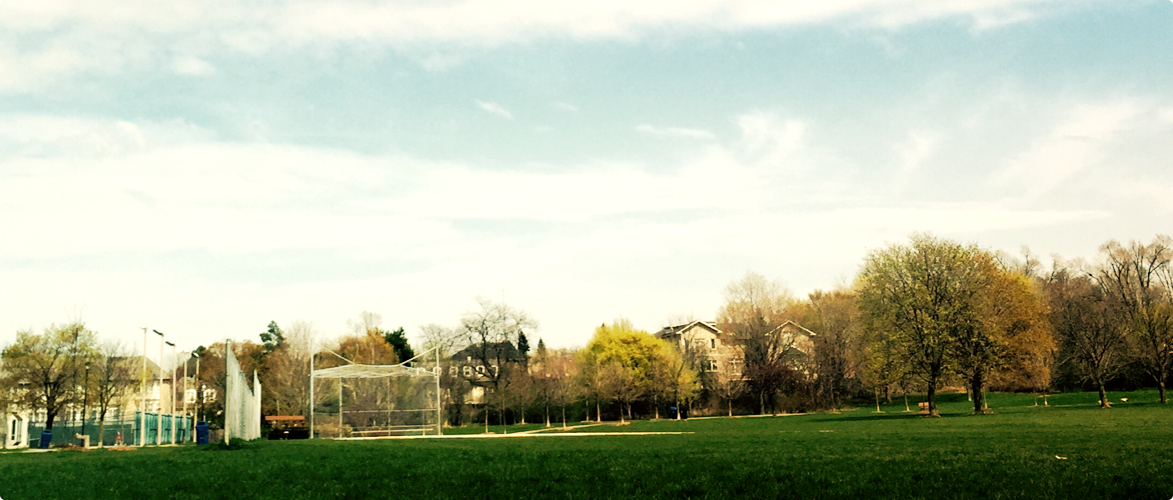
Lawrence Bathurst is a midtown neighbourhood centred on the Lawrence and Bathurst intersection, running roughly from Lawrence Avenue north to Wilson Avenue, between Bathurst Street and Dufferin. It's post-war residential: detached and semi-detached homes from the 1940s and 1950s, modest in scale, on streets that have been largely stable for decades. Detached homes were trading between $1.3 million and $2 million in early 2026, with semis at $1 million to $1.5 million. The Bathurst Street corridor has anchored one of Toronto's most established Jewish communities since the post-war period, and that community remains the neighbourhood's defining character.
Lawrence Bathurst sits in the middle of Toronto’s north-south Bathurst Street corridor, the strip of midtown neighbourhoods that runs from Bloor through Forest Hill and into the suburbs north of Wilson. The neighbourhood itself is bounded roughly by Lawrence Avenue to the south, Wilson Avenue to the north, Bathurst to the east, and Dufferin to the west. It’s not a glamorous address by Toronto standards. The streets are post-war residential, the houses are modest brick bungalows and semis from the 1940s and 1950s, and the main commercial node at Lawrence and Bathurst is anchored by a Shoppers World mall rather than the kind of independent retail strip that drives prices in Trinity Bellwoods or the Annex.
What the neighbourhood offers is something more specific than glamour. The Bathurst corridor north of Lawrence has been one of Toronto’s most concentrated Jewish communities since the post-war migration north from Kensington Market and the Junction. Conservative and Orthodox synagogues sit along Bathurst between Lawrence and Wilson. Several Jewish day schools operate within walking distance of the residential streets. The kosher delis, bakeries, and butchers that have served the community for decades are still there, alongside newer establishments serving the South Asian and Middle Eastern communities that have grown in the neighbourhood over the past twenty years.
This community specificity is the reason families choose Lawrence Bathurst. Buyers who don’t need what the corridor offers sometimes overlook it entirely. Buyers who do need it often pay a premium for the location despite the modest housing stock, because the equivalent community infrastructure doesn’t exist to the same degree anywhere else in the 416 outside of Thornhill.
The dominant housing type in Lawrence Bathurst is the post-war detached or semi-detached brick home: two storeys, three bedrooms, a basement, and a narrow lot of 25 to 35 feet. Most were built between 1945 and 1965, and reflect varying levels of renovation over the following decades. The bones are consistent: solid brick construction, working layouts, functional room sizes. The variation is in what’s been done since: some homes have been extensively renovated with modern kitchens, finished basements, and updated mechanical systems; others are closer to their original 1950s state and represent a renovation project priced accordingly.
Detached homes in good condition on the better streets between Bathurst and Dufferin are trading between $1.3 million and $2 million in early 2026. The spread is driven by lot size, renovation quality, and proximity to the subway. Homes directly on Glencairn or Viewmount, within a five-minute walk of Lawrence West station, command the upper end of the range. Properties further west toward Dufferin, or on less desirable streets with heavier traffic, sit toward the lower end. Semi-detached homes range from $1 million to $1.5 million, with the same factors driving the spread.
There’s no condo supply to speak of in this neighbourhood. The built form is almost entirely low-rise residential. Buyers looking for a condo or a townhouse will need to look at the commercial nodes on Bathurst or Lawrence for the limited number of newer projects that have been built in recent years, and those are few. This is fundamentally a neighbourhood for freehold buyers, which is part of why the family buyers who choose it are committed to it: you come here to own a house.
Lawrence Bathurst has a narrower buyer pool than more broadly desirable midtown neighbourhoods like Davisville or Lawrence Park. The buyers who choose it are largely choosing it for specific reasons: community, proximity to Jewish institutions, school catchments, or value relative to Forest Hill. That specificity makes the market behave differently than a neighbourhood where buyers are choosing it from a longer list of comparable options. Supply and demand are both relatively contained.
In early 2026, well-priced detached homes in good condition are selling within two to three weeks of listing without significant drama. Properties that need work, or that are priced above what the renovation quality justifies, are sitting longer. The spring market in this neighbourhood tends to be strong: family buyers who want to be in before the September school year start their search in February and March and make decisions by April. That window produces the most competitive conditions of the year.
The neighbourhood is not immune to the broader softness in the Toronto freehold market that has developed since the 2022 rate increases. Prices in early 2026 are below their 2022 peaks, as they are across most Toronto residential markets. But the community-driven buyer pool provides a floor that pure speculation-driven markets don’t have: buyers who want to live in this specific community for specific reasons will still pay for the right property even in a softer market.
The most consistent buyer is the Jewish family looking to stay on the Bathurst corridor. This might be a young family buying their first house who grew up in the neighbourhood, a family relocating from Thornhill and wanting to come back into the city, or a family in Forest Hill who has run the numbers and decided that the price gap between Forest Hill and Lawrence Bathurst isn’t justified by the difference in daily life. The community infrastructure matters enough to these buyers that they’ll accept a house that needs work or a lot that’s narrower than they’d prefer rather than move to a neighbourhood where the shul isn’t walking distance and the day school requires a thirty-minute drive.
The second category is the buyer priced out of Forest Hill. Forest Hill Village and Forest Hill South, immediately to the south, are among the most expensive residential markets in Toronto. Lawrence Bathurst offers the same corridor, often the same day schools via transportation arrangements, and prices 30 to 50 percent lower. Buyers who stretch for Forest Hill sometimes discover they could have bought more house in Lawrence Bathurst for the same money and experienced very little difference in practical daily life.
A third and growing category is buyers from South Asian and Middle Eastern backgrounds who have found the neighbourhood comfortable and well-situated relative to community institutions on Bathurst and the adjacent streets. This diversification has been gradual and has changed the character of some streets without displacing the Jewish community institutions that remain the neighbourhood’s primary draw.
The post-war construction that dominates this neighbourhood produces a consistent set of things worth checking before an offer. Homes built between 1945 and 1965 often have original knob-and-tube wiring that insurance companies increasingly refuse to cover or require upgraded before issuing a policy. They may have galvanized steel water supply pipes that have corroded internally, reducing water pressure and occasionally failing at connections. The basement waterproofing on homes of this era was minimal by current standards, and many basements have had water intrusion at some point. A home inspector who knows post-war Toronto construction will look at all of these specifically; a general inspection is not sufficient.
The lot depth matters in this neighbourhood because many buyers plan to add to the home or eventually build something larger. Lawrence Bathurst lots vary substantially: corner lots can be genuinely large, while interior lots on shorter streets may be 85 feet deep or less. Confirm the survey before proceeding if lot dimensions are a factor in your decision. The city’s zoning for this area allows for laneway suites and garden suites on lots that meet the minimum criteria, which is worth investigating if rental income is part of the financial model.
School catchment is important to verify specifically, not assumed from the general neighbourhood. The boundaries between TDSB, TCDSB, and the Jewish day school arrangements shift at specific streets and junctions. If a particular school is the reason you’re buying at this address, confirm your specific address falls within the catchment using the board’s current boundary tool before submitting an offer.
The buyer pool in Lawrence Bathurst is narrower than in neighbourhoods with broader appeal, which means sellers need to market to the specific buyers who choose this area rather than running a generic listing. The families buying here are making community-driven decisions. A listing that makes clear the proximity to specific synagogues, the day school options, and the walking distance to the Bathurst corridor institutions is doing more useful work than one that leads with generic midtown-Toronto talking points about transit and restaurants.
Presentation still matters. The post-war homes in this neighbourhood have a reputation for functional but dated interiors, and a well-renovated home stands out clearly in the listing photos. Buyers have usually toured Forest Hill properties in the same search cycle, and while they’ve accepted that Lawrence Bathurst will be less impressive in scale, they’re still comparing renovation quality. A home that shows a well-done kitchen and bathrooms, finished basement, and maintained mechanical systems will move faster and at better terms than the same floor plan that hasn’t been updated.
Spring is the critical selling window. The family buyers who drive this market are working to September school-year timelines. A listing that hits in March or April will catch buyers in active decision-making mode. A listing in July may wait for the next wave in September and October, when a second set of buyers who started their search later comes through. Avoid November and December if you have timing flexibility: the buyer pool thins considerably and the spring market in most years produces meaningfully better outcomes.
The main commercial node is Shoppers World at the Bathurst and Lawrence intersection: a mid-century strip mall that has been partially updated but remains fundamentally a suburban-format shopping centre in the middle of the city. It has a Fortinos grocery store, a Shoppers Drug Mart, a variety of service businesses, and the kind of practical retail that residents use weekly without much ceremony. It’s not a destination, but it’s functional, and for families with young children and a full week’s worth of errands to run, functional is what matters.
The Bathurst Street corridor between Lawrence and Wilson is where the neighbourhood’s specific character is most visible. My Zaidy’s Bakery and Bagel World are the two names most often cited by residents as irreplaceable. Several kosher butchers and fish markets operate on the strip. The delis that have been there for twenty or thirty years coexist with newer establishments catering to the South Asian and Middle Eastern communities that have grown in the area. The result is a commercial strip that has more food options per block than the surrounding streets would suggest, even if the overall retail experience doesn’t match what’s available in the Annex or on Yonge and Eglinton.
Parks in the immediate area include Ledbury Park at Ranee and Dufferin, which has a community centre, an outdoor pool, and recreational programming that families use year-round. The community centre is genuinely active: skating in winter, swimming in summer, sports programming through the TDSB and the city’s recreation system. For a neighbourhood without a dominant park at its centre, Ledbury fills the role adequately for families with children in the elementary years.
Lawrence West subway station at Bathurst and Lawrence is the transit anchor. It sits on the Spadina line, which runs south to Bloor-Yonge and Union, and north to Sheppard-Yonge for the east-west Sheppard connection. A rider at Lawrence West can be at Bloor-Yonge in about 15 minutes, which puts the Bloor-Danforth line and the downtown core within reasonable commute range. Glencairn station, one stop north, serves the blocks north of Lawrence. For residents within a ten-minute walk of either station, the subway provides a genuine car-free commute to most of the city’s major employment areas.
The 7 Bathurst bus runs the full length of Bathurst Street, connecting south to Bloor-Bathurst station and north toward York University. It’s useful for residents who are west of the subway line and don’t want to walk to Lawrence West. The Lawrence bus connects east toward Mount Pleasant and the Yonge corridor. For residents near Dufferin, the 29 Dufferin bus provides a north-south option. The overall transit network in this neighbourhood is solid by Toronto suburban standards, though it falls short of the walking-distance transit access available in denser downtown neighbourhoods.
Most households in Lawrence Bathurst own at least one car. The roads are wide, parking is generally available on residential streets, and the driving distances to the highway network via Dufferin, Allen Road, or Bathurst itself are short. Residents who work in the Financial District or at Yonge and Eglinton often drive to the subway and take the train the rest of the way rather than doing the full trip by bus. This is a neighbourhood where car ownership makes daily life easier even if it’s not strictly required.
Forest Hill is the comparison every Lawrence Bathurst buyer has run. The boundary between Forest Hill South and Lawrence Bathurst runs roughly along Lawrence Avenue, and the price difference on either side of that line is significant. A detached home in Forest Hill proper starts at $2.5 million and runs past $4 million for anything with meaningful lot size or architectural distinction. The same buyer’s dollar that buys a 1950s semi needing renovation in Forest Hill buys a detached home in decent condition in Lawrence Bathurst. The community institutions on the Bathurst corridor serve both neighbourhoods: many Forest Hill families use the same synagogues, day schools, and delis that Lawrence Bathurst families walk to. The difference is the house, the lot, and the address prestige, not the daily community life.
Ledbury Park, the blocks around Dufferin and Ranee, is sometimes considered part of this neighbourhood and sometimes considered separately. It sits further from the Bathurst subway corridor and has a slightly different buyer profile: less community-driven, more value-driven, with prices at the lower end of the area range. Buyers who are flexible about which specific Bathurst-corridor streets they buy on sometimes find better value in the Ledbury blocks than on the more desirable streets east toward Bathurst.
Glencairn, the area around Glencairn station one stop north on the subway, is the northern extension of this neighbourhood. Housing prices are slightly lower, the community character is similar, and the subway access is equivalent. Buyers who find Lawrence Bathurst pricing at the top of their range sometimes buy near Glencairn and find the trade-off acceptable: slightly less institutional density along the commercial strip, slightly more house for the money.
Schools are one of the primary reasons families choose this neighbourhood, and the picture is more varied than a simple public-vs-private framing captures. The Jewish day schools along the Bathurst corridor, including Associated Hebrew Schools, Robbins Hebrew Academy, and several others, draw students from across the neighbourhood and from Forest Hill and Thornhill families who have moved into the area. These schools operate outside the public board system and require separate applications and tuition, but for families who prioritise Jewish education they’re the deciding factor in choosing this address over a comparable neighbourhood elsewhere in the city.
Within the TDSB public system, Ledbury Park Elementary School serves part of the neighbourhood and has a community reputation as a well-run school with active parent involvement. Lawrence Park Collegiate Institute covers part of the secondary catchment, though catchment boundaries in this area are not straightforward and should be confirmed before purchase. Lawrence Park CI is generally considered one of the stronger TDSB secondary schools in the midtown corridor, with academic programs and extracurricular depth that reflect a parent community that pays attention to school quality.
The TCDSB Catholic system has options in the area as well. Families who don’t need Jewish day school and aren’t committed to the public system have more choices than the neighbourhood’s relatively modest profile would suggest. The practical advice is unchanged from any Toronto neighbourhood: use the TDSB and TCDSB school boundary tools with your specific address before counting on any catchment assumption. Two streets over can change the school.
Is Lawrence Bathurst a good neighbourhood for Jewish families? It’s one of the most established Jewish communities in Toronto. The Bathurst corridor from Lawrence north to Wilson has Conservative and Orthodox synagogues, several Jewish day schools, kosher bakeries, butchers, and delis that have been on the strip for decades. Families who want to walk to shul, send children to a Jewish day school without a long drive, and buy kosher food as part of routine grocery shopping choose this corridor specifically for those reasons. The community has diversified over the past two decades, with South Asian and Middle Eastern families now well-represented, but the Jewish institutional infrastructure remains the strongest in the 416 outside of Thornhill. For families where that infrastructure matters, Lawrence Bathurst remains one of a very small number of options in the city.
How does Lawrence Bathurst compare to Forest Hill? Forest Hill, immediately to the south, is significantly more expensive. Detached homes in Forest Hill proper start at $2.5 million and the ceiling is well above $4 million. Lawrence Bathurst offers much of the same daily life: the same Bathurst corridor synagogues, the same day schools, the same commercial strip, and shorter or comparable walking distances to the institutions that matter, at 30 to 50 percent less. The homes are smaller, the lots are narrower, and the streets are architecturally less impressive. Buyers who want the community without the Forest Hill price, or who have run the comparison honestly and decided the gap in house quality doesn’t justify the price gap, buy in Lawrence Bathurst. It’s not a consolation prize. For buyers who know what they need from a neighbourhood, it’s the right answer.
What is the transit like from Lawrence Bathurst? Lawrence West subway station at Bathurst and Lawrence is the main hub, on the Spadina line. Glencairn station is one stop north. Both connect south to Bloor-Yonge and Union Station without a transfer, putting downtown about 20 to 25 minutes away by subway. The 7 Bathurst bus covers the length of Bathurst Street for residents who aren’t close to the subway stops. Most households here own a car and use it for weekly errands and trips to the highway, even if they commute by subway. The neighbourhood is well-served by transit for commuting purposes and less well-served for local daily life without a car, particularly for anything west of Dufferin or east of Bathurst.
The Lawrence Bathurst neighbourhood was built out almost entirely in the two decades after the Second World War. The streets north of Lawrence were largely undeveloped farmland and market garden land through the 1930s, and the post-war housing boom that built suburban Toronto south and north of the old city turned this area into a residential neighbourhood between roughly 1945 and 1965. The homes reflect the construction standards and spatial assumptions of that period: small by current expectations, solidly built, with basements and garages that were considered generous at the time.
The Jewish community character of the corridor developed through the 1950s and 1960s as families moved north from the original immigrant settlement areas in Kensington Market, the Junction, and the streets around College and Spadina. Those communities had been established since the early 20th century by Eastern European Jewish immigrants, and the move to the Bathurst corridor north of Lawrence was a move to better housing and a larger community infrastructure: new synagogues, new schools, new delis and bakeries established to serve a community that had the economic stability to support them. The institutions built in that period, many of which are still operating, give the neighbourhood its specific character sixty years later.
The neighbourhood has changed gradually since the 1980s and 1990s. Some Jewish families have moved further north to Thornhill and Vaughan, where larger homes on larger lots became available at lower prices. South Asian and Middle Eastern communities, including significant Persian and Israeli communities, have moved into the neighbourhood and changed the composition of both the residential population and the commercial strip. The result is a neighbourhood that is more diverse than it was thirty years ago but retains the community institutions and the street-level character that defined it in its first generation.
Street-level knowledge is hard to find online. Our team works in Lawrence Bathurst every day. They know which pockets hold value, where the school catchment lines actually fall, and what the market is doing right now. Talk to us before you make a decision about Lawrence Bathurst.
Talk to a local agent