
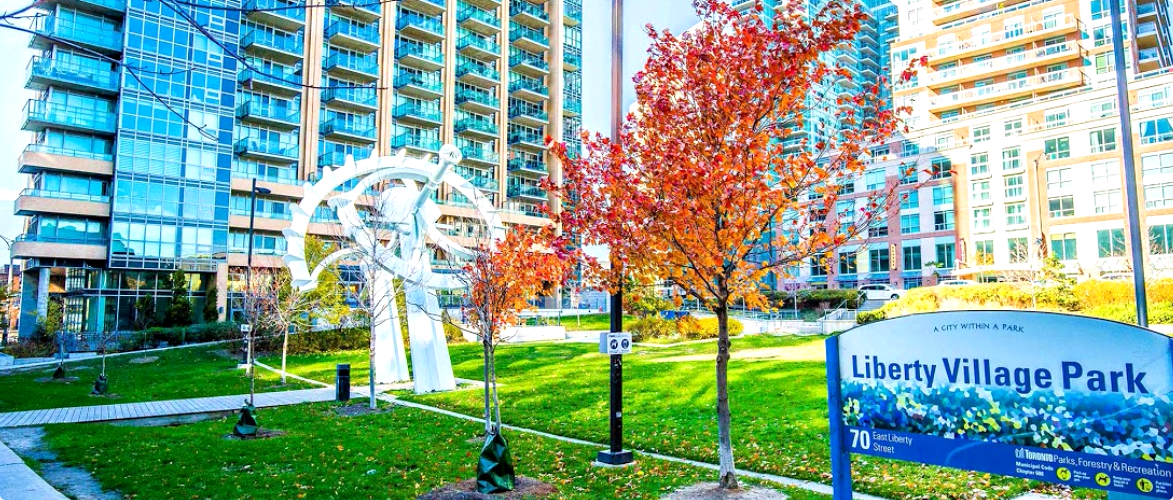
Liberty Village is a former industrial precinct between King Street West and the CNE grounds, Dufferin to Strachan, redeveloped almost entirely into condos since the late 1990s. The neighbourhood's converted late-19th-century brick factory buildings give it a distinct streetscape, though purpose-built towers now make up the majority of the housing stock. One-bedroom condos were trading between $550,000 and $750,000 in early 2026, with two-bedrooms from $750,000 to just over $1.1 million.
Liberty Village sits on land that once held some of Toronto’s most productive manufacturing. The precinct runs from King Street West south to the CNE grounds, and from Dufferin east to Strachan Avenue. In the 1990s, developers began converting the Victorian-era brick factory buildings into loft condos. By the mid-2000s, purpose-built towers had filled most of the remaining lots. Today it’s one of the most densely populated neighbourhoods in the city, and one of the most uniformly condo.
Freehold properties are essentially absent. If you’re coming to Liberty Village looking for a semi-detached or a rowhouse, you’re in the wrong neighbourhood. The entire residential supply is condos, loft conversions, and a small number of purpose-built rental buildings. The original factory buildings along Liberty Street itself, and along Hanna Avenue, give the neighbourhood its visual identity. The towers that went up around them are a different product: purpose-built glass-and-concrete mid-rise buildings from the 2000s and 2010s.
The neighbourhood has strong bones as a place to live. The internal streets are pedestrian-scaled and relatively car-free. Lamport Stadium occupies the western edge. BMO Field and Exhibition Place are a ten-minute walk south. The population is young, heavily professional, and owns a remarkable number of dogs. On a weekday morning, the coffee shops and the dog park on East Liberty Street are in full operation by 7:30.
Liberty Village is a condo-only market, and the range within that category is wider than it looks from outside. The original loft conversions in the former factory buildings are the most distinct product: 10 to 14-foot exposed concrete ceilings, polished concrete or original hardwood floors, industrial window frames, floor plans that often run horizontally rather than stacking vertically. These buildings hold a premium over equivalent square footage in purpose-built towers because supply is genuinely fixed. The factory buildings that exist are the factory buildings that exist.
One-bedroom condos in the standard purpose-built buildings were trading between $550,000 and $750,000 in early 2026, depending on floor, view, building quality, and the condition of finishes. Loft conversions in the same size bracket trade at the upper end of that range or above it. Two-bedrooms in purpose-built buildings run from $750,000 to $1.1 million; well-maintained two-bedroom lofts with good natural light have sold past $1.2 million in recent years.
Parking is a real consideration here. The neighbourhood’s street parking is limited, and the internal streets around East Liberty and Hanna are busy enough that relying on neighbourhood parking is not practical. Most purpose-built buildings have underground parking at a purchase price of $50,000 to $80,000 for a spot, often sold separately. Buyers who need a car should budget for a parking space as part of the purchase decision.
The Liberty Village condo market in 2026 reflects the broader condo weakness that has affected the 416 since interest rates rose in 2022 and 2023. Days on market are elevated. Inventory is higher than at any point in the 2015 to 2022 run-up. Buyers have more time and more options than they have had in years, and sellers who bought during the peak are finding market values below their purchase prices in some buildings.
The buildings that are holding value best are the ones with low investor ratios, well-funded reserves, and genuine character. The loft buildings on Liberty Street and Hanna Avenue have outperformed the purpose-built towers precisely because their supply is capped and owner-occupier rates tend to be higher. Buildings with 60 percent or more investor owners are seeing the most price softness because rental supply in those buildings is dense and individual investors are selling when they can.
For buyers, this is a window. The same units that were attracting multiple offers in 2021 and 2022 are sitting on the market at prices that have corrected 15 to 25 percent in many buildings. The question to answer before buying is whether you’re getting a good building, not just a good price. A corrected price in an underperforming building is still a poor purchase.
The buyer pool divides into three groups. The largest is young professionals in their late 20s and early 30s who work downtown or on King Street West and want to walk or cycle to the office. Liberty Village delivers a downtown-adjacent address, a walkable internal neighbourhood, and a price point that is 10 to 20 percent below King West proper. For this buyer, it’s a deliberate value decision within the inner city.
The second group is investors, and the concentration of investment-owned units is high enough to matter to owner-occupier buyers. In some buildings, more than half the units are rented out, which affects the building culture, the condo board composition, the reserve fund discipline, and the experience of living there. Buyers who want an owner-occupier community should pull the status certificate and review the ownership breakdown before proceeding.
The third group is buyers from outside the city who know the neighbourhood from its reputation as a tech and creative hub and are arriving with equity from a home sale elsewhere. These buyers are often less sensitive to the price-per-square-foot comparison with adjacent neighbourhoods and more focused on the address and the lifestyle it represents. They tend to buy at the top of the building quality range.
The status certificate is not optional in Liberty Village. It is the document that tells you whether the building you’re buying into is financially sound, legally in order, and physically maintained. Several buildings in the neighbourhood are now 15 to 20 years old and reaching the point where reserve fund studies are flagging capital work. An underfunded reserve in a building with aging elevators, a parking structure that needs membrane work, or mechanical systems approaching end of life is a material financial risk for the buyer. Have a condo lawyer review the full certificate, not just the summary.
Investor ratios matter more in Liberty Village than in most Toronto neighbourhoods. A building where 65 or 70 percent of units are investor-owned has a different character than one where owner-occupiers are the majority. Board governance tends to be weaker. Maintenance requests move more slowly. The culture of the building is shaped by tenants who have no ownership stake in the long-term outcome. Some buyers don’t care. If you’re buying to live there, you probably should.
Building age and the developer’s history both predict what you’ll find in the status certificate. The 2003 to 2008 wave of Liberty Village development includes some buildings that were under-reserved from the beginning. Newer buildings from 2012 onward generally have more realistic reserve fund structures. If the building was registered before 2010 and the status certificate shows a reserve fund at less than 70 percent of the recommended amount, ask hard questions before proceeding.
The presentation gap matters here more than it did when the market was running hot. In 2020 and 2021, buyers in Liberty Village were waiving inspections and competing against three or four other offers on units that had chipped laminate and original 2005 appliances. That market is gone. Buyers today have comparable units to choose from and will move to the better-presented option at the same price.
Loft units in the factory buildings should be sold on their physical character. The ceiling height, the original brickwork, the industrial window frames. Professional staging that works with the industrial aesthetic outperforms staging that tries to soften it into something more generic. The buyers for these units are choosing the product specifically for what makes it different from a conventional condo. Give them the version of it that shows why it’s worth the premium.
Timing in the condo market follows a different rhythm than freehold. The spring window applies here too, but the February and March listings in Liberty Village often have less competition than the April and May cluster. Sellers who list in late February, when fewer units are active and buyers who’ve been searching since January are ready to move, can find a concentrated pool of serious buyers without the field competition of mid-spring.
The neighbourhood has developed its own internal commercial strip along East Liberty Street. There are grocery options, coffee shops, a LCBO, and a growing number of restaurants that serve the dense residential population. It’s not the Queen West strip and it’s not trying to be. It functions as a neighbourhood amenity for daily needs rather than a destination for the rest of the city.
BMO Field for TFC and Argonauts games, and the Enercare Centre at Exhibition Place for concerts and events, put major venues within walking range. The CNE grounds directly south host the annual fair every August, which the neighbourhood residents either love or plan around depending on their relationship with crowds and noise. Game days at BMO Field bring significant street traffic through the Dufferin and King intersection.
Dog culture is genuinely significant in Liberty Village. The off-leash area and the general dog density on the internal streets have become part of the neighbourhood’s identity to the point that listings regularly mention it. For buyers who have dogs, the infrastructure is legitimately good. For buyers who don’t, it’s worth knowing that weekend mornings on the internal streets feel like a dog park regardless of whether you use the actual one.
The King streetcar runs along King Street West, which is the neighbourhood’s northern boundary. From the internal Liberty Village streets, the walk to King is five to eight minutes depending on which part of the neighbourhood you’re in. The streetcar provides a direct connection east into the Financial District and west toward Roncesvalles. It’s a well-used route and subject to the same bunching and delays that affect most surface streetcar lines in Toronto.
The Dufferin bus runs north-south on Dufferin Street, connecting to Dufferin subway station on the Bloor-Danforth line. From there, the subway network takes over. The bus is a useful north-south option for reaching the subway but adds a transfer for anyone heading downtown, making it slower than the King car for the Financial District commute. Exhibition GO station, on the Lakeshore West line, sits just south of the neighbourhood and provides direct service to Union Station in under ten minutes, which is genuinely fast. It also connects west to Mississauga and Hamilton.
Cycling is practical on the internal streets, which are low-traffic by design. The Martin Goodman Trail runs along the waterfront to the south. The trail connects east toward the harbourfront and west toward Humber Bay. The cycling infrastructure degrades once you move north onto King or east toward downtown, though the infrastructure has improved incrementally on some corridors.
King Street West proper, east of Strachan, is the most direct comparison. The housing stock is similar, the transit access is comparable, and the demographic overlap is significant. King West carries a 10 to 20 percent price premium for equivalent condos, reflecting its direct address on the streetcar line, the density of restaurants and bars within walking range, and a perception of prestige that Liberty Village doesn’t quite carry. Buyers who find King West pricing beyond reach often look at Liberty Village as the next step west.
Leslieville, on the east side of the city, attracts the same demographic profile: young professionals, dual-income couples, some small families. The housing stock in Leslieville skews toward freehold, which makes it a different product. Buyers who have decided they need freehold often end up in Leslieville rather than Liberty Village; buyers committed to condo living find Liberty Village more convenient for a downtown or King West office commute.
The South Core, directly east along Lake Shore, is a newer condo neighbourhood with some of the tallest residential towers in the city. The South Core is newer, larger in scale, and less established as a pedestrian neighbourhood. Liberty Village feels more like a community because its streets are older and more human-scaled. The South Core delivers larger units at comparable prices but without the factory-building character that draws Liberty Village buyers specifically to Liberty Village.
Liberty Village is not a family neighbourhood in the conventional sense. Families with children live here, and some are happy here, but the neighbourhood’s housing stock was not designed with them in mind. One-bedroom and small two-bedroom condos make up the majority of the supply. The outdoor space available to residents is the internal streets and the CNE grounds rather than backyards or quiet residential blocks.
The public elementary school for the area is Alexander Muir/Gladstone Avenue Junior and Senior Public School, which serves this pocket of the west end. The school has a reasonable reputation and serves a mixed demographic from the surrounding neighbourhood. Families with specific French Immersion requirements or other program needs should confirm availability and registration separately through the TDSB, as waitlists for French programs in popular west-end schools can be significant.
Secondary school catchment in this part of the city typically flows to Parkdale Collegiate Institute. Families buying Liberty Village condos with secondary school-age children should factor this into the decision. Buyers who are planning ahead and anticipate moving before their children reach secondary school age are less constrained by this, but it’s worth knowing before you’re committed to the address.
Is Liberty Village a good investment for condo buyers? It depends on the building, and the variation between buildings is significant enough that “Liberty Village” as a single answer doesn’t work. The loft conversions in the original factory buildings have held value well because their supply is genuinely fixed. Purpose-built towers from the 2003 to 2010 period vary significantly: buildings with high investor ratios, underfunded reserves, or aging mechanical systems are underperforming the neighbourhood average. Before treating any building as an investment, pull the status certificate, check the investor ratio, and review the most recent reserve fund study. A discounted unit in a building with structural financial problems is not a bargain.
What are common problems with Liberty Village condos? The 2005 to 2010 wave of construction is aging into its first round of major capital work. Elevator reliability, parking structure membrane replacement, HVAC systems, and building envelope issues are the most common items appearing in status certificates for buildings in that vintage. Condo fee increases are following as boards work through deferred maintenance and underfunded reserves. Newer buildings, registered after 2012, are generally in better shape, but the status certificate is the only way to know what condition a specific building is actually in. Never waive the review of a status certificate in this neighbourhood.
How does Liberty Village compare to King West for condo buyers? King Street West proper carries a 10 to 20 percent price premium over Liberty Village for comparable units. The transit advantage is marginal: both depend on the King streetcar, though King West residents are a five-minute shorter walk from the car. King West has more ground-floor restaurant and retail density within walking range. Liberty Village’s internal streets are quieter and more pedestrian-scaled, which some buyers prefer. Buyers stretching to get into King West sometimes find that Liberty Village delivers a comparable daily experience at a meaningfully lower purchase price, particularly if they work near Exhibition GO rather than at King and Bay.
How high are condo fees in Liberty Village buildings? Fees vary considerably by building age, size, and what they include. In purpose-built towers, fees in the range of $0.65 to $0.85 per square foot per month are common for buildings that include heat and water in the fee. Newer buildings with more amenities and higher reserve fund contributions can run above $0.90 per square foot. The older loft buildings sometimes have lower fees but require scrutiny of the reserve fund adequacy before interpreting a low fee as a positive sign. A fee that was set artificially low to attract buyers and never properly adjusted is a liability, not a feature.
The land that is now Liberty Village was among Toronto’s most productive manufacturing territory through the late 19th and early 20th centuries. The precinct held a concentration of industrial operations: the Inglis company, which made washing machines and munitions during World War II, occupied a significant portion of the land. By the 1980s, deindustrialisation had left the brick factory buildings largely vacant. The neighbourhood that had grown up around the factories, Parkdale to the north and the Exhibition grounds to the south, remained, but the industrial core was hollowing out.
Redevelopment began in the 1990s with the conversion of the factory buildings. The brick construction, the exposed timber frames, and the scale of the floor plans made them well-suited to loft condo conversion. The neighbourhood’s identity as a tech and creative hub built on the physical character of those buildings: startups and small creative agencies filled the commercial spaces at grade while residential units filled the floors above. The name Liberty Village came from Liberty Street, one of the main internal streets of the precinct.
The purpose-built towers that followed in the 2000s filled in the remaining lots and pushed the population density significantly higher. The original factory buildings are now a minority of the building stock by unit count, though they remain the neighbourhood’s most distinctive physical presence. The industrial character that was a selling point in the 1990s became a marketable brand for the neighbourhood as a whole, even as the majority of its units look nothing like the brick loft that started it.
Street-level knowledge is hard to find online. Our team works in Liberty Village (Exhibition) every day. They know which pockets hold value, where the school catchment lines actually fall, and what the market is doing right now. Talk to us before you make a decision about Liberty Village (Exhibition).
Talk to a local agent