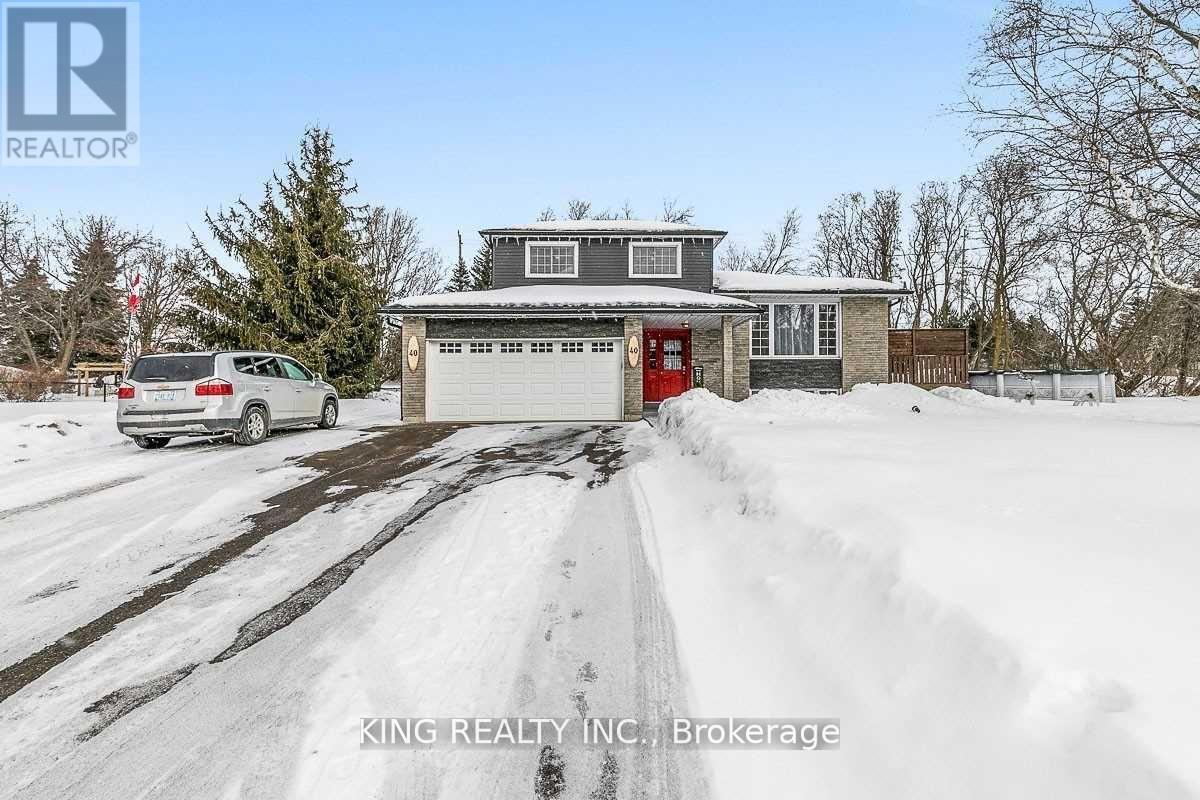
Mono Mills is a rural crossroads hamlet in northeast Caledon within the Oak Ridges Moraine Conservation Plan. It attracts hobby farmers, remote workers, and retirees seeking large lots and genuine rural separation from GTA density. No transit, no services, and 75 to 90 minutes from downtown Toronto.
Mono Mills is a tiny hamlet at the northeast corner of Caledon, near the intersection of Highway 9 and Airport Road. It sits at the edge of Caledon where the municipality borders the Town of Mono to the north and Adjala-Tosorontio to the east. The community is rural in the truest sense: a handful of homes at a rural crossroads, with agricultural land and the Oak Ridges Moraine surrounding it.
Mono Mills is not a destination or a commuter community. It is a settlement that exists because of its historical crossroads position. Buyers here are buying land and countryside first and a community second. The name appears on maps and road signs more than it describes a functioning village with services or amenities.
Properties in and around Mono Mills are primarily rural residential on large lots, hobby farms, and working agricultural land. The typical listing is a detached home on a half-acre to several-acre parcel on a concession road. There is no subdivision housing and no townhouse or condo supply whatsoever.
Prices depend almost entirely on the specific property: lot size, house size, condition, and whether there are outbuildings, a workshop, or equestrian facilities. Homes on standard rural lots start around $1.1M to $1.3M for a well-maintained detached house. Properties with significant acreage, a barn, or equestrian facilities command considerably more. Transaction volume is very low, typically fewer than 10 sales per year in the immediate area.
The market around Mono Mills is part of the broader rural Caledon and Mono area, and buyers should expand their comparable search to include properties along the Highway 9 and Airport Road corridors and into the Town of Mono. Prices in the Town of Mono and Adjala-Tosorontio often overlap with what buyers find in northeast Caledon.
This is a long-hold market. Buyers who buy here typically stay for many years. The liquidity is limited and the buyer pool for a rural property at this distance from the GTA is narrower than in Bolton or Caledon East. That is a known characteristic, not a deficiency; it is priced in to the values, which is why rural properties in this area cost less per acre than comparable land closer to the GTA edge.
Buyers in the Mono Mills area are generally in one of two groups. The first is people who specifically want a working farm or a property with land: a place to grow food, keep animals, or operate a home-based rural business. The second is remote workers or retirees who want maximum separation from GTA density and have chosen to give up convenience in exchange for land, quiet, and countryside.
Neither group is making a compromise. Both groups are making a deliberate choice that most GTA residents would not make. The self-selection effect produces a community of people who value rural life deeply, are self-sufficient in ways that suburban residents typically are not, and who invest in their properties and land rather than in urban amenities.
The landscape around Mono Mills is defined by the Oak Ridges Moraine, the rolling terrain of the Hockley Valley area, and the agricultural fields of the northern Caledon plateau. The intersection of Hwy 9 and Airport Road is the crossroads that defines the hamlet. Concession roads branch off in all four directions into agricultural countryside.
Properties in this area vary significantly in character. A house right on the highway has different attributes than a property set back 500 metres on a concession road. Buyers need to be specific about what they are looking for: highway proximity for access, or concession road privacy for separation. The area has both, and they are not far apart.
There is no transit near Mono Mills. Highway 9 runs east-west and connects to Highway 400 east of Barrie or west toward Orangeville. Airport Road runs north-south between Brampton and Barrie. The drive to Brampton is approximately 40 to 45 minutes south. The drive to Newmarket or Aurora via Hwy 9 east is similar. The drive to downtown Toronto is 75 to 90 minutes.
Residents here are entirely car-dependent. Most have more than one vehicle, including at least one that can handle rural roads in winter conditions. Gravel roads and seasonal maintenance are part of life on many concession roads in this area. A 4-wheel drive or all-wheel drive vehicle is a practical necessity for some of the properties on side concessions.
The Hockley Valley area, a 10 to 15 minute drive northwest, has a provincial park with hiking, skiing in winter, and some of the best trail access in the GTA periphery. The Oak Ridges Moraine provides significant public land and conservation areas throughout the region. The Mono Cliffs Provincial Park is approximately 20 minutes north and has hiking trails on the escarpment face.
For buyers who want to be embedded in a natural landscape rather than adjacent to it, the area around Mono Mills delivers. Coyotes, deer, wild turkeys, and migratory birds are regular visitors to properties throughout the area. The stars at night are visible without the light pollution that blankets most of the GTA.
There are no commercial services in Mono Mills. The nearest groceries and fuel are in Palgrave to the south, about 10 minutes, or in Orangeville, about 25 minutes north. Residents manage shopping by planning ahead rather than making spontaneous trips.
Healthcare is through Headwaters Health Care Centre in Orangeville or Brampton Civic Hospital. Emergency services have longer response times in rural areas than in urban communities, which is a reality buyers should acknowledge. Most rural property owners have first aid training and are prepared for the self-sufficiency that rural life requires.
Children in the Mono Mills area are within the Peel District School Board and Dufferin-Peel Catholic District School Board catchments. School bus service runs to schools in Palgrave and Caledon East, with longer rural routes than in urban communities. Secondary school students travel to Brampton or Bolton.
Rural school buses can involve early morning pickups and long rides for children at the northern edge of the catchment area. Families who move to this area typically do so with older children who are more independent, or with a plan to manage school transport that includes parental driving during the elementary years.
The Mono Mills area is within the Oak Ridges Moraine Conservation Plan and greenbelt boundaries that significantly constrain development. This is a stability factor for existing property owners, as the rural character and natural landscape around the hamlet will not be fundamentally altered by large-scale development. The protections are among the strongest in Ontario for the Moraine lands.
Highway 9 has been the subject of improvement discussions over the years to address bottlenecks on the east-west corridor. Any improvement to the Hwy 9 or Airport Road intersection infrastructure would reduce drive times and improve the accessibility of this area modestly. No major change is imminent as of 2026.
What is it actually like to live in Mono Mills?
Mono Mills is rural in a way that most people who grew up in the GTA have not experienced. Your nearest neighbour may be several hundred metres away. You manage your own well and septic. Grocery runs are planned events, not spontaneous trips. You know the names of the farmers on the roads around you. In winter, you clear your own driveway, and if you are on a maintained country road, the plough comes through on a schedule rather than instantly. What you get in exchange is land, quiet, stars, and a relationship with the natural world that is genuinely different from anything you can replicate in a suburb. People who move here and stay describe it as the best housing decision they made. People who move here and leave do so because they underestimated how much they relied on the infrastructure of urban life.
Is the land around Mono Mills within the greenbelt?
Most of the Mono Mills area falls within the Greenbelt Plan area and the Oak Ridges Moraine Conservation Plan. These designations restrict new residential development on the affected lands and protect the natural heritage systems of the Moraine. For existing property owners, this is a strong form of protection against the kind of suburban encroachment that has changed many areas of the GTA fringe over the past 30 years. Buyers should confirm the specific plan designation for any parcel they are considering, as the boundaries vary and specific properties may fall under different levels of protection.
Can I operate a farm or agricultural business from a property near Mono Mills?
Yes. Agricultural use is the primary land use designation in this area, and rural residential properties on the surrounding concession roads typically come with the right to farm. Hobby farming, market gardening, small livestock operations, equestrian facilities, and related agricultural businesses are common. Zoning restrictions vary by lot and municipality, and some uses require permits or approval from the municipality and potentially from the Nottawasaga Valley Conservation Authority or Toronto and Region Conservation Authority depending on location. Buyers with specific farming or commercial agricultural plans should review the zoning and permitted uses for any property before purchasing.
What is the drive from Mono Mills to downtown Toronto?
The drive from Mono Mills to downtown Toronto takes approximately 75 to 90 minutes on a typical weekday morning, using Airport Road south to Hwy 410 and then the 427 or DVP route. On off-peak hours, the drive can be completed in 65 to 75 minutes. There is no transit alternative. This is among the longer commutes of any community included in this guide, and it reflects the genuinely remote character of the northeast Caledon area. Buyers considering a daily commute from Mono Mills to Toronto should drive the route at commute time before deciding, because the paper distance does not capture the road conditions on winter mornings in this area.
Rural property sales in the Mono Mills area require an agent with specific experience in agricultural and estate properties. The skills needed are different from suburban residential work: reading a survey, understanding well and septic documentation, evaluating barn and outbuilding condition, and knowing what drainage tile, workable acreage, and agricultural soil designation mean for value.
Buyers in this area benefit from representation who can also navigate the planning context: Moraine and greenbelt restrictions, permitted uses, and any outstanding drainage or water management issues that are common on rural properties. A buyer who purchases without this knowledge and later discovers a significant well issue or a Moraine restriction on a planned addition will wish they had done that work earlier.
Street-level knowledge is hard to find online. Our team works in Mono Mills every day. They know which pockets hold value, where the school catchment lines actually fall, and what the market is doing right now. Talk to us before you make a decision about Mono Mills.
Talk to a local agent