
Moore Park is a quiet, almost entirely residential neighbourhood north of Rosedale, bounded by the Mount Pleasant Cemetery to the west, Bayview Avenue to the east, St. Clair Avenue East to the north, and Moore Avenue to the south. The housing stock is predominantly detached brick homes from the 1920s and 1940s in Tudor and Georgian revival styles, and detached properties on Moore Avenue and Inglewood Drive were trading between $2.5 million and $4.5 million in early 2026. Fewer than 40 homes typically change hands here in a year, which makes it one of the lowest-turnover residential addresses in the city.
Moore Park sits in a position that doesn’t make obvious sense on a map: it’s geographically close to the centre of the city, with the downtown core less than five kilometres to the south, yet it feels more removed from urban life than neighbourhoods twice as far from Bay Street. That quality is not incidental. It’s the product of specific geography.
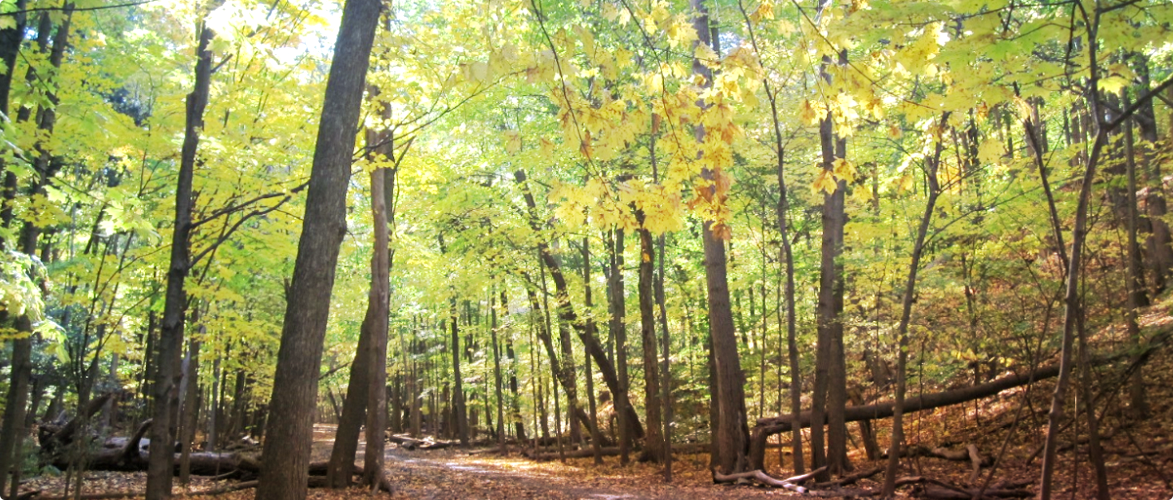
The Mount Pleasant Cemetery forms the western boundary. Nearly 200 hectares of mature trees, paved walking paths, and quiet — open to walkers during daylight hours — creates a green buffer between Moore Park and the Yonge Street corridor to the west. To the east, the Moore Park Ravine drops into the Don Valley trail system, which connects south to the Evergreen Brick Works and Chorley Park. You can walk from the foot of Kilbarry Road down into the ravine, pick up the trail, and reach the Brickworks without touching a road. The neighbourhood has natural boundaries on three sides, and St. Clair Avenue East closes the fourth. Inside those boundaries, the streets are residential in a way that isn’t common this close to the core.
Moore Avenue and Inglewood Drive are the two addresses people name first when they talk about Moore Park. Both are lined with detached brick homes from the 1920s through 1940s, set back on lots that feel generous for their location. The architecture is largely Tudor and Georgian revival, consistent in scale, and well-maintained. A few streets in, Avoca Avenue and Kilbarry Road carry the same character with slightly different lot configurations. The neighbourhood has no commercial strip of its own. Residents use the Yonge and St. Clair corridor to the west or the Summerhill shops to the south, and the absence of local retail is part of why the streets stay quiet.
The dominant property type in Moore Park is the detached brick home built between 1920 and 1945. Tudor revival details — half-timbering, steeply pitched rooflines, arched doorways — appear on a significant portion of the stock. Georgian revival is the other common style: simpler brick facades, symmetrical windows, more formal proportions. These aren’t small houses: many have four or five bedrooms, finished lower levels, and rear gardens deep enough to feel private. Lot sizes typically run 35 to 50 feet wide and 100 to 130 feet deep, which is materially more land than you’d find for the same money in Rosedale or Summerhill.
Semis exist in Moore Park but they’re the exception. The neighbourhood is overwhelmingly detached, and that’s a genuine point of difference against comparable-priced areas to the south where semis make up a larger share of transactions. For buyers who want a true detached home with separation on both sides, Moore Park delivers that more consistently than most of its neighbours at a similar price point.
The entry price in early 2026 is roughly $2.5 million for a detached home that needs updating, on a standard-sized lot, in a condition that’s livable but not finished. A well-renovated home with a thoughtful kitchen, updated bathrooms, and maintained character details — original hardwood, plaster ceilings, proper trim — trades from $3 million upward. The top of the market, which means larger lots, deeper gardens, potential ravine exposure, or homes with significant architectural integrity, runs $4.5 million and above. There are almost no properties under $2 million in the neighbourhood. Buyers who want Moore Park proximity without Moore Park prices typically look at Davisville Village to the north, where the trade-off is smaller homes and more semis for a 30 to 40 percent discount.
Moore Park is one of the lowest-turnover residential markets in Toronto. In a typical year, fewer than 40 properties transact across the whole neighbourhood. That’s not a large number, and it has practical consequences for buyers: when a home you want comes to market, you may not see another comparable one for a year or more. Buyers who treat Moore Park as a browsing exercise and wait for something better often find the something better doesn’t arrive. The inventory rhythm here is not like Davisville or Summerhill where a few dozen listings appear each spring.
The homes that do come to market tend to attract serious buyers quickly. Families in Moore Park typically stay for decades. The turnover happens at life transitions — estates, downsizing, occasional job relocations — rather than as part of a speculative or upgrade cycle. A property that goes to market in spring with correct pricing and a well-presented home will draw multiple offers in almost any market condition. Properties that arrive with aspirational pricing sit longer and eventually find their level, but the depth of buyer interest is genuine at fair value.
In early 2026, the broader Toronto freehold market is running at a measured pace relative to 2021 and 2022. Moore Park is insulated from the sharper corrections because the buyer profile doesn’t carry the same debt load as first-time buyers in adjacent areas. Cash-rich buyers, equity-rich upgraders, and buyers from within the immediate neighbourhood and Rosedale make up most transactions. The neighbourhood doesn’t spike and crash the way condo markets do. It moves slowly in both directions.
The buyers who end up in Moore Park are almost always choosing it over Rosedale to the south, Summerhill to the southwest, or Davisville Village to the north. The decision against Rosedale is often about value: the same budget that buys a renovated four-bedroom in Moore Park buys something smaller or less updated south of Moore Avenue. Some buyers also find Moore Park’s uniformity of scale more appealing — Rosedale’s architectural variety, which is a selling point for many, can feel unsettled to buyers who want a neighbourhood that feels consistent.
The decision for Moore Park over Summerhill is usually about quiet. Summerhill has more urban energy: the Yonge Street strip, the LCBO, the station. Moore Park has none of that on its own streets. Buyers who want to live within walking distance of those amenities but not adjacent to them choose Moore Park and walk west to St. Clair when they need the city.
The school catchment drives a significant portion of the buyer pool. North Toronto Collegiate Institute is the secondary school assignment for Moore Park addresses, and it’s one of Toronto’s stronger public secondary schools. Families who identify NTCI as the secondary school target and then work backward to find an affordable neighbourhood within the catchment often find Moore Park is the floor of what the catchment delivers. Davisville is cheaper and also within the NTCI zone for many addresses, which is why buyers who can’t absorb Moore Park prices often look there next.
The age of the housing stock matters here more than it might on a street where homes have been fully renovated through successive ownership. Many Moore Park homes were built in the 1920s and 1930s and have had one or two renovation cycles since, but the underlying systems — plumbing, electrical panels, roofing on older additions — can carry the history of those decades. A thorough pre-offer home inspection is important on any property, but it’s especially important here because the presentation can be excellent while the mechanicals are approaching end of life. A home with a new kitchen and original knob-and-tube wiring behind the walls is a project most buyers don’t want to discover after closing.
Lot depth matters more in Moore Park than street presence. The deeper lots on the south side of Moore Avenue and on several blocks of Inglewood Drive allow for rear extensions that work with the existing footprint rather than overwhelming it. Lots that run only 90 feet deep constrain what a future renovation can accomplish. Buyers who plan to expand should measure the lot and speak to a local architect before assuming the garden can accommodate what they have in mind.
The ravine proximity that makes some streets desirable also introduces practical considerations. Properties on Kilbarry Road and a handful of addresses on the eastern edge of the neighbourhood back onto or sit near the ravine escarpment. These lots typically carry restrictions under the Toronto and Region Conservation Authority that limit what can be built within the regulated setback. Buyers interested in a rear addition or garden structure on a ravine-adjacent property should confirm the TRCA setback lines before making an offer, not after.
Moore Park buyers are typically experienced purchasers who have already owned in Toronto, often in adjacent neighbourhoods. They’ve seen a lot of property. They know what a genuine 1930s Tudor looks like when the details are intact — the leaded glass, the proper oak millwork, the plastered ceilings — and they know when a renovation has stripped those things out and replaced them with something that doesn’t fit the house. A seller who has maintained the original character and updated the mechanicals and kitchen without destroying the bones will consistently outperform comparable listings that have been renovated for a generic buyer who doesn’t exist in this neighbourhood.
Condition transparency matters. The buyer pool for a $3 million property has resources for due diligence and expectations about disclosure. Sellers who try to obscure deferred maintenance or known issues with staging and superficial presentation typically encounter deals that fall apart during inspection or see conditions that reflect the buyer’s uncertainty about what they’re actually getting. An open pre-listing inspection, shared with prospective buyers, often produces cleaner offers and fewer conditional collapses than a strategy built on hope.
Timing follows the same seasonal pattern as the broader freehold market: spring listings in March, April, and early May draw the deepest buyer pool. The fall window in September and October is the second-best opportunity. Selling in November or December is not impossible, but the active pool shrinks and buyers who are still looking in winter often have specific requirements that may or may not match what the property offers.
The two green spaces that define Moore Park’s daily outdoor life are both unusual in how they function. The Mount Pleasant Cemetery on the western boundary is open to walkers during daylight hours. It’s a large, formally planted landscape with wide paved roads, mature trees, and a quiet that’s hard to find this close to Yonge Street. Many Moore Park residents walk or run through it regularly, treat it as they would a park, and consider it one of the neighbourhood’s underrated practical assets. The main entrance on Yonge Street is a 15-minute walk from most Moore Park addresses.
The Moore Park Ravine on the eastern side of the neighbourhood connects to the broader Don Valley trail system. The Chorley Park area, at the top of the ravine off Elm Road, is a small open space with a trail head. From there, the path descends into the ravine and connects south toward the Evergreen Brick Works on Bayview Avenue. The Brickworks runs a farmers’ market on Saturdays from spring through fall, and the trails connect to it in about 25 minutes on foot from the foot of Kilbarry Road. For residents who run or cycle, the ravine is a direct route to the full Don Valley trail network without touching a road of any consequence.
Chorley Park itself — the cleared plateau above the ravine at the end of Elm Road — has a modest open field and is used by the neighbourhood for informal recreation. It’s not a full park facility in the sense of a playground or sports courts, but the space and the ravine access it provides are part of what makes the eastern streets of Moore Park feel particularly insulated from the city despite their location.
St. Clair station on the Yonge-University subway line sits at the northern edge of Moore Park on St. Clair Avenue East. From most addresses on Moore Avenue and Inglewood Drive, the walk to the station is 10 to 15 minutes. A few streets closer to St. Clair — the northern blocks off Avoca Avenue — are within an honest 8-minute walk. The station connects south to Bloor and then downtown, and north toward Eglinton. It’s a practical connection for residents who commute by transit, without the neighbourhood being close enough to the station to suffer the pedestrian and commercial noise that surrounds major transit stops.
The 97 Yonge bus runs on Yonge Street on the western side of the neighbourhood and supplements the subway for trips that don’t require going underground. The 63 Ossington route and 82 Rosedale connector are less directly relevant to most Moore Park addresses, but the 97 provides a surface connection along Yonge that fills gaps in the subway schedule.
Driving out of Moore Park is straightforward. St. Clair Avenue East connects quickly to Mount Pleasant Road and the Don Valley Parkway interchange, which is the primary highway access point for the neighbourhood. The DVP can reach the 401 in under 10 minutes in off-peak conditions. For residents who work in the Financial District or along the waterfront, the drive via Bayview Avenue south through the Rosedale Valley Road is one of the more direct and consistent routes in the central city. Parking at home is not a constraint in the way it is in Trinity Bellwoods or Roncesvalles: most Moore Park properties have a driveway or a detached garage behind the house, and on-street parking is available on most residential streets.
Rosedale is the most frequent comparison. The two neighbourhoods share a city district name, a school catchment, and a general character of established, well-maintained residential streets. The differences are real. Rosedale’s housing stock is older, more varied, more architecturally ambitious in places, and more expensive across almost every category. A home that sells for $3.5 million on Inglewood Drive would likely be priced $400,000 to $700,000 higher for a comparable property on Cluny Drive or South Drive in Rosedale. The Rosedale buyer pool is deeper and more competitive. For buyers who want the feel of the area without the sharpest version of Rosedale pricing, Moore Park is the consistent answer. The trade-off is that Moore Park homes are more uniform — less likely to contain the occasional architectural surprise that Rosedale produces.
Davisville Village sits immediately north of St. Clair and shares the North Toronto Collegiate Institute catchment for many of its addresses. The housing stock is different: smaller lots, more semis, homes from the same era but built to a tighter footprint. Detached homes in Davisville were trading between $1.5 million and $2.3 million in early 2026 — a discount of 30 to 50 percent against comparable Moore Park properties, depending on size. Buyers who want the NTCI catchment and a reasonable commute but can’t absorb Moore Park prices typically land in Davisville. The practical difference in daily life is smaller than the price difference suggests. The character difference is real: Moore Park feels more removed and more established than Davisville’s busier, more urban streets.
Summerhill sits southwest of Moore Park, between St. Clair and Rosedale Valley Road, along the Yonge Street spine. It’s more urban in character than Moore Park — the Summerhill LCBO, the restaurant strip on Yonge, and the subway station at Summerhill give it more street-level energy. Pricing is comparable to Moore Park, sometimes higher on specific streets closest to the station. Buyers who want to walk to their wine shop choose Summerhill. Buyers who want a quiet street and don’t need those amenities at their door choose Moore Park.
Whitney Public School at 300 Raglan Avenue serves most Moore Park addresses for junior kindergarten through Grade 8. It’s a well-regarded school with a consistent academic reputation and a parent community that reflects the neighbourhood’s demographic: engaged, involved, and generally familiar with how the TDSB programs work. The school has a French Immersion stream, which fills early and requires an application separate from the standard catchment registration. Families who want Whitney’s French Immersion program should contact the school well before their child’s JK year.
Deer Park Public School on Ferndale Avenue is the catchment school for some addresses south of the Moore Park boundary, where the neighbourhood blends into Rosedale. If your target address is near Moore Avenue, verify which school it falls under using the TDSB boundary tool before assuming. A few blocks can change the assignment, and the distinction matters if the school is part of your reason for being in the area.
The secondary school story is the one most buyers care about. North Toronto Collegiate Institute on Broadway Avenue in Leaside is the catchment secondary school for Moore Park addresses and consistently ranks among the strongest public secondary schools in Toronto on both academic results and university placement rates. It offers a range of arts and enrichment programs alongside its standard curriculum. Families who identify NTCI as their secondary school target and then work backward to find a neighbourhood often land in Moore Park, Davisville, or parts of Leaside depending on their budget. The catchment is the most cited non-price reason buyers give for choosing Moore Park over Summerhill or Rosedale, where the secondary school catchments flow differently.
What is the average house price in Moore Park in 2026? Detached homes in Moore Park were trading between $2.5 million and $5 million in early 2026, depending on lot size, condition, and whether the home has been updated. A property that needs a full renovation — mechanicals, kitchen, bathrooms — might come in near the $2.5 million floor. A home with a well-executed renovation that respects the original character, good lot depth, and no deferred maintenance will be in the $3.2 to $4 million range. Larger properties on deeper lots, homes with ravine exposure, or those with significant architectural integrity push higher. There are essentially no properties under $2 million in the neighbourhood, which makes it one of Toronto’s more uniformly expensive residential addresses for the freehold buyer.
How does Moore Park compare to Rosedale? Moore Park and Rosedale share a city district boundary but are distinct in character and price. Rosedale is more expensive — typically $400,000 to $700,000 more for a comparable property — more architecturally varied, and has homes that range more dramatically in scale, from imposing 19th-century properties down to smaller post-war infill. The Rosedale subway station gives southern Rosedale addresses strong transit proximity. Moore Park is calmer, more consistent in scale, and gives buyers more lot for the money. The homes are largely from the 1920s through 1940s, built to similar proportions, and the neighbourhood has a settled quality that Rosedale, with its more varied stock, doesn’t uniformly replicate. Buyers who want architectural drama choose Rosedale. Buyers who want quiet, consistent residential streets with good lot size choose Moore Park.
Is Moore Park walkable to a subway station? St. Clair station on the Yonge-University line is at the northern edge of the neighbourhood on St. Clair Avenue East. From Moore Avenue and the central streets of the neighbourhood, the walk is 10 to 15 minutes depending on the specific address. Blocks on Avoca Avenue closer to St. Clair can do it in 8 minutes at a normal pace. It’s a practical walking distance for regular commuters, and the neighbourhood is quiet enough that the walk is pleasant year-round. The station connects south to Bloor, where you can transfer to the east-west line, and north to Eglinton for the crosstown LRT. For residents who don’t rely on transit, the neighbourhood’s position near the DVP and St. Clair Avenue provides quick road connections in multiple directions.
Can you walk from Moore Park into the ravine? Yes, and this is one of the neighbourhood’s most practical and least obvious assets. The Moore Park Ravine connects to the Don Valley trail system from the foot of several streets on the eastern side of the neighbourhood, including Kilbarry Road. From there you can follow the trail south to Chorley Park and continue to the Evergreen Brick Works on Bayview Avenue, which hosts a Saturday farmers’ market from spring through fall. The walk to the Brickworks takes about 25 minutes at a normal pace. The Mount Pleasant Cemetery on the western boundary is open to walkers during daylight hours and functions as a 200-hectare green corridor, with mature canopy and paved roads. The combination gives Moore Park residents access to a scale of green space that the neighbourhood’s own footprint, roughly 15 square blocks, wouldn’t suggest.
Moore Park takes its name from John T. Moore, a Toronto alderman who subdivided the land in the 1880s and 1890s as the city expanded north from Rosedale. The area was developed as a planned residential suburb, with streets laid out in a relatively orderly grid west of Bayview and north of Rosedale Valley. The intention was middle-to-upper-class residential use from the start, and the homes built through the 1910s, 1920s, and 1930s reflect that original ambition: larger than the working-class housing being built in the Annex or Bloor West Village at the same time, set back from streets on wider lots, and designed in the revival styles popular with Toronto’s professional class between the wars.
The Tudor and Georgian revival homes that dominate Moore Avenue and Inglewood Drive were largely built between 1920 and 1945. The architectural firms working in the neighbourhood during this period — several of them active across Rosedale and Forest Hill simultaneously — gave Moore Park a coherent visual character that has been maintained through successive generations of owners. The neighbourhood has never gone through a period of significant decline or redevelopment. Unlike areas that saw demolition and infill in the postwar decades, Moore Park’s residential fabric has remained largely intact since the 1940s, which is why the housing stock today feels consistent in a way that’s unusual for a central Toronto address.
Mount Pleasant Cemetery, which predates the residential development to its east, was established in 1876 and is the burial site of several prominent Canadians including Prime Minister William Lyon Mackenzie King and hockey figures from the early professional era. The cemetery’s western boundary has shaped Moore Park’s western edge since the neighbourhood was first laid out, and its presence as a quiet, forested landscape has been a consistent part of the neighbourhood’s character for 150 years.
Street-level knowledge is hard to find online. Our team works in Moore Park (Bennington Heights) every day. They know which pockets hold value, where the school catchment lines actually fall, and what the market is doing right now. Talk to us before you make a decision about Moore Park (Bennington Heights).
Talk to a local agent For Rent
 For Rent
 For Sale
 For Sale