
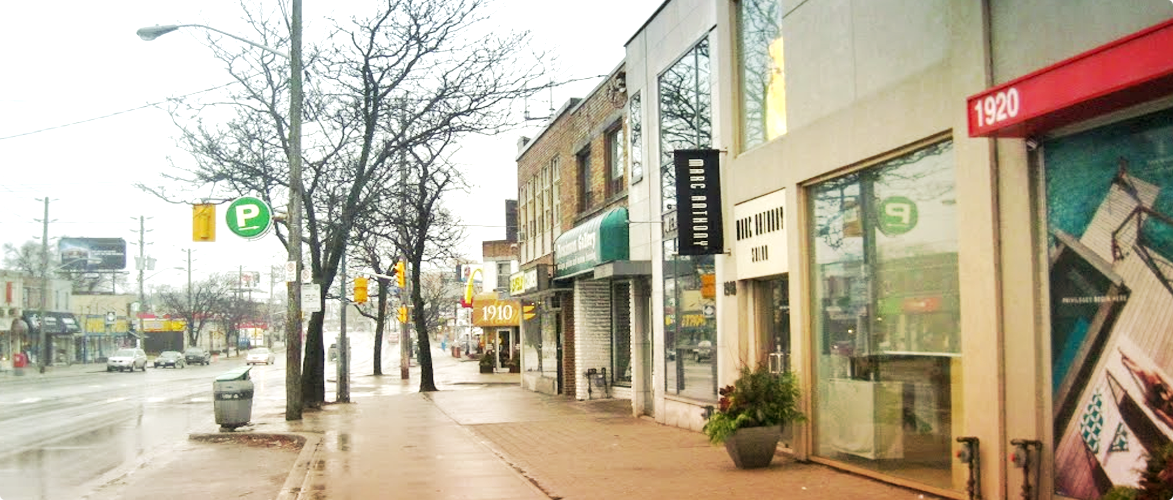
Nortown sits in midtown Toronto between Lawrence Avenue and Wilson Avenue, straddling the Bathurst Street corridor. The neighbourhood is built around Ledbury Park, a quiet green space that anchors a stock of solid post-war detached homes from the 1940s to 1960s, many renovated, some still in original condition. Detached homes trade from $1.5 million to around $3 million; semis, where they appear, from $1.2 million. Lawrence West subway station on the Spadina-University line puts downtown within 25 minutes without a car.
Nortown occupies the stretch of midtown Toronto north of Lawrence Avenue along the Bathurst Street corridor, running roughly to Wilson Avenue in the north, with Dufferin to the west and Bathurst as the spine. The neighbourhood gets its name from a small commercial node on Bathurst that has served the area for generations: a cluster of kosher delis, bakeries, local services, and a few newer cafes that have arrived as the neighbourhood has attracted younger buyers. Ledbury Park, a modest but well-kept green space near the centre of the residential streets, gives the neighbourhood its other common name.
The housing stock defines the character here more than any commercial strip. Nortown was built out primarily in the 1940s, 1950s, and into the early 1960s, a period when Toronto was expanding north from the older city and the Bathurst corridor was filling in with solid, mid-century family homes. These are detached brick houses with mature trees, double-car driveways, proper backyards, and the kind of interior proportions that pre-war row houses don’t offer. Many have been renovated once or twice. Some remain in original condition and offer a buyer the opportunity to renovate on their own terms.
The neighbourhood sits in a value gap that experienced buyers recognise. Forest Hill is immediately to the south and commands a significant premium for similar housing stock. Lytton Park is to the east, also more expensive. Nortown offers the same midtown detached-home character, the same transit access to the Spadina-University subway line, and the same proximity to good schools at prices that reflect less name recognition rather than any meaningful difference in what the homes are or where they sit.
The typical Nortown purchase is a detached brick home from the 1940s to 1960s: three or four bedrooms, a full basement, a rear garden, and a driveway. Lot widths typically run 40 to 50 feet, larger than the semis in neighbourhoods like Lawrence Park or Lytton Park to the east. That lot width is one of the practical reasons buyers come here: there’s room for an addition, a proper kitchen renovation, or a rear structure without being constrained by a 25-foot frontage. Prices for these detached homes run from roughly $1.5 million at the lower end to $3 million for well-renovated homes on better streets, with the spread depending heavily on the extent and quality of renovation.
Semis do appear in the neighbourhood, typically priced from $1.2 million, and they represent a way into the area for buyers who need midtown Bathurst corridor access but can’t absorb the detached price. They’re less common than in the older parts of the city further south, and buyers who specifically want a detached home won’t have trouble distinguishing the stock.
The post-war construction era has specific implications. These homes were built with good materials and conservative techniques: the bones are sound. The systems are the question. Electrical panels from the 1960s may need upgrading. Plumbing in original condition often contains galvanised pipe that degrades over time. HVAC systems in unrenovated homes will be dated. Buyers doing a pre-purchase inspection should give the mechanical systems the same attention as the cosmetic condition, because a house that looks dated but has updated systems is a better starting point than one that’s been surface-renovated over ageing infrastructure.
Nortown does not move like the high-profile midtown streets to its south. It moves deliberately, with a buyer pool that is less speculative and more need-driven than what you’ll find competing for Forest Hill properties. The typical transaction here involves a family making a considered relocation: moving up from a smaller property in the 416, relocating from the suburbs for the transit access, or choosing to stay in the Bathurst corridor after years in a condo or rental. Multiple-offer situations occur on well-priced properties but are less routine here than in Lawrence Park or Lytton Park.
In early 2026, most listings are priced to invite negotiation rather than to trigger a formal offer night. The well-priced, well-presented homes on the better streets attract attention quickly. Properties with dated systems, deferred maintenance, or an asking price that doesn’t reflect actual condition sit longer. The market distinguishes between the two categories more cleanly than it did during the peak years of 2021 and early 2022, when almost everything moved fast regardless of condition.
Spring and early fall are the active windows. Listings that come in late January and February ahead of the spring wave sometimes carry better terms for prepared buyers because competition hasn’t fully assembled yet. November and December are slow, and sellers who list then are usually motivated by circumstances rather than timing, which creates its own opportunity.
Three buyer profiles show up consistently in Nortown. The first is the family that has decided it wants midtown Toronto with subway access and has done the comparison to Forest Hill, Lawrence Park, and Lytton Park, found those neighbourhoods priced out of reach, and arrived at Nortown as the place that delivers what they need at a number that works. These buyers are not settling. They’ve identified the value case and they know the neighbourhood’s fundamentals are strong.
The second profile is the Jewish family that has deep roots in the Bathurst corridor. The corridor from Lawrence Avenue north through Wilson is one of the most established Jewish communities in Toronto, with synagogues, day schools, kosher food, and a social infrastructure built over several generations. Families that want to stay within that community, or that are relocating to Toronto from another city and want to be within it, look at Nortown as one of the primary choices alongside Cedarvale and the Glebe areas further north.
The third profile is the buyer moving up from a condo or a smaller property along the Lawrence West subway line who has accumulated enough equity for a detached home and doesn’t want to leave the area. These buyers know the neighbourhood from their rental years. They know the commute, the shops, the park. They’re buying what they’ve already been living adjacent to.
Post-war construction has a specific inspection checklist that applies across this neighbourhood. Knob-and-tube wiring was still in use in the early 1950s, and some homes in the older pockets of Nortown still have portions of it in the walls. Insurance on a home with active knob-and-tube is difficult and expensive to obtain. If a pre-listing inspection or the seller’s disclosure mentions it, factor a full electrical upgrade into the purchase calculus. This is not a deal-breaker, but it’s a cost that needs to be understood before the offer is submitted.
The basement is worth particular attention. Many of these homes have full-height basements that were developed at some point in the past 40 years, and the quality of that development varies widely. A basement finished in the 1980s may have vapour barrier and insulation standards that don’t meet current code. Lateral water entry is common in the neighbourhood during heavy rain events, especially on lower-lying streets. Walk the perimeter of the property and look at the grading. If the grade slopes toward the foundation wall, that’s a conversation to have with the inspector before proceeding.
Ledbury Park itself is directly adjacent to some of the most sought-after streets, and proximity to the park is a selling point in listings. Walk the streets around the park at different times: there is recreational use on summer evenings and weekends, but it’s a quiet neighbourhood park, not a high-traffic destination. The streets immediately adjacent command a modest premium that holds well on resale because the park isn’t going anywhere.
Buyers in this market are deliberate and experienced. They’ve typically toured homes in Forest Hill, Lawrence Park, and Lytton Park before arriving here. They understand the value case and they’re not looking to be sold the neighbourhood. What they’re evaluating is the specific home: the condition of the systems, the quality of any renovation work, the site, and whether the price reflects the combination of those things honestly.
The renovated homes that sell best here are the ones where the work was done to a genuine standard rather than a listing-presentation standard. A full kitchen renovation with proper cabinetry and new plumbing will be recognised and valued. A surface refresh of dated finishes will be recognised for what it is. The buyer pool in this range of the market is not easily fooled, and a home presented honestly in good condition will outperform a home that has been dressed up without the underlying work being done.
Spring listing remains the strongest window. The Bathurst corridor buyer pool assembles in February and is actively looking through May. A well-priced home listed in March or April with three to four weeks of market exposure before a decision date is the format that produces the best results. Sellers who chase the market by listing too high in spring and then reducing into summer typically end up at a lower net price than they would have achieved with honest pricing from the start.
The Bathurst Street strip through Nortown is not a destination strip in the way that Queen West or Ossington are. It’s a neighbourhood commercial street: a mix of kosher butchers, delis, bakeries, dry cleaners, pharmacies, and the occasional restaurant that has been feeding the area for longer than most of its residents have been alive. Miles Nadal JCC on Spadina, a short bus ride south, is the anchor community institution for many families. Synagogues serving both Conservative and Orthodox communities are within walking distance for most of the neighbourhood, and several Jewish day schools are accessible without a long commute.
The neighbourhood’s social infrastructure is largely built around family and community rather than nightlife or restaurant culture. There are coffee shops and places to eat along Bathurst, but the area doesn’t have the density of dining options that draws visitors from other parts of the city. This is a feature for many of the families who live here: the neighbourhood serves its residents without trying to be anything beyond that.
Ledbury Park provides the outdoor gathering space. It’s a properly maintained city park: a wading pool, sports fields, benches, and mature trees. In summer it’s active with children from the surrounding streets. It’s not a large park, but it’s well-used and it gives the interior streets of the neighbourhood a focal point that they wouldn’t otherwise have in a post-war residential grid.
Lawrence West station is the primary transit connection. It sits on the Spadina-University line, which runs express through the midtown corridor and directly into the downtown core. Most streets in Nortown are within a 10 to 15-minute walk of the station. From Lawrence West, Bloor-Yonge is roughly 15 minutes and Union Station is around 25 minutes. For a neighbourhood that isn’t served by the Bloor-Danforth line, this is genuinely good downtown access, and it’s one of the meaningful advantages Nortown holds over comparable post-war neighbourhoods that sit further from the subway.
The 7 Bathurst bus runs along the western edge of the neighbourhood and connects to Bathurst station on the Bloor-Danforth line for cross-town travel. The 52 Lawrence West bus runs east from Lawrence West station along Lawrence Avenue toward Lawrence station on the Yonge line, giving residents access to both major north-south subway spines without needing to reach Yonge Street directly.
Driving is straightforward. Allen Road is accessible from the neighbourhood and connects to the 401 in minutes. Lawrence Avenue connects east to Yonge and the network of mid-city arterials. Most Nortown residents with cars don’t find traffic a daily friction because the road network in this part of midtown is designed for residential distribution rather than commuter channelling. For families where one person commutes downtown by transit and one drives, the combination works well.
Forest Hill is the most direct comparison and the neighbourhood most Nortown buyers have looked at first. The housing stock is similar in type and era; the transit access is comparable. Forest Hill commands a premium of roughly 30 to 50 percent for equivalent homes, a gap that reflects the address’s established prestige, the concentration of private schools, and a buyer pool that includes a significant proportion of high-net-worth purchasers who are less price-sensitive. Buyers who can’t absorb that premium often land in Nortown and find the practical difference in daily life smaller than the price difference implies.
Lawrence Park sits to the northeast and is another natural comparison. Lawrence Park homes are generally detached and the streets are well-established, but the transit connection is weaker: Lawrence station on the Yonge line is the primary option, and it’s a longer walk from most Lawrence Park streets than Lawrence West station is from Nortown. Nortown buyers who prioritise subway access over the Yonge line identity of Lawrence Park find the tradeoff straightforward.
Lytton Park, east of Nortown along the Lawrence corridor, is a smaller and more expensive pocket with a strong local identity and excellent schools. It carries a premium over Nortown that reflects both the school catchment and the address recognition among buyers who know that stretch of the market. Buyers who are flexible on the specific address and focused on the practical variables (transit, home size, lot, systems) consistently find Nortown’s value case holds up against all three neighbours.
Ledbury Park Elementary and Junior High School is the public school serving the core of the neighbourhood. It runs from JK through Grade 8 and has a community feel consistent with a residential midtown school rather than a large urban campus. Families who’ve been in the neighbourhood for a generation are familiar with it; newer buyers often investigate the school before deciding, and the consistent feedback is that it functions well as a neighbourhood school without being a destination school that draws from outside its catchment.
For secondary school, the public catchment routes to Bathurst Heights and then through the TDSB’s secondary school system. Families with specific program interests often look at the TDSB’s alternative secondary schools, which require separate applications, or consider the Jewish day school options that extend from elementary through secondary. Several schools within the Bathurst corridor provide Jewish education from early childhood through high school, and the proximity of those schools is one of the explicit reasons families from within the community choose this neighbourhood over other midtown options that would offer equivalent housing and transit access.
Verify current catchment boundaries using the TDSB’s online tool before using any specific address in a school decision. Catchment boundaries in this part of midtown have shifted in the past, and a two-block difference can change the assigned school.
What is the difference between Nortown and Ledbury Park? They refer to the same general area, approached from different directions. Ledbury Park is the green space at the neighbourhood’s heart, and the name is used most often by residents who live close to it. Nortown is the informal name for the commercial node on Bathurst Street and the wider residential area surrounding it. Real estate listings use both interchangeably. For practical purposes, a property described as Nortown or Ledbury Park is in the same pocket: post-war homes north of Lawrence on the Bathurst corridor, with Lawrence West subway station nearby and the park within walking distance of most streets.
How does Nortown compare to Forest Hill for buyers? Forest Hill is immediately to the south and is one of Toronto’s most expensive addresses. Nortown offers similar detached housing from the same construction era at a meaningful discount: a home that sells for $3.5 million in Forest Hill Village North might trade for $2 to $2.5 million in Nortown depending on the street and condition. The transit access is arguably better in Nortown: Lawrence West station is more convenient for most of the neighbourhood than the walk to the stations serving Forest Hill. Buyers who want midtown detached housing with subway access and can’t absorb Forest Hill prices find Nortown’s value case straightforward.
What subway access does Nortown have? Lawrence West station on the Spadina-University line is the primary connection. Most streets in the neighbourhood are within a 10 to 15-minute walk. From Lawrence West, the ride to Bloor-Yonge is roughly 15 minutes; to Union Station, around 25 minutes. This is one of Nortown’s most consistent selling points for buyers who want midtown residential character without depending on a car for every downtown trip. The Bathurst bus also runs along the western edge and connects to Bathurst station on the Bloor-Danforth line for those who need the east-west line as well.
Are there Jewish schools accessible from Nortown? Several Jewish day schools serving both Conservative and Orthodox communities are within reasonable distance of the neighbourhood. The Bathurst corridor from Lawrence north is one of Toronto’s most established Jewish communities and has developed an educational infrastructure that reflects that. The specific schools and their grade ranges change over time, so the right approach is to contact the schools directly for current enrolment information. Families relocating to Toronto specifically to be within the Bathurst corridor community consistently identify school access as one of the primary reasons Nortown is on their shortlist.
The streets north of Lawrence Avenue along the Bathurst corridor were largely agricultural and institutional land until the mid-20th century. The post-war housing boom drove rapid suburban expansion through this part of midtown, and the blocks that now make up Nortown were built out primarily through the 1940s and 1950s as Toronto’s growing middle class moved north from the older city. The homes built during this period were designed for families: full basements, three and four bedrooms, double-wide lots, proper yards. The neighbourhood filled in during a decade when the expectation was that a working household could afford a detached house in a decent area of the city.
The Jewish community’s presence in the neighbourhood deepened through the second half of the 20th century as families from the older Kensington Market and College Street communities moved north and as the Bathurst corridor became the established address for Toronto’s growing Jewish population. Synagogues and schools followed the residential concentration. The commercial strip on Bathurst through Nortown reflects that history directly: the kosher food businesses, the community services, and the institutions that line the street are not recent arrivals.
Nortown’s relative lack of name recognition compared to its southern and eastern neighbours has preserved its value gap over several decades of rising Toronto prices. The homes are the same calibre; the construction period is the same; the transit access is comparable. The gap reflects address prestige rather than any practical difference, which is the reason buyers who do the analysis rather than follow the address names tend to end up here.
Street-level knowledge is hard to find online. Our team works in Nortown (Ledbury Park) every day. They know which pockets hold value, where the school catchment lines actually fall, and what the market is doing right now. Talk to us before you make a decision about Nortown (Ledbury Park).
Talk to a local agent