
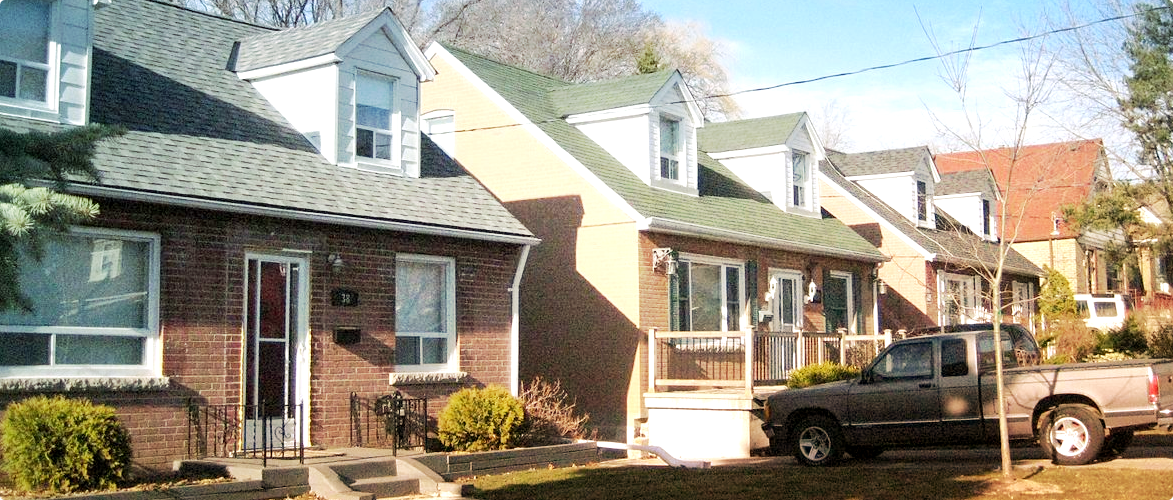
O'Connor-Parkview sits on the eastern edge of East York where the streets dead-end into ravine and the housing stock is largely the same brick detached homes that went up in the 1940s and 1950s, wider lots and quieter than anything you'll find at a comparable price west of the Don Valley.
O’Connor-Parkview sits in the east end of Toronto, technically in the former municipality of East York, bounded roughly by the Don Valley Parkway to the west, O’Connor Drive to the north, Victoria Park Avenue to the east, and the CN rail corridor to the south. It’s not a neighbourhood with a sharp commercial identity or a single street that defines it. What it has is a consistent residential character: solid postwar brick houses on mature streets, access to the Taylor-Massey Creek ravine along its western and southern edges, and a mid-market price point that has made it a reliable entry point for buyers priced out of Riverdale and Playter Estates to the west.
The neighbourhood actually contains two sub-areas with slightly different characters. The western portion, along and north of O’Connor Drive, is older and has a tighter street grid, with homes built primarily in the 1940s and 1950s. The eastern portion, known as Parkview Hills, was developed slightly later and has streets that curve with the topography, larger lots, and homes that were marketed in the late 1950s as a step up from the worker housing to the west. Parkview Hills gives the neighbourhood its second name and accounts for much of the premium end of the local market.
East York was an independent municipality until 1998, when it was amalgamated into the City of Toronto. That history matters because the neighbourhood’s infrastructure, schools, and civic facilities were built to East York standards and reflect a mid-century suburban planning model rather than the older urban fabric you find in Riverdale or Leslieville. The streets are wider, the houses are set back further, and the residential character is quieter and more car-oriented than the neighbourhoods a few kilometres to the west. It feels like Toronto without feeling like the denser city, which is exactly what draws many buyers to it.
The Don Valley Parkway provides fast access to Highway 401 north and the Gardiner Expressway south, which makes the neighbourhood practical for car commuters who work in areas not well served by the TTC. That DVP access has been a consistent factor in the neighbourhood’s appeal since the highway opened in the 1960s, and it remains relevant today: buyers who work in Markham, North York, or anywhere along the 401 corridor find O’Connor-Parkview a workable base in a way that neighbourhoods further into the city are not.
O’Connor-Parkview is almost entirely a freehold detached market. Condos don’t exist here in any meaningful way, townhouse supply is minimal, and semi-detached properties appear occasionally but not consistently. What the neighbourhood sells is detached brick houses on proper lots, mostly built between 1945 and 1965, and that’s the choice you’re making when you buy here: freehold ownership of a house and the land under it, with no maintenance fees and the full liability for maintenance that goes with it.
The housing stock divides broadly into bungalows and two-storey houses. Bungalows, which are common throughout East York, typically run 900 to 1,100 square feet on the main floor with a full unfinished or partially finished basement that doubles the livable square footage when completed. These were originally three-bedroom homes but many have been converted to two bedrooms above grade by enlarging the remaining rooms. A bungalow in original or lightly updated condition sold in the $900,000 to $1,050,000 range in 2026. A bungalow with a finished basement, updated kitchen and bathrooms, and a legal basement apartment was pushing $1.1 million to $1.2 million depending on location.
Two-storey houses, particularly in the Parkview Hills section and on the streets closest to the ravine, tend to run 1,400 to 1,800 square feet above grade on deeper lots. These are the neighbourhood’s upper-tier properties and they trade accordingly. A well-maintained two-storey on a 40-foot lot in Parkview Hills with a renovated interior was asking and achieving $1.2 million to $1.35 million in early 2026. Properties with ravine exposure or backing onto parkland at the bottom of a deep lot commanded a premium above that range when they appeared, which isn’t often.
Lot sizes throughout the neighbourhood run typically from 25 to 40 feet wide and 90 to 120 feet deep. The wider lots are concentrated in Parkview Hills and on the east side of the neighbourhood toward Victoria Park. Buyers coming from the older parts of the city who are used to 16 or 20-foot-wide Toronto houses will find the East York lots noticeably more generous, and the backyard space in particular, which can run 80 or 90 feet deep, is one of the practical arguments for this neighbourhood that matters once you’ve got children or a dog.
O’Connor-Parkview has historically been a slower-moving market than the more competitive precincts further west along the Danforth. It doesn’t generate the same bidding war density that Riverdale or Leslieville do in a strong cycle, and it doesn’t draw the same volume of agent activity that keeps those markets liquid and quick to reprice. In practice, this means listings here sit a few days longer on average, conditional offers get accepted more frequently than in more competitive neighbourhoods, and there’s generally more room to negotiate than in comparable East York streets to the north or west.
The seller profile is predominantly long-term owners. Many homes in this neighbourhood have been held for 20 or 30 years by the same family, and they come to market when an estate is settled or when a long-time owner is downsizing. Properties with deferred maintenance are common, because houses held for decades by elderly owners often reflect years of functional-but-minimal upkeep rather than active renovation. This creates buying opportunities for people who understand construction costs and can model what a property is worth after work, but it also means inspection findings in this neighbourhood are almost always significant.
The 2022 to 2024 rate environment slowed sales volume noticeably, as it did across Toronto’s freehold market, and prices pulled back from the early 2022 highs by roughly 10 to 15 percent depending on property type. By 2026, the market had stabilized but hadn’t fully recovered the frothy peaks: a house that sold for $1.35 million in February 2022 was more likely to be valued at $1.15 to $1.2 million in early 2026, which represents meaningful entry price for buyers who missed the run-up and are now evaluating where value sits relative to the 2022 benchmark.
The market here doesn’t move fast enough to reward panic buying or rushing conditional removal on the basis of competition pressure. Most transactions are negotiated rather than bid, and buyers who do the work upfront, get a proper inspection, understand the property’s maintenance position, and make an offer that reflects their actual cost-to-own calculation, tend to get deals done without the stress that defines buying in more competitive east-end precincts. That’s a practical advantage for first-time buyers and for families who need the inspection period to understand what they’re actually getting.
Families with young children are the dominant buyer group in O’Connor-Parkview, and the neighbourhood suits them well. The detached housing stock, the lot sizes, the relative quiet of the residential streets, and the proximity to Taylor Creek Park for outdoor space make it a practical family address in a city where that combination gets expensive quickly. Buyers in this group are typically coming from condos in the downtown or midtown, or from smaller houses in denser neighbourhoods where backyard space is minimal, and they’re trading commute time for living space in a calculation that lands differently for every household.
Car-dependent commuters are a second consistent buyer type, particularly those heading to destinations not well served by the TTC. The Don Valley Parkway is directly accessible from the neighbourhood via Coxwell or through the park road system, and the 401 is a 15-minute drive north under normal conditions. For someone commuting to Markham, Scarborough, or anywhere along the northern highway corridors, O’Connor-Parkview is one of the closer options that still offers a genuine house rather than a condo. That DVP proximity is priced into the neighbourhood, but not inflated out of reach.
Buyers who’ve been priced out of Riverdale or Playter Estates and are recalibrating their expectations form a third group. These are typically people who’ve been watching the Pape and Danforth corridor for two or three years, getting outbid on Playter Estates houses, and arriving at O’Connor-Parkview having worked out that the $200,000 to $400,000 premium for a comparable house in Riverdale doesn’t buy them anything proportional. The trade-off is transit and street life, and buyers who have run that calculation explicitly tend to settle into the neighbourhood with few regrets.
The long-term resident base skews older, reflecting the neighbourhood’s roots in the postwar East York working and middle class. Portuguese and Italian families who bought here in the 1950s and 1960s are still present among elderly homeowners, and their well-maintained but unmodernized houses are among the most interesting buying opportunities when they come to market. These properties typically have original kitchens and bathrooms, sound structure, and the kind of original-owner care that produces houses in better physical condition than comparable properties that have been rented out or poorly maintained. They also represent the renovation pipeline that has been slowly shifting the neighbourhood’s demographic profile over the past 15 years.
The Parkview Hills section is the most desirable pocket in the neighbourhood and it has a distinct character that justifies the premium. The streets here, Pharmacy Avenue, Craigmore Crescent, Danforth Road in its eastern stretch, and the crescents and courts that branch off them, were laid out to follow the natural contours of the land rather than in a strict grid. The result is a quieter, more enclosed street environment than the older O’Connor Drive section to the west, with cul-de-sacs that see no through traffic, large established trees, and deep lots that back onto parkland or ravine edge. These are the houses in O’Connor-Parkview that rarely come to market and rarely fail to sell quickly when they do.
O’Connor Drive itself is the neighbourhood’s main commercial and arterial spine, running east-west through the middle of the precinct. The streets immediately north and south of O’Connor Drive, places like Barrington, Glenmore, Fulton, and Eldon, have the tighter grid and smaller lots typical of the 1940s build-out. Houses here are solid but less distinctive than the Parkview Hills stock, and they come to market more frequently. For buyers whose budget sits below the Parkview Hills range, these streets offer good value in a functional neighbourhood without any particular drawback beyond lot size.
The streets closest to the Coxwell Ravine and Taylor Creek Park along the southern and western edges of the neighbourhood carry a premium for obvious reasons. Houses that back onto the ravine have a privacy and natural view that is genuinely scarce at this price point in Toronto, and they hold value in soft markets better than comparable houses on interior lots. Buyers specifically looking for ravine-backing properties should focus on the western blocks of Barrington, Glenmore, and the ravine-side sections of Gough Avenue and Cedarvale Avenue.
The area around the East York Civic Centre, on Cosburn Avenue near Coxwell, is a practical sub-pocket for buyers who want walkable access to the library, community centre, and arena. These facilities sit within a short walk of the Cosburn Avenue residential streets, which have a mix of bungalows and two-storey houses at prices that track the broader neighbourhood range. It’s not the most distinctive pocket in O’Connor-Parkview, but it’s well-serviced and practical, and the community centre pool and arena are used heavily enough to make the proximity genuinely useful for families with active children.
O’Connor-Parkview is bus-dependent for TTC access, which is the main transit limitation of the neighbourhood and the primary reason it trades below Riverdale and Pape Village at a comparable house type. There is no subway station within the precinct. The nearest stations are Victoria Park on the Bloor-Danforth Line 2, roughly 20 minutes by bus from the eastern part of the neighbourhood, and Woodbine, also on the Bloor-Danforth Line, accessible from the south. Pape station is approximately 20 to 25 minutes by bus from the western part of O’Connor-Parkview via the O’Connor bus route.
The primary TTC routes serving the neighbourhood are the 87 O’Connor bus, which runs along O’Connor Drive east-west and connects at Pape Avenue to Pape station and at Victoria Park to Victoria Park station, and the 70 O’Connor bus which has a slightly different routing. The 24 Victoria Park bus runs north-south and connects to the Bloor-Danforth line at Victoria Park station. These routes are frequent enough during peak hours, with buses running every 8 to 12 minutes, but the multi-leg nature of many trips adds time that a single-step subway ride wouldn’t. A commute from O’Connor-Parkview to downtown Union Station takes approximately 45 to 55 minutes by transit depending on the specific origin address.
The Don Valley Parkway is the neighbourhood’s transit advantage for car commuters, and it compensates for the TTC limitations for a significant portion of residents. Access to the DVP southbound is straightforward from Coxwell Avenue or from the Cosburn Avenue approach. Northbound, the DVP gives quick access to the 401 and to the Don Mills corridor. In off-peak hours, driving to downtown takes 20 to 25 minutes. In peak traffic, the DVP can be congested, and residents heading to the Financial District on a weekday morning often find the bus-to-subway combination more predictable than sitting on the parkway.
Cycling is practical for some trips. The Martin Goodman Trail can be reached via the Taylor Creek Park trail system, which connects through the ravine from the neighbourhood’s western edge down to the lakeshore trail. That route is pleasant but not practical for speed. Danforth Avenue, accessible by a short ride north, has a painted bike lane heading west that connects to the broader Danforth cycling corridor. For errands on O’Connor Drive or trips to the Danforth, cycling is a realistic option for most of the year. For downtown commuting, the distance and terrain make it demanding but possible for fit riders who are willing to commit to it.
Taylor-Massey Creek Ravine is the defining natural feature of the neighbourhood and it distinguishes O’Connor-Parkview from most East York addresses at a comparable price. The ravine runs along the western and southern edges of the precinct, and the Taylor Creek Park trail system within it extends east from the Don Valley through the neighbourhood, connecting directly to the broader Don Valley trail network. For residents in the streets adjacent to the ravine edge, the park is functionally in their backyard. For residents further east, it’s a 10 to 15 minute walk to the nearest trail entry point.
The Taylor Creek trails are well-maintained and used heavily by dog walkers, trail runners, and cyclists throughout the year. The creek itself runs at the bottom of the ravine, and the trails wind along both banks with enough variation in elevation and terrain to make the walk interesting rather than monotonous. The trail connects west to the Don Valley main trail at the confluence, and from there north to Sunnybrook Park and Serena Gundy Park, or south along the Don to the Martin Goodman Trail at the lakeshore. For people who run or cycle trails regularly, this connectivity is a genuine asset: you can cover many kilometres without leaving the ravine system.
Taylor Creek Park itself has formal park facilities including a picnic area and a playground near the northern entry points off O’Connor Drive. The Michael Bleakley Memorial Garden in the park is a community garden that has been maintained by neighbourhood volunteers for years. The park is dog-friendly and is consistently cited by residents as the main reason they’ve stayed in the neighbourhood when they could have afforded to move. That’s not hyperbole. At this price point in Toronto, direct ravine access is genuinely difficult to find, and the parks on the Rosedale and Don Mills side of the Don Valley that provide comparable trail access come with addresses that cost significantly more.
Away from the ravine, the neighbourhood has smaller local parks that serve the interior streets. Dentonia Park, accessible from Danforth near Victoria Park, is a larger park slightly outside the precinct boundary but within reasonable cycling or walking distance from the eastern parts of the neighbourhood. The East York Memorial Arena and the East York Community Centre on Cosburn have outdoor spaces used for summer programming. The green space situation in O’Connor-Parkview is stronger than the address price suggests, and the Taylor Creek access in particular is the detail that surprises buyers who haven’t explored the neighbourhood on foot before making a decision.
O’Connor-Parkview doesn’t have a main street in the Roncesvalles or Danforth sense. O’Connor Drive provides a functional local strip with a pharmacy, a few restaurants, a dry cleaner, and basic services, but it’s not a destination street. Residents treat it as a convenience layer for quick errands and rely on the Danforth for anything more substantial. The Danforth is a 5 to 10 minute drive or a 15 to 20 minute bike ride from most addresses in the neighbourhood, and it provides a full range of restaurants, groceries, and services that the local strip doesn’t attempt to replicate.
For groceries, the main options nearby are a Metro on Danforth near Pape Avenue and a Loblaws further east at the Carlaw and Danforth intersection. FreshCo on Victoria Park serves the eastern part of the neighbourhood. None of these is a walk from most O’Connor-Parkview addresses: grocery runs here require either a short drive or a transit trip, and that’s a practical reality of the neighbourhood that buyers from more walkable areas should factor in before deciding. For households with a car, it’s a non-issue. For households without one, it shapes the weekly routine.
The East York Town Centre on Pharmacy Avenue is the neighbourhood’s primary big-box retail destination, with a Walmart, a Cineplex, a dental and medical office cluster, and a mix of national chain retailers. It’s not a neighbourhood retail strip, it’s a suburban-format mall, and it’s about a 10-minute drive or a 20-minute bus ride from the western part of the neighbourhood. It serves the practical retail needs of the area well despite its format, and the presence of a large pharmacy and grocery component makes it a useful weekly destination for many residents.
Independent food and restaurant options along O’Connor Drive are limited but functional. There are a few established neighbourhood restaurants that have served the area for years without much pretension or press attention, and that’s consistent with the neighbourhood’s character. The energy and variety of Danforth dining, from Greek restaurants that have been operating since the 1970s to newer independent spots that have arrived as the Danforth has gradually attracted younger residents, is accessible enough that most O’Connor-Parkview residents treat it as their dining neighbourhood by default. For specialty food shopping, the Danforth also carries a Greek deli and import culture that is specific to that corridor and unavailable elsewhere in the east end at this distance from downtown.
The natural comparison for O’Connor-Parkview is Riverdale and Playter Estates to the west, and the comparison is straightforward: you get more house and more lot for less money, and you give up proximity to the Pape and Broadview subway stations and the denser restaurant and retail corridor along the Danforth. For a buyer whose priority is the house itself, that trade makes sense. For a buyer whose priority is walking to a subway station or being embedded in a neighbourhood with active street life, Riverdale or Leslieville is the better fit even at a higher price.
Compared to Pape Village, which sits immediately to the west and is covered separately on this site, O’Connor-Parkview is quieter, has larger lots, and feels more distinctly suburban in its character. Pape Village has the advantage of Pape station literally at its northern edge, which is a meaningful difference for transit-dependent buyers. O’Connor-Parkview compensates with the ravine access and generally wider lots that Pape Village can’t offer given its tighter street grid and narrower property sizes.
East of O’Connor-Parkview, the Clairlea and Oakridge neighbourhoods in Scarborough offer detached homes at lower prices, but the built form changes: more postwar bungalows on similar lot sizes, but further from the Danforth corridor and further from the Don Valley trail system. For buyers who’ve been looking at Clairlea and wondering whether O’Connor-Parkview justifies the premium, the answer depends on whether the East York location and the ravine proximity matter to you. If they do, the gap is worth it. If you’re purely optimizing for square footage per dollar, Clairlea and Wexford will serve you better.
O’Connor-Parkview has a longer established-resident tenure than most Toronto neighbourhoods at a comparable price point. The Portuguese and Italian communities that settled in East York in the 1950s and 1960s are still present, particularly among older homeowners, and the neighbourhood reflects that in small ways: carefully maintained front gardens, some older commercial properties along O’Connor Drive with a functional rather than curated character, and a general absence of the conspicuous renovation culture that marks more gentrified areas. That’s changing at the margins as long-term owners age and their homes come to market, but the pace is slow.
Families with school-age children are a consistent presence. EA Beare Public School draws from the immediate area, and East York Collegiate Institute on Cosburn is the main secondary destination, with SATEC at WA Porter Collegiate on Lawrence Avenue East drawing students who want its specialized technology and arts programming. Neither school is among the Toronto District School Board’s most competitive by test score rankings, but they’re functional neighbourhood schools with reasonable reputations and extracurricular programming that serves most students well. Families who want access to French Immersion or other specialized programs typically look at Cosburn Middle School or make arrangements at other TDSB facilities.
Daily life in O’Connor-Parkview is centred on the Danforth for groceries, restaurants, and services, with O’Connor Drive providing a secondary local strip that has a pharmacy, a few food spots, and basic services. It’s not a neighbourhood with a main street of its own in the Roncesvalles or Bloorcourt sense. Residents who want that street-life quality tend to migrate up to the Danforth by car or bike, which is a 5 to 10 minute trip from most addresses. The East York Civic Centre area has a library, community centre, and arena that serve as the neighbourhood’s main public gathering infrastructure.
What do detached homes sell for in O’Connor-Parkview in 2026?
Detached homes in O’Connor-Parkview sell in the $900,000 to $1.3 million range in 2026, depending on lot size, condition, and whether the basement has been finished or converted. Bungalows with original kitchens and bathrooms sit at the lower end; updated two-storeys on wider lots, particularly those with south-facing backyards or ravine proximity, push toward and occasionally above the top of that range. The neighbourhood doesn’t have a condo or townhouse market, so almost everything trading here is freehold detached. Semi-detached supply is minimal. If you’re comparing price per square foot against condos in nearby areas, the math on a detached home in O’Connor-Parkview tends to look good once you factor in the land value and the absence of maintenance fees.
How does O’Connor-Parkview compare to Riverdale or Playter Estates?
O’Connor-Parkview is meaningfully cheaper than Riverdale or Playter Estates for a comparable detached home, typically by $200,000 to $400,000 depending on the specific streets. The trade-off is transit: Pape and Broadview subway stations are closer to those western neighbourhoods, while O’Connor-Parkview buyers are working with bus connections to Victoria Park or Woodbine. The lots here tend to be deeper and the streets quieter, and you’re closer to the Coxwell Ravine and Taylor-Massey Creek trails, which matters to buyers who want ravine access without paying Rosedale prices. For buyers who drive or work remotely, the transit disadvantage largely disappears, and the price gap becomes the dominant factor.
What should buyers inspect for in O’Connor-Parkview homes?
Homes in O’Connor-Parkview are mostly 60 to 80 years old, so inspections regularly turn up knob-and-tube wiring in attics and walls, cast iron drain stacks that are corroding or already cracked, and older oil furnaces that were converted to gas but never fully updated. Basement waterproofing is a consistent issue on homes that back onto sloped lots near the ravine. Foundation parging on the exterior brick tends to crack and separate over time. None of these are reasons to walk away, but every one of them has a cost, and you want those costs quantified before you firm up. A thorough inspection in this neighbourhood typically takes three to four hours and is worth every minute of it.
Are there good schools in O’Connor-Parkview?
The main public elementary school serving the area is EA Beare Public School on Pharmacy Avenue. For secondary, students typically go to East York Collegiate Institute on Cosburn Avenue or SATEC at WA Porter Collegiate on Lawrence Avenue East, which has a strong arts and technology focus that draws students from across the east end. The Toronto Catholic District School Board also serves the area. None of these schools are among Toronto’s most sought-after magnet programs, but East York Collegiate and SATEC both have solid academic reputations and specialized programs that keep many families in the neighbourhood through high school without needing to travel across the city.
O’Connor-Parkview’s housing stock is almost entirely a product of the postwar period in East York, which was then an independent municipality, and that origin matters to understanding what you’re buying. East York was built out rapidly between 1945 and 1965 to house returning veterans and their families, and the homes reflect that moment: solid construction, brick exteriors, practical layouts, designed for families with children and a car in the driveway. The municipality had its own planning department, its own standards, and its own identity separate from the City of Toronto, which it only amalgamated into in 1998. That independent civic identity is still felt in the neighbourhood’s character today.
The Parkview Hills section of the neighbourhood, which gives it half its name, was developed slightly later than the older O’Connor Drive corridor and tends to have somewhat larger homes on slightly more generous lots. The streets in Parkview Hills, many of which curve and dead-end at the ravine, were laid out with an awareness of the topography that the older grid sections weren’t. Houses here were marketed in the late 1950s as a step up from the worker housing further west, with better finishes and more yard space. Some of that original character is still visible in the homes that haven’t been substantially altered.
The neighbourhood’s proximity to the Don Valley and its ravine system has protected it from the kind of intensification pressure that has reshaped areas further west. The ravine edge creates a hard stop on development, the residential streets have remained largely single-family, and the commercial activity on O’Connor Drive has stayed at a neighbourhood scale rather than transforming into the mixed-use corridors you see on parts of Danforth or Kingston Road. For buyers who want a Toronto address without the density and noise that come with it, that stability, rooted in geography as much as policy, is the neighbourhood’s most durable asset.
Street-level knowledge is hard to find online. Our team works in O’Connor Parkview (Parkview Hills) every day. They know which pockets hold value, where the school catchment lines actually fall, and what the market is doing right now. Talk to us before you make a decision about O’Connor Parkview (Parkview Hills).
Talk to a local agent