
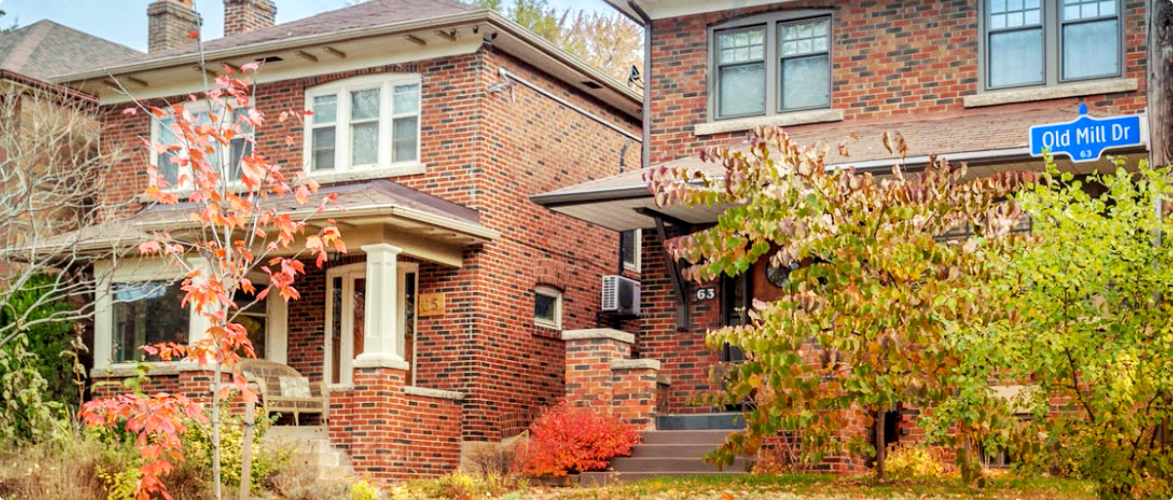
Old Mill is a small, established neighbourhood in the Humber River valley on the western edge of Toronto. The streets are quiet, the tree canopy is dense, and some lots back directly onto the river or the forested ravine slope. It is one of the few places in Toronto where a genuine ravine address and a subway station are within the same postal code. Properties are predominantly custom detached homes from the 1920s through 1960s, and they almost never come to market.
Old Mill occupies a stretch of the Humber River valley that doesn’t look or feel like Toronto. The streets are quiet, the tree canopy is dense, and from the right lots you can watch the river from your kitchen window. It is one of the few places in the city where genuine natural landscape, not the manufactured version you get in newer developments, shapes what daily life feels like. People who live here tend to stay a long time, and when a property does come to market, it attracts buyers who’ve been watching the neighbourhood for years.
The residential addresses centre on Humber Valley Road, Old Mill Road, Humber Trail, and the smaller streets that feed into them. The lots vary considerably. Some are flat and generous. Others drop sharply toward the ravine and give a sense of privacy that money alone can’t replicate elsewhere in the city. The Toronto and Region Conservation Authority regulates the portions of many lots closest to the water, which shapes what owners can build, but also guarantees that the forested riverbank will never be developed away from you.
What keeps Old Mill in a category of its own is the subway station. The Bloor-Danforth line stops here, which means a resident on Humber Valley Road can be at Bloor and Yonge in under half an hour without a car. That combination, ravine privacy and genuine transit access, doesn’t exist anywhere else in Toronto. The neighbourhood earns its reputation not through marketing but through the simple fact that very few properties come up, and buyers don’t leave.
The housing stock in Old Mill is almost entirely custom detached homes built between the 1920s and the 1960s. Many of them were architect-designed or built by the original owners to specifications that reflected genuine ambition. You’ll find Tudor revival, Georgian, and mid-century designs sitting on the same block without the streetscape feeling chaotic. The common thread is quality of construction from an era when that word still meant something, and lot sizes that range from generous to extraordinary.
Entry-level in 2026 means a home that needs substantial updating on a lot with limited ravine exposure, priced from around $2.5M. Move up the range and you’re buying more lot depth, more direct engagement with the ravine or river, and typically more recent renovation work. Homes in the $3.5M to $5M range have usually had kitchens and bathrooms done within the last decade and sit on lots where the back garden genuinely opens onto the forested slope. Properties above $5M are the estate lots, the ones with setbacks that put 60 or 80 feet of private green space between the house and the ravine edge, often paired with significant square footage and full renovations throughout.
There are occasional newer builds in the neighbourhood, custom homes completed in the last 15 years on lots that came available after an original structure was demolished. These trade at the top of the range and offer modern layouts and mechanical systems inside an exterior that typically nods to the traditional character of the street. Condominiums don’t exist here. Townhouses are essentially absent. This is a neighbourhood of large single-family homes on private lots, and that’s unlikely to change given the heritage character and TRCA constraints.
Old Mill trades in very low volume. In a given year, 10 to 20 properties change hands across the core streets, and in quieter periods the number can be smaller. That low turnover means price comparables are thin, which creates both opportunity and risk for buyers. A home that comes to market with strong staging and smart pricing can draw multiple offers even in a soft broader market because the pool of buyers who’ve been waiting for Old Mill inventory is always deeper than the supply.
The buyers who compete here are not speculating or stretching. They’re typically selling something else, often a fully paid-off home in another premium neighbourhood, and arriving with substantial equity. That profile tends to stabilize prices even when the broader Toronto market softens. Old Mill didn’t see the sharp corrections in 2022-2023 that hit the pre-construction condo sector or the more speculative parts of the 905. Prices pulled back modestly, then recovered. The floor here is relatively durable.
What moves prices most in individual transactions is lot configuration and ravine exposure. Two homes of similar size and renovation quality on the same block can trade $600,000 or $800,000 apart based on whether the rear lot line backs the ravine slope or a neighbouring property. Buyers who understand this before they start looking will make better decisions and avoid overpaying for a flat interior lot when a ravine lot is what they actually want. Seasonal timing matters less here than in other markets. Serious buyers watch the neighbourhood year-round, and a well-priced listing in February attracts the same calibre of offer as one in April.
The buyers who end up in Old Mill have almost always looked carefully at Rosedale, Moore Park, Forest Hill, and the Kingsway, and decided that what they actually want is land and quiet more than address recognition. They’re not abandoning prestige. Old Mill is a genuinely prestigious address. But the prestige here is quieter and more private than in the more trafficked premium neighbourhoods, and the buyers tend to value that distinction.
A significant number of Old Mill residents relocated from Rosedale or Forest Hill. The conversation is usually the same: the children are older, the Rosedale lot felt constraining, and the idea of a ravine at the back of the property, with the river audible on a quiet evening, offered something the established address couldn’t match. They traded cachet for space and nature, and most of them say they made the right call. This isn’t a neighbourhood for someone who wants to be seen. It’s a neighbourhood for someone who wants to be comfortable.
The other buyer profile is the Etobicoke family that has been climbing the local market for a decade, selling and upgrading through the Bloor West Village and Kingsway progression, and arriving in Old Mill as the logical destination. These buyers know west Toronto well, often have roots in the area, and feel strongly about the Bloor-Danforth subway connection that makes the location practical for a household where someone still commutes downtown. The neighbourhood also attracts professionals who work at Humber River Hospital and want to live within meaningful distance of their workplace while maintaining a setting that doesn’t feel like a suburb.
The TRCA review is the first thing to understand before making any offer in Old Mill. The Toronto and Region Conservation Authority has jurisdiction over a significant portion of the lots near the Humber River, and their regulated area maps are publicly available on the TRCA website. For any property that touches or approaches the ravine, you need to know exactly where the regulated area boundary runs and what that means for future construction, additions, or landscaping. This isn’t a dealbreaker on most lots, but it determines what you can do with the property after you own it, and that should factor into your offer price.
The age of the housing stock requires careful inspection discipline. Homes from the 1930s and 1940s have charm that newer construction can’t replicate, but they also have mechanical systems, foundations, and structural elements that may have been updated partially, poorly, or not at all. A thorough home inspection by an inspector with specific experience in older Toronto homes is not optional here. Knob-and-tube wiring, cast iron drains, original clay sewer laterals, and post-and-beam foundations that have settled unevenly are all possibilities depending on the property. The inspection should cover the full lot, including any retaining walls, drainage patterns on the ravine slope, and the condition of any structures in the rear garden.
If a property carries heritage designation, either at the provincial or municipal level, confirm what that designation covers and what it restricts before you commit. Some heritage designations are narrow and only affect the exterior streetscape. Others are more comprehensive. Your lawyer should review any heritage designation schedule as part of the title search. Finally, verify the floodplain status directly. Toronto’s flood mapping is more nuanced than many buyers realize, and the Humber River has a documented flood history. Properties in the Special Policy Area have specific development constraints that are distinct from standard TRCA regulation.
Selling in a low-volume, high-value market like Old Mill requires a different approach than selling in a neighbourhood where 200 homes trade every year. Comparables are thin, which means the listing price conversation is more nuanced and requires an agent who genuinely knows this specific market rather than one who’s pulling averages from a broader west Toronto dataset. Overpricing in a thin market doesn’t just sit, it actively signals to the serious buyers who’ve been watching the neighbourhood that something is wrong with the property, and those buyers are sophisticated enough to wait you out.
Presentation matters enormously at this price point. The buyers coming through a $3.5M or $4.5M Old Mill home are not imagining what the property could be. They’re evaluating what it is, and they’re comparing it to everything else they’ve seen in this and adjacent premium markets. Professional staging in the style that suits the home’s architecture, real photography with natural light used well, and a floor plan that communicates the lot depth and outdoor space all make a measurable difference to which offers arrive and at what price. If the landscaping has been neglected, address it before listing. The connection to the ravine and the garden is a primary selling point, and it should look like one.
Timing in Old Mill is less seasonal than in the broader market, but the spring window from mid-March through May still tends to produce the deepest buyer pool. The neighbourhood shows best in late spring when the ravine tree canopy fills in and the river is running. That natural backdrop does real selling work, and a listing that hits the market when the ravine looks its most impressive has an advantage over the same home photographed in November. If you have flexibility on timing, use it.
The Humber River Trail runs through the heart of what makes this address distinctive. From the footbridge near the Old Mill ruins, the trail system extends north through Etobicoke toward Humber Summit and south to Lake Ontario, giving residents access to roughly 50 kilometres of paved and natural-surface trail without getting in a car. On weekday mornings the trail is populated mostly by residents walking dogs and running. On weekends it draws cyclists and hikers from across the city, though the section closest to Old Mill retains a quieter character than the more publicized sections further south near the lake.
The ruins of the original mill on the south bank of the river are a heritage site and something of a landmark for the neighbourhood. The Old Mill Inn and Spa occupies the site, and the brick ruins of the original grist mill are preserved as part of the grounds. The building dates to the early 19th century and has been rebuilt and repurposed multiple times over the intervening 200 years. It’s not a tourist attraction in any major sense but it gives the neighbourhood a tangible historical grounding that most Toronto addresses lack.
The river itself floods. The Humber has a documented history of significant flooding, most dramatically in 1954 during Hurricane Hazel, which caused catastrophic damage throughout the valley. The flood protection infrastructure that followed Hazel, combined with the TRCA’s ongoing management of the floodplain, has dramatically reduced flood risk for existing structures. But the Humber is still a live river in a valley, and buyers should understand the floodplain mapping relevant to any specific property rather than assuming that distance from the water equals distance from risk. The TRCA staff are accessible and willing to answer specific questions about individual lots, which is worth doing before removing conditions on a purchase.
Old Mill station on the Bloor-Danforth line is the neighbourhood’s most practically significant feature for many households. The station is at the bottom of Bloor Street West where it crosses the Humber, and it’s within a 10-15 minute walk of most Old Mill residential addresses. From here, downtown (King and Bay) is roughly 25-30 minutes by subway. The Yonge-Bloor interchange puts you on the Yonge line for connections north or south. For a neighbourhood that looks and feels like a rural retreat, this is exceptional transit access.
Driving is straightforward. Bloor Street West connects east toward downtown and west toward Etobicoke and Highway 427 quickly. The Gardiner Expressway and Lake Shore Boulevard are accessible via Parkside Drive or Royal York Road in under 15 minutes in normal traffic. Highway 401 is north via Kipling or Royal York. The neighbourhood’s road network is quiet by design, with Old Mill Road and Humber Valley Road functioning more as residential lanes than through streets, which keeps cut-through traffic minimal.
Cycling along the Humber Trail southward connects to the Martin Goodman Trail at Lake Shore and from there to downtown’s separated cycling infrastructure. The ride from Old Mill to the financial district via trail and Lake Shore is achievable in 45-50 minutes for a reasonably fit cyclist, and it’s a genuinely pleasant route. The hill back up from the river valley on the return is the main deterrent. For children, Humber Valley Public School is within walking distance for most of the core residential streets, and the trail system provides safe off-road routes to the school for families willing to use them.
The comparison buyers make most often is between Old Mill and Rosedale. Both offer custom detached homes, deep lots, and a sense of remove from the city’s density. The meaningful differences are lot configuration, landscape character, and what the address signals. Rosedale lots are typically flatter and more formal. Old Mill’s terrain is more dramatic, with the ravine doing work that Rosedale’s manicured gardens can’t replicate. Rosedale has stronger address recognition, particularly among buyers and social networks east of Yonge. For buyers who aren’t motivated by where their peers live, Old Mill frequently offers more land and more landscape for a comparable price.
Baby Point, immediately north of Old Mill along the Humber, is the most natural alternative for buyers priced out of Old Mill’s upper range. The housing stock is similar, the ravine adjacency is real, and the neighbourhood has a registered private community association with a clubhouse and tennis courts that some residents value. Baby Point prices generally run from $1.8M to $3.5M, which is a meaningful step below Old Mill’s floor for comparable properties. The trade-off is that Baby Point lots are typically smaller and less likely to have the direct ravine exposure that defines Old Mill’s premium tier.
The Kingsway, just south along Bloor, offers a different kind of west Toronto prestige, centred on Bloor Street retail, the established Kingsway streetscape, and somewhat more accessible prices for comparable square footage. It’s a flatter neighbourhood with more consistent lot sizes and a different feel: prosperous and residential but without the drama of the valley setting. Some buyers look at both and choose the Kingsway specifically because the flat lots are easier to renovate and maintain. Others look at both and choose Old Mill because the valley is irreplaceable. Both are defensible positions depending on what you’re actually optimizing for.
Humber Valley Public School on Berry Road is the local public elementary school and has a strong reputation within the Toronto District School Board. Many Old Mill families walk their children to school through the neighbourhood’s quiet residential streets, which is a practical argument for the location that sometimes gets overlooked in conversations dominated by price and lot size. Etobicoke Collegiate Institute is the local public secondary school on Montgomery Road, a well-regarded school with strong academic programming and a stable enrolment. Families who prefer private schooling typically look at Upper Canada College, Bishop Strachan, or Havergal, all of which are accessible by car from Old Mill in reasonable commuting time.
For daily errands, Bloor Street West between Runnymede and Royal York is the practical commercial street. It has a Sobeys, an independent pharmacy, a handful of cafes, and the restaurant strip around The Kingsway has expanded steadily through the 2020s. The farmer’s market circuit (Dufferin Grove, Wychwood Barns) is accessible by subway or car on weekends. The neighbourhood itself has almost no retail, which is part of the appeal for residents but a practical consideration for buyers moving from walkable neighbourhoods like the Annex or Leslieville.
The community character is quiet, private, and not especially organized around a neighbourhood association in the way that Baby Point is. Residents tend to know their immediate neighbours well and interact less with the broader neighbourhood as a formal unit. The trails bring people together informally. Dog ownership is high and the river trail functions as the neighbourhood’s social infrastructure. It’s a community of people who valued privacy enough to pay for it, and the neighbourhood reflects that preference honestly.
What does a house in Old Mill actually cost in 2026?
The entry point for a detached home in Old Mill proper is around $2.5M, and that typically gets you a property that needs significant updating on a lot with some ravine proximity but not necessarily direct river frontage. Homes with deep ravine lots, direct Humber River views, or significant recent renovation work trade from $3.5M to $5M. The top end, reserved for custom builds on the largest estate lots, exceeds $6M. The price spread reflects lot depth and ravine exposure more than house size alone. A smaller home on a lot that backs directly to the river will consistently trade above a larger home on a flat interior lot two streets away, sometimes by $600,000 to $800,000. If you’re budget-constrained but want the neighbourhood, prioritizing a well-located lot over house size is the better long-term strategy.
How do TRCA setbacks affect building or renovating in Old Mill?
The Toronto and Region Conservation Authority regulates development near the Humber River floodplain and the ravine system. On many Old Mill lots, there are hard limits on how close to the rear property line you can build, and any addition, deck, or structure within the regulated area requires TRCA approval in addition to a City of Toronto building permit. The process adds time and cost to renovation projects, sometimes significantly. Before making an offer on any Old Mill property, your lawyer should confirm whether the lot falls within a TRCA regulated area and what the specific setback rules are for that parcel. The TRCA publishes regulated area maps online and their planning staff answer specific questions about individual properties. This isn’t a reason to avoid the neighbourhood, but it’s a variable that directly affects what you can do with the land after you own it, and it should inform both your offer price and your renovation plans.
Is Old Mill actually walkable, or do you need a car for daily life?
Old Mill is walkable to transit in a way that surprises most buyers. The Old Mill subway station puts you on the Bloor-Danforth line, which means downtown is roughly 25-30 minutes without a car. What the neighbourhood lacks is walkable retail. There are no grocery stores or restaurants within easy walking distance of the residential streets. Bloor Street West has groceries, cafes, and services, but it’s a 10-15 minute walk for most residents, uphill on the return. Most households here use a car for grocery runs and routine errands. The transit access is genuinely excellent for commuting; the walkability score for daily tasks is low. That tradeoff is consistent with the neighbourhood’s character as a quiet residential enclave, and buyers should be honest with themselves about whether it suits how they actually live.
How does Old Mill compare to Baby Point next door?
Baby Point sits immediately north of Old Mill along the same stretch of the Humber River, and the two are sometimes grouped together, but they’re distinct markets. Baby Point is a registered heritage neighbourhood with a private residents’ club and a tighter street grid. Homes there are also custom detached from the same early-to-mid 20th century period, but the lots are generally smaller and the prices are lower, roughly $1.8M to $3.5M. Old Mill proper has the deeper ravine lots and more dramatic landscape engagement, and prices reflect that gap. Baby Point also has the community infrastructure of its association, which some buyers actively want. If budget is a constraint but the ravine setting is the priority, Baby Point offers the closest comparable experience at a lower entry point, though you’ll typically sacrifice some lot depth and direct river exposure to get there.
The Humber River was a significant travel and trade route for Indigenous peoples, including the Mississaugas of the Credit, for thousands of years before European settlement. The river valley that now forms the backdrop of Old Mill was a portage route connecting Lake Ontario to the upper watershed, part of a network that extended deep into the interior of the continent. The land that is now Old Mill sits within the Toronto Purchase territory, and that history is present in the landscape in ways that predate any residential development.
The mill that gives the neighbourhood its name was established in the early 1800s on the south bank of the Humber. The original structure burned and was rebuilt multiple times through the 19th century, serving the agricultural communities of upper Etobicoke as a grist and saw mill. By the early 20th century the industrial use was long gone, and the ruined brick walls became a picturesque backdrop for the hotel and dining operation that developed around them. The Old Mill Inn, which still operates on the site, has been a destination for Torontonians for most of the 20th century.
The residential development of the streets above and around the valley happened primarily in the 1920s and 1930s, as Toronto’s prosperous professional class began to look westward beyond the established Rosedale and Forest Hill addresses. The deep ravine lots along the Humber were understood from the beginning as exceptional, and the homes built on them reflected that understanding. Many were architect-commissioned, built for families who intended to stay for decades. The demographic has shifted somewhat, with buyers now more likely to arrive with urban backgrounds than the industrial or commercial money that originally built the houses, but the housing stock itself has changed slowly and mostly well. Old Mill is one of the few Toronto neighbourhoods where the original residential vision is still largely intact.
Street-level knowledge is hard to find online. Our team works in Old Mill every day. They know which pockets hold value, where the school catchment lines actually fall, and what the market is doing right now. Talk to us before you make a decision about Old Mill.
Talk to a local agent