
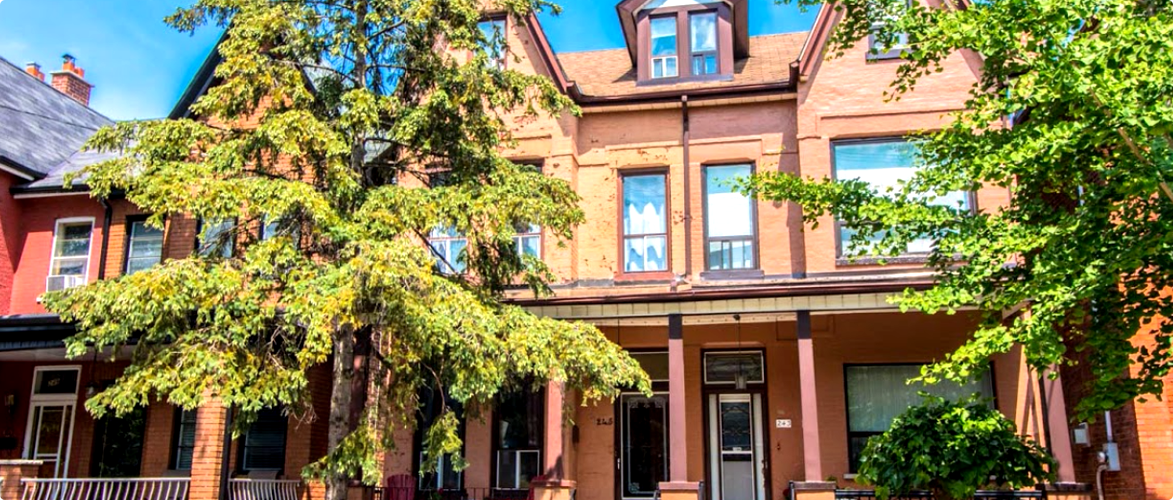
Palmerston sits in the lower Annex, between Spadina and Bathurst and from Bloor south toward College, built on a grid of wide Victorian streets where three-storey brick houses occupy deep lots behind mature canopy trees. Palmerston Boulevard itself is one of the city's few true residential boulevards, with a wide grass median and a row of substantial Edwardian homes that have attracted University of Toronto faculty, lawyers, and doctors for generations. Renovated detached homes on the best streets were selling between $2.2 and $3 million in early 2026, with semi-detached houses starting around $1.6 million.
Palmerston Boulevard is the street that names the neighbourhood and shapes its character. Running from College to Bloor with a wide grass median and a canopy of elms and maples, it’s one of the few residential streets in Toronto that reads as a boulevard in the European sense: wide enough for the trees to form a complete arch overhead, lined with three-storey Victorian and Edwardian houses whose brick facades and front porches face each other across the planted centre strip. The city designated it a heritage street decades ago, which means the boulevard features are protected in a way that the median strips on other Toronto residential streets are not. Walking north from College on a summer afternoon, the transition from the street noise of the surrounding grid to the relative quiet of the boulevard is noticeable within half a block.
The parallel streets, Euclid, Palmerston itself below College, Markham, and Lippincott, share the housing type and the building era without the boulevard designation. On these streets, the lots are slightly narrower, the houses slightly more variable in their footprints, and the streetscape less formally organised. They are, in the best sense, ordinary residential streets of the type that built Toronto’s inner city: tree-lined, quiet in the evenings, with front porches that get used and neighbours who know each other. The houses on Markham and Lippincott particularly reflect the range that existed within Victorian speculative development: some are substantial three-storey homes with original detail intact, others are narrower semis that were always more modest in scale.
The neighbourhood’s geography places it at a useful intersection of Toronto’s inner-city assets. Christie Pits Park is a short walk north, providing the outdoor space that the smaller lots on these streets can’t offer privately. Kensington Market is 10 minutes south on foot. The Bloor subway runs along the northern edge of the neighbourhood, with Bathurst and Spadina stations both accessible without a bus or streetcar. University of Toronto’s main campus is a 15-minute walk east. For a buyer who needs to be somewhere specific in the central city most days of the week, almost no combination of commute, amenity, and neighbourhood character beats what Palmerston offers at its price point.
Palmerston’s housing stock is among the most substantial in Toronto’s inner city. The typical detached home is three storeys, brick, built between 1890 and 1920, with a frontage of 20 to 28 feet and a lot depth that ranges from 100 to 140 feet depending on the street. These are not narrow Victorian semis. They are large houses that were originally built for prosperous professional families and have spent the intervening century in various states of single-family occupancy, conversion to multi-unit rental, and reconversion back to single-family use. The condition of any given home reflects that history, and the range is wider than in neighbourhoods with a more homogenous renovation timeline.
The semi-detached properties in the neighbourhood, which are more common on Markham, Lippincott, and the streets south of College, are still large by Toronto standards. A typical semi runs 1,800 to 2,400 square feet above grade, with a full basement that may or may not be finished. The lot depths on these properties make rear additions feasible, and many have been extended at the back to add kitchen and family room space that the original footprint lacked. The quality of those additions varies: permitted, well-executed rear additions add genuine square footage and value; informal, unpermitted additions create complications that show up in the home inspection and in financing. Pulling the permit history for any extended property before making an offer is straightforward and worth doing.
Multi-unit conversions are a category that deserves specific attention. A meaningful portion of Palmerston’s largest houses were converted to three- or four-unit rental properties in the postwar decades, and some remain in that configuration. Buying a multi-unit property with sitting tenants has regulatory implications under the Residential Tenancies Act that affect your ability to occupy or redevelop the property. Ontario’s eviction rules for owner-occupancy purposes have specific requirements and timelines. Buyers who want to convert a multi-unit back to single-family use should speak with a real estate lawyer before making an offer, understand exactly what the process involves, and budget realistically for both the legal process and the physical conversion work that follows.
Palmerston trades within the Annex market, which has been one of Toronto’s most consistently in-demand areas for the past 40 years. The buyer pool is deep and specific: University of Toronto faculty, lawyers, physicians, and senior public servants make up a significant portion of purchasers, along with professionals returning from Toronto after years abroad and families who grew up in the area and are buying for the first time. This buyer profile is unusually resistant to market sentiment shifts. The Annex and Palmerston held their values better than most Toronto neighbourhoods in the 2022-2023 correction and recovered faster in 2024. The reason is structural: the buyer pool doesn’t disappear when rates rise; it adjusts its price expectations and waits, then re-enters when pricing reaches a level it finds defensible.
The result is a market that moves in a narrower range than more speculative parts of the city. You won’t find the double-digit year-over-year appreciation that some east-end neighbourhoods saw in 2020 and 2021, and you won’t find the sharp corrections either. Properties in Palmerston tend to trade within 5 to 8 percent of their assessed value in most market conditions, with outliers on either side driven by specific circumstances rather than market swings. This makes pricing more predictable for buyers and sellers alike, which is one of the reasons the neighbourhood attracts the kind of buyer who plans to stay for 10 to 20 years rather than cycling every five.
Days on market for well-priced turnkey homes in Palmerston runs short: 7 to 14 days in balanced conditions, with multiple offers still occurring for properties that present well and are priced with discipline. The multi-unit and unrenovated end of the market moves more slowly, not because of lack of interest but because the buyer pool for those properties is narrower: investors who understand the tenancy implications, buyers who can fund both the purchase and a substantial renovation simultaneously, and developers looking for specific lot configurations. Sellers of multi-unit properties should expect longer marketing periods and should price to reflect the actual buyer pool rather than the single-family buyer who will not be able to acquire the property without significant legal work.
The neighbourhood has attracted University of Toronto academics for so long that it reads almost as an extension of the campus community. Faculty members who want to walk to convocation hall, attend evening lectures, and live within the intellectual orbit of the university have been choosing Palmerston and the broader Annex for generations. That long tenure creates a neighbourhood where a significant portion of the population has been there for decades, knows the streets deeply, and participates in local institutions, from the Palmerston Library branch to the Christie Pits Film Festival, as a matter of course. New buyers enter a neighbourhood with an established social fabric rather than one that is still forming.
The second primary buyer group is professional families who prioritise school catchment and walkability above almost everything else. Palmerston Avenue Junior Public School’s French Immersion stream is a meaningful draw for families who want to place their children in a bilingual educational pathway. These buyers are typically in their mid-30s to mid-40s, with children in or approaching primary school age, and they’ve done significant research on school options across the central city before settling on the Palmerston catchment. For them, the neighbourhood is as much a school decision as a real estate one, which is worth understanding if you’re buying for different reasons and competing against them for the same properties.
A third cohort is buyers returning to Toronto after time in other cities or abroad. The Annex and Palmerston appear frequently on the shortlists of people who grew up in Toronto, spent 10 to 15 years in New York, London, or Vancouver, and are returning with capital and a specific idea of what Toronto neighbourhood life should feel like. They tend to be decisive buyers who move quickly when they find the right property, and their presence in the market at any given moment can create competitive dynamics on individual listings that the neighbourhood’s generally measured pace doesn’t suggest in aggregate. Sellers who catch this buyer at the right moment often achieve prices above comparable sales.
The inspection issues in Palmerston are shaped by the age and original quality of the housing stock. These houses were built well, with full brick construction, substantial timber framing, and foundations that have performed adequately for over a century. The issues that appear are typically the accumulation of deferred maintenance and the consequences of conversion work done cheaply. Original plaster walls and ceilings, which survive in many of these homes behind later drywall installations or in rooms that weren’t renovated, are not a problem in themselves but require specific repair skills and materials when they fail. An inspector who treats them like standard drywall will give you inaccurate cost estimates for addressing any defects.
Electrical systems are the most frequent significant finding. The original knob-and-tube wiring in these homes was installed for a fraction of the electrical load a household now requires, and the homes have been updated in layers over the decades without always achieving a complete replacement. The common pattern is a new panel with modern breakers feeding a mix of new wiring in the renovated areas and original wiring in the areas that weren’t touched. The insurance implications of active knob-and-tube are significant, and the cost of a full replacement depends on the extent of the original wiring that remains. Get a specific scope and estimate from a licensed electrician before closing on any home where the inspector flags partial electrical updates, because the range between a minor remediation and a complete rewire is substantial.
The multi-unit question affects pre-offer diligence in a specific way. If you’re buying a property with sitting tenants and intend to occupy it, you need to understand the specific requirements of the Residential Tenancies Act’s owner-occupancy provisions before the offer stage. The process has specific notice requirements and timelines that affect when you can actually move in, and it has been subject to legal changes in recent years that affect landlord rights. The practical advice is straightforward: speak with a real estate lawyer before making an offer on a tenanted property, not after. The legal fee for that conversation is modest relative to the consequences of misunderstanding your rights and obligations before you’ve committed to a purchase.
Sellers in Palmerston have access to one of Toronto’s most reliable buyer pools, but the neighbourhood’s measured pace means that the marketing approach matters more than the urgency of the offer date. The Annex-area buyer is typically well-researched, has usually seen the comparable sales, and arrives at a viewing with a clear sense of what they’re willing to pay for a home in this specific condition. Aggressive pricing strategies that work in faster-moving markets tend to backfire here: the buyer who feels they’ve been set up for a bidding war often walks away, and the resulting price reduction signals weakness that affects the remainder of the marketing period.
Presentation for a Palmerston sale starts with the original architectural fabric. If the home has retained its original trim, original hardwood floors, or original plaster ceiling details, these should be the centre of the staging and photography rather than minimised in favour of a generic modern aesthetic. The buyer who chooses Palmerston is often choosing it precisely because the houses have a character that new construction doesn’t replicate. A Victorian trim detail that was painted over in the 1990s and has been carefully restored is a selling point. A Victorian interior that was gutted and replaced with a kitchen-design-show renovation is less distinctive in this market than sellers sometimes assume.
Disclosure on multi-unit properties is an area where sellers frequently underestimate the buyer’s need for information. A buyer acquiring a property with tenants needs the full tenancy history, the current rents, and the details of any notices that have been served or disputes that exist with the tenancy tribunal. Sellers who provide this information proactively reduce the chances of late-stage complications. Sellers who are vague about tenancy details invite buyer scepticism that extends beyond the tenancy situation itself and can undermine confidence in the property as a whole. Prepare this documentation before going to market, not during the conditional period.
Christie Pits Park is the neighbourhood’s primary outdoor space, and it functions as more than a park. The 14-hectare site at Bloor and Christie has a pool, a hockey arena, four baseball diamonds, a playground, and a winter skating program, making it a genuine multi-season community facility rather than a passive green space. The Christie Pits Film Festival runs every summer, drawing audiences from across the city for free outdoor screenings. The park’s southern lip, along Bloor, is an active edge with the coffee shops and restaurant patios that serve the neighbourhood on the Bloor strip. Residents of Palmerston’s northern blocks can reach the park in 5 minutes on foot. Those further south are looking at a 12- to 15-minute walk, which is manageable but different from having it directly at the end of the street.
Kensington Market is a 10-minute walk south through the neighbourhood, and its presence shapes daily life in a way that residents of the area describe as one of the practical benefits they didn’t fully anticipate before moving. The market provides a concentration of independent food retail, from the cheese shops and fishmongers to the produce vendors and the specialty grocery importers, that reduces the need for a large-format grocery run for everything fresh. Residents who cook regularly tend to structure their weekly food shopping around Kensington for fresh items and a less frequent trip to a larger store for staples. The market’s cheese shops and bakeries on Baldwin Street and Augusta are worth knowing specifically.
The Bloor Street West corridor between Bathurst and Spadina, which runs along the neighbourhood’s northern edge, has a commercial density that covers most daily needs without requiring transit. The Indigo bookstore, the Bloor Cinema, several banks, multiple pharmacies, and a concentration of independent restaurants and cafes sit within a 15-minute walk of any Palmerston address. The Spadina subway station at the east end of this stretch and the Bathurst station at the west end bracket the neighbourhood’s subway access. College Street at the southern edge of the neighbourhood offers a second commercial strip with a different character: more restaurant- and bar-oriented, with Little Italy beginning just west of Bathurst and contributing a dining density that fills the gap between Kensington and Annex-area options.
The Bloor-Danforth subway line runs along Bloor Street, which forms the northern boundary of the neighbourhood. Bathurst Station and Spadina Station are both accessible on foot from most Palmerston addresses: Bathurst is a 7- to 12-minute walk from the mid-neighbourhood streets, and Spadina is a 10- to 15-minute walk from the eastern blocks. This puts a significant portion of the TTC network within reach without a bus or streetcar transfer, which is genuinely unusual in Toronto outside a handful of inner-city neighbourhoods. A ride from Bathurst Station to Bloor-Yonge takes 10 minutes. The same trip to Union Station connects via the Yonge line south.
For surface transit, the 511 Bathurst streetcar runs north-south along Bathurst Street and connects the neighbourhood to the waterfront and to Bloor, extending the range of transit options beyond the subway. The 506 Carlton streetcar on College Street, at the southern edge of the neighbourhood, provides an east-west connection that avoids the subway for trips to the Danforth or Dundas West. The 94 Wellesley bus connects through the U of T campus. Residents who use transit regularly report that the combination of these routes makes car ownership optional for most daily purposes, which is reflected in the relatively low vehicle ownership rates in census data for the area.
Cycling infrastructure has improved on several key corridors near the neighbourhood. The Bloor Street protected bike lanes, running from the bridge over the Don River west to Avenue Road, provide a protected east-west cycling route along the neighbourhood’s northern boundary. Palmerston Boulevard itself, with its wide median and low traffic volume, is a natural cycling route north-south even without formal infrastructure. Huron Street, one block east, has been identified in city planning discussions as a cycling priority corridor, though implementation timelines depend on the city’s capital budget. For residents who cycle, the neighbourhood sits at a useful point in the network, with reasonable connections in multiple directions and the relatively flat terrain of the lower Annex making cycling practical year-round for riders with appropriate equipment.
The Annex, Palmerston, and Seaton Village form a contiguous band of the inner city west of Spadina, and the distinctions between them are real but subtle enough that buyers who haven’t spent time in each often collapse them into a single area. The Annex, properly speaking, sits east of Bathurst between Bloor and Davenport, and it has the highest name recognition and the highest prices in the cluster. Properties on Admiral Road, Walmer Road, and the streets between Spadina and Bathurst carry Annex premiums that reflect decades of demand from U of T faculty, political figures, and cultural institution leaders. Palmerston sits west of Bathurst on similar streets with similar housing but slightly less name recognition, which means the price differential is real and has historically been in the range of 10 to 20 percent for equivalent properties.
Seaton Village, which sits north of Palmerston and west of Bathurst up toward Christie, is a quieter residential area with housing that runs slightly smaller and slightly less formal than the boulevard streets. The streets around Palmerston Avenue north of Harbord and the blocks around Albany Avenue and Barton Avenue define Seaton Village’s character: it feels like a neighbourhood rather than an institution-adjacent address, and buyers who want Annex-area amenity access without the Annex-area price sometimes find Seaton Village to be the right balance. The Christie Pits park access from Seaton Village is arguably better than from the southern Palmerston streets, and the Bloor subway is equally close.
For buyers choosing between the three, the primary variables are price point, housing size, and the importance of the specific address. The Annex proper commands a premium that is partly rational (the housing stock includes some of the largest and finest Victorian homes in the city) and partly based on name recognition. Palmerston offers most of the same practical attributes at a discount that, on a $2.5 million property, amounts to $250,000 to $500,000. Seaton Village offers a somewhat smaller, quieter version of the same neighbourhood at a further discount. Buyers who care primarily about living in the area rather than having a specific address tend to find Palmerston the most defensible value in the cluster.
Palmerston is, in daily life, a quieter neighbourhood than its central location suggests. The residential streets between Bloor and College carry very little through traffic, which is a practical consequence of the grid’s orientation and the absence of arterial roads cutting through the neighbourhood’s interior. Palmerston Boulevard specifically has such low traffic volume that it functions more as a linear park than a road for most of the day. The ambient noise on these streets is mostly the canopy, the neighbourhood’s children, and occasionally the Church Street bus on Bathurst a block west. The contrast with the energy of Bloor Street or Kensington Market, both within 15 minutes, is stark enough to be one of the neighbourhood’s defining qualities.
The Bloor Street corridor along the northern boundary brings commercial energy that residents interact with differently depending on where they are in the neighbourhood. For the blocks immediately south of Bloor, the noise from the Annex restaurants and bars on weekends is present but not intrusive for most buyers who’ve assessed properties in person. For the southern blocks near College, the Bloor energy is irrelevant: College Street is the relevant northern boundary, and its restaurant strip is the active edge you engage with. Buyers should visit a property at multiple times of day and on a Saturday evening before committing, because the lived experience varies more by specific block and time of week than the general neighbourhood description captures.
Student presence in the neighbourhood is a fact of life that buyers should understand accurately rather than either dismissing or overstating. The proximity to the University of Toronto means that the streets closest to campus, particularly the blocks between Harbord and Bloor east of Bathurst, have a significant student rental presence in the converted Victorian houses. The Palmerston Boulevard streets and the blocks south of College are less affected. For buyers concerned about noise and street character, the specific block matters more than the neighbourhood name. A property on Palmerston Boulevard itself or on Markham south of Harbord is removed from the student-rental concentration in a way that a property on a block adjacent to the campus is not. Checking the rental density on a specific street before purchasing is straightforward through city assessment records.
What are typical home prices in Palmerston in 2026?
Renovated detached Victorians and Edwardians on streets like Palmerston Boulevard, Euclid, and Markham were selling between $2.2 and $3 million in early 2026. Properties on the boulevard itself, particularly those with significant architectural detail and a full restoration to single-family use, could exceed that range. Semi-detached homes started around $1.6 million for renovated examples and were occasionally found below $1.4 million for homes requiring substantial work. Multi-unit converted properties traded at a wide range depending on tenancy status and the extent of renovation required. Buyers should calculate the total acquisition and restoration cost when looking at multi-unit properties: a three-unit Victorian priced at $1.8 million with $400,000 in required conversion work is priced equivalently to a turnkey single-family home at $2.2 million, less the legal and carrying costs of the conversion process.
What is the heritage status of Palmerston Boulevard?
Palmerston Boulevard holds a heritage designation that protects its distinctive boulevard features, the wide grass median, the double rows of mature trees, and the relationship between the building setbacks and the planted centre strip. The designation does not apply to the individual buildings in the same way that a heritage designation on a specific property would, meaning that owners retain the ability to renovate and modify their homes subject to standard zoning rules, but the streetscape elements that create the boulevard character are protected from removal. This matters for buyers because it means the boulevard’s defining visual quality is unlikely to be compromised by future street work or development decisions. The Heritage Toronto designation also means the street is maintained to a higher standard than undesignated residential streets, which has practical implications for the long-term character of the investment.
How walkable is Palmerston for daily errands?
The neighbourhood scores very highly on walkability by the measures that reflect actual daily life. Kensington Market, 10 minutes south on foot, covers fresh produce, fish, cheese, and specialty grocery without requiring transit. The Bloor Street commercial strip, 5 to 10 minutes north, covers pharmacy, banking, bookshops, hardware, and a wide range of dining. Loblaws at Christie and Bloor and the Metro on Spadina cover large-format grocery within a 12-minute walk of most addresses. College Street south of the neighbourhood adds further restaurant and service options. The practical result is that residents of the neighbourhood consistently report that they rarely need a car for daily errands, which is reflected in household vehicle ownership rates that are well below the Toronto average. Buyers should confirm the walk times from a specific address rather than from the neighbourhood centre, as the Bloor proximity varies meaningfully between the northern and southern blocks.
Are there development risks in Palmerston?
The neighbourhood is not immune to the intensification pressures affecting the entire Bloor corridor. The Bloor-Spadina intersection and the Bloor-Bathurst intersection both have active development proposals that will add density to the immediate station areas, and the city’s Official Plan supports mid-rise intensification on Bloor Street itself. The residential streets set back from Bloor are more insulated, and the heritage character of Palmerston Boulevard provides some protection against the most aggressive development scenarios on that specific street. Buyers whose properties back onto or face Bloor Street should understand what is currently proposed or under construction in their sightline. The interior residential blocks, particularly those south of Harbord, face considerably less development pressure and have remained stable in character for decades. The general trend in city planning is toward density at subway stations and on arterials, with the residential streets behind them protected by zoning. That pattern is consistent with what has happened in Palmerston over the past 20 years.
Palmerston’s stability as a real estate market derives from factors that are structural rather than cyclical. The housing stock is genuinely irreplaceable: three-storey Victorian and Edwardian brick houses on deep lots, close to a subway line, in a neighbourhood with established cultural institutions and a buyer pool that has been choosing this area for 40 years. The city is not building more housing of this type anywhere near this location. What comes to market is exclusively resale, and the sellers are predominantly long-term owner-occupiers whose reasons for selling are life-stage driven rather than market-timing driven. That supply pattern keeps inventory tight even when broader market sentiment softens.
The University of Toronto connection is a stability driver that is often underweighted in real estate analysis. The university employs thousands of faculty and senior staff who receive housing allowances, who have specific preferences for walkable proximity to campus, and who represent a demand cohort that is largely insulated from private-sector employment volatility. The presence of U of T in the neighbourhood’s demand structure means that even in years when private-sector employment contracts and buyer confidence falls, the institutional buyer pool remains largely intact. That dampens the amplitude of price corrections in a way that is measurable in historical transaction data for the area.
The neighbourhood’s physical infrastructure also contributes to its stability in a way that is easy to overlook. The mature tree canopy on Palmerston Boulevard and the parallel streets represents 60 to 100 years of growth that cannot be replicated in any reasonable timeframe. The heritage boulevard designation protects that canopy from the municipal road-work decisions that have stripped mature trees from other streets. The result is a streetscape that will continue to look fundamentally similar in 20 years to how it looks today, which is a different kind of asset than a neighbourhood where the physical character is changing rapidly. Buyers who value residential consistency over transformation are buying into a neighbourhood where the next two decades are likely to look much like the last two, and where the assets they’re buying for today will still be present when they sell.
Street-level knowledge is hard to find online. Our team works in Palmerston every day. They know which pockets hold value, where the school catchment lines actually fall, and what the market is doing right now. Talk to us before you make a decision about Palmerston.
Talk to a local agent