
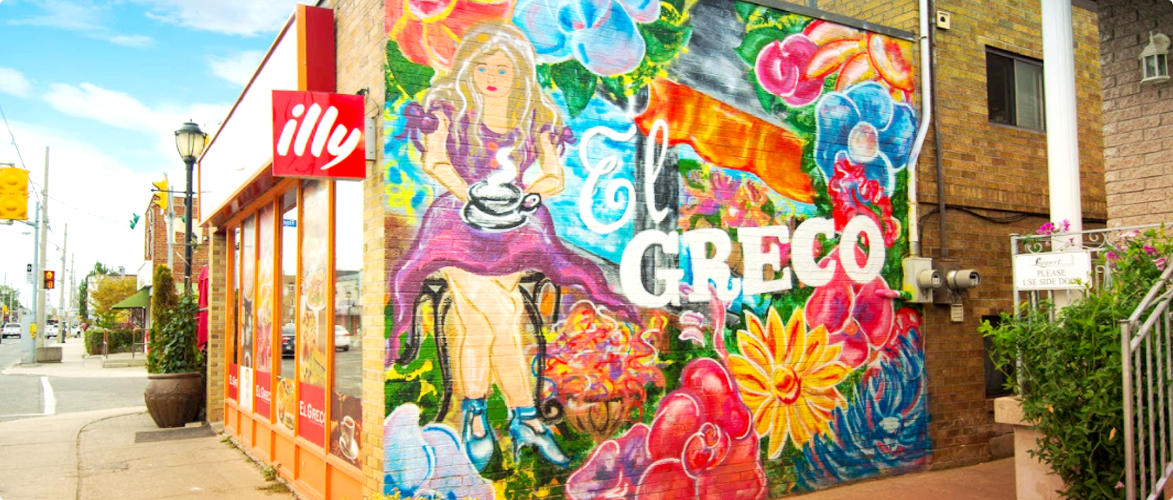
Pape Village is a compact stretch of East York residential streets immediately south of the Danforth, with Pape subway station at the northern edge and Withrow Park a short walk to the east.
Pape Village is a small, defined residential area in East York that sits directly south of the Danforth, centred on Pape Avenue and the quiet streets that run off it between Danforth Avenue and Cosburn/Mortimer to the south. It’s not a large neighbourhood by Toronto standards, maybe a dozen streets deep, but it has a clear identity: brick semis and detached homes built in the 1920s and 1940s on narrow lots, a tight grid layout, and Pape subway station sitting at its northern edge on the Bloor-Danforth line. The combination of that transit access and the relative affordability compared to Riverdale immediately to the west is what puts this neighbourhood on the list for a specific kind of buyer.
The character is residential without being remote. You can walk to the Danforth in three minutes from almost anywhere in the neighbourhood, which means access to the Greek restaurants on Pape and Danforth, the grocery stores, the coffee shops, and the commuter infrastructure of the subway. But the streets south of the Danforth are quiet in a way the Danforth itself isn’t: no through-traffic volume, no commercial activity, just rows of brick houses with small front gardens and narrow driveways where they exist. It’s a functional combination that doesn’t require trade-offs between access and quiet the way many Toronto neighbourhoods do.
The neighbourhood has been going through slow but consistent renovation activity over the past decade as older owners sell and buyers who intend to stay invest in upgrades. You’ll find streets where original 1930s semis sit next to fully renovated versions of the same building type, the contrast making both ends of the market visible at once. That renovation cycle is not complete, which means there’s still supply at the lower end of the price range for buyers who’re comfortable taking on a project, alongside finished homes for buyers who aren’t.
The dominant housing type in Pape Village is the brick semi-detached home, typically from the 1920s through the 1940s, on a lot that’s 16 to 25 feet wide and 90 to 120 feet deep. These are narrow buildings by modern standards, usually two storeys, with a layout that puts the kitchen at the rear of the main floor and two or three bedrooms upstairs. The square footage above grade is typically 900 to 1,300 square feet, which doesn’t sound like much but often functions better than the numbers suggest because the layouts are efficient and the ceiling heights on older homes tend to be higher than in newer construction. Basements are common and most have been finished to some degree, adding usable if not technically counted square footage.
Detached homes exist in Pape Village but they’re less common than semis, and they tend to be on the slightly wider streets or on corner lots. A detached home here is typically 20 to 30 feet wide, which is still narrower than a detached in O’Connor-Parkview or Clairlea, but the freehold structure is worth a meaningful premium over the adjacent semi. Detached supply is thin, and when a well-maintained detached comes to market in Pape Village, it typically attracts more attention than comparable semis because buyers in this price range are often trying to exit the semi category entirely.
In 2026, semis in average condition sell between $800,000 and $950,000. Renovated semis with updated kitchens, bathrooms, and finished basements push to $1,000,000 and occasionally above it. Detached homes sit in the $1,000,000 to $1.4 million range, with the upper end reserved for fully updated homes on wider lots or with garden suite potential in the rear. There are no condos in this neighbourhood and essentially no purpose-built rental buildings; it’s almost entirely freehold residential on individual lots.
Pape Village punches above its neighbourhood profile in terms of market competitiveness. The Pape subway access draws buyers from a broader search radius than the neighbourhood’s size might suggest, and that consistent demand against a limited supply of freehold homes means the market here is generally tighter than in areas further east or south. Semis in good condition, priced accurately in the $850,000 to $950,000 range, regularly attract two to four offers in a normal spring market. Detached homes, particularly anything under $1.2 million, attract serious competition when they come to market because the supply is genuinely thin.
Holdback strategies, where offers are reviewed on a set date after a week or two of showing, are commonly used by listing agents here, and they work when the home is priced correctly. The risk for sellers who set the list price too aggressively is that the offer date arrives without the anticipated crowd, which is a difficult position to recover from in a neighbourhood where second-look buyers are watching carefully for signs of trouble. Buyers working in Pape Village should expect to be pre-approved, ready to move quickly on inspection, and prepared for a multiple-offer environment on anything that’s been properly prepared and priced.
Conditional offers are less common in Pape Village than in slower east-end markets, particularly for semis in the $800,000 to $950,000 range where competition is real. Buyers who need conditions typically do best on homes that have been sitting for more than three weeks without a price reduction, where the seller may be more open to conditions in exchange for a clean deal. On new listings in the first two weeks, clean offers tend to win. The review period for incoming buyers should include a pre-inspection or at least a review of disclosure documents and any available previous inspection reports before the offer date.
Pape Village draws a specific buyer: someone who wants freehold residential south of the Danforth with genuine subway access and has concluded that paying Riverdale prices isn’t justified for their situation. That buyer is sometimes a couple buying their first house after outgrowing a condo, sometimes a family with young children who want a neighbourhood school and a park, and sometimes a single buyer who wants the house rather than the condo but doesn’t need a large lot or a detached building. The common thread is that transit access matters to them, and they’ve done the comparison between Pape Village and the streets immediately west and decided the price difference is worth more than the Riverdale postal code.
Buyers from the Greektown stretch of the Danforth sometimes look at Pape Village specifically because of the food and community infrastructure immediately north. The stretch of Danforth between Pape and Woodbine has grocery stores, restaurants including some of the most established Greek spots in the city, and the kind of neighbourhood commercial density that makes daily errands easy on foot. For buyers who grew up in the east end or have connections to the established Greek-Canadian community in this part of Toronto, the location has a specificity that doesn’t show up on maps but matters in the decision.
Investors are present in Pape Village but they’re competing against owner-occupiers who’re willing to pay more to live in the home, which keeps the investment calculus honest. Basement suite potential on semis is real in many cases, particularly where a separate entrance exists or can be created at the side of the building, and that rental income makes the carrying costs more manageable for buyers who are stretching to get into the market. The renovation investor profile is also present; the neighbourhood has enough original-condition homes to support buyers who want to buy and improve, though the margins require discipline because the ceiling on renovated semis is well-established at around $1.05 to $1.1 million.
Pape Village homes date largely from the 1920s through the 1940s, which puts them among the older residential stock in East York, and the inspection issues that come with that age are predictable enough that buyers should build them into their budget before they ever see a specific home. Knob-and-tube wiring is present in a significant number of semis that haven’t been fully rewired; some have been partially updated with modern wiring in the main living areas but still have original wiring in the attic or behind walls. Insurance companies will ask about this, and some won’t underwrite a home with active knob-and-tube without a full rewire, so get clarity on the electrical status before you firm up.
Clay and cast iron sewer laterals are the other consistent issue. The lateral is the pipe that runs from the house to the city main, typically under the front yard, and on homes this age it’s often original clay tile or early cast iron that has cracked, shifted at joints, or been infiltrated by tree roots. Scoping the sewer with a camera is a straightforward $300 to $400 inspection that tells you the condition of the pipe before you commit. A lateral replacement runs $8,000 to $15,000 depending on depth and access. On semi-detached homes, the shared wall condition at the party wall is worth examining, particularly the roof junction where the two units meet, as this is a common point of water entry that neither owner tends to maintain proactively.
Lot depth and rear yard access should be confirmed if you’re planning to add a garden suite; the City of Toronto’s garden suite permissions require minimum rear yard dimensions that not every Pape Village lot can meet given their narrowness. A quick review of the property’s zoning and lot dimensions on the city’s online mapping tool before you make an offer takes ten minutes and prevents a much longer disappointment after. Also confirm whether any existing basement suite was finished with permits; unpermitted suites that don’t meet current egress requirements may need remediation before they can be legally rented.
Sellers in Pape Village are in a reasonably strong position by east Toronto standards because the subway access draws buyers from a wider search area and the freehold supply south of the Danforth is genuinely limited. The challenge is that buyers in this price range, $800,000 to $1.1 million for a semi, are doing real comparison shopping against Leslieville and East Danforth streets to the south, and against the lower Riverdale streets to the west. If your home is priced at $950,000 and needs a new kitchen, new roof, and electrical work, the buyer will price that work in and offer accordingly. Sellers who understand their buyer’s math, and price to account for the home’s condition rather than pretending it doesn’t matter, consistently do better than sellers who insist on a price the market won’t support.
Pre-sale preparation matters in this neighbourhood because the buyer pool is comparing renovated against unrenova ted continuously. The return on a kitchen update, not a full renovation but new cabinet faces, countertops, and appliances, tends to be positive in Pape Village because it removes the largest single objection buyers have to an otherwise-good semi. Exterior paint, cleaned-up front landscaping, and a fresh basement floor make a home show differently even if the underlying structure is unchanged. These are not expensive improvements relative to the purchase price, and they shift a home from the $850,000 bracket to the $925,000 bracket more reliably here than in slower markets.
Timing the listing for late February through late April gives Pape Village sellers access to the strongest buyer demand of the year. The spring market in this neighbourhood is real: buyers who’ve been watching since January get active in February, and the first genuinely good homes to list in March tend to generate the kind of competition that produces the best prices. Fall, September through early November, is a credible secondary window. Summer listings are possible but the buyer pool thins and homes that need work sit longer when buyers are distracted by other things.
Withrow Park sits a few blocks west of Pape Village’s centre, accessible via streets like Browning or Wolfrey, and it’s one of the more useful neighbourhood parks in East York in terms of programming and infrastructure. The park has a wading pool that runs through the summer, a supervised outdoor skating rink in winter that’s one of the better-maintained rinks in the east end, a large open field that hosts informal sports and events, and a well-used dog park. Families with young children reference Withrow specifically when they talk about why they chose this part of the east end, and it’s worth the short walk from Pape Village’s eastern streets even if it’s not immediately adjacent.
The Danforth strip immediately north of the neighbourhood is part of daily life in Pape Village in a way that commercial streets don’t function for most Toronto residential areas. The stretch of Danforth between Pape and Woodbine has a No Frills on Pape for weekly grocery shopping, a Metro a short walk east, multiple butchers and specialty food shops concentrated in the Greek commercial area, and enough coffee shops and restaurants that residents routinely walk there for weekday lunches and weekend dinners. The Carrot Common on Danforth, with a health food store and various independent businesses, is within easy reach. This is not generic commercial infrastructure; it’s a specific, walkable, functional strip that reduces the number of trips residents need to make by car.
The neighbourhood’s own streets are quiet, with no through-traffic and very little commercial activity south of the Danforth, which means the combination of access and quiet is unusually well-balanced. You’re not trading noise for convenience here the way you would be if you lived on the Danforth itself or on a major arterial like Coxwell or Woodbine. The residential streets of Pape Village function as a buffer behind the commercial activity of the Danforth, and for the right buyer, that arrangement is close to ideal.
Pape station is the defining transit asset of this neighbourhood. It sits at the corner of Pape Avenue and Danforth Avenue, which is literally the northern boundary of Pape Village, and from most streets in the neighbourhood you can walk there in five to twelve minutes. The station is on the Bloor-Danforth subway line, putting you 20 minutes from Bloor-Yonge, 15 minutes from Broadview, and 12 minutes from Woodbine to the east. Commuters heading downtown are at Union in roughly 35 to 40 minutes door-to-door from most Pape Village addresses, which is among the shorter transit commutes available in Toronto’s east end at this price point. That number matters: it’s comparable to commutes from neighbourhoods that cost significantly more.
The 72 Pape bus runs north-south on Pape Avenue and connects the neighbourhood to the subway if you’re coming from the southern edge near Cosburn or Mortimer. Eastbound and westbound buses on Danforth provide cross-town access for destinations not on the subway line. The overall transit picture here is better than most of the east end, with the possible exception of streets immediately adjacent to Broadview or Pape stations in Riverdale, which have comparable or slightly shorter walks but substantially higher home prices.
Driving from Pape Village is straightforward. Pape Avenue connects directly to Danforth and, heading south, to Gerrard Street and the broader east-end grid. The DVP is accessible via the Bloor Street Viaduct or via O’Connor Drive further east, putting highway access within 10 minutes of most addresses. Street parking on residential streets is generally available; most homes have narrow driveways that can take one car, and street parking is unrestricted overnight on most residential streets. Cycling on Pape Avenue itself is possible but the lane infrastructure is limited; the quieter residential streets in the neighbourhood provide a more comfortable alternative for cyclists heading east or west.
The most direct comparison for Pape Village is Riverdale, specifically the streets south of Danforth between Broadview and Pape. Those streets have the same building types, similar lot sizes, and access to the same Bloor-Danforth subway line. The difference is price: comparable semis in Riverdale trade $150,000 to $250,000 higher than Pape Village equivalents, and detached homes carry a similar premium. The premium is real and partly justified by Riverdale’s proximity to Broadview station and its more established renovation cycle, but for a buyer who’s clear-eyed about what they’re buying, the Pape Village discount for essentially the same subway access is significant. Pape station and Broadview station are one stop apart; the commute difference is about two minutes.
Compared to East Danforth and the streets south of it toward Gerrard, Pape Village has better transit (Pape station vs. a longer bus ride for most East Danforth residential streets) and comparable or slightly higher prices. East Danforth buyers get more house in some cases, particularly on wider lots further east, but give up the walkable subway access that Pape Village offers. For buyers who don’t need the subway, East Danforth streets between Pape and Coxwell can offer better value; for buyers who do need the subway, Pape Village is usually the better choice at a given budget.
Against O’Connor-Parkview to the east, Pape Village has the transit advantage: Pape station is immediately accessible, while O’Connor-Parkview buyers are on buses to Victoria Park or Woodbine. O’Connor-Parkview compensates with wider lots, more detached supply, and slightly lower average prices. The neighbourhoods attract different buyers. Someone who works downtown and commutes daily five days a week will generally find Pape Village more practical. Someone who works remotely or drives will find O’Connor-Parkview’s larger lots and quieter streets more compelling for the same money or less.
Pape Village has a character that reflects its location: close enough to the Danforth’s established Greek-Canadian community that some of that demographic extends into the residential streets, and close enough to Leslieville and the broader gentrification wave moving east that newer buyers are visible on every block. Long-term owners who bought in the 1980s and 1990s are still present, particularly on the streets closer to Cosburn, and they give the neighbourhood a stability that’s different from areas that turned over entirely in a single decade. The result is a mix that feels genuinely varied rather than uniformly new or uniformly established.
Families with children are a consistent part of the neighbourhood’s profile, drawn by Withrow Park, Roden Public School, and the relative quiet of the residential streets combined with the Danforth’s commercial convenience. Roden Public School on Boultbee Avenue serves the neighbourhood at the elementary level. East York Collegiate Institute handles secondary students. Neither school is among the TDSB’s highest-profile academic programs, but both have functional extracurricular programs and serve the neighbourhood’s families without requiring cross-city commutes for secondary school, which matters to parents who want their children to have a local secondary experience.
The daily rhythm of Pape Village runs through the Danforth. Morning coffee before the subway commute, groceries at the No Frills or the Metro, dinner at one of the Greek restaurants on the strip, walks to Withrow Park on weekends. It’s a neighbourhood that functions well without a car for daily tasks, which is a genuine quality of life advantage for households that prefer not to drive. The east end’s community of small food businesses, independent shops, and long-established institutions gives the area a texture that newer suburban developments in the 905 lack regardless of how much was spent on the house itself.
What do homes sell for in Pape Village in 2026?
Semi-detached homes in Pape Village sell in the $800,000 to $1.1 million range in 2026, with condition and lot width being the primary variables. Renovated semis with updated kitchens and finished basements on the wider streets, particularly those on Browning or Wolfrey, tend to sit at the upper end. Homes in original condition with deferred maintenance sell at a discount that reflects the work ahead. Detached homes, which are less common and tend to attract more competition when they come to market, trade between $1,000,000 and $1.4 million depending on size, updates, and whether the lot has any garden suite potential. There are no condos or purpose-built rentals in this neighbourhood; essentially everything trading is freehold.
How far is Pape Village from Pape subway station?
Pape subway station sits at the corner of Pape Avenue and Danforth Avenue, which is the northern boundary of the neighbourhood. From most streets in Pape Village, the walk to the station is between five and twelve minutes. Streets that run directly off Pape Avenue, like Browning, Wolfrey, and Morse, are the closest. Streets further south, approaching Cosburn and Mortimer, add a few minutes or a short ride on the 72 Pape bus. Either way, the subway access from Pape Village is among the best of any residential neighbourhood in East York, and it’s one of the primary reasons buyers choose this area over comparable streets further east where transit means a longer bus ride before the subway.
What are the main inspection concerns in Pape Village homes?
Pape Village homes are largely from the 1920s through the 1940s, making them among the older residential stock in East York. Inspectors consistently flag knob-and-tube wiring in older semis that haven’t been fully rewired, clay or cast iron sewer laterals that are at or past their service life, and flat roofs on rear additions that need replacement. On semi-detached homes specifically, the shared roof junction at the party wall is worth examining closely, as it’s a common point of water entry that neither owner tends to maintain proactively. Budget for these items rather than being surprised by them after you’ve firmed up; none of them are dealbreakers, but each has a real cost that should be in your numbers before you commit.
Is Pape Village good for families with children?
Pape Village works well for families with children, primarily because of Withrow Park a few blocks to the west, which has a wading pool, a supervised outdoor skating rink in winter, a dog park, and a large open field that handles informal sports and community events year-round. Roden Public School is the main TDSB elementary school serving the neighbourhood, and East York Collegiate Institute handles secondary students. The streets themselves are quiet enough that children can move around independently once they’re old enough, and the Danforth immediately north provides a walkable commercial strip with groceries, a library branch, and the other daily services that make family life easier without requiring a car for every errand.
Pape Village was built largely between the early 1920s and the mid-1940s, making it a product of two distinct phases of East York’s residential expansion. The earlier streets, those closest to the Danforth, were developed as Toronto’s streetcar network extended east and workers sought affordable housing within commuting distance of downtown. The homes from this period are typically narrower, with lot widths of 16 to 20 feet, and their layouts reflect the expectations of that era: small rooms, formal separation between kitchen and living areas, modest bathrooms. They were not built for the way people live now, but the bones are solid and the brick has lasted a century without significant structural compromise on most examples.
The Danforth commercial strip, which predates most of the residential development to its south, was established as a streetcar route and grew in importance as the subway arrived in 1966 with the opening of the Bloor-Danforth line. Pape station at Danforth was part of that original opening, and its presence immediately changed the value proposition of the residential streets to the south. Properties near Pape station have carried a transit premium relative to the surrounding area ever since, and that premium has grown as transit-oriented purchasing became more explicitly part of how buyers in Toronto think about location.
East York’s independent municipal history, it was its own city until the 1998 amalgamation, is less visible in Pape Village than in some other parts of the former municipality, but it shaped the planning decisions that kept these streets residential rather than allowing the kind of mixed-use intensification that happened on some arterial streets in old Toronto. The result is a neighbourhood that has maintained its residential character for close to a century while the city around it changed significantly. That stability isn’t an accident; it reflects both the zoning decisions made during East York’s independent years and the physical constraints of a tight grid with few large lots that would attract major redevelopment attention.
Street-level knowledge is hard to find online. Our team works in Pape Village every day. They know which pockets hold value, where the school catchment lines actually fall, and what the market is doing right now. Talk to us before you make a decision about Pape Village.
Talk to a local agent