
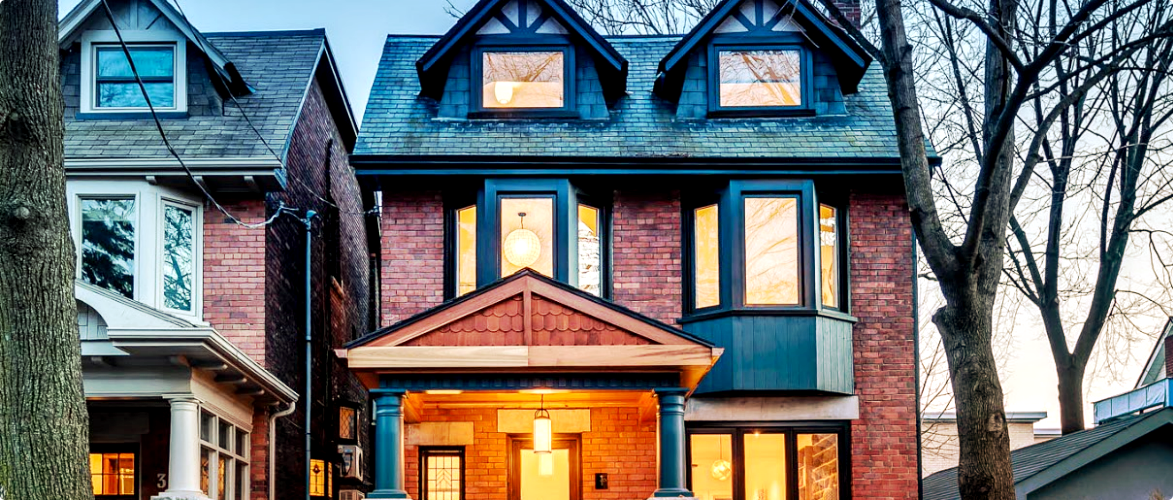
Playter Estates is a small, tightly bounded neighbourhood in east Toronto: north of Danforth Avenue between Broadview and Chester avenues, extending up toward the cemetery. Its Victorian and Edwardian brick semis and detached homes from the 1890s to 1920s are among the best-maintained in the east end, and streets like Playter Boulevard and Jackman Avenue are among the most consistently sought-after in this part of the city. Semis trade from $1.3 million to $1.8 million; detached homes from $1.7 million, with well-renovated properties reaching $2.5 million and beyond. Broadview subway station is a five-minute walk from most of the neighbourhood.
Playter Estates is one of those Toronto neighbourhoods that doesn’t show up in general east-end searches as often as it should. Bounded roughly by Danforth to the south, Broadview to the west, Chester to the east, and the Necropolis and Mount Pleasant Cemetery to the north, it’s a small residential pocket with a defined character that experienced east-end buyers have known about for years. The streets are quiet and tree-lined. The housing stock is consistent in era and quality. Broadview subway station is a five-minute walk from most of the neighbourhood.
The homes on Playter Boulevard and Jackman Avenue are the ones that anchor the neighbourhood’s reputation. These are Victorian and Edwardian brick semis and detached houses from the 1890s through to the 1920s: tall, narrow, well-proportioned, built when brick was the standard material and before the economies of scale that produced the more uniform post-war suburbs. Many have been renovated with care. The quality of renovation in Playter Estates is higher than average for the east end, which reflects the buyer profile: these are people who bought with the intention of staying and invested accordingly.
The neighbourhood is often grouped with Riverdale in casual description and in some real estate listings, but residents maintain a clear distinction. Riverdale runs further south and west; it’s busier and more varied in housing stock. Playter Estates is north of the Danforth, quieter, more consistent, and carries its own pricing. Buyers doing a proper east-end search will eventually isolate these streets and understand why they command a premium over comparable addresses further east along the Danforth.
The majority of purchases in Playter Estates involve Victorian or Edwardian brick semis: two and a half to three storeys, three bedrooms, narrow frontages typically running 14 to 20 feet, with small rear gardens and occasional lane access. These homes were built between roughly 1895 and 1925 and they show the construction approach of that period: solid brick, plaster walls, original hardwood where it survives, tall ceilings. A well-maintained semi with a renovated kitchen and bathrooms but the original character preserved trades from $1.3 million to $1.8 million, with the range depending primarily on renovation quality, lot depth, and the specific street.
Detached homes are present but less common. They run from $1.7 million at the lower end to $2.5 million and above for fully renovated four-bedroom properties on the best streets. Playter Boulevard and Jackman Avenue are the addresses that produce the strongest detached prices. Properties on these streets with well-executed renovations and good lot depth have sold above $2.5 million and generated competitive interest even in quieter market conditions.
There’s no meaningful condo supply within the neighbourhood itself; the condo options for this area sit along the Danforth strip and on the commercial streets closer to Broadview station. Buyers looking for condo entry into the east-end Broadview market will find more selection in Riverdale proper. Playter Estates is primarily a freehold neighbourhood, and the buyers attracted to it are generally looking for exactly that.
Playter Estates is a sought-after address in the east end with a correspondingly small inventory. There are only so many streets, and the housing stock is fixed in number. When a property in the core of the neighbourhood is priced correctly, it attracts buyers who have been watching the area for months and know the value of what’s on offer. Well-presented semis on Jackman and Playter Boulevard regularly generate multiple offers in spring and early fall, sometimes with competitive pricing above list.
In early 2026, the freehold market in the east end is more stable than condos, which are seeing extended days on market across the city. Playter Estates freehold properties in good condition with honest pricing are moving. Properties priced ambitiously by sellers who remember the 2021 and 2022 peaks are sitting, and the market is distinguishing clearly between the two categories. Buyers who arrive prepared, with financing confirmed and a clear sense of what the comparable sales support, are in a good position on properties that aren’t generating immediate competition.
The best buying conditions in Playter Estates have historically been in the late fall and winter, when the pool of active buyers thins but motivated sellers remain in the market. A well-priced property that appears in November may attract one or two serious buyers rather than six or eight, which changes the dynamic. Buyers who can move through the inspection and offer process quickly during that window often close at terms they wouldn’t have achieved in spring.
The buyers who land in Playter Estates have almost always compared it explicitly to Riverdale and Leslieville. The decision against Leslieville is usually about transit: Leslieville is served primarily by streetcar along Queen East, which is slower and less predictable than the Broadview subway connection. Buyers who need reliable downtown commuting and are choosing between the two east-end neighbourhoods consistently give Playter Estates the edge on that variable, even though Leslieville typically offers better value per square foot.
The decision over Riverdale proper is more nuanced. Riverdale has the Broadview Hotel on Danforth, a more active restaurant strip, and housing on the south side of the neighbourhood that sits closer to the ravine trails. Playter Estates is quieter, its streets are more consistent in quality, and Jackman Avenue school gives it a family credential that matters to buyers with children. Families that have done the school research and decided Jackman is the right place for their kids often make the neighbourhood choice around that decision.
The buyer profile that shows up most consistently is the east-end family that has done a thorough comparison of the market, knows what they’re paying a premium for, and has decided the combination of transit, school, housing quality, and street character justifies the price over alternatives. These are not impulsive buyers. They’ve typically been looking for six months to a year, they know the streets well, and when a property that matches their requirements comes up they’re prepared to move on it.
Victorian and Edwardian homes in this age bracket carry predictable issues that a good inspection will surface. Knob-and-tube wiring is present in some of the older unrenovated properties; as with any home containing active knob-and-tube, insurance becomes difficult and the remediation cost needs to be factored into the offer. Lead service connections for water were standard until the mid-20th century, and some properties on streets that haven’t had full municipal upgrades may still have a lead service pipe between the water main and the house. A plumber can confirm this before closing, and the cost of replacement varies by the length and access involved.
The foundations on this vintage of construction are typically poured concrete or stone, and lateral water entry during heavy rain is a known issue on some streets. Look carefully at the basement during an inspection: efflorescence on the walls (a white chalky deposit) is evidence of past water entry. Damp or poured concrete that has been painted over recently is worth noting. A foundation that has been waterproofed properly from the exterior is a positive; a basement that’s been cosmetically addressed without underlying work is a liability.
The lane access at the rear of properties is variable. Some lots have parking pads or garages accessed from the lane; others don’t. Parking is not universally available on Playter Estates properties, and buyers who need it should confirm the arrangement on the specific address rather than assuming it from the neighbourhood. The absence of parking is reflected in list prices on some properties, but buyers who need parking and pay Playter Estates prices for a property without it will find themselves in a difficult resale position down the line.
Buyers in this market are thorough. They’ve toured Riverdale, Leslieville, and probably Greenwood-Coxwell before narrowing to Playter Estates. They understand the housing stock and they’re evaluating the condition of your specific home against others they’ve seen. A semi that’s been cared for but not recently renovated can still sell well here if it’s priced to reflect the renovation cost honestly. A semi that’s been cosmetically staged over deferred maintenance will attract conditional offers that don’t survive inspection, which is the worst outcome for a seller.
The homes that achieve the strongest prices in Playter Estates are typically the ones where renovation has preserved the original character rather than replaced it. The buyers drawn to these streets are drawn to the Victorian brick, the tall ceilings, the original hardwood where it survives. They’re not looking for a house that could be in Leaside. A kitchen that works with the proportions of the house, good natural light from the rear, and evidence that the systems have been maintained or updated will outperform a kitchen with high-end finishes on top of neglected plumbing.
The spring market is the strongest window, and listings that appear in March and April with proper preparation consistently outperform equivalent properties listed in late summer or fall. Preparation here means not just staging and photography, but having a pre-listing inspection available to buyers so that conditional offers are less necessary. In a market where buyers are prepared to move quickly on the right property, removing the inspection condition as a barrier requires giving buyers the information they need in advance.
The Danforth is the southern commercial edge of the neighbourhood and one of the most diverse restaurant streets in the city. The stretch from Broadview east through Greektown has been known for decades for its concentration of Greek restaurants, and while the strip has diversified and some of the older institutions have closed, the food culture remains strong. The neighbourhood’s immediate access to this strip is a genuine practical advantage: good restaurants and cafes within a 10-minute walk, a farmers’ market at Withrow Park on Saturdays in season, and the day-to-day errands that most residential streets require.
The Broadview Hotel on the Danforth, renovated and reopened in 2017, has become a neighbourhood anchor point with a rooftop bar, a ground-floor cafe, and programming that draws people from across the east end. Its presence has raised the profile of the immediate Broadview and Danforth intersection significantly, and properties within easy walking distance have benefited from the increased activity on the commercial strip.
The ravine trails are accessible from the northern and eastern edges of the neighbourhood. The Don Valley ravine system connects from near the cemetery south through the valley and eventually to the waterfront. It’s a proper natural trail system: uneven ground, tree cover, sections that feel removed from the city even though the subway is minutes away. Residents who use the ravine regularly cite it as one of the features they wouldn’t give up. It’s a resource that doesn’t appear on a floor plan but shapes how people live in the neighbourhood.
Broadview station is the primary transit connection, and its convenience is one of the most consistent reasons buyers give for choosing Playter Estates over east-end alternatives. Most streets in the neighbourhood are within a five to eight-minute walk. From Broadview on the Bloor-Danforth line, it’s three stops west to Yonge-Bloor, and from there the Yonge line carries you to Union Station in around 10 minutes. Total commute time from most Playter Estates streets to Union Station by transit is 20 to 25 minutes under normal conditions, which is competitive with mid-city neighbourhoods on the same line.
Chester station is accessible from the eastern and northern parts of the neighbourhood and gives some streets a second option, reducing the walk to under five minutes. Pape station, one stop east of Broadview, is walkable from the eastern edge and useful for those who need the Pape bus connections heading north. The 504 King streetcar is accessible from the south for those working at King and Bay who prefer a direct streetcar connection to the subway transfer.
Cycling is a genuine option. The Danforth has painted bike lanes that connect east toward Woodbine and west toward the Bloor viaduct. A cyclist on a reasonable bike can reach King and Bay in 20 to 25 minutes from Playter Boulevard on a clear morning. The ravine trail system also connects south toward the waterfront for those who prefer an off-road commute. Broadview Avenue itself is a busy arterial but has a separated lane on portions of its length that makes the connection to downtown more manageable than it was a decade ago.
Riverdale is the closest comparison and the one most buyers work through first. The two neighbourhoods share the Broadview transit connection, a similar era of housing stock, and a position north of the Danforth. What they don’t share is price or feel. Riverdale is larger, more varied, and contains a wider range of housing types and conditions. Playter Estates is smaller, more consistent, and carries a premium that reflects the concentration of well-maintained housing on its core streets. A buyer who finds a semi on Playter Boulevard and a semi on a comparable Riverdale street will typically find the Playter Estates property $100,000 to $200,000 higher for an equivalent level of renovation, reflecting the school catchment and the street character.
Leslieville is the comparison that tends to come from buyers who have decided transit is negotiable. Leslieville is a well-established east-end neighbourhood with good restaurants, strong community identity, and housing prices that have risen significantly over the past decade. But it’s served primarily by the 501 Queen streetcar, which is slower and less reliable than the Broadview subway connection. Buyers who commute downtown by transit and have priced both options often find the travel time difference significant enough to justify Playter Estates’ higher price.
Greenwood-Coxwell and the Pape corridor sit further east and offer older Victorian housing stock at a discount to Playter Estates. The transit access from those streets is to Pape or Donlands stations, which are further east on the Bloor-Danforth line and extend the downtown commute by one or two stops. The value is better; the address recognition and school options are different. Buyers who have exhausted the Playter Estates inventory or find it priced beyond reach often move east to these neighbourhoods and find similar housing at a 15 to 25 percent discount.
Jackman Avenue Junior and Senior Public School is the neighbourhood school and is one of the most frequently cited reasons families choose Playter Estates over comparable east-end addresses. It runs from JK through Grade 8 and sits on Jackman Avenue itself, which means children from most streets in the neighbourhood walk to school. The school has a strong local reputation, reflected both in parent feedback and in EQAO results that have historically tracked above the city average for the east end. The community feel of the school is shaped partly by its size and partly by the concentration of neighbourhood families in its catchment.
For secondary school, the public catchment routes to Riverdale Collegiate Institute, which is one of the TDSB’s better-regarded east-end secondary schools. It has a range of programs and a student body that reflects the diversity of the surrounding neighbourhoods. Families who have a specific program in mind, including arts or technology pathways, should investigate whether Riverdale Collegiate or one of the TDSB’s alternative secondary schools better fits that interest, as some programs require separate applications regardless of catchment.
Withrow Avenue Public School sits on the southern edge of the neighbourhood and serves some of the streets closer to the Danforth. Families buying in the southern portion of Playter Estates should confirm which school their specific address falls into rather than assuming it will be Jackman. The TDSB’s school locator tool gives a definitive answer by address. Catchment boundaries in this part of the east end have been stable for several years but can shift, and confirming with the board directly before making a decision based on school access is the right approach.
Is Playter Estates part of Riverdale? Playter Estates is adjacent to Riverdale but has its own distinct identity, and residents are consistent about the distinction. The two neighbourhoods share similar housing stock and the same Broadview subway access, but Playter Estates sits north of Danforth between Broadview and Chester avenues and has its own street character, school catchment, and community feel. Listings in the area sometimes use “Riverdale” loosely to capture search interest, but buyers researching the specific streets will find the boundary is real. Playter Estates is generally quieter than Riverdale proper, and its prices reflect the consistency of its housing stock and the catchment at Jackman Avenue school rather than any adjacency to Riverdale’s identity.
How far is Playter Estates from the subway? Broadview station on the Bloor-Danforth line is the primary connection, and most streets in the neighbourhood are within a five to ten-minute walk. Chester station is also accessible from the northern and eastern parts of the neighbourhood, giving some residents two walking options. From Broadview, it’s three stops to Yonge-Bloor, and the total commute to Union Station by transit runs 20 to 25 minutes from most of the neighbourhood. For a Toronto east-end address, this is genuinely good transit access and is one of the consistent reasons buyers choose Playter Estates over Leslieville, which depends primarily on the Queen streetcar.
What is Jackman Avenue Public School like? Jackman Avenue Junior and Senior Public School has a strong local reputation and is frequently cited by families as one of the primary reasons they chose Playter Estates. It runs from JK through Grade 8, sits on Jackman Avenue within the neighbourhood, and draws from a catchment concentrated enough that most children walk. EQAO results have historically tracked above the city average for east-end schools. The school has a tight community feel driven by its size and the concentration of neighbourhood families in its intake. Families should check current results directly through the EQAO website and confirm catchment for their specific address through the TDSB locator before relying on school access in a purchase decision.
How does Playter Estates compare to Leslieville for buyers? The two neighbourhoods have similar housing eras and east-end community character, but different transit profiles and different price points. Leslieville is served primarily by the 501 Queen streetcar, which is slower and less reliable than the Broadview subway connection that Playter Estates offers. Buyers who commute downtown daily often find that transit gap significant enough to justify Playter Estates’ higher prices, which run roughly 15 to 25 percent above comparable Leslieville properties depending on the street and condition. Leslieville has a more active restaurant and bar culture on Queen East and Gerrard. Playter Estates has quieter streets, better transit, and the Jackman school catchment. The decision between them depends on which of those variables matters most to the specific buyer.
The neighbourhood takes its name from the Playter family, who owned much of the land in this part of east Toronto from the early 19th century. John Playter received a land grant in the late 18th century and the family farmed and held land in the Don Valley area for several generations. The street name Playter Boulevard and the neighbourhood name derive directly from this history. The residential development of the area began in earnest in the 1890s and continued through the Edwardian period, producing the housing stock that still defines the neighbourhood’s character today.
The construction period from roughly 1895 to 1925 was one of rapid east-end expansion. Toronto’s streetcar network had extended east along the Danforth, making land north of it accessible for commuting workers. The developers who built out these streets were targeting the skilled working class and lower middle class of early 20th-century Toronto: solid brick semis and modest detached homes designed to last, not to impress. The fact that they’re now selling for $1.5 million and above reflects a century of rising land values rather than any original expectation of premium status.
The neighbourhood’s reputation grew through the latter decades of the 20th century as the east end gentrified from the Danforth south and the streetcar corridors east. Playter Estates benefited from proximity to the Broadview transit node, the quality of its existing housing stock, and the concentration of families that established Jackman Avenue school’s community feel over multiple generations. By the time the broader real estate market caught up to east Toronto in the 2000s and 2010s, Playter Estates already had a stable identity and a buyer pool that understood what it was.
Street-level knowledge is hard to find online. Our team works in Playter Estates every day. They know which pockets hold value, where the school catchment lines actually fall, and what the market is doing right now. Talk to us before you make a decision about Playter Estates.
Talk to a local agent