
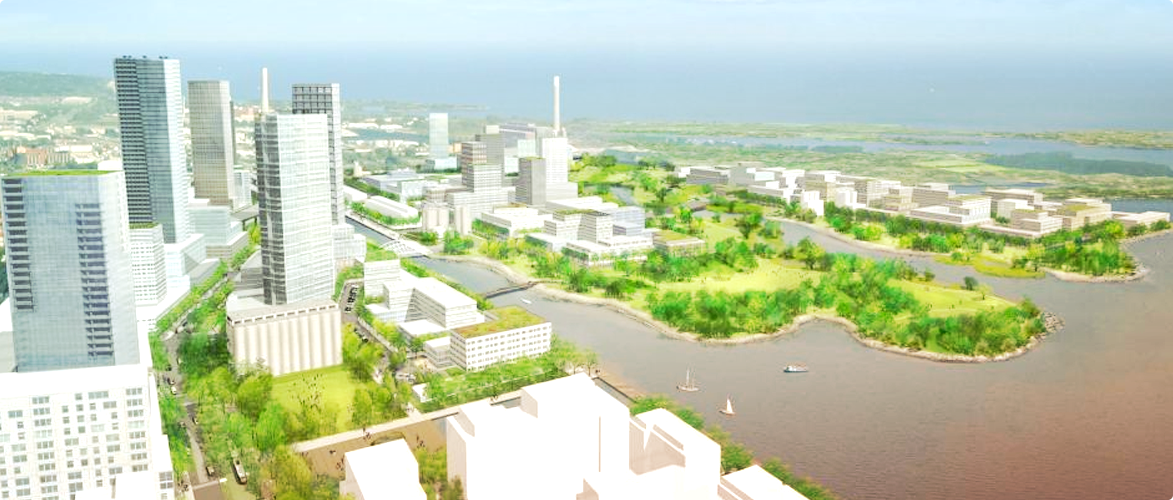
The Port Lands are the largest undeveloped piece of land on the Toronto waterfront, currently being transformed through the Port Lands Flood Protection project. The Don River is being re-routed through a new naturalized channel, new roads and parks are being built, and Villiers Island is emerging as a planned mixed-use neighbourhood. This is not a mature residential area — it is a city-building project in progress, and buyers today are positioning early.
The Port Lands sit on the eastern waterfront south of Eastern Avenue and east of the Don River mouth, and they are the most consequential piece of undeveloped urban land in Toronto. For much of the 20th century this was working industrial territory: grain terminals, fuel storage, film studios, and container handling. The industry has largely departed or contracted, leaving behind a flat, open landscape intersected by the old Keating Channel and the Parliament Street slip, with views of the lake to the south and the downtown skyline to the northwest. The scale of it is hard to grasp until you stand in the middle of it.
What is happening here in 2026 is the active physical transformation of that landscape into a new part of the city. The Port Lands Flood Protection project, a partnership between the City of Toronto, Infrastructure Ontario, and Waterfront Toronto, is re-routing the mouth of the Don River through a new naturalized channel, creating the island landmass that will become Villiers Island and protecting the surrounding land from the floodplain status that has blocked development for decades. That infrastructure work is visible and ongoing. New roads, new parks, new bridges, and a re-naturalized riverscape are all in progress or in detailed design.
The honest framing for anyone looking at the Port Lands as a real estate opportunity in 2026 is this: there is no established neighbourhood here yet. What exists is the credible, publicly committed infrastructure of a future neighbourhood, along with the earliest pre-construction residential projects on its western fringe. Buyers who understand that framing clearly can make a considered decision about whether the opportunity is right for them. Buyers who arrive expecting a neighbourhood in the conventional sense, with streets, cafes, transit, and a resale market, will be disappointed.
There is essentially no resale residential inventory in the Port Lands proper in 2026. The Cherry Street North and Cherry Street South condominium buildings, located at the intersection of Cherry Street and Lake Shore Boulevard East on the western boundary of the area, represent the nearest approximation of an established residential presence. These buildings were among the first purpose-built residential developments in what Waterfront Toronto designates the Lower Don Lands planning area. A limited number of resale units come to market in these buildings, priced broadly in the $700,000 to $1.1M range for one- and two-bedroom units depending on floor, view, and condition.
What most buyers interested in the Port Lands are actually doing is looking at pre-construction projects. Several condominium towers have been approved or are in planning and sales stages in the West Don Lands and along the Lower Don Lands eastern waterfront precinct. Pre-construction pricing in this area reflects both the speculative premium associated with buying into a planned neighbourhood and the cost realities of building in 2025 and 2026, which are materially higher than they were five years ago. Expect pre-construction pricing in the $900 to $1,200 per square foot range for approved projects, with occupancy dates ranging from the late 2020s into the early 2030s.
The Villiers Island residential community, which is the centrepiece of the Port Lands transformation plan, is not yet in pre-construction sales for residential units. The infrastructure work on the island itself is ongoing, and residential development applications are in progress, but buyers cannot yet commit to a Villiers Island unit. When those projects do come to sales, they’ll be among the most scrutinized pre-construction launches in Toronto’s recent history. The demand will be real. Whether the pricing will reflect a reasonable long-term return is a separate question that the market will sort out in real time.
Describing the Port Lands as a real estate market in the conventional sense overstates what exists in 2026. The Cherry Street buildings have a thin resale market. Pre-construction projects in the adjacent West Don Lands and Corktown area provide some pricing signal for what new construction commands in this part of the waterfront. But the Port Lands proper is a pre-market, shaped more by development applications, Waterfront Toronto planning decisions, and broader Toronto condo market conditions than by buyer-seller transactions in a functioning neighbourhood.
The Toronto pre-construction condo market had a difficult 2024 and 2025. Rising interest rates, escalating construction costs, and a wave of investors who had bought at peak 2021-2022 prices facing assignment losses reshaped the economics of new development across the city. Some developers postponed launches. Some projects with approvals did not proceed to sales. The Port Lands projects that did launch into this environment did so at higher per-square-foot prices than the market conditions of 2024 supported easily, and assignment resales in the area have reflected that tension. Buyers should review the specific project, the developer’s track record, and the current assignment market before drawing any conclusion about value from launch pricing.
The long-term directional case for the area is more straightforward than the short-term one. A re-naturalized river, new waterfront parks, Ontario Line transit, and tens of thousands of planned new residents represent real demand drivers. The question is timing. The gap between the vision and the liveable neighbourhood is still measured in years and billions of dollars of public and private capital. Anyone buying pre-construction here is essentially lending money to that vision, and they should price their risk accordingly.
The buyers most actively interested in Port Lands pre-construction in 2026 fall into a few recognizable categories. The first is the investor who has been active in Toronto pre-construction for a decade and sees in the Port Lands a structural similarity to other waterfront transformations they’ve read about: the Brooklyn waterfront, London’s Docklands, Toronto’s own Distillery District before it became what it is now. They’re buying the trajectory, not the current state. These buyers typically have diversified real estate holdings and are treating the Port Lands as a long-term position rather than a short-term flip.
The second group is first-time buyers or younger households who’ve been priced out of established neighbourhoods and are drawn to the Port Lands by a combination of relatively accessible pre-construction entry points (relative to, say, the Distillery or Leslieville resale market) and the appeal of being in at the beginning of something. These buyers deserve the most direct caution. Pre-construction carries risks that resale does not: developer insolvency, construction delays, closing costs that arrive years after the signing, and a resale market at occupancy that may not support what they paid. Entry-point pricing in a pre-construction project is not the same as affordable housing.
The third group is buyers specifically motivated by the design vision of Villiers Island. Waterfront Toronto’s planning documents for Villiers Island describe a net-zero community built around ecological principles, human-scale streets, and genuine mixed use. For buyers who care about those values in a specific way, the Port Lands represents a potential address that doesn’t yet exist anywhere else in Toronto. These buyers are often architects, planners, or design professionals who can read the planning documents with genuine comprehension. They’re making a considered long-term bet on a specific vision of urban life, and they know the timeline is uncertain.
Pre-construction purchases in the Port Lands area require a real estate lawyer who specializes in pre-construction transactions, not a generalist who handles resale closings. The purchase agreement for a new development is a developer-drafted document that runs to dozens of pages and is weighted in the developer’s favour in ways that are not obvious to buyers without counsel. The cooling-off period for pre-construction condos in Ontario is 10 days from the date you receive a copy of the executed agreement and the disclosure statement. Use that period. Have your lawyer review the agreement before the cooling-off period expires, not after.
Specific things to investigate before signing: the developer’s track record on previous projects, including whether previous buildings were delivered on time and within the promised specifications. Look at the TARION warranty history for the developer’s previous projects. In Ontario, TARION administers new home warranties, and their database is publicly searchable. Look at the deposit structure and confirm you have the liquidity to meet each deposit milestone. Pre-construction deposits typically run to 15-20% of the purchase price, paid in stages over the construction period, and that capital is illiquid until closing.
The occupancy fee structure in Ontario pre-construction deserves specific attention. When a building reaches occupancy, buyers may move in before the building is registered as a condominium. During that occupancy period, you pay an occupancy fee to the developer rather than mortgage payments. The occupancy fee is not credited to your purchase price and is often higher than buyers expect. The period between occupancy and final registration, when your mortgage finally closes, can run six months to over a year. Buyers who haven’t budgeted for this, or who have arranged mortgage approvals that expire before registration, face real financial stress at closing. Model this explicitly before you sign.
If you own a unit in the Cherry Street buildings or have a pre-construction assignment to sell, the Port Lands resale and assignment market in 2026 is thin and requires realistic expectations. The resale market in the Cherry Street buildings functions like a small building resale market anywhere in the waterfront: it’s driven by building-specific factors (view, floor, renovation quality, parking and locker inclusions) and broader waterfront condo market conditions. The neighbourhood amenity context is still limited compared to established areas like the Distillery or Leslieville, which affects relative pricing.
Assignment resales, where you’re selling your contract to purchase a pre-construction unit before it closes, have been challenging across Toronto’s condo market since 2023. The buyers for assignments are typically other investors or end-users who have missed the original launch, and they’re doing their own math on whether the assignment price, plus their own closing costs and carry costs, produces a reasonable outcome. In a market where pre-construction pricing has outpaced resale values in many buildings, assignment buyers have leverage they didn’t have in 2021. If you’re holding a Port Lands assignment and need to exit, have a frank conversation with an agent who specifically works in the assignment market, not a general residential agent, about realistic clearing prices.
For the small number of resale units that come to market in the Cherry Street buildings, the story you’re selling is access and trajectory. The Cherry Street location puts a buyer on the western edge of a transforming waterfront precinct with Ontario Line transit coming, Corktown to the north, and the Distillery District nearby. Present that story accurately: the amenity context is still developing, the neighbourhood is at an early stage, but the transit and waterfront infrastructure investment is real and documented. Buyers who understand what they’re buying at this stage will be easier to retain than those who were sold a vision that overstated the present reality.
The Port Lands Flood Protection project is the single most important infrastructure intervention in the area’s history and the event that makes residential development here viable for the first time. The Don River currently exits into the Keating Channel through an engineered mouth that leaves the surrounding land within the 100-year floodplain, which has legally blocked residential and sensitive use development on the Port Lands for decades. The project re-routes the river through a new naturalized channel that flows around what will become Villiers Island before entering the inner harbour through a new river mouth further west. This flood protection work removes approximately 240 hectares from the floodplain, unlocking development rights across a massive area.
The physical works are substantial and visible. New bridges over the Don, a naturalized river valley with wetlands and ecological habitat, and the earth works that will form the island itself are all in progress. Waterfront Toronto and Infrastructure Ontario are managing the project with a budget exceeding $1.25 billion. The parks that will frame the new river, Villiers Beach and the Don Greenway, are designed as substantial public amenities, not placeholder green space. When complete, the new river mouth will provide a continuous naturalized corridor connecting the Don Valley trail system to the waterfront and Lake Ontario.
This infrastructure transforms the development potential of the Port Lands but does not transform it instantly. The floodplain removal process involves regulatory steps with Conservation Ontario and the provincial government. Each parcel of newly de-risked land still needs planning approvals, servicing, and market conditions that support development. The sequence from completed flood protection works to occupied residential buildings runs through multiple regulatory and market stages, and the optimistic timeline for early Villiers Island residential occupancy puts first residents there in the early 2030s. The pessimistic timeline is later. Both are honest estimates given where the project stands in 2026.
Transit access to the Port Lands in 2026 is adequate for a neighbourhood with very few residents and improving for a neighbourhood with many. The 514 Cherry streetcar runs from Cherry Street south into the Port Lands area and connects north to King Street East, where the 504 King streetcar provides service east and west across the city. From King and Cherry, downtown is roughly 15-20 minutes by streetcar in moderate traffic. The connection to the subway requires a transfer to the Yonge or University lines at Queen or King stations. For the small number of residents currently living in the Cherry Street buildings, this transit is functional if not exceptional.
The Ontario Line changes this picture considerably when it opens. The planned alignment runs east-west along a roughly Eastern Avenue corridor, with a station at Corktown that will serve the northern edge of the Port Lands area, and potentially a stop closer to the waterfront precinct itself. The Ontario Line connects to the subway network at multiple points and will reduce travel time to downtown significantly. The Ontario Line’s first segments are expected to open in the late 2020s, though major infrastructure projects in Toronto have historically opened later than initial projections.
Cycling infrastructure in and around the Port Lands is more developed than you might expect. The Martin Goodman Trail runs along the waterfront to the south, providing a separated cycling route east to the Beaches and west to downtown. Cherry Street has cycling infrastructure connecting north to King and the broader network. For the adventurous cyclist, the ride from Cherry and Lake Shore to the downtown financial district takes roughly 20-25 minutes on a clear day via the waterfront trail and Queens Quay. The Port Lands themselves have been designed from the beginning with cycling integration as a priority, and the street grid being built now reflects that intention. Driving is straightforward, with Cherry Street connecting north to King Street East and east to Lake Shore Boulevard, which runs to the DVP and the 401.
The most natural comparison for buyers considering Port Lands pre-construction is the West Don Lands, directly north of the area on the other side of the Keating Channel and Lake Shore Boulevard East. The West Don Lands is further along in its development cycle. The Canary District, built for the 2015 Pan Am Games athletes’ village, is now a functioning mixed-use neighbourhood with residents, a YMCA, a food market, a park, and street-level retail. Pre-construction and resale pricing in the West Don Lands runs slightly ahead of the Port Lands equivalents because the neighbourhood amenity context is established rather than planned. If you want a waterfront-adjacent eastern neighbourhood with real infrastructure around it now, the West Don Lands is a more legible choice.
The Distillery District, immediately to the northwest of the Port Lands, represents what the Port Lands might eventually resemble in terms of density, heritage character, and destination retail, though the Distillery’s Victorian industrial heritage is unique and not replicable. Resale pricing in the Distillery runs higher than current Port Lands pre-construction pricing, which reflects the established neighbourhood premium. The Distillery is a functioning place with restaurants, galleries, and a Christmas market that draws hundreds of thousands of visitors. The Port Lands equivalent doesn’t exist yet. If you’re weighing the two, you’re comparing a certain present against an uncertain future at a price discount. Both are defensible positions depending on your timeline.
Leslieville and South Riverdale, directly north of the Port Lands along Queen Street East, give another useful comparison. These are genuinely established residential neighbourhoods with resale markets, walkable retail, cafes, schools, and community character built over decades. Detached homes in Leslieville trade from $1.1M to $1.8M depending on size and condition. Condos run from $550,000 upward. For buyers who want a neighbourhood that works today rather than one that will work in 2035, Leslieville is the direct alternative. It’s also more honestly comparable to what Villiers Island is designed to eventually become than to what the Port Lands are now.
Daily life in the Port Lands in 2026 is honest about what’s there and what isn’t. For residents of the Cherry Street buildings, daily life means living on the edge of an active construction zone with views that shift as infrastructure works progress, and walking or cycling north to Corktown or the Distillery District for coffee, groceries, and services. There are no schools, no grocery stores, no pharmacies, and no community centres within the Port Lands proper. The nearest full-service grocery is a short trip north on Cherry Street to King Street East. The Distillery District has cafes and restaurants but is not a grocery destination. For daily errands, residents rely on King Street East, the Leslieville strip on Queen Street, or a car.
The community that exists in the Cherry Street buildings is small, self-selected, and skewed toward people who found value in being early to this precinct. There’s a genuine pioneer quality to living here now: you get views, quiet, and the experience of watching something significant being built around you, at the cost of the amenity infrastructure that makes a neighbourhood legible. Whether that tradeoff is acceptable depends entirely on the individual. For some buyers, particularly younger professionals who are mobile and treat their home as a base rather than a community anchor, it works. For families with children, the lack of schools, parks, and walking-distance services makes the current state of the Port Lands genuinely impractical as a primary residence.
As development progresses, the city’s planning documents for the Port Lands include schools, libraries, community centres, and neighbourhood parks distributed through the new districts. The Villiers Island plan specifically calls for a new elementary school site as part of the community infrastructure. None of this is built or open in 2026. The planning commitments are real, the city has approved the frameworks, and the public investment in supporting infrastructure signals genuine intention to follow through. But the gap between planning approval and open school is measured in years, and families making decisions now should be clear-eyed about which phase of the neighbourhood’s development they’re buying into.
Can I buy a home in the Port Lands right now?
Not in the established residential sense. In 2026 the Port Lands have essentially no resale housing market. The Cherry Street condo buildings on the western edge of the area represent the earliest residential occupancy, and a limited number of resale units come to market there. The broad Port Lands redevelopment zone is still in the infrastructure and planning phase. What you can buy is a pre-construction unit in one of the approved projects in the adjacent Lower Don Lands precinct. That means committing money today for a completed unit several years from now, accepting all the risks that come with pre-construction: developer viability, construction delays, occupancy fee obligations, and a resale market at closing that may be different from today’s expectations. Anyone considering this should speak with a real estate lawyer experienced in pre-construction agreements before signing anything.
What is Villiers Island and when will people actually live there?
Villiers Island is a new island that will be created by re-naturalizing the mouth of the Don River, diverting the river through a new channel and creating a landmass surrounded by water on three sides where the old industrial waterfront stood. The Port Lands Flood Protection project is building this now, and the physical works are visible and progressing. The island is planned as a net-zero community with a mix of residential, commercial, and civic uses. First residential occupancy on Villiers Island is not expected before the early 2030s under optimistic projections. Residential development applications are in progress but pre-construction sales on Villiers Island itself have not launched as of 2026. The full buildout of the surrounding Port Lands area is a multi-decade project spanning well into the 2040s and beyond.
What transit will serve the Port Lands?
The Ontario Line, under active construction in 2026, will have a station at Corktown that serves the northern edge of the Port Lands and Lower Don Lands area. The Ontario Line connects to the subway network at multiple points and will materially reduce travel time to downtown and midtown. The Ontario Line is expected to open in stages from the late 2020s onward, though the history of major Toronto transit projects cautions against relying too firmly on specific opening dates. In the meantime, the 514 Cherry streetcar provides service on Cherry Street, and the 501 Queen and 504 King streetcars are accessible at the north end of the area. Transit will get significantly better here. The question is when, and that uncertainty is part of what buyers are pricing when they look at pre-construction in this precinct.
Is buying pre-construction in the Port Lands a reasonable investment?
That depends on your time horizon, financial position, and what alternative uses of that capital exist for you. The Port Lands represent one of the largest planned urban transformations in Canadian history, and the flood protection infrastructure, new parks, re-naturalized river, and Ontario Line transit are real public commitments backed by more than a billion dollars of government spending. The long-term case for the area is credible. The short-term case is more complicated. Pre-construction closings in new Toronto neighbourhoods faced significant stress in 2024 and 2025 as interest rates and construction costs shifted the economics for both developers and buyers. Anyone buying pre-construction in this area needs a genuine long-term horizon, financial reserves sufficient to meet deposit milestones and weather closing delays, and a frank conversation with both a real estate lawyer and an accountant before signing. It is not a liquid investment, and it is not a low-risk one.
The land that is now the Port Lands did not exist 200 years ago. The area south of the original Lake Shore was created through a series of filling and reclamation projects that began in the 1910s and accelerated through the 1920s. The Toronto Harbour Commission, established in 1911 to rationalize the city’s waterfront, directed a major land reclamation effort that filled in the marshes and river delta at the mouth of the Don and created a large flat industrial plain where shallow water and marsh had been. The Don River, which historically entered Lake Ontario through a broad delta with marshes and wetlands, was redirected through the straight, engineered Keating Channel that still marks the western boundary of the Port Lands today.
The industrial era of the Port Lands ran roughly from the 1920s through the 1990s. The area hosted grain elevators, fuel storage facilities, a ship-building yard, the R.L. Clark water filtration station, and a significant film and television studio complex that still operates in the northwest corner. The Hearn Generating Station, a massive brick power plant on the south waterfront, operated from 1951 until 1983 and has since become an industrial heritage site and periodic event venue. Its two towering stacks are the most visible landmark from the lake and a persistent feature of the Port Lands skyline. The future of the Hearn is under ongoing planning discussion, with proposals ranging from adaptive reuse as a cultural venue to redevelopment as part of the broader Port Lands master plan.
The planning for the transformation of the Port Lands has a longer history than most people realize. Waterfront Toronto, the tri-government corporation responsible for waterfront revitalization, has been engaged in Port Lands planning since the early 2000s. Multiple master plans, public consultations, and design competitions have shaped the current vision over more than 20 years. The flood protection project, which is the enabling infrastructure for everything else, received final funding approval from all three levels of government in 2017. The decision to proceed was not automatic or inevitable. It came after years of advocacy, competing visions, and at least one major failed attempt to bring a large private technology campus to the area, which collapsed in 2020. What is being built now reflects a genuine public choice to invest in a city-building vision rather than a private development deal, and that distinction matters for understanding why the project is proceeding at the scale and pace it is.
Street-level knowledge is hard to find online. Our team works in Port Lands (Lower Don Lands) every day. They know which pockets hold value, where the school catchment lines actually fall, and what the market is doing right now. Talk to us before you make a decision about Port Lands (Lower Don Lands).
Talk to a local agent