
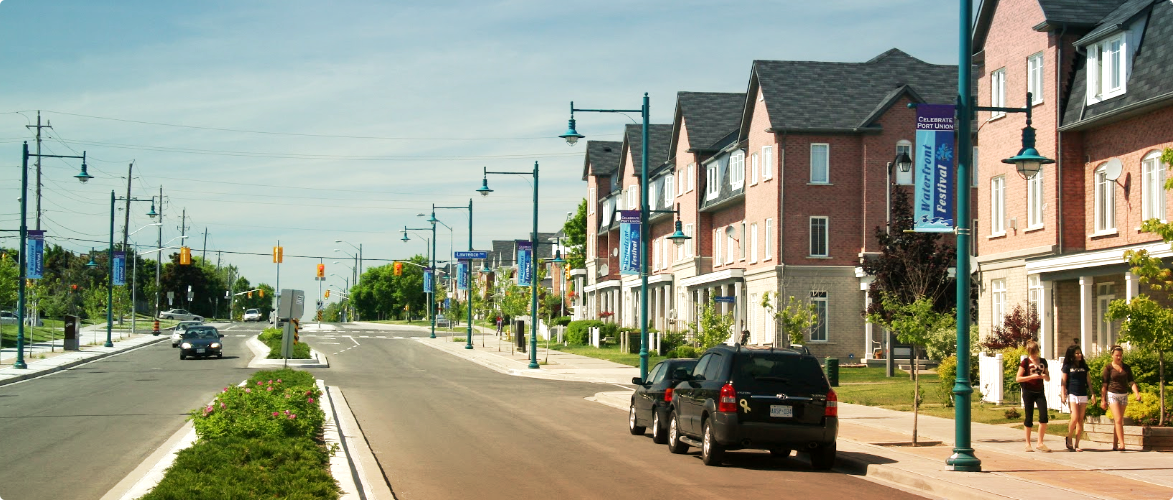
Port Union and West Rouge sit at the far southeast corner of Toronto, adjacent to Rouge National Urban Park and Lake Ontario. Rouge Hill GO station connects to Union Station in under an hour. Detached 1980s-1990s homes run $950K to $1.4M in 2026.
Port Union and West Rouge occupy the far southeast corner of Toronto, where the city meets Lake Ontario and the Rouge River valley. This is the end of the line in every sense: the most easterly residential community within the city boundary, where Scarborough’s suburban grid gives way to a lakeshore setting and the beginning of Rouge National Urban Park. The Rouge Hill GO station, on the Lakeshore East corridor, connects the neighbourhood directly to Union Station, and that transit link is the single most important fact about Port Union and West Rouge’s real estate market.
The housing here is almost entirely from the 1980s and 1990s, built during the last major wave of Toronto suburban expansion before the city’s boundary stopped growing. The homes are detached two-storeys and four-plus-one configurations typical of that era: brick construction, attached garages, floor plans with separate formal rooms and an open-concept back of the house. It’s suburban housing stock in good condition, and it’s located at the edge of one of Canada’s newest and largest national parks.
The neighbourhood identity divides roughly into two: Port Union, which is the area closer to the waterfront and the GO station along Port Union Road and Lawrence Avenue East, and West Rouge, which is the residential subdivision north and east of Port Union toward the Rouge River. They function as a continuous community, and buyers looking at one typically look at both.
For families who want to own a substantial home, have access to genuinely impressive natural land through Rouge National Urban Park, commute to downtown by GO train in under an hour, and spend significantly less than they would for comparable housing in North York or Etobicoke, Port Union and West Rouge make a clear and coherent argument.
The homes in Port Union and West Rouge are predominantly detached two-storey houses from the late 1980s and 1990s. These are full-size suburban family homes: typically 1,800 to 2,500 square feet on the main and upper floors, with a basement that adds living space or storage depending on how it’s been developed. Lots are in the 30 to 40 foot frontage range, with enough backyard for outdoor furniture and children’s play. The attached double garage is standard on most properties.
Construction quality for this era is generally solid. Homes are brick or brick veneer, and the major structural systems have held up well. The age of these homes means that some mechanical items, particularly original furnaces, air conditioning units, and plumbing connections, are reaching the end of their typical service life. The roof shingles on a 30-year-old home may be original; the windows may be the original builder units. These are the items to assess carefully in a home inspection, and the state of each significantly affects the near-term cost of ownership.
Some homes have been renovated and updated by long-term owners, with updated kitchens, bathrooms, and mechanicals. Others are essentially original from their build year. The price for an updated home is meaningfully higher than for an equivalent unrenovated property; the question is whether the premium is proportional to the work already done and the cost avoided.
Homes backing onto or facing Rouge National Urban Park, or backing onto the Port Union waterfront area, carry significant premiums. The premium reflects genuine scarcity: there’s a limited number of homes with park or water adjacency, and they don’t come to market frequently. For buyers who specifically want that exposure, patience is required.
The 2026 price range for detacheds in Port Union and West Rouge runs roughly $950,000 to $1,400,000. The lower end covers smaller or unrenovated homes without premium location features; the upper end reflects updated homes, larger lots, or park and water adjacency.
Port Union and West Rouge have a market with consistent demand and relatively limited supply, which creates more competition than many other Scarborough communities. The GO train connection, the park access, the lakefront trail, and the family-sized suburban homes combine to produce a clearly defined buyer appeal that translates into genuine market pressure for the right properties.
Well-priced detacheds in the neighbourhood sell with regularity, and multiple-offer situations happen on homes that combine good condition, a decent lot, and a reasonable asking price. The market isn’t as frenetic as it was during the 2020-2021 peak, but it’s more active than the median Scarborough neighbourhood. Sellers who price accurately and present their homes well don’t typically sit long.
The upper end of the price range, above $1,200,000, is more selective. The buyer pool at that price point is smaller, and homes need to clearly demonstrate the value to justify it: size, condition, location, or some combination. Average days on market at the upper end runs longer than at the core of the price range.
Park-adjacent and waterfront-adjacent properties behave like a separate micro-market. They come up infrequently, they attract specific and motivated buyers, and they don’t discount easily. Sellers of these properties are often well-aware of their scarcity value and price accordingly. The negotiation dynamic is different from a standard subdivision home; buyers pursuing these addresses need to be prepared to move quickly and competitively.
The neighbourhood is somewhat insulated from broader Toronto market corrections because the buyer profile is relatively specific and committed. The combination of GO access and park proximity is not replaceable elsewhere in Toronto at comparable price points, and that specificity creates a floor under demand that more generic suburban communities don’t have. Prices fell here during the 2022 rate increase cycle, but less dramatically than in purely rate-sensitive markets.
The buyers who choose Port Union and West Rouge are often families who’ve done significant research and arrived at a clear conclusion: this specific combination of home size, park access, waterfront proximity, and GO train commuting is the best they can find in Toronto at this price point. That specificity means buyers in this neighbourhood tend to be committed and informed rather than casual.
GO train commuters are the clearest buyer category. Rouge Hill station on the Lakeshore East line puts Union Station within 40 to 50 minutes, and that reliability makes the neighbourhood viable for full-time downtown employment in a way that bus-only transit communities aren’t. Buyers who work at Bay and King, in the financial district, at hospitals along University Avenue, or anywhere else in the Union Station orbit can live in Port Union without a car commute.
Families with children make up a large portion of buyers. The combination of suburban home sizes, quiet residential streets, proximity to trails and park land, and the Port Union Waterfront Park makes the neighbourhood well-suited to family life in a way that’s harder to achieve in denser parts of the city. Parents who grew up in suburban environments and want their children to have similar outdoor access find that Port Union and West Rouge deliver it within the Toronto boundary.
Move-up buyers from other Scarborough communities, who’ve built equity in a smaller or less desirable property and are ready to trade up to a larger home in a neighbourhood with more natural amenity, are a consistent presence. The price point, while above the Scarborough median, is still accessible to buyers who’ve been in the market for a few years and have meaningful equity.
Buyers from Pickering, Ajax, and Durham Region sometimes look at Port Union as a way to stay on the Lakeshore East GO corridor while moving into Toronto. The prices are higher than in Durham Region, but the Toronto location and the school system access matter for some families making that transition.
Port Union and West Rouge break into recognizable sub-areas based on their relationship to the major geographic features. The area closest to the waterfront, along Port Union Road south of Lawrence Avenue East and including the streets adjacent to the Port Union Waterfront Park, is the most prestigious and highest-priced part of the community. Homes here are closest to the lake, the waterfront trail, and the Rouge Hill GO station, making them the trifecta that the most motivated buyers target.
West Rouge, the residential subdivision that runs north and east from the Port Union core toward the Rouge River and Rouge National Urban Park, has homes that back onto or border the park in some cases. These park-adjacent addresses are highly sought after and rarely change hands. The interior streets of West Rouge are conventional suburban residential, well-maintained, and quiet. Most of the West Rouge subdivision was developed in the late 1980s and early 1990s and has a consistent character throughout.
Lawrence Avenue East runs through the heart of the community and serves as the main east-west connector. The commercial activity near Lawrence and Port Union Road forms the neighbourhood’s small commercial node, with a convenience-oriented strip of retail covering everyday needs. Most residents consider this intersection the practical centre of the community.
The streets directly adjacent to Kingston Road and Highway 401, which cuts across the north end of the community, are less desirable for residential purposes due to noise and traffic proximity. Buyers focused on quiet residential environments should stay south of the highway, which describes most of the established residential portion of the neighbourhood in any case.
Rouge Hill Drive and the associated crescent streets form the main residential fabric of Port Union proper. These streets have the consistent 1980s-1990s suburban character that defines the area, with established trees softening the visual uniformity of the housing. There’s less variation within the neighbourhood than in older, more organically developed Scarborough communities.
Rouge Hill GO station is the neighbourhood’s defining transit asset. It sits on the Lakeshore East GO rail corridor and provides direct service to Union Station with a journey time of approximately 40 to 50 minutes during peak service. The train frequency during morning and evening rush hours is sufficient for regular commuters; off-peak service is less frequent. Parking at Rouge Hill station is available, and unlike some GO stations further into the suburban network, it’s possible to drive to the station in a few minutes from most of the neighbourhood’s residential streets. Some residents walk or cycle to the station when conditions allow.
TTC bus service is available in the neighbourhood, primarily on Lawrence Avenue East and Port Union Road. These routes connect to Kennedy subway station on Line 2 and to the broader Scarborough bus network. The bus-to-subway route to downtown is significantly longer than the GO option, running 70 to 90 minutes in total; most downtown commuters from Port Union use the GO.
Highway 401 passes through the northern part of the neighbourhood and provides fast highway access east toward Durham Region and west toward central Toronto and the 400-series highway network. For residents who commute by car to employment outside the downtown core, whether in Scarborough, Pickering, or Markham, the 401 access is a practical advantage. Getting downtown by car during rush hour is a different proposition; the Gardiner and DVP corridors are congested and the drive can match or exceed the GO travel time depending on conditions.
Kingston Road runs through the area and connects west along the lakeshore toward Scarborough and east into Pickering. It’s a useful surface route for errands and local trips and handles the commercial activity that serves the neighbourhood’s everyday needs.
For buyers whose daily commute is the primary location driver, the GO train access from Rouge Hill station is the clearest and most reliable transit advantage in this part of Scarborough. It compares favourably to the bus-only transit options in most other Scarborough communities at similar price points.
The green space assets adjacent to Port Union and West Rouge are exceptional for a Toronto neighbourhood, and they’re one of the primary reasons buyers choose this community over other Scarborough options at similar price points. Rouge National Urban Park is the centerpiece: established as a national park in 2015, it covers over 79 square kilometres straddling the Toronto-Markham-Pickering boundary and includes the Rouge River valley, forests, meadows, agricultural land, and beach access at the river mouth. From the West Rouge subdivision, trail access into the park is a short walk, and the park’s trail network extends for kilometres in multiple directions.
Port Union Waterfront Park sits at the foot of Port Union Road along Lake Ontario and provides direct lakefront access: a beach area, a lakefront trail that connects east toward Rouge Beach and west across Scarborough’s waterfront, benches, and open space for picnics and passive recreation. This waterfront park is the neighbourhood’s daily social gathering point in good weather and is used consistently by residents of all ages. The Waterfront Trail connection through the park is part of a longer route that eventually connects across the entire Toronto waterfront.
Rouge Beach, where the Rouge River meets Lake Ontario, is within cycling distance of most of the neighbourhood and offers a natural beach setting that’s unusual within the city boundary. The beach is swimmable in appropriate conditions; the surrounding area has picnic facilities and serves as one of the most distinctive natural spots in eastern Toronto.
The Highland Creek trail system is also accessible from the neighbourhood’s western side, providing additional trail connections south toward Lake Ontario and north through east Scarborough. The network of connecting trails means a resident who wants to spend a full day outdoors has the routes to do it from their front door without repeating ground.
For buyers who weight outdoor access highly, Port Union and West Rouge deliver a combination of lake, river, and national park access that’s genuinely unique in Toronto. It’s the neighbourhood’s strongest differentiator and the thing that keeps demand for it consistent even when the broader Scarborough market softens.
Port Union and West Rouge are not walking-distance neighbourhoods for most retail and services. The local commercial strip near Lawrence Avenue East and Port Union Road handles convenience-level shopping: a grocery option, a pharmacy, a few fast-food outlets, and some service businesses. It’s adequate for grabbing essentials without a long drive but not sufficient for a full weekly shop.
For broader grocery and retail, Scarborough Town Centre is the closest major shopping destination, roughly 15 to 20 minutes west by car. It provides the full range of grocery options, national retail chains, a food court, and cinema. Most Port Union and West Rouge residents make a regular weekly or bi-weekly trip to Scarborough Town Centre for shopping that goes beyond convenience-store level.
Kingston Road connects the neighbourhood to a longer stretch of commercial activity through east Scarborough. The Kingston Road corridor has grocery stores, ethnic food options, hardware, automotive services, and the mix of independent and chain businesses that characterizes the road’s entire length through Scarborough. For residents comfortable with driving, this commercial corridor handles most needs.
Restaurants and cafes in the immediate neighbourhood are limited. There are a handful of local options near the Lawrence-Port Union intersection, but there’s no restaurant strip in the neighbourhood itself. Residents who eat out regularly typically drive west along Kingston Road or into Scarborough generally. The Beach neighbourhood in east Toronto is roughly 25 to 30 minutes west and offers a much more developed restaurant and cafe scene for residents who want that on occasion.
Healthcare services in the immediate area are limited to a small number of family medicine and dental offices. For specialist care and hospital services, Scarborough Health Network facilities, including Scarborough General Hospital, are accessible by car. The relative distance from major healthcare infrastructure is a practical consideration for households with intensive healthcare needs, though it’s not unusual for suburban Scarborough communities at this distance from the urban core.
The schools serving Port Union and West Rouge are part of the Toronto District School Board and Toronto Catholic District School Board systems for southeast Scarborough. The specific catchment school for any address should be confirmed directly with the relevant board, as boundaries in southeast Scarborough can be non-obvious.
Sir Oliver Mowat Collegiate Institute is the main TDSB secondary school for the area. It has a strong academic reputation within the Scarborough context and offers full academic and applied programming. The school’s student population is diverse, drawing from the broader southeast Scarborough area. The school’s performance on standardized measures is above the Scarborough average, reflecting the socioeconomic mix of the communities it serves.
Elementary schools in the area include Centennial Road Junior Public School and West Rouge Public School, which serves the West Rouge subdivision directly. Class sizes and academic performance at both schools are broadly consistent with TDSB averages; families who want more detail should look at current EQAO data for specific schools rather than relying on general neighbourhood-level assessments.
French immersion is available at designated schools in the area. Families wanting the French immersion pathway should confirm which school offers it at the relevant grade level for their child and whether any busing or transport is involved in accessing that program from their specific address.
The Catholic board operates separate schools in southeast Scarborough for families choosing that system. The relevant schools in the TCDSB system serve overlapping catchments with the TDSB schools, and the choice between boards is typically about values and preference rather than proximity.
The University of Toronto Scarborough campus is accessible from the neighbourhood by car or a combination of bus routes, providing post-secondary options without a long-distance commute for families whose children are at that stage. Centennial College is similarly accessible by car from southeast Scarborough.
Port Union and West Rouge sit at the eastern edge of Toronto’s developable area, bounded by the Rouge National Urban Park, the lake, and the city boundary. That constraint means the neighbourhood has very limited opportunity for new residential development and is likely to remain physically stable in a way that more centrally located communities are not. The existing subdivision is built out; there’s no significant vacant land for new housing at scale.
The main development dynamic affecting the neighbourhood is infill and replacement on individual lots: occasional teardowns of older 1980s homes being replaced with custom builds, and renovation activity as long-term owners update properties. This level of change is normal and doesn’t materially affect the character of the neighbourhood.
The GO station area has some potential for transit-oriented development consistent with Metrolinx’s approach at other GO stations across the network. The Rouge Hill station parking lot and the immediately adjacent commercial properties along Lawrence Avenue East represent land that, if Metrolinx pursues station-area development, could see mixed-use residential added over a medium-to-long time horizon. This isn’t imminent but is a credible possibility in a 10-to-15-year frame.
Kingston Road intensification, consistent with City and provincial policy for arterial corridors, will continue to generate development proposals as the road’s commercial properties age and owners seek to maximize land value. The scale of this change is unlikely to be disruptive to the residential neighbourhood behind the arterial, but it will gradually transform the highway-facing commercial streetscape.
Rouge National Urban Park’s establishment is a permanent feature of the neighbourhood’s context. The park’s protected status means the eastern boundary of the urban area is fixed, which is an unusual planning certainty for Toronto’s suburban edge. Buyers don’t need to worry that the parkland adjacent to West Rouge will eventually become subdivisions; it won’t. That permanence is itself a value proposition for buyers purchasing near the park boundary.
How reliable is the Rouge Hill GO for daily commuting?
The Lakeshore East corridor is one of the more reliable GO lines for peak-hour service. During morning and evening rush hours, trains run with sufficient frequency that missing one doesn’t mean an extended wait. The journey to Union Station from Rouge Hill runs 40 to 50 minutes. Where the service is less useful is off-peak: midday, evenings, and weekends have significantly reduced frequency, so residents who need to travel at irregular hours or who don’t have predictable commute windows find the GO less practical and rely on the car or TTC buses. For a standard Monday-to-Friday downtown commute, it works well. Confirm the current schedule with Metrolinx before buying on the assumption that a specific train time will work for your routine.
Can you actually access Rouge National Urban Park from the neighbourhood, or is it far away?
In the West Rouge portion of the neighbourhood, some streets border the park directly and trail access begins at the end of the street. The more central parts of Port Union are a short drive or a 15-to-20-minute walk from the nearest formal park entry point. The park has trail access from the Rouge Beach area at the lakefront and from multiple entry points further north in the river valley. The honest picture is that residents of West Rouge specifically are very close to the park and can walk in easily; residents in the Port Union core are close but not immediately adjacent. If daily trail access is the priority, the specific address matters: look at the map and confirm how far the nearest trail entry is from the specific property.
What are the main things to check on a 1990s home here?
The primary concerns for homes from this era are the mechanical systems. The original furnace and air conditioning unit on a 1990s home may be 25 to 35 years old and near or past end of life; replacement costs run $5,000 to $10,000 or more. Poly-b plumbing, a flexible plastic pipe used extensively in Ontario homes from roughly 1978 to 1995, is present in many homes of this vintage and has been a source of significant water damage failures; confirm whether it’s been replaced. The roof shingles on an original 1990 build are likely at end of life if they haven’t been replaced. Windows from the early 1990s are functional but below current energy performance standards. A thorough inspection should address all of these items, and the state of each should inform both your offer price and your budget for the first few years of ownership.
How does West Rouge compare to Port Union proper?
West Rouge is the subdivision north and east of Port Union Road, closer to Rouge National Urban Park but further from the waterfront and the GO station. Port Union proper, closer to the lake and the Rouge Hill station, has shorter walks to the waterfront and transit but less immediate park access. The two communities share schools, community infrastructure, and the same general character. Price differences between the two are mainly driven by lot specifics and proximity to the premium features: park adjacency in West Rouge, waterfront and GO adjacency in Port Union. Neither is definitively better; the choice depends on whether your priority is the park or the lake and station.
The combination of GO station access and park and waterfront adjacency makes Port Union and West Rouge a market where the premium features command real price differences depending on specific location. An agent needs to understand those micro-market variations, not just the neighbourhood-level average. A home backing onto Rouge National Urban Park is a genuinely different product from an equivalent home on an interior street in West Rouge, and the price should reflect that difference accurately rather than being pegged to a broad comparable average.
For buyers specifically targeting park-adjacent homes, the supply is thin and the properties move quickly when they do come up. Having a standing search alert and a pre-approval in hand before you need it is not optional in that segment. Your agent should also be networking for off-market opportunities in this pocket, because some of the best-located properties in established suburban neighbourhoods change hands through referral before they reach the public listing database.
The mechanical inspection issues specific to 1990s homes, described in the FAQ section, warrant a specific conversation with your inspector before they start. Ask them to test the heating system, confirm the plumbing type, and assess the roof lifespan with dates. Quantifying the near-term capital expenditure requirement on any specific home is the difference between accurately assessing what you’re paying versus what the home will cost you to maintain in the first five years.
The GO train schedule matters to buyers whose daily commute depends on it. Before committing to a property based partly on the GO access, download the current Lakeshore East schedule and confirm that the train times align with your actual work hours. The GO is reliable within its schedule, but the schedule has specific departure windows that need to fit your routine.
If you’re comparing Port Union and West Rouge against Pickering or Ajax on the Lakeshore East corridor, the comparison worth making is not just price but also the value of being inside Toronto’s boundary for schools, municipal services, and long-run land value. TorontoProperty.ca works with buyers across southeast Scarborough. Get in touch to talk through the comparison.
Street-level knowledge is hard to find online. Our team works in Port Union every day. They know which pockets hold value, where the school catchment lines actually fall, and what the market is doing right now. Talk to us before you make a decision about Port Union.
Talk to a local agent