
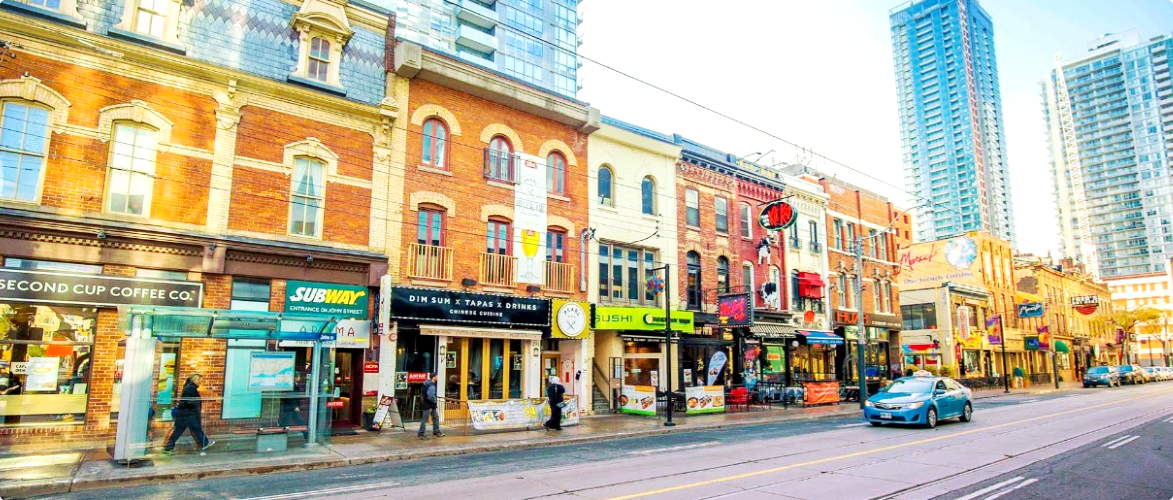
Queen Street West and the Fashion District run from University Avenue to Bathurst Street, with the Fashion District designation applying to the blocks between Spadina and Bathurst where the garment industry once operated. The neighbourhood is now a mix of condos, converted lofts, and the hotel and bar scene anchored by The Drake and The Gladstone. One-bedroom condos and hard lofts were trading between $550,000 and $750,000 in early 2026, with two-bedrooms running from $800,000 to $1.2 million. Freehold on these blocks is rare.
Queen Street West runs from the edge of the financial district at University Avenue out to Roncesvalles, but the stretch that defines the neighbourhood in real estate terms is the kilometre between Osgoode subway station and Bathurst Street. The Fashion District occupies the western end of that stretch: the blocks between Spadina and Bathurst where garment factories and cutting rooms operated for most of the twentieth century, many in brick warehouse buildings that now house loft condominiums. The two designations overlap in daily use, and most buyers treat them as one market.
The commercial strip is dense and continuous. The Drake Hotel at 1150 Queen West and the Gladstone Hotel a few blocks east at 1214 are the cultural anchors of this part of the street, both converted from Victorian railway hotels and now operating as restaurants, event venues, and neighbourhood gathering points. The Bell Media building at 299 Queen West, formerly MuchMusic, sits at the Spadina corner and signals the media and creative industry presence that has defined this area since the 1980s. The CAMH campus occupies a large block on the south side of Queen between Ossington and Shaw, with a long-term redevelopment plan that will eventually change the land use pattern on that side of the street.
What makes this neighbourhood work for the people who buy here is the concentration of creative and media employers within walking or streetcar distance. Design firms, post-production houses, advertising agencies, and media companies cluster between here and the King West corridor. Residents who work in those industries can live within twenty minutes of their office on foot or on the 501. That commute math drives the buyer profile on this street more than any other single factor.
Freehold on Queen West and in the Fashion District is genuinely scarce. The street was built as a commercial corridor, and the side streets between Queen and Dundas hold some Victorian commercial-residential conversions, but buyers who want a house with a yard and a garage will find very few options. The residential market here is predominantly condominiums: purpose-built towers from the 1990s onward mixed with loft conversions in the former garment factory buildings.
Hard lofts are the most distinctive product on the market and the most sought after. These are units converted from the warehouse and factory buildings that run through the Fashion District. The physical characteristics are fixed in the structure: poured concrete ceilings at eleven to fourteen feet, exposed brick, oversized windows designed for factory floor light, and in some buildings original hardwood or concrete floors. A one-bedroom hard loft of 600 to 700 square feet will typically trade between $620,000 and $780,000 depending on floor, condition, and specific building. Two-bedroom hard lofts from 850 to 1,100 square feet run from $900,000 to $1.25 million.
Purpose-built condos in the neighbourhood are priced below equivalent hard lofts but offer newer mechanical systems, lower maintenance costs in the near term, and in some buildings amenities the converted buildings don’t have. A standard one-bedroom in the 500 to 600 square foot range trades between $550,000 and $700,000. Parking is an expensive add-on in most buildings, typically $50,000 to $80,000 for a deeded space, and not every unit includes one. Buyers who need parking should confirm its availability before shortlisting buildings.
Queen West condos and lofts are running at longer days on market in early 2026, reflecting the same condo-specific softness present across the 416. Buyers have more negotiating room than they did in 2021 and 2022, particularly in purpose-built buildings where competing listings in the same tower create price pressure. Hard lofts in the most desirable Fashion District buildings are holding value better than standard condos because supply in those specific buildings is fixed and the product can’t be replicated by new construction.
The investor presence in this neighbourhood is significant. The short commute to downtown employers, the brand recognition of the address, and the rental premium that hard lofts command have attracted a consistent investor buyer pool since the 2000s. In the current market, investors are more cautious and financing conditions have tightened, which is part of why condo listings are sitting longer. End users, meaning people who actually intend to live in the unit, now have negotiating room that wasn’t present two years ago.
Spring listings start appearing in February and peak through April and May. The fall market runs from mid-September through early November. Units listed in December and January typically carry more flexibility, and buyers active in those months often find they can negotiate terms they couldn’t achieve in spring. The key variable for buyers is how many competing listings exist in the specific building at the time of the offer, so checking inventory in the exact address before presenting is worth doing.
The buyers who end up on Queen West are usually choosing between it and King West to the south or Trinity Bellwoods to the west. The decision against King West often comes down to street character: King West has skewed toward newer glass towers and a bar district feel, while Queen West has more architectural variety and a longer-established creative industry identity. Buyers who want the cultural geography of the fashion and media district tend to prefer Queen West. Buyers who want the newer building stock and the financial core proximity often choose King West.
The decision against Trinity Bellwoods is usually about housing type. Trinity Bellwoods buyers are typically buying semis and detached houses. Queen West buyers are buying condos and lofts. The two neighbourhoods share Queen Street as a boundary but serve different buyer profiles. Someone who has decided they want a hard loft in a converted factory building is not cross-shopping against a Victorian brick semi, and vice versa.
The buyers who end up on Queen West are often creative professionals in their early to mid-30s, either buying alone or as couples without children yet. The neighbourhood works for them because of the commute, the street life, and the buildings themselves. The constraint is space: most units here are compact relative to what the same budget would buy in a suburban or even a midtown location, and buyers who are confident they won’t need more square footage in five years are more comfortable with the trade-off than buyers who are uncertain about their plans.
The 501 Queen streetcar is the primary transit line for everyone on this stretch of Queen West, running east to the financial core, the St. Lawrence Market area, and Leslieville, and west toward Parkdale and Sunnyside. Most residents use it daily. At Osgoode station on the eastern boundary, the Yonge-University subway line picks up riders and puts them anywhere on the north-south spine within minutes. Bathurst streetcar at the western end of the Fashion District connects north to Bloor and Dupont.
The 501 has a known reliability problem that any resident will mention. It is one of the longest surface transit routes in the city, shares lanes with car traffic along most of its length, and bunches when delays accumulate. The city has been working on transit signal priority and lane improvements along the corridor for years, with partial progress. In practice, riders who need to be somewhere at a specific time allow extra time or use ride-share for the first portion of a time-sensitive trip. For casual use and off-peak hours, the streetcar is convenient and frequent.
For cyclists, the Bloor Street bike lanes a few blocks north offer the most comfortable east-west route. Queen Street itself is heavily trafficked and the experience on a bicycle varies significantly by time of day. The neighbourhood is flat, which helps. Residents who work in the King-Spadina area or the financial core can often cycle the entire commute without using a major arterial street. Most groceries, pharmacies, and everyday needs are within a ten-minute walk, which makes the absence of a car genuinely manageable for residents whose work is in the downtown core.
Queen Street West between Spadina and Bathurst has one of the highest concentrations of independent food and beverage operators of any commercial strip in Toronto. The Drake Hotel at 1150 Queen West operates a ground-floor restaurant, a basement bar, an event space, and a rooftop terrace, and it functions as a neighbourhood living room as much as a hotel. The Gladstone Hotel at 1214 Queen West operates similarly and has a longer history as a community venue, having hosted arts markets, community events, and independent live music for decades. These two hotels set the tone for the hospitality character of the strip.
TIFF Bell Lightbox, the Toronto International Film Festival’s year-round home, sits at the corner of King and John, about a ten-minute walk from the eastern end of the neighbourhood. During the September festival, the energy of the surrounding area is measurably different: screenings, events, and the concentration of film industry visitors affect the Queen West strip for those ten days in a way that residents either enjoy or plan around. The rest of the year, TIFF runs a regular repertory cinema and events program that draws from across the city.
Grocery options on Queen West itself are limited. The closest full supermarkets are along Dundas West or accessible by streetcar. The neighbourhood has a density of specialty food shops, butchers, and organic grocery options that work well for residents who shop frequently in small quantities, but buyers who do a weekly family-sized shop will drive or use delivery. Farmers markets operate seasonally at Dufferin Grove Park and Trinity Bellwoods Park nearby. The street skews toward restaurants, bars, and specialty retail rather than the practical daily grocery errands that many residents handle elsewhere.
The Centre for Addiction and Mental Health occupies a substantial block on the south side of Queen Street West between Ossington and Shaw. The campus includes clinical facilities, research buildings, and administrative space, and it has been operating on this site in various forms since the late nineteenth century. CAMH is one of the largest mental health teaching hospitals in North America and employs hundreds of people in the neighbourhood. Its presence is a significant reason the Queen West street is less purely residential and more mixed-use than equivalent blocks further west.
CAMH has been working through a long-term campus redevelopment plan that involves replacing older institutional buildings with a more open urban block structure, including the introduction of public streets through what is currently a closed campus. Phase 1 of that redevelopment introduced a public park strip and improved the Queen Street frontage. Later phases will change the land use pattern on the south side of the street between Ossington and Shaw over the coming decade. Buyers considering properties near the CAMH campus should understand that the block is actively changing and the long-term outcome is a more open, mixed-use development pattern rather than additional institutional use.
For residents, the CAMH campus is notable primarily for what it isn’t: it’s not retail or entertainment, which creates a stretch of the south side of Queen that feels different from the blocks to the east. The redevelopment will eventually address this. In the near term, buyers weighing properties on the blocks adjacent to the campus are buying into a transitional stretch rather than a fully activated commercial street. The transit access and commute math remain the same regardless of the CAMH adjacency.
The Fashion District’s most distinctive residential buildings are the converted garment factory and warehouse structures, most built between 1900 and 1940 on the blocks between Spadina and Bathurst. The Candy Factory Lofts at 993 Queen West is one of the better-known conversions: a former candy manufacturing facility converted to residential lofts in the 1990s, with two-storey units, exposed brick, and the heavy timber frame that the original building required. Units here trade at a premium and turn over infrequently. The Garment Factory at 150 Sudbury, just south of Queen near Bathurst, is another established conversion with a loyal resale following.
Purpose-built condos from the 1990s and early 2000s sit alongside the conversions throughout the neighbourhood. These buildings have fewer character elements than the factory conversions but often have larger layouts for equivalent price, newer elevators and mechanical systems, and in some cases better maintenance fee structures because the envelope was purpose-built for residential use. Buyers weighing a hard loft against a purpose-built condo should factor in the age of the building’s mechanical systems: a factory conversion from 1995 is now thirty years old, and capital reserves and maintenance fees will reflect that.
Newer construction on Queen West has been limited by the neighbourhood’s older building stock and the heritage designations on a number of the industrial buildings. Where new towers have gone up, they’ve typically been on the corners of major intersections or on sites that were surface parking lots. The result is that the residential product on Queen West is more varied in age and character than most comparable Toronto neighbourhoods, which is part of its appeal and also part of what makes unit-by-unit due diligence more important here than in a newer tower market.
Queen West is not a neighbourhood that draws buyers primarily because of its school options. The elementary schools serving this catchment are Queen Victoria Junior Public School and Ryerson Community School, both acceptable neighbourhood schools but not the destination programs that drive buyers to certain parts of North York or the Annex. The neighbourhood does not have the same school-as-selling-point dynamic that moves real estate in parts of the city with strong IB or French immersion programs at the elementary level.
Buyers with school-age children who prioritise school quality typically look at other west-end neighbourhoods with stronger elementary catchments. That said, families do live here, particularly in the larger hard loft units and in the Victorian rowhouses on the side streets between Queen and Dundas. The side streets off Lisgar, Beaconsfield, and Fennings have lower traffic than Queen Street itself and function as genuinely residential blocks. The constraint for families is usually space rather than schools: a two-bedroom condo at 850 square feet works for a couple but gets tight once there are children and the need for a separate work-from-home space.
Private school options are accessible by transit. Upper Canada College in Forest Hill and Bishop Strachan School are the most common choices for Queen West families willing to pay private school fees. Both are reachable by transit without a transfer. The Toronto District School Board’s francophone schools and French immersion programs at the elementary level are available in neighbouring catchments, which some buyers investigate before purchasing. The honest summary is that buyers who are optimising for school access tend not to end up on Queen West, and buyers who end up on Queen West have usually decided that street life and commute are the higher priorities.
Queen West and the Fashion District have supported a strong rental market for two decades, driven by the concentration of downtown employers, the neighbourhood’s brand recognition, and the appeal of hard loft units to renters willing to pay a premium for the physical character of the space. One-bedroom loft units in the fashion district buildings rent between $2,400 and $3,200 per month depending on size, floor, condition, and building. Purpose-built one-bedrooms in the same area run $2,200 to $2,900. Two-bedroom units rent from $3,200 to $4,500 at the higher end.
Investors who bought in this neighbourhood before 2020 are generally holding equity even in the current softer condo market. Investors who bought at 2021 or 2022 peak prices face a more difficult calculation: rental income at current rates does not cover carrying costs on a mortgage at current interest rates on a unit purchased above $700,000. This is not unique to Queen West but it is acutely visible in a market where investor listings are a meaningful share of current supply.
The long-term rental demand for this corridor is structurally sound because the employment base nearby is large and stable: media companies, design firms, creative agencies, CAMH itself, the hospital network further east, and the financial core all employ the kind of professional renters who pay market rents without difficulty. Short-term rental, meaning Airbnb and similar platforms, has been significantly constrained by municipal regulation since 2021. Investors who built a business model on short-term rental income in this neighbourhood need to have adjusted that model or are running at lower yields than projected.
What’s the difference between a hard loft and a soft loft, and does it matter to price? A hard loft is a genuine conversion from an industrial or commercial building, with the physical characteristics of that building intact: concrete ceilings, exposed brick, oversized factory windows, heavy timber or steel structure. A soft loft is a new-build designed to evoke those elements with lower ceilings, applied finishes, and contemporary construction. The difference matters significantly to price. A hard loft in the Fashion District will command $75,000 to $150,000 more than a comparable soft loft or purpose-built condo of the same square footage in the same area, because the physical elements of a genuine conversion cannot be replicated by new construction. Buyers who want the character should buy the genuine article. Buyers who care primarily about space efficiency and modern mechanical systems will often find better value in a purpose-built building.
Is parking included in most Queen West condos? No. Parking is either not available or sold separately in most Fashion District buildings, typically at $50,000 to $80,000 for a deeded underground space. Some buildings have no parking allocation at all because they were converted from structures built before car ownership was universal. Buyers who need a car for daily use should verify parking availability at the specific building before shortlisting it. The 501 Queen streetcar and the Osgoode subway station make this one of the more car-optional neighbourhoods in the city, and many residents genuinely manage without one. The parking situation should be treated as a constraint to confirm, not an assumption.
What should I know about maintenance fees in the older converted buildings? The garment factory and warehouse conversions are thirty to forty years old as residential buildings and have gone through multiple maintenance cycles. Maintenance fees in these buildings reflect the cost of operating an older envelope: typically $0.75 to $1.10 per square foot per month, which is above the rates in newer purpose-built condos. The status certificate for any unit in a converted building should be read carefully, specifically the reserve fund study and any pending special assessments. A building with a fully funded reserve will have higher monthly fees but will not surprise buyers with special assessments for roof or mechanical replacements. Buyers who are price-sensitive on monthly carrying costs may find purpose-built condos in the neighbourhood a better fit than the converted buildings.
Queen Street West and the Fashion District offer something specific: a downtown address with genuine architectural character in the residential buildings, walking distance to creative industry employers, and a street life that’s been building for thirty years. What they don’t offer is freehold housing, large square footage at accessible prices, strong elementary schools, or easy car storage. Buyers who have worked through that trade-off honestly and decided the positives outweigh the constraints are usually happy here. Buyers who have talked themselves into overlooking the constraints often aren’t.
The hard loft market is the strongest argument for this neighbourhood. The Candy Factory, the Garment Factory, and the other converted industrial buildings hold value through market cycles in a way that standard condos don’t, because the product is genuinely irreplaceable. A new condo building on King Street is competing against every other new condo building. A unit in a 1920s garment factory converted in 1997 is competing against a very small pool of comparable properties. Scarcity supports price. Buyers who understand this and buy the right building are usually comfortable with the trade-off on price per square foot.
The neighbourhood is not getting quieter. The CAMH redevelopment, ongoing intensification along the corridor, and the sustained popularity of the Drake and Gladstone as cultural venues mean the Queen West strip will remain active. Residents who prefer a quieter urban environment typically end up in Roncesvalles or Little Portugal. Residents who want to be at the centre of something are often right where they want to be on this stretch of Queen Street, on a Saturday morning when the street is busy and the 501 is running and the coffee shop on the corner has a line out the door.
Street-level knowledge is hard to find online. Our team works in Queen St West (Fashion District) every day. They know which pockets hold value, where the school catchment lines actually fall, and what the market is doing right now. Talk to us before you make a decision about Queen St West (Fashion District).
Talk to a local agent