
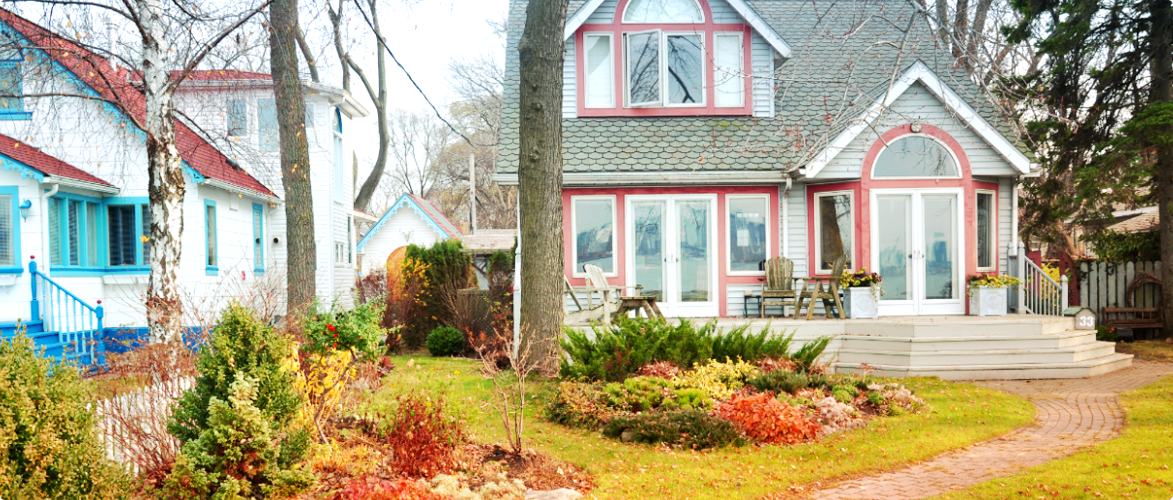
The Toronto Islands sit in Lake Ontario about a kilometre south of Harbourfront, and the ferry ride to get there takes ten minutes. That short crossing puts you in one of the most genuinely unusual residential addresses in North America. There are no cars on the residential islands. The homes on Ward's Island and Algonquin Island are a mix of cottages, bungalows, and modest houses that have been modified, extended, and improved over decades of continuous occupation. Roughly 250 people live here year-round, and the community has a cohesion that's rare in a city Toronto's size. None of this comes without real constraints. The land under every home is leased from the City of Toronto, not owned. The ferry is the only way in or out, and it doesn't run 24 hours. Lake Ontario's water levels have caused flooding in recent years. And the prices have risen to a point where you're paying over a million dollars for a cottage on leased land with no car access and a ferry-dependent daily life. Whether that's a good deal is a question each buyer has to answer for themselves, but it requires understanding what you're actually buying.
The Jack Layton Ferry Terminal sits at the foot of Bay Street, and on a clear morning the crossing to Ward’s Island takes ten minutes. By the time you dock and step onto the island’s wooden boardwalk, downtown Toronto is visible across the water but feels genuinely far away. There are no cars. The streets, if you can call them that, are narrow enough that two cyclists can barely pass each other. The homes are set close together, painted in colours that suggest decades of individual decision-making, with gardens that have the particular density of spaces that have been tended for years. About 250 people live here year-round. Most of them know their neighbours by name. Many have been here for decades.
The Toronto Islands are a residential anomaly. There is nothing else like them in Toronto and very little like them in any major North American city. The two residential islands, Ward’s Island on the east and Algonquin Island immediately to the west, are part of the same archipelago that includes Centre Island, the western islands operated by Parks Canada, Centreville amusement park, and several kilometres of beaches and parkland that draw millions of visitors each summer. The residential portion is a small, protected community occupying the quietest part of the chain. City of Toronto parkland buffers it from the seasonal crowds.
Buyers come here for reasons that are hard to describe to people who haven’t made the crossing. The combination of lake views, car-free streets, strong community identity, and ten minutes to the financial district adds up to something that doesn’t have a simple name. What they need to understand before they buy is equally specific: the land under every home is leased from the city, not owned; the ferry schedule governs your life in ways that require genuine adjustment; Lake Ontario has flooded portions of the islands in recent years; and the prices, starting at roughly $1.2 million for a modest cottage, reflect the scarcity of a community that almost never sells. This guide covers all of it, because the Islands reward careful buyers and punish impulsive ones.
Every home on the Toronto Islands is a land lease property. You buy the physical structure, the house itself, and you receive the right to occupy the land underneath it under a lease agreement with the City of Toronto. You do not own the land. You pay an annual lease fee to the city, which varies by property and has been subject to periodic adjustments. When you eventually sell, you’re selling the structure and assigning the lease. This is a fundamentally different ownership structure from a standard freehold purchase, and it affects everything from how the property is financed to how it’s valued at resale.
The homes themselves are a range of cottage-style structures, bungalows, and modest houses that have been improved, extended, and in some cases significantly renovated by successive owners. Because no new residential construction has been permitted on the islands for decades, every home is existing stock that’s been adapted in place. Some are charming and well-maintained. Some have been expanded into genuinely comfortable year-round homes with modern kitchens, updated bathrooms, and proper insulation. Others are more cottage than house and require work or seasonal tolerance. What they share is a compact footprint: lots are small, rooms are generally modest in size, and the kind of square footage you’d expect from a $1.5 million purchase on the mainland isn’t what you’ll find here. You’re paying for location, scarcity, and lifestyle, not square footage.
As of 2026, homes on Ward’s Island and Algonquin Island are trading in the $1.2 million to $2.5 million range and occasionally beyond for properties that have been extensively renovated or occupy particularly desirable lot positions. The wide price range reflects genuine variation in lease terms, condition, size, and lot orientation. A south-facing home with lake views on a quiet part of Ward’s Island commands more than a north-facing cottage backing onto a pathway on Algonquin. The lease term remaining is a specific variable that affects value: a lease with 40 years remaining and clear renewal language is a different asset from one with 12 years remaining and ambiguous renewal terms. Your lawyer must review the actual lease document, not a summary, before you make any offer.
The Toronto Islands real estate market operates under conditions that are essentially unique in Toronto. There are roughly 262 residential properties on the islands, and turnover is extremely low. In a typical year, fewer than ten properties change hands. Some years see fewer than five sales. That thin volume means comparable data is scarce, price discovery is difficult, and individual transactions can move the apparent market significantly. When a renovated home sells at the top of the range, it sets a reference point that sellers for the next two years will point to. When a property sells below expectations because of lease complications or deferred maintenance, it takes years for that sale to fade from buyer consciousness.
Financing adds another layer of complexity. Most major Canadian banks will not lend on land lease properties, or if they will, the terms are less favourable than for freehold or standard condo purchases. Buyers typically need to identify lenders who specifically work with land lease structures, and the pool of willing lenders is smaller than buyers expect. This limits the buyer pool. Purchasers who can’t arrange financing at a competitive rate will face higher carrying costs, which affects how much they can actually pay. All-cash buyers have historically had an advantage on the Islands for this reason, and a meaningful portion of transactions have been cash or near-cash.
The market does have genuine scarcity value working in its favour. No new residential units will be created on the Islands. The community won’t grow. Every buyer who wants to live there is competing for the same small stock of properties. That structural scarcity has pushed prices consistently upward over the past two decades, even accounting for the complications of land lease financing and the practical constraints of island living. Whether that trend continues depends partly on City of Toronto lease renewal policy, partly on how lenders evolve their appetite for this asset class, and partly on how many buyers in any given year have the specific combination of financial capacity and lifestyle fit that Islands living requires.
The people who buy on the Toronto Islands are a specific type of buyer, and they know it. They’ve usually visited the islands multiple times before considering a purchase. They’ve ridden the ferry in February. They’ve mapped the commute to their office from the ferry terminal. They’ve thought about what happens when they need to bring a large appliance to the house, or when a contractor needs to do significant work. They’ve asked how groceries come home. They’ve considered what they’ll do when the last ferry has left and they’re still at a dinner party on the mainland. Buyers who do all of that work and decide they can genuinely live this way are the ones who end up happy on the Islands.
The community skews toward people who have chosen to opt out of car culture specifically. Many residents don’t own a car at all, or they garage one on the mainland and use it selectively. They cycle, they walk, they take the ferry and then transit. The neighbourhood has a countercultural flavour that has persisted across the decades since the community fought a protracted legal battle in the 1980s to remain on the islands after the city attempted to clear the residential areas for parkland. That fight forged a community identity that remains visible today. Residents are engaged, opinionated, and protective of what they have. New buyers enter a community with strong norms, and the adjustment period is real.
There are also buyers who come specifically for the downtown proximity reframed. The Islands are ten minutes from the financial district by ferry, which is a shorter commute than many people have from the 905. For remote workers or people with flexible schedules, the trade-offs are easier to manage. Someone who commutes twice a week can plan around the ferry schedule without real hardship. Someone who needs to be at an office by 8:00 AM every morning and stay until 6:00 PM will find the schedule more constraining. The honest question isn’t whether the Islands are a good lifestyle. For some people they clearly are. The question is whether your specific life, your schedule, your family structure, your social patterns, genuinely fits.
The single most important step before making any offer on a Toronto Islands property is retaining a lawyer who has specific experience with land lease transactions, and ideally with Islands properties specifically. This is not the moment to use your standard residential real estate lawyer if they’ve never handled a land lease. The lease document itself is the core asset you’re purchasing rights under, and understanding its specific terms, the annual fee, the fee escalation mechanism, the expiry date, the renewal provisions, and any restrictions on use or modification, is essential before you set an offer price. A lease with 15 years remaining and no confirmed renewal path is a fundamentally different risk profile from one with 40 years remaining and city-confirmed renewal terms. The difference in value can be hundreds of thousands of dollars.
Financing pre-approval must specifically cover land lease properties. Call your bank before you start seriously shopping and ask directly: will you lend on a land lease property on the Toronto Islands? Many will say no. Some credit unions and alternative lenders work with this structure, and there are mortgage brokers who specialize in it. Get this sorted before you fall in love with a property, not after. Discovering that you can’t get standard financing after your offer is accepted, or that the available rate is significantly higher than you budgeted, turns a dream purchase into a difficult situation.
Building inspection on the Islands requires specific attention to a few things that don’t apply on the mainland. Foundation conditions in a lake-adjacent environment are important: look for evidence of water infiltration, elevated moisture in crawlspaces, and how previous owners have managed water. Ask specifically about flooding events and what was done to the structure afterward. Check the condition of the roof carefully given the lake weather exposure. Understand how utilities reach the property, water, sewer, and electrical connections on the Islands are managed differently from mainland connections, and any issues with those connections can be expensive and logistically complicated to repair when every piece of equipment needs to arrive by boat.
Selling an Islands property is a slow process by Toronto standards, and sellers who understand that going in have a better experience than those who expect a bidding war within two weeks of listing. The buyer pool is small and self-selecting. Many interested parties will get as far as researching the ferry schedule, the lease structure, or the financing options, and then step back. The buyers who make it through that filter tend to be serious and informed, which makes the actual transaction smoother, but getting to that buyer takes time. Plan for a longer listing period than you would expect for a comparable-priced property on the mainland.
Pricing requires genuine care. With fewer than ten transactions per year to work from, comparables are always thin and often dated. A sale from 18 months ago tells you something, but the market moves and the specific terms of that sale, the lease duration, the renovation quality, the negotiating dynamics, may not translate directly to your property. Sellers who overprice and then reduce are particularly exposed here because the buyer pool is small enough that a price reduction is immediately visible to every active buyer. Getting the price right from the start is more important on the Islands than in most Toronto markets.
Presentation matters considerably. The Islands attract buyers who are emotionally engaged with the lifestyle concept, and a home that photographs well in that context, with garden shots, interior light, and the proximity to water visible, will attract more attention than one that looks like a standard real estate listing. Island homes have a specific visual character, and listing photos that capture it honestly while showing the home at its best are worth investing in. Equally, be transparent in the listing materials about the lease terms, the ferry schedule, and the practical constraints. Buyers who arrive already informed and already committed to that lifestyle will waste less of everyone’s time.
The land lease is the defining characteristic of Toronto Islands real estate and the thing that most requires careful attention from buyers. Here is the basic structure: the City of Toronto owns all the land on the residential islands. When you buy a home here, you’re buying the structure only. The land under it is leased to you under a residential land lease agreement, for which you pay an annual fee to the city. The lease has a term, an expiry date, and provisions about what happens at expiry. Those provisions vary by property, and they are not uniform across the community.
The history of this arrangement is directly tied to the community’s fight for survival in the 1980s. When the city moved to clear the Islands for parkland, residents fought back, and the eventual resolution was the land lease system as a compromise: residents could stay, but the land would remain city property. The leases that came out of that settlement have been in place for decades, and many are now approaching or past their original term dates. The city has negotiated renewals with the Islands Community Association on a rolling basis, but the terms of those renewals, the duration, the fee schedule, the conditions, have varied. Some properties have clearer and longer renewal paths than others.
For a buyer, the practical due diligence is this: obtain the specific lease document for the property you’re considering. Have your lawyer confirm the current term end date, the annual fee and how it escalates, what happens at term end, whether the city has issued any renewal commitment for this specific property, and whether there are any restrictions on use, renovation, or subletting that would affect your plans. A lease with a long remaining term and a confirmed renewal pathway is worth meaningfully more than one approaching expiry without resolution. Price your offer accordingly, and do not accept a seller’s representation of the lease terms as a substitute for reading the actual document.
The ferry is the only scheduled public connection between the residential islands and the mainland, and it is genuinely central to daily life. The Toronto Island ferry operates from the Jack Layton Ferry Terminal at the foot of Bay Street, a short walk from Union Station, the 509 and 510 streetcars, and the Harbourfront area generally. The crossing to Ward’s Island takes approximately ten minutes. During the main operating season, ferries run frequently and the wait is usually short. The winter schedule is reduced significantly, with fewer daily crossings and a tighter evening cutoff. The ferry does not run 24 hours. Missing the last crossing means finding alternative arrangements, either a commercial water taxi (which operates but not always on demand) or planning to stay on the mainland overnight.
Residents adapt to this structure in specific ways. Most keep a bicycle in the city somewhere useful, either at the ferry terminal end or at a workplace, so they can move quickly between the dock and their destination without depending on transit timing. Many keep a separate set of arrangements for late nights out: a friend’s couch, a hotel reward point booking, or a regular water taxi contact. Groceries and larger purchases require planning. A large grocery run means carrying bags onto the ferry, which is manageable but changes the rhythm of shopping compared to loading a car in a parking lot. Contractors working on your home arrive by ferry with their tools, and large equipment or materials need to come over on the ferry as well, which affects renovation costs and timelines.
Within the islands themselves, movement is by foot, bicycle, or electric golf cart for those who need to carry things. There are no cars and no car roads on the residential islands. The paths between homes are narrow, the pace is slow, and that’s the entire point. Residents who come from high-density, high-speed urban environments almost universally describe the transition to island pace as jarring at first and then something they can’t imagine giving up. The absence of traffic noise, the lake sounds, and the physical scale of the place, where everything you need is a short walk away, create a daily life that feels structurally different from anything on the mainland.
The standard comparison question for a neighbourhood guide is: how does this compare to similar areas nearby? For the Toronto Islands, that question doesn’t have a straightforward answer, because there is nothing similar. No other Toronto neighbourhood is car-free. No other Toronto community sits on an island in the lake. No other residential address in the city requires a ferry to get home. The closest comparisons have to be made on specific attributes rather than overall character.
On price per square foot, Islands homes compare to prime downtown condos in buildings like those at Harbourfront or in the King West corridor. You’re spending similar money for a fraction of the condo tower amenities and considerably more outdoor space and privacy. A buyer who would otherwise be looking at a two-bedroom condo on Queens Quay for $1.3 million is a plausible Islands buyer on price, but the lifestyle gap between those two options is enormous. The condo buyer gets a concierge, underground parking, and the ability to order pizza at midnight. The Islands buyer gets a garden, lake sounds at night, and a community that knows their name.
Buyers sometimes compare the Islands to cottage country, specifically to properties on the Trent-Severn waterway or on Lake Simcoe, where you can get a waterfront property in a similar price range. The practical differences are significant. Cottage country is seasonal in a different way: it’s a destination, not a primary residence for most buyers. The Islands are a year-round urban community with city services, city schools, and city infrastructure, despite the pastoral setting. A buyer choosing between a cottage on Lake Simcoe and a home on Ward’s Island is choosing between two genuinely different life models. The Islands buyer is choosing to make the island their actual daily life, not a weekend escape. That distinction matters for how you think about the purchase.
The Toronto Islands community is one of the most cohesive in the city. Two hundred and fifty year-round residents on a car-free island, many of them long-term, creates a social density that urban neighbourhoods of ten times the size often lack. Neighbours know each other. The community association is active and genuinely influential: it negotiates lease renewals with the city, runs community events, manages common spaces, and has historically served as the collective voice of island residents in disputes with the municipality. New buyers enter this community, and that’s a meaningful statement: you don’t just buy a property here, you join a group with strong norms and a shared history.
For families with children, the school situation requires planning. There is no school on the islands. Children attend school on the mainland, which means a daily ferry crossing as part of the school routine. For younger children, this is managed with parent supervision and works well enough that many families do it without major difficulty. As children get older and want more independence, the ferry adds a layer of complication that mainland families don’t deal with. High school students who have after-school activities, sports, or social lives that keep them on the mainland until evening need to manage the ferry schedule, which is real homework of a different kind. Families who choose the Islands with school-age children have all thought this through and made their peace with it. It’s worth thinking through carefully before you assume it will be fine.
Daily life on the islands is physically active by default. You walk or cycle everywhere. Groceries are carried by hand or in a bicycle basket. The park and beach infrastructure that surrounds the residential area is immediately accessible and used constantly by residents who treat it as their extended backyard. The Centreville amusement park on Centre Island operates seasonally and draws visitors from the mainland but doesn’t spill into the residential areas. The western islands managed by Parks Canada have their own visitor infrastructure. Ward’s Island residents have a beach and a clubhouse. Algonquin Island residents have a similar setup. The community gardens are well-tended and often the subject of neighbourly negotiation that reveals both the community’s character and the compressed space everyone is navigating.
What is a land lease and why does it matter for Toronto Islands homes? A land lease means you own the physical home, the structure, but you lease the land it sits on from the City of Toronto. Every year you pay a lease fee to the city. The lease has a term with an expiry date and renewal provisions. What makes this critical in practice is that the terms vary by property. Some homes have leases with long remaining terms and clear city-backed renewal commitments. Others are closer to expiry with less certainty about what comes next. A home with an ambiguous or short-term lease is worth less than one with a long, secure lease, sometimes by a significant amount. Never rely on a seller’s verbal description of the lease. Your lawyer must read the full document before you finalize any offer price.
How does the ferry work and what happens when it’s not running? The Toronto Island ferry leaves from the Jack Layton Ferry Terminal at the foot of Bay Street and takes about ten minutes to reach Ward’s Island. During peak season the service runs frequently and the wait is short. In winter the schedule is reduced, with fewer departures and an earlier last crossing. There is no 24-hour ferry service. If you miss the last ferry, your options are a commercial water taxi, which operates but costs money and requires advance arrangements, or staying on the mainland. Residents structure their lives around this: they know the schedule, plan their evenings accordingly, and most have arrangements for occasional late nights. The honest advice is to ride the ferry several times in different seasons before buying. It is genuinely manageable for many people, but it should be a real experience, not an assumption, before you commit.
What do Toronto Islands homes actually cost in 2026? In 2026, you’re looking at a range of roughly $1.2 million to $2.5 million or more for homes on Ward’s Island and Algonquin Island. Prices vary significantly based on the size and condition of the structure, the renovation quality, the lot position and orientation, views, and most critically, the specific terms of the land lease. A modest, original-condition cottage with a short lease remaining will sit at the lower end. A fully renovated home with south-facing lake exposure and a long, secure lease will sit at the top. Financing these purchases requires a lender willing to work with land lease properties, and most major banks will not do so. Budget time to find the right lender before you start shopping seriously, and get written confirmation that your specific approval covers a land lease property on the Toronto Islands.
What are the flooding risks on the Toronto Islands? Lake Ontario water levels are variable, and the Toronto Islands have experienced significant flooding events. The floods of 2017 and 2019 were the most severe in recent memory, temporarily displacing residents and causing damage to structures on lower-lying parts of the islands. The residential areas on Ward’s Island and Algonquin Island are at the eastern end of the archipelago and generally sit slightly higher than the park and beach areas to the west, but they are not immune. Before buying, ask specifically about the flooding history of the property: has it flooded, when, how badly, and what was done to the structure in response. Ask about the city’s current shoreline management plans for the residential islands. And get specific insurance advice from a broker who knows this property type, because standard home insurance policies often exclude or limit flood coverage, and a lake-adjacent land lease property needs a tailored policy.
People have lived on the Toronto Islands in various forms for centuries. Indigenous peoples used the peninsula, which the islands were before a major storm severed them from the mainland in 1858, as a seasonal fishing and gathering place. European settlement of the islands began in the mid-1800s, and by the late 19th century there were hotels, summer cottages, and a significant seasonal population. The eastern islands, particularly Ward’s Island, developed a year-round residential character as working-class Toronto families built modest cottages and, over time, made them into permanent homes.
The conflict that defined the modern community came in the 1950s through the 1980s, when the City of Toronto repeatedly attempted to clear the residential islands for public parkland. The city had acquired the islands and wanted to eliminate the private residential use. Residents fought back over decades, through courts, through politics, and through sustained public advocacy. The community won a partial and qualified victory in the 1993 Islands Residential Community Stewardship Act, which established the land lease framework that governs the neighbourhood today. Under that act, residents could stay, but they would lease the land from the city rather than own it. The legislation also established the Toronto Islands Community Association as the negotiating body for lease terms on behalf of all residents.
The fight for the islands shaped the community’s identity in ways that are still visible today. Residents are disproportionately engaged in civic and political life. The community association is active and effective. There’s a strong awareness of how recently and contingently the community exists, which creates a collective seriousness about protecting it. New buyers who understand that history tend to integrate more easily than those who arrive treating the islands as a scenic backdrop for their personal lifestyle choice. The community has earned what it has, and it keeps a record.
Street-level knowledge is hard to find online. Our team works in Toronto Islands (Wards Island) every day. They know which pockets hold value, where the school catchment lines actually fall, and what the market is doing right now. Talk to us before you make a decision about Toronto Islands (Wards Island).
Talk to a local agent