
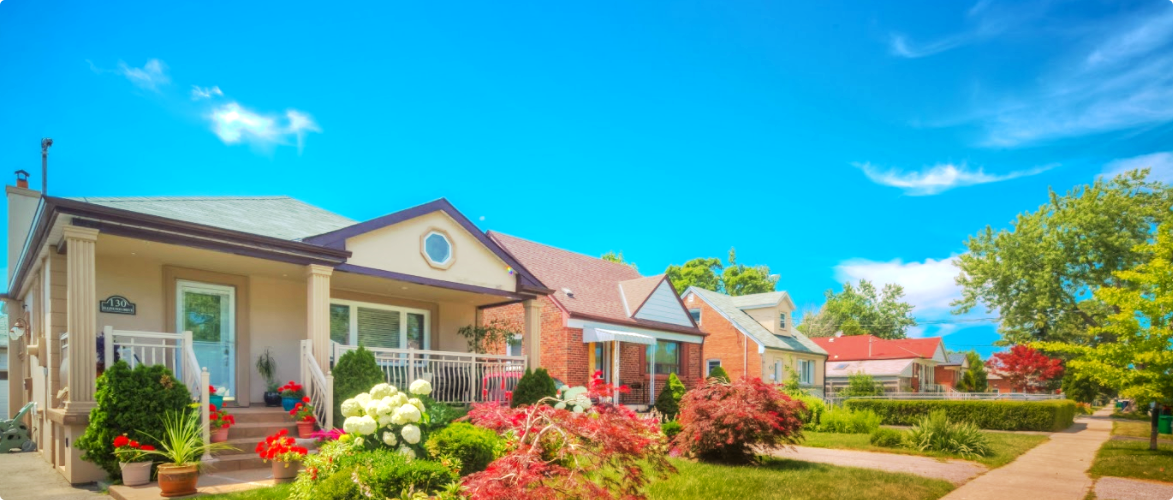
Wexford-Maryvale sits in central Scarborough between Lawrence Avenue East and the 401, with Victoria Park Avenue to the east and Pharmacy Avenue to the west. Post-war bungalows on full lots, transit access via Victoria Park and Lawrence Avenue, and Wexford Collegiate School for the Arts in the secondary school catchment. Detached homes sell from $850,000 to $1.2 million in 2026.
Wexford-Maryvale sits in central Scarborough between Lawrence Avenue East, Pharmacy Avenue, Victoria Park Avenue, and the 401, a quietly positioned neighbourhood that doesn’t generate much attention in real estate conversations but has been steadily attracting buyers who’ve done the comparison work and found that it offers more than its price tag would suggest.
The neighbourhood was developed primarily in the post-war decades, and the housing stock reflects that: bungalows, raised bungalows, and split-levels on lots of 40 to 50 feet, set back from the street with mature front trees and the well-worn appearance of a community that’s been lived in continuously for 60 or 70 years. It’s not a neighbourhood that’s been stylishly curated or that attracts buyers from outside Scarborough because of its social cachet. It’s a neighbourhood where people live, maintain their houses, and stay.
Lawrence Avenue East is the main commercial corridor and has been improving. The strip has the standard suburban mix of grocery stores, pharmacies, and fast food, but a more diverse restaurant scene has developed over the past decade as the neighbourhood’s composition has shifted toward Caribbean, Filipino, South Asian, and Latin American communities. The commercial strip reflects those communities now in a way it didn’t fifteen years ago, and the result is a more interesting and varied set of food options than the architectural character of the commercial strip would lead you to expect.
The proximity to Victoria Park subway station, one bus transfer north to Lawrence station on the Yonge line or west to Victoria Park station on the Danforth, gives this neighbourhood a transit connection that makes downtown commuting genuinely feasible. That’s the practical asset that sets Wexford-Maryvale apart from comparable Scarborough bungalow neighbourhoods further east or north.
The housing stock in Wexford-Maryvale is almost entirely post-war freehold, a mix of bungalows, raised bungalows, and semi-detached homes that were built in the late 1940s through the 1960s. Detached properties dominate, though semi-detached homes are more common here than in some of the more exclusively detached Scarborough neighbourhoods. The lots run to the typical Scarborough suburban standard: 40 to 50 feet wide, 110 to 120 feet deep, with adequate backyard space and a garage on most detached properties.
In 2026, detached bungalows in this neighbourhood are selling from $850,000 for a property in original or minimally updated condition to $1.1 million for a well-maintained or partially renovated home. Fully renovated properties on good lots approach $1.2 million but that ceiling is harder to push past without the neighbourhood’s reputation catching up to justify it. Semi-detached homes sell in the $750,000 to $900,000 range, providing an accessible entry point for buyers who need the lower price point but want a freehold property rather than a condo.
The basement suite situation is comparable to other central Scarborough neighbourhoods: a significant proportion of homes have finished basements with kitchen facilities, some permitted and some informal. Buyers planning to use a basement suite for income should confirm permit status and code compliance before including rental income in their financing calculation. The income potential is real and meaningful, with one-bedroom basement suites in central Scarborough renting from $1,400 to $1,800 per month.
The condition range among available properties is wider here than in a higher-demand neighbourhood. Some properties have had minimal investment over their lifetimes; others have been extensively updated. A careful home inspection is essential to distinguish between properties that are genuinely well-maintained and those that appear acceptable on the surface but carry significant deferred maintenance underneath. The lower purchase price means more room to absorb renovation costs, but buyers should understand what they’re taking on before committing.
Wexford-Maryvale is a buyers’ market in the honest sense: supply is adequate, days on market are reasonable, and conditional offers are achievable. It’s not a neighbourhood where bidding wars are a regular feature. The buyer pool is smaller and more deliberate than in higher-demand addresses, and the market price is more negotiable as a result. Buyers who’ve been repeatedly outbid in Leslieville, East York, or the Danforth often find the Wexford-Maryvale market less stressful to navigate.
The neighbourhood has seen modest price appreciation over the last decade without the dramatic spikes and corrections that higher-demand markets experienced. This relative stability is both a characteristic of the neighbourhood’s buyer profile, which tends to be hold-oriented and not speculative, and a reflection of its position in the market hierarchy: close enough to demand to benefit from city-wide price growth, far enough from the hot centres that it doesn’t get carried away in bubble conditions.
Properties in good condition with functional updates sell at or near asking. Properties in poor condition or significantly overpriced relative to the neighbourhood ceiling sit and require price reductions. The ceiling here is defined by what buyers can justify paying for a Wexford-Maryvale address versus alternatives in more established parts of Scarborough or East York. Sellers who understand that ceiling and price accordingly sell reasonably quickly. Sellers who price as though the neighbourhood were East York are consistently disappointed.
The spring market (March through May) sees the most activity. Fall (September through November) is the second peak. Summer and the January-February window offer the most negotiating room for buyers with patience.
The buyers who choose Wexford-Maryvale have typically concluded that this neighbourhood offers the best value for a detached freehold property within a reasonable transit distance of downtown. They’ve looked at East York and found it $200,000 to $400,000 out of reach for a detached home. They’ve looked at further-east Scarborough and decided the transit situation there is too constraining. Wexford-Maryvale lands in the middle: accessible, affordable by Toronto standards, and practical for daily life.
First-time buyers with budgets in the $850,000 to $1.0 million range are a consistent presence. A detached home at this price is genuinely unusual in Toronto, and buyers who’ve been looking for a detached property without stretching their budget beyond sustainability end up here. They’re often surprised by how much house they get for their money compared to the condo or semi-detached properties they’d be buying at the same price in a closer-in neighbourhood.
Caribbean-Canadian, Filipino, and South Asian families who have community connections to this part of Scarborough make up a substantial share of buyers. The neighbourhood’s community composition, its places of worship, its restaurants, its cultural events, is part of the attraction for these buyers alongside the price and the transit access. They’re not discovering the neighbourhood; they’re choosing it because it’s where their community is.
Investors with a long-term view are also present, particularly those looking at properties with basement suite income potential. The rental market in central Scarborough is active and the cap rates on well-priced detached bungalows with legal basement units are competitive with condo investments in higher-priced areas of the city.
The neighbourhood’s geography is defined by Lawrence Avenue East to the north, Pharmacy Avenue to the west, Victoria Park Avenue to the east, and the 401 to the south. Within that rectangle, the residential streets run in the standard post-war grid pattern, with Warden Avenue as the main north-south corridor bisecting the neighbourhood. Most streets within the grid are comparably quiet and residential, with the primary variation being proximity to Lawrence and the commercial noise that comes with it versus the calmer streets one or two blocks south.
The streets closest to Lawrence Avenue have more traffic and commercial activity within earshot. Buyers who want maximum residential quiet should look at the interior streets rather than those immediately adjacent to the avenue. The difference is meaningful on a daily basis: Lawrence Avenue is a busy road and the blocks fronting it or immediately behind it feel more urban than the interior streets, which are genuinely quiet suburban residential.
Warden Avenue through the neighbourhood is also an arterial with traffic, but the residential streets off Warden are set back enough that the impact is manageable. The 401 forms the southern boundary and the sound of highway traffic is audible on the streets immediately adjacent to it. Buyers on those streets are typically getting a minor discount for the highway proximity, which is rational given the noise environment.
The northern part of the neighbourhood, above Lawrence, technically extends into a different planning area. Most buyers using the Wexford-Maryvale address are focused on the residential streets between Lawrence and the 401, where the neighbourhood’s character is most consistent and the housing stock most representative of the typical offering. The Pharmacy-Lawrence corridor itself has accumulated more diverse commercial activity than other parts of the neighbourhood, and the immediate blocks around that intersection are the most walkable in terms of daily errands.
Transit in Wexford-Maryvale is better than in most of Scarborough, which is the neighbourhood’s most practical advantage over comparable suburban addresses further east. The Victoria Park bus runs south along Victoria Park Avenue from the neighbourhood to Victoria Park subway station on the Bloor-Danforth line, and north toward Lawrence Avenue. From Victoria Park station, the Danforth line connects west to downtown. The total door-to-downtown commute by this route runs approximately 45 minutes, which is competitive with many inner-city neighbourhoods.
The Lawrence Avenue bus runs east-west along the northern boundary, connecting toward Lawrence station on the Yonge line to the northwest and toward Scarborough further east. Lawrence station provides access to the Yonge subway line and points downtown and north. Either connection, Yonge via Lawrence or Bloor-Danforth via Victoria Park, is a reasonable downtown transit option from this neighbourhood.
Car access is good. The 401 is on the neighbourhood’s southern boundary, with onramps via Warden Avenue and Victoria Park Avenue. Driving downtown takes 25 to 40 minutes depending on traffic. The Don Valley Parkway is accessible via the 401 westbound. For residents who work in Scarborough, Markham, or the Don Mills corridor, the car access from this neighbourhood is quite convenient.
Cycling is possible but requires comfort with urban arterial streets. The Victoria Park Avenue cycling infrastructure and the Lawrence Avenue bicycle lanes provide routes, but these are busy roads rather than protected cycling corridors. Riders who are comfortable with urban cycling can reach East York and the Danforth in about 20 to 25 minutes.
The neighbourhood’s green space is modest but adequate for a post-war suburban area. Wexford Park, the main neighbourhood park, has playing fields, a playground, and the standard recreational facilities you’d expect from a community park of its era. It’s well-used by residents with children and serves as the social hub for the immediate residential area around it.
The Gatineau Hydro Corridor runs through the neighbourhood as a wide open green strip that functions as informal parkland, providing a walking and cycling route and a linear open space that the neighbourhood’s residential streets would otherwise lack. It’s not manicured parkland but it’s used regularly by dog walkers, cyclists, and people who want a surface running route that’s off the main roads.
The Taylor Massey Creek ravine system runs through parts of the broader area and connects to the Don River trail network further west. Access from Wexford-Maryvale to the creek trail is not immediate from most addresses, requiring a short drive or longer walk to access trailheads. The ravine trail is a genuine amenity for residents who use it, providing a natural environment for walking and running that’s distinct from street-level urban walking.
Compared to ravine-adjacent neighbourhoods like Todmorden Village or West Rouge, green space access in Wexford-Maryvale is adequate rather than exceptional. This is a neighbourhood where the transit access, the price point, and the community character are the primary assets rather than natural surroundings. Buyers who place high value on walkable green space should weigh this against the other factors that make the neighbourhood attractive.
Lawrence Avenue East is the neighbourhood’s primary commercial corridor and it’s more interesting than it looks from the car. The strip has the standard suburban anchor tenants, a Sobeys, a Shoppers Drug Mart, and the usual fast food chains, alongside a genuinely diverse range of independent restaurants and food businesses that reflect the neighbourhood’s Caribbean, Filipino, South Asian, and Latin American communities. A Jamaican patty shop, a Filipino bakery, a roti restaurant, a Vietnamese pho shop: the food options here are not what the exterior appearance of the strip would suggest.
The Pharmacy-Lawrence intersection has accumulated more diverse commercial activity than other sections of the strip. There are Caribbean grocery stores with fresh produce and imported goods that aren’t available in chain supermarkets, butcher shops catering to West Indian cooking styles, and a range of service businesses catering to the neighbourhood’s communities. For residents from these communities, the practical amenity of being able to buy specific ingredients and products locally is a real quality-of-life factor.
Scarborough Town Centre is about fifteen minutes by car and handles the regional shopping needs that the local strip doesn’t cover. Most residents make the trip for electronics, clothing, and larger household purchases. The STC is close enough to not be a significant inconvenience but far enough that it’s not a daily destination.
The Victoria Park Avenue corridor to the east has its own commercial cluster, with grocery stores, restaurants, and service businesses serving a slightly different community mix. Residents of Wexford-Maryvale have access to both commercial corridors, which together provide a reasonable range of options without requiring a major shopping trip for most everyday needs.
The TDSB elementary schools serving Wexford-Maryvale include Wexford Public School and several others on the Lawrence and Pharmacy corridors. The schools reflect the neighbourhood’s community composition: diverse, multi-cultural, and with a student population drawn from households across the income spectrum. They’re not academically ranked schools in the Fraser Institute sense, and buyers for whom school ranking is the primary factor in neighbourhood selection are looking at a different set of addresses.
French Immersion programs are available through the TDSB and are worth exploring for families who want a program-focused option within the public system. The application process is separate from standard catchment registration and should begin early. The specific French Immersion school available from any address in the neighbourhood should be confirmed with the TDSB, as programming and availability change periodically.
The TCDSB serves Catholic families with separate elementary schools. Boundary verification for both boards is essential before making school catchment a factor in any specific purchase decision.
Secondary school catchment in this area typically points to Wexford Collegiate School for the Arts, which has a distinctive profile as a Toronto arts school with specialized programs in visual arts, music, drama, and dance alongside the standard academic curriculum. For families with children interested in arts education, this is a genuinely attractive secondary school option that buyers in more expensive east-end neighbourhoods would have to apply to without a catchment guarantee. Wexford’s arts focus is a real differentiator from the standard secondary school offering in this part of the city, and it’s worth understanding for families with artistically inclined teenagers.
Wexford-Maryvale is not a neighbourhood in dramatic transformation, but it’s improving steadily and the improvements are visible. The commercial strip on Lawrence has been seeing modest investment and turnover toward more diverse and interesting businesses. Some blocks that were declining have stabilized. The neighbourhood is not a comeback story in the way that some central Scarborough areas are being positioned, but it’s moving in a positive direction quietly and without the speculative pricing that accompanies louder neighbourhood narratives.
The Lawrence-Pharmacy intersection area has seen some planning activity related to mid-rise and higher-density residential development along the Lawrence corridor. The city’s planning framework supports intensification on Lawrence Avenue, and several sites along the avenue are candidates for redevelopment. This is a long-term trend rather than an immediate change, but buyers on lots fronting or adjacent to Lawrence should be aware of the planning direction for that corridor.
The residential streets well set back from Lawrence are not under significant development pressure. The zoning on these streets is stable residential and there are no major proposals that would alter the neighbourhood’s interior character. Buyers in the interior streets can expect their immediate block to look similar in ten years.
The broader Scarborough transit improvement agenda, including the subway extension to Scarborough Centre, will improve the general accessibility and desirability of Scarborough as a whole over the coming decade. Wexford-Maryvale’s transit situation is already better than most of Scarborough, so the relative benefit is somewhat muted, but improved transit connectivity across the borough is generally positive for all Scarborough property values.
How does Wexford-Maryvale compare to East York for buyers? East York’s detached bungalow market starts at roughly $1.1 to $1.2 million and climbs quickly from there. The housing stock is similar in type and era to Wexford-Maryvale, but the East York address, the proximity to the Danforth, and the established desirability of the east-end freehold market carry a premium of $200,000 to $400,000 on comparable properties. Buyers who can’t reach East York pricing, or who’ve decided the premium isn’t justified by the practical differences in their daily life, consistently find Wexford-Maryvale a better value. The transit connection, through Victoria Park or Lawrence Avenue, is genuinely adequate for downtown commuters, and the commercial and recreational options are sufficient for most households. The primary difference is social: East York has a more established and homogeneous buyer profile and neighbourhood narrative, and some buyers value that identity enough to pay for it.
What is Wexford Collegiate School for the Arts? Wexford Collegiate School for the Arts is a TDSB secondary school with a specialized arts focus, offering conservatory-style programs in visual arts, music, dance, drama, and technical theatre alongside the standard Ontario secondary school curriculum. Students in the arts programs audition for placement and receive significantly more instructional time in their chosen art form than a standard secondary school arts elective would provide. The school has produced a notable number of students who’ve gone on to professional arts careers and post-secondary arts programs. For families with children who are serious about an art form by Grade 8, the school is a genuine attraction, and the catchment advantage of purchasing in Wexford-Maryvale versus applying from outside the catchment is worth noting. Students outside the catchment can still apply but compete for limited open spots.
Is central Scarborough safe? Wexford-Maryvale’s crime statistics are consistent with other established Scarborough residential neighbourhoods at this price point. The neighbourhood doesn’t have the concentrated social housing context that affects some central-city areas, and the residential streets are owner-occupied and quiet. Property crime in the form of vehicle theft and break-and-enters is a city-wide issue that affects all Toronto neighbourhoods, including this one. Buyers should assess security and insurance costs across any Toronto neighbourhood rather than assuming central Scarborough is uniquely problematic. The street-level experience in Wexford-Maryvale on most days is ordinary and residential.
Can I renovate a bungalow in Wexford-Maryvale and come out ahead? The economics depend on the purchase price, the renovation scope, and the neighbourhood’s price ceiling, which is currently around $1.1 to $1.2 million for a renovated detached bungalow. A buyer purchasing at $870,000 with $150,000 in renovations has $1.02 million into the property, which is within the range of what a well-presented renovated bungalow can achieve in this neighbourhood. Buyers who renovate to a higher standard than the neighbourhood justifies won’t recover the investment in the sale price; the ceiling applies regardless of finish quality. The renovation case is strongest when the purchase price is at the bottom of the market range, the renovation is functional rather than luxury, and the buyer plans to live in the property for several years rather than immediately flip it.
Wexford-Maryvale is a neighbourhood where straightforward buyer’s agent work matters more than flashy negotiating tactics. The market isn’t a sprint; it’s a deliberate process where identifying the right property, understanding what it’s actually worth relative to condition and location within the neighbourhood, and structuring a conditional offer properly are the skills that deliver value.
The home inspection question is worth raising explicitly. Homes of this era, 1950s through 1960s construction, have predictable maintenance requirements that an inspection will surface. An agent who advises waiving inspection to compete is not serving your interests in a market where conditional offers are achievable. The inspection cost on a property at this price is immaterial relative to what it might surface.
The school situation at Wexford Collegiate is worth understanding in detail if you have school-age children approaching secondary school. An agent who knows the neighbourhood should be able to explain the catchment advantage and how it compares to what buyers in other areas have to navigate to access the same school.
TorontoProperty.ca covers central Scarborough and East York. If Wexford-Maryvale is on your shortlist, reach out for a current picture of what’s available and what the realistic value looks like for your specific budget and criteria.
Street-level knowledge is hard to find online. Our team works in Wexford-Maryvale every day. They know which pockets hold value, where the school catchment lines actually fall, and what the market is doing right now. Talk to us before you make a decision about Wexford-Maryvale.
Talk to a local agent For Sale
 For Rent
 For Sale
 For Rent