
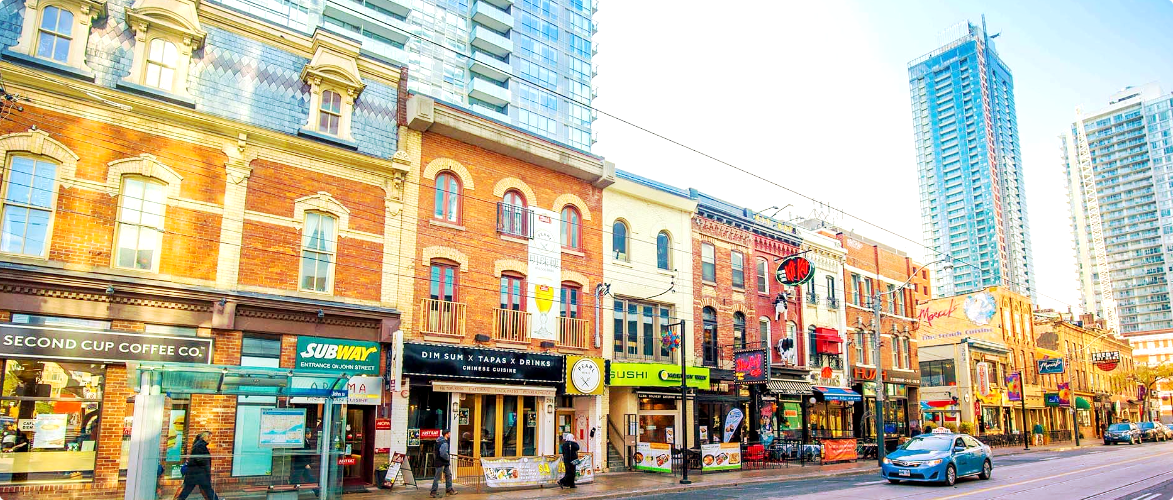
West Queen West runs along Queen Street from Bathurst to Roncesvalles, where the gallery district, the Drake Hotel, and Ossington Avenue sit behind a housing stock of brick row houses, converted semis, and a handful of low-rise condos on quieter streets like Beaconsfield and Argyle. Renovated semis in the neighbourhood were selling between $1.2 and $1.6 million in early 2026, with detached homes starting around $1.8 million on the best blocks. It's one of the few parts of the city where serious art culture and residential stability occupy the same streets.
The stretch of Queen Street between Bathurst and Roncesvalles has been called the art district, the design strip, and half a dozen other things over the years, but the description that holds up is simpler: it’s a commercial corridor with genuine character that formed organically rather than being planned into existence. The galleries arrived first, then the restaurants, then the hotels, and then, in the 2000s, the money. What remains is a Queen Street that still functions as a real neighbourhood main street while attracting visitors from across the city every weekend. The residential blocks behind it are quieter than most people expect.
Beaconsfield Avenue, Argyle Street, and Northumberland Avenue run south from Dundas and north from King, creating a grid of brick rowhouses and semis that belong firmly to the west end’s late-Victorian building era. The houses were built between roughly 1890 and 1915, mostly as working-class housing for families employed in the nearby industries that have long since disappeared. What’s left is a cohesive brick streetscape with narrow lots, small backyards, and the kind of patina that new construction spends decades trying to replicate. Many of these homes have been renovated thoroughly over the past 20 years, with modern kitchens and rear additions behind preserved facades.
The neighbourhood’s northern boundary at Dundas marks a shift in character. North of Dundas, you’re into Trinity Bellwoods proper, with its own housing stock and park identity. South of Queen, the blocks toward King and Liberty Village attract a different buyer. West Queen West sits between these two zones, which is one reason it has held a distinct identity rather than being absorbed into either. Buyers who specifically choose this neighbourhood are often choosing the Queen Street corridor as much as any particular street: the streetcar access, the concentrated amenity, and the cultural density that exists here and almost nowhere else in the city at this price point.
The typical West Queen West purchase is a red-brick semi-detached house on a 15- to 18-foot-wide lot, with two or three bedrooms, a partially finished basement, and a rear yard that may or may not have laneway access. The houses follow the pattern of the late-Victorian west end: front parlour, dining room, kitchen at the back, bedrooms above, and a bathroom configuration that ranges from adequate to extensively reconfigured depending on when the renovation happened. If the home was updated in the early 2000s, the kitchen is probably due for another cycle. Updates from 2015 onward are more likely to hold up, particularly if the renovation included new electrical and updated plumbing.
Detached homes exist but they’re less common. When they come up, particularly on the wider lots on Beaconsfield between Dundas and Queen, they attract competitive offers and are priced to reflect their scarcity. The distinction between semi and detached matters more in this neighbourhood than in some others because the lots are narrow: a detached home on a 20-foot lot gives meaningful separation from neighbours and different development possibilities. Laneway housing is a live question for many buyers. The laneways behind Beaconsfield and Northumberland have seen some development already, and lots with confirmed laneway potential carry a premium that reflects the $250,000 to $350,000 construction cost for a one-bedroom suite. Buyers should have this assessed before making an offer rather than assuming eligibility.
The condo supply in West Queen West is limited compared to King West or the waterfront. A few low-rise buildings exist on and near Queen Street, typically four to eight storeys, with units that reflect the neighbourhood’s creative identity more than the financial district aesthetic further east. These aren’t glass towers. They’re older buildings with smaller footprints, and the units trade accordingly, typically in the $650,000 to $850,000 range for one- and two-bedroom configurations. For buyers who want a freehold entry into the neighbourhood at lower cost, the unrenovated semi is the more common path, though it requires capital and time that the condo does not.
West Queen West trades within the broader west-end market but has its own rhythm. The neighbourhood attracts a buyer who is often making a values-based choice as much as a financial one. That buyer is typically employed in creative industries, media, architecture, or adjacent fields, and they’re choosing this address over, say, Leslieville or the Danforth because the Queen West identity matters to them. That specificity of buyer pool creates a market that is deep in good conditions and can soften noticeably when sentiment shifts, because the buyer who moves on has fewer natural successors than in a neighbourhood with a broader appeal. In 2022 and 2023, the neighbourhood felt that clearly. Recovery in 2024 and 2025 was real but uneven by street and by property type.
Renovated turnkey semis have historically absorbed market corrections better than unrenovated stock. The buyer pool for a well-finished semi on Beaconsfield includes professionals from outside the creative industries who can live with the neighbourhood’s energy in exchange for the commute convenience and the park access. The buyer pool for a work-needing semi with outdated systems is narrower: it’s someone with the appetite, capital, and time to manage a renovation on a tight lot in a neighbourhood where contractors are expensive and parking for trades is a persistent challenge. Days on market for unrenovated properties typically runs two to four weeks longer than for finished homes in the same price bracket.
Multiple offers still occur on well-priced finished semis, particularly those with outdoor space and either a parking spot or confirmed parking eligibility. Properties that sit without offers in the first two weeks are usually priced above the current buyer ceiling or have a specific issue, most commonly a problematic addition, drainage problems in the basement, or knob-and-tube wiring that hasn’t been fully updated. These issues are discoverable on inspection but are often underweighted by sellers who anchor to peak prices. Buyers who approach this market with a completed home inspection and a clear view of renovation costs are consistently better positioned than those who waive conditions to compete on price alone.
The neighbourhood draws a specific cohort and has for the better part of two decades. Buyers typically work in the arts, design, film, architecture, journalism, or the creative side of technology. They tend to be in their mid-30s to mid-40s, often without children or with one child, and they’ve been renting in the area long enough to know the streets well before they buy. They want Queen Street walkability, proximity to Trinity Bellwoods Park, and the specific social texture of a neighbourhood where the gallery on the corner is a working gallery rather than a pop-up. They’re not buying into a brand. They’re staying in a place they already know.
A secondary buyer cohort comes from outside this profile: professionals in law, finance, and medicine who prioritise the Queen streetcar commute downtown and the amenity density over the neighbourhood’s cultural identity specifically. These buyers typically purchase renovated, turnkey properties and are less interested in the unrenovated stock that appeals to the first group. They tend to stay for three to seven years and sell when family formation requires more space or a different school catchment. Their presence stabilises the market for finished properties and creates a consistent resale supply that the neighbourhood depends on.
Long-term owner-occupiers, many of whom bought before 2010 when prices were significantly lower, form the neighbourhood’s residential backbone. On blocks like Northumberland south of Dundas, you’ll find families who have been there for 15 to 20 years, who know every neighbour, and who have watched the neighbourhood change around them with something between pride and ambivalence. Their tenure reflects the neighbourhood’s genuine liveability rather than its marketed identity, which is worth paying attention to. Places where long-term residents stay tend to stay liveable. The challenge in West Queen West is that the entry price now makes that kind of deep-roots tenure harder to replicate for new buyers.
The inspection issues that come up most often in West Queen West follow the pattern of the housing stock. These are late-Victorian semis that have been renovated in waves over the past 50 years, and the quality of those renovations varies enormously. Knob-and-tube wiring is the most common electrical issue: many homes had their panels upgraded without replacing the branch wiring, which means a 200-amp service feeds circuits that are still running on original cloth-covered wiring inside the walls. This is an insurance problem before it’s a safety problem, but it will affect your ability to get standard coverage at standard rates. Get clarity on the wiring before removing conditions.
Foundation issues are the second area to investigate carefully. Many of these semis were built on rubble stone foundations that have shifted over 110 years and have been patched rather than systematically addressed. A damp basement in a West Queen West semi can mean anything from a correctable drainage problem at the back of the lot to a foundation requiring significant waterproofing work. The narrow lots make exterior waterproofing excavation expensive and logistically complex. An inspector who has worked on west-end Victorian stock specifically will recognise what they’re looking at. A generalist inspector may miss the distinction between cosmetic damp and active water ingress.
Rear additions are worth particular attention. The neighbourhood saw a wave of rear kitchen additions between 2005 and 2015, and the quality of those additions varies from fully permitted work by licensed contractors to underpermitted structures built without proper footings. The city’s permit records are publicly searchable, and your agent or lawyer can help you pull the history before you close. An addition with no permit isn’t automatically a dealbreaker, but it means you’re inheriting the liability for any deficiencies, and it can affect insurance and future financing. Budget for a structural assessment of any addition that looks like it was built informally, regardless of how finished the interior looks.
Sellers in West Queen West have the advantage of a neighbourhood with genuine name recognition that attracts buyers before they’ve even seen the listing. The Drake Hotel address, the galleries, the park proximity: these are real marketing assets that agents in more anonymous neighbourhoods would pay significant money for. The question for most sellers isn’t whether buyers will come. It’s whether the property is positioned correctly within a buyer pool that is discerning and, in early 2026, somewhat cautious about overpaying after the corrections of the previous two years.
Preparation matters more here than in some other west-end neighbourhoods because the buyer is often someone who has spent considerable time in the area and knows what a well-maintained West Queen West semi looks like. They notice the difference between a house where systems have been properly maintained and one where deferred maintenance has accumulated behind fresh paint. Fixing the obvious things, the broken rear fence, the cracked porch step, the bathroom fan that vents into the attic rather than outside, is worth doing before photos rather than offering a credit. Credits are negotiated down. Done work is not.
Pricing strategy in this market rewards specificity over ambition. The gap between the list price of an unrenovated semi and a finished one on the same block can be $200,000 to $350,000, and buyers are sophisticated enough to apply that differential correctly. Sellers who price an unrenovated home as though it were turnkey attract the wrong buyers, burn days on market, and often end up taking less than a correctly priced listing would have generated. Agents with recent transaction history specifically in West Queen West, not just the broader Queen West or Little Portugal area, will have the comparable data to price accurately. Interview for that specifically.
The Drake Hotel at 1150 Queen Street West and the Gladstone House at 1214 Queen Street West are the two anchors of the neighbourhood’s cultural identity, and they operate as more than just hotels. Both have event spaces, galleries, and restaurants that function as neighbourhood institutions rather than tourist destinations. The Drake’s art programming has been running continuously since its 2004 opening, and the Gladstone’s community-facing calendar is similarly embedded in neighbourhood life. For residents, they’re venues where things actually happen, not places you visit once and never return to. Their presence on Queen Street is part of what makes this stretch feel curated by people who live here rather than designed for people who visit.
Ossington Avenue, running north from Queen up to Bloor, is the other defining corridor. The blocks between Queen and Dundas on Ossington have some of the best bar and restaurant density in the city without the King West volume: smaller rooms, less corporate programming, and a crowd that tends to be neighbourhood-based rather than destination-driven. Restaurants like Bar Isabel on the north end and the concentration of spots around the Queen-Ossington corner have given Ossington a reputation that extends well beyond the neighbourhood. For residents, the practical effect is that you’re a five-minute walk from dinner options that people make reservations for weeks in advance.
The CAMH campus redevelopment deserves mention here as a physical change that has altered the streetscape south of Queen. The partnership between CAMH and the development community has produced a stretch of new buildings on the south side of Queen between Ossington and Shaw that includes retail, rental housing, and public space. The street-level activation around Workman Arts and the adjacent buildings has added life to a stretch that felt institutional a decade ago. For buyers looking at properties in the blocks immediately north of the campus, this is worth understanding: the development pressure on that portion of Queen isn’t finished, and the long-term vision for the western portion of the CAMH lands will continue to shape the neighbourhood over the next decade.
The 501 Queen streetcar is the neighbourhood’s primary transit link, running the full length of Queen Street from Neville Park in the east to Long Branch in the west. In practical terms, this means a ride from the corner of Queen and Ossington to Osgoode Station takes about 12 minutes in off-peak traffic and 20 to 25 minutes during rush hour, depending on signal timing and how far the car has to travel to catch up. The streetcar is a known quantity: it runs frequently during peak hours, it’s surface-level so it’s affected by traffic, and it connects directly to the subway at both Spadina and Osgoode without requiring a transfer. Buyers commuting to the financial district or University Avenue institutions tend to find it adequate. Buyers commuting to the Yonge subway line east of Bay Street find it slower.
Cycling infrastructure on the neighbourhood’s streets has improved measurably since 2020. The protected lanes on Shaw Street provide a north-south connection from Bloor down through the neighbourhood toward the lakefront trail, and the Queens Quay connection makes a reasonable cycling commute to the downtown core possible for riders comfortable with urban cycling. The Bloor Street bike lanes, accessible via Shaw or Ossington, extend that network east and west. For buyers who cycle and work within roughly 8 kilometres of the neighbourhood, the cycling infrastructure makes the neighbourhood significantly more practical than transit commute times alone would suggest.
Car ownership in West Queen West is less common than in comparable-priced areas further out. Parking is tight: many semis don’t have a dedicated spot, and street parking is permit-regulated but competitive on the residential side streets. Buyers who drive regularly should confirm parking arrangements before purchasing, whether that’s a private spot, a garage, or a confirmed ability to get a permit. The neighbourhood’s walkability score is high enough that many residents go months without needing a car, but the practical challenges of car ownership in a neighbourhood built before the automobile should be factored in honestly.
The three neighbourhoods are frequently compared because they share a housing type, a price band, and a west-end identity, but they serve different buyers. Trinity Bellwoods is defined by the park: its character is organised around that 15-hectare space in a way that makes proximity to it a primary purchase driver. The streets closest to the park, Crawford, Euclid, and Shaw north of Queen, command the highest prices in that neighbourhood, and the park brings a community cohesion on weekends that West Queen West’s linear Queen Street corridor can’t replicate in the same way. If the park is the feature you’re buying for, Trinity Bellwoods is where to look. West Queen West sits on the park’s western edge and benefits from it without having the same identity wrapped around it.
Roncesvalles is more family-oriented in practice. The elementary school options are stronger: Fern Avenue Junior and Senior Public School and St. Vincent de Paul Catholic School both have solid reputations, and the neighbourhood’s street life on Roncesvalles Avenue is quieter and more residential in character than Queen Street’s gallery-and-bar density. Prices in Roncesvalles have historically run slightly below West Queen West for equivalent properties, though that gap narrowed in 2024. Buyers with children who prioritise school quality and a calmer street environment tend to end up in Roncesvalles. Buyers who want the specific Queen Street energy and are willing to manage the school options tend to stay in West Queen West.
The honest distinction between the three is about lifestyle priority. West Queen West is the right choice if you want to live close to the cultural density of Queen Street itself, if the Ossington restaurant strip is a regular part of your week, and if you’re comfortable with a neighbourhood that has more foot traffic and nightlife noise than the others. Trinity Bellwoods is the right choice if park access is central to how you live and you want the specific community character that the park creates. Roncesvalles suits buyers who want west-end character with more everyday practicality. There is no universal answer, which is why buyers who have lived in or spent significant time in each area before buying tend to make the choice they’re most satisfied with long-term.
The neighbourhood’s gallery and hotel reputation doesn’t fully prepare buyers for what the residential streets actually feel like. Beaconsfield south of Dundas is genuinely quiet, with a density of mature trees that shades the street in summer and creates a canopy that buffers the neighbourhood from Queen Street’s traffic noise. Argyle, one block west, has a similar character. These are streets where kids play in front yards and neighbours know each other. The noise and foot traffic of the 501 Queen line is real, but it doesn’t penetrate the residential blocks the way buyers sometimes fear. A semi two streets back from Queen reads differently than the listing description implies.
Dundas Street West, the neighbourhood’s northern boundary, has a different energy: more utilitarian, with independent retail, a laundromat, a few breakfast spots, and the kind of mixed commercial strip that serves the people who live there rather than people who come from elsewhere to visit. The portion of Dundas between Ossington and Dufferin has been developing slowly, with a few new restaurant openings in the past three years, but it hasn’t been curated the way Ossington south of Dundas has been. Buyers who find that more authentic. The contrast between the two corridors is real and worth understanding before you settle on a specific block.
The neighbourhood does have a noise issue on the Queen Street-facing blocks, particularly between Thursday and Saturday nights. The clustering of bars and late-night venues between Ossington and Dufferin, and the foot traffic moving between the Drake and the surrounding spots, means that properties fronting Queen or on the first side street with windows facing south will hear that. It’s not the same as living in the Entertainment District, but it’s also not nothing. Buyers who work standard hours and sleep by midnight tend to adapt. Buyers with young children or early-morning schedules should look at properties on the north-facing streets or the blocks further from Queen. The side streets off Argyle and Northumberland, particularly north of the CAMH campus, sit at a meaningful remove from the nightlife concentration.
What are typical home prices in West Queen West in 2026?
Renovated semis on streets like Beaconsfield, Argyle, and Northumberland were selling in the $1.2 to $1.6 million range in early 2026. Detached homes, which are scarce in this neighbourhood, started around $1.8 million and reached $2 million or more on the best-positioned lots. Low-rise condo units traded between $650,000 and $850,000 depending on size and building vintage. Unrenovated semis offered occasional entry points below $1.1 million, but these typically required $150,000 to $250,000 in work to reach current finish standard. Buyers should budget for inspection and legal costs on top of purchase price, and factor in the renovation estimates for any property that isn’t presented as turnkey, because the gap between asking and actual acquisition cost can be substantial on unrenovated stock.
Is West Queen West walkable?
Yes, by the measures that matter to most buyers. The Queen Street corridor has grocery, pharmacy, banking, coffee, and restaurant options within a five-minute walk of most addresses in the neighbourhood. The No Frills at Dufferin, the Metro at Roncesvalles, and the specialty food options along Ossington provide a range of grocery shopping that covers everyday needs without requiring a car. The walk score on most residential blocks in West Queen West runs between 92 and 96 out of 100, which reflects that practical reality. The qualification is that the grocery options closest to the neighbourhood skew toward natural food and specialty retail rather than large-format discount grocery, which matters if weekly grocery cost is a budget consideration. The No Frills on Dufferin corrects for that, but it’s a 12-minute walk from the eastern end of the neighbourhood.
Can you build a laneway house on a West Queen West property?
Many lots in the neighbourhood can support a laneway suite under the city’s current bylaw, but not all of them. Eligibility depends on lot area, lot depth, and the configuration of the existing rear structure. The laneways behind Beaconsfield, Argyle, and Northumberland have seen development under the bylaw, and the pattern of what qualifies is relatively predictable. A laneway housing consultant can assess a specific property before purchase for $300 to $500, which is a worthwhile investment if the development potential is part of why you’re buying. Construction cost for a one-bedroom laneway suite runs $250,000 to $350,000 at 2026 build rates. Rental income from a one-bedroom laneway suite in this neighbourhood runs $2,200 to $2,800 per month, which provides meaningful offset against carrying costs. Buyers interested in this option should confirm eligibility and financing implications before relying on it in their purchase calculus.
How are the schools in West Queen West?
The primary catchment schools for most West Queen West addresses are Givins-Shaw Junior Public School on Shaw Street, Dewson Street Junior Public School slightly north in the Trinity Bellwoods catchment, and Alexander Muir-Gladstone Avenue Junior and Senior Public School on Gladstone Avenue. Givins-Shaw has a stable reputation and a strong French Immersion stream that draws enrolment from beyond the immediate catchment. It’s not among the highest-demand schools in Toronto by the measures typically cited in real estate discussions, but it’s a functional school with engaged staff and a parent community that reflects the neighbourhood’s investment in local institutions. Buyers placing significant weight on school quality should visit, check the EQAO data for the specific school serving their address, and talk to parents in the area before making a decision based on general neighbourhood reputation alone.
West Queen West has absorbed two significant price corrections since 2017 and has recovered both times, which is a reasonable piece of evidence about its long-term demand fundamentals. The neighbourhood isn’t holding its value because of speculation or because investors are parking money in the housing stock. It’s holding its value because the combination of features it offers, the Queen Street transit, the Trinity Bellwoods park access, the Ossington amenity density, and the specific cultural character of the arts district, doesn’t exist anywhere else in the city at this price point. You can buy a similar house in Roncesvalles or Dufferin Grove at a slight discount. You can’t buy the same address.
The supply constraint is structural. These are Victorian semis on narrow lots in a mature neighbourhood. The city isn’t building more of them, and the lots are too small for the kind of intensification that adds supply in areas where larger parcels exist. What comes to market in West Queen West is almost exclusively resale, and resale supply in any given year is limited to the fraction of long-term owners who are moving for life reasons rather than timing the market. That constraint keeps the buyer-to-seller ratio more favourable for sellers than market sentiment alone would suggest, even in softer conditions.
The cultural institutions that anchor the neighbourhood’s identity are also not going anywhere. The Drake and Gladstone are established businesses with real estate roots and community programming that has been running for two decades. The CAMH campus redevelopment is a multi-decade project that adds density and street life to the neighbourhood’s southern edge on a timeline that extends well beyond the current market cycle. Buyers who purchase in West Queen West are buying into a neighbourhood with genuine institutional anchors, not a temporary concentration of trendy retail that could relocate when rents shift. That distinction between durable cultural infrastructure and transient commercial energy is what separates addresses that hold long-term value from those that don’t.
Street-level knowledge is hard to find online. Our team works in West Queen West every day. They know which pockets hold value, where the school catchment lines actually fall, and what the market is doing right now. Talk to us before you make a decision about West Queen West.
Talk to a local agent